
Home » How to Secure SAF Offtake Agreements That Lenders Will Back
How to Secure SAF Offtake Agreements That Lenders Will Back
9 min read · Aug 20, 2026 · By Alex
Lenders do not finance a SAF plant on a promise. If you want to know how to secure SAF offtake agreements that survive a credit committee, start from one fact: most developers hold letters of intent, and almost no lender will lend against them.
I work with SAF developers across Southeast Asia, and I see the same pattern. The technology is credible, the feedstock story is improving, the buyers are polite and interested. Then the financing process starts, and the offtake turns out to be the weakest page of the data room. It is non-binding, it is too short, the price is undefined, or nobody has checked whether the fuel can physically reach the buyer.
This guide is written for the developer. It explains what a bankable SAF offtake agreement contains, where deals break in practice, and how to build the offtake so that lenders and equity investors believe the revenue. It also covers the part most guides skip: making the agreement work on the ground, from the plant gate to the aircraft wing.
In short
- A lender needs a binding, long-term, priced commitment from a creditworthy buyer. A letter of intent is a starting point, not an asset.
- Tenor, volume, price mechanism, counterparty credit, delivery and termination terms are what a credit committee reads first.
- Book and claim can add a second revenue stream, but only if the certificates are traceable and the contracts are long enough to be financed.
- An agreement that cannot be executed (logistics, blending, specifications, certification) is not bankable, whatever the signature page says.
- The sequence that works: diagnose what you hold, design the sales strategy, structure and negotiate the contract, then translate it for lenders.
In this article
Why offtake decides whether your SAF project gets financed
Offtake is one of three pillars that lenders look for in a SAF project, next to secure feedstock and proven technology, and a project can be strong on two pillars and still stall on the third (S&P Global, July 2026).
Southeast Asia adds a specific difficulty. Asia-Pacific lacks binding SAF mandates, so lenders cannot model a reliable revenue floor the way they can in the EU or the UK, where mandates create a volume floor. Current national targets and airline commitments are not enough on their own to support a 15-year offtake agreement, and the first wave of regional SAF production looks more likely to be aimed at European and UK export markets, where binding mandates already exist (S&P Global, July 2026).
What this means for you as a developer:
- Your offtake strategy has to be built buyer by buyer, with real commercial terms, because no mandate will do the work for you.
- If you plan to export, the buyer’s compliance needs (carbon intensity, certification, traceability) become part of your contract. I cover this in the EU compliance and carbon intensity work.
- Offtake cannot be treated as a late-stage task. Credit committees also reject projects over governance, sponsor track record and structure more often than over technology, and some projects approach lenders for a loan when what they actually need first is equity (S&P Global, July 2026). A weak offtake makes every other weakness more visible.
If you are earlier in the journey, the Roadmap to Bankability shows where offtake sits among the other steps.
What a bankable SAF offtake agreement looks like
A bankable agreement gives a lender three things: a revenue line it can model, protection when something goes wrong, and confidence that the buyer will still be there in year eight. The terms below are the ones I check first on any draft.
A binding commitment, not an intention
The most common problem is also the simplest. Many SAF deals are memoranda of understanding or non-binding letters of intent, and lenders will not finance against them: enforceable agreements are required, not MOUs (SimpliFlying).
The structure that lenders prefer is take-or-pay: the buyer pays for the agreed volume whether or not it takes delivery. Buyers often resist it. A send-or-pay clause gives the buyer more flexibility but leaves the supplier exposed if volumes fall short (Mission Possible Partnership). If you accept send-or-pay, you need to know exactly what that does to your debt service, and your lender will ask.
A practical rule: if the buyer can walk away without a financial consequence, your lender will treat the volume as uncontracted.
A tenor that matches your debt
Lenders size the debt against contracted revenue. If your senior debt runs for ten years and your offtake runs for three, the bank will finance three years of revenue, not ten. Guidance from the market varies slightly: lenders generally want a tenor of at least five years and ideally ten or more (Mission Possible Partnership), while other analysis of SAF financing points to seven to ten years or longer (SimpliFlying). The honest answer is that the required tenor depends on your technology, your debt profile and your lenders, which is why it should be tested early, not discovered at term sheet stage.
Volumes that cover your fixed costs and your ramp-up
A contract for 30 percent of nameplate capacity does not de-risk a plant that needs 70 percent to cover its fixed costs. Check three things: the contracted volume against the break-even utilisation, the ramp-up profile in the first years (a buyer’s minimum take cannot assume full output on day one), and what happens to the uncontracted volume. A credible plan shows a backbone of firm volumes and a smaller share of flexible or spot sales, not the other way round.
A price mechanism that holds up in a downside case
Lenders want revenue visibility and the producer needs resilience. That means a defined formula, not a promise to “discuss pricing”. Options include a fixed price, a floor, or an index-linked price with a SAF premium, and sometimes a contract for difference. Two points deserve more attention than they usually get:
- Feedstock pass-through. Feedstock price pass-through in offtake contracts is becoming a bankability requirement, and most of the contracts reviewed by lenders covering this region still lack it (S&P Global, July 2026). If your feedstock cost moves and your selling price does not, the margin disappears. This is also why offtake and feedstock supply have to be solved together.
- Policy and incentive swings. Price formulas should account for changes in incentives and regulation, with buffers built in against policy risk (RMI, 2025).
A counterparty lenders can underwrite
Credit quality matters. Airlines often have sub-investment-grade ratings and short procurement habits, which is a problem for a 10-year contract. Corporate buyers with stronger credit than most airlines, such as technology, pharmaceutical or consulting firms buying certificates, are one way to improve the credit profile of the revenue (RMI, 2025). If the buyer’s credit is weak, you can look at guarantees, a parent company commitment, or splitting the volume across several buyers.
Delivery, quality and termination terms
This is where drafts that look strong often fall apart. Read the delivery clause as an operator would:
- Where and when is title transferred, and who carries the logistics risk?
- What are the specification tolerances, and what happens to off-spec volumes during an outage?
- What triggers liquidated damages, and are they proportionate?
- Under what conditions can the buyer terminate, and does the lender have step-in or cure rights?
- Who bears change-in-law and force majeure, in a market that is still moving?
The independent review of these clauses, from the point of view of both the producer and the lender, is part of the contracting and risk management work I rely on.
What lenders check, at a glance
| What the lender checks | What weak looks like | What bankable looks like |
|---|---|---|
| Commitment | MOU or letter of intent, no penalty to exit | Binding agreement, take-or-pay or equivalent |
| Tenor | 1 to 3 years, or rolling | Matched to the debt term, with margin |
| Volume | Indicative, “up to” | Firm minimum covering fixed costs, realistic ramp-up |
| Price | “To be agreed”, spot only | Defined formula, floor or index, feedstock pass-through |
| Counterparty | Unrated, no support | Creditworthy buyer or credit enhancement |
| Delivery | Vague point and date, no tolerance | Defined point, schedule, tolerances, remedies |
| Termination | Buyer can exit freely | Balanced triggers, lender cure rights |
| Product definition | “SAF” without standard | Specification and certification defined |
Physical offtake, book and claim, or both
For SAF, offtake does not always mean a physical delivery to a single airport. Book and claim separates the environmental attribute from the physical fuel, so that a buyer anywhere can claim the emissions reduction of fuel produced elsewhere. This opens the door to buyers who do not fly from your region, including corporates with Scope 3 business travel emissions.
Contracting both the environmental attributes and the physical fuel can stabilise two separate revenue streams rather than one, and the weak spots are just as real. Certificate transfers need robust, transparent tracking so that investors can rely on the cash flows, and most current book-and-claim contracts are short-term and carry no protection against volatility, which is why they do not yet support long-term financing on their own (RMI, 2025).
For a book-and-claim structure to actually underwrite debt, three conditions have to hold. The certificate registry has to track transfers transparently enough for a lender to verify the cash flow it is lending against. The contract needs the same policy-risk buffers and standardised product requirements as a direct fuel sale, not a lighter version of them. And the certificates need to be tradable, not simply issued and shelved, so the project can realise their value across the life of the financing (RMI, 2025). A buyer who commits to all three is underwriting a revenue stream a lender can actually model. A buyer who commits to none of them is making a sustainability claim, not a financeable contract.
My advice to developers:
- Treat certificates as an additional route to secure offtake, not a substitute for a financeable core contract.
- Ask early which registry and which scheme the buyer accepts, and whether your fuel qualifies. That depends on its carbon intensity and compliance profile.
- Make sure the contract states what is sold (fuel, attribute, or both), who retains the claim, and how double counting is prevented.
On the commercial side, I work with a partner that operates a SAF certificates marketplace, so I can help you test this route alongside traditional buyers. See the Offtake Agreements page for how that fits together.
Where SAF offtake deals break in practice
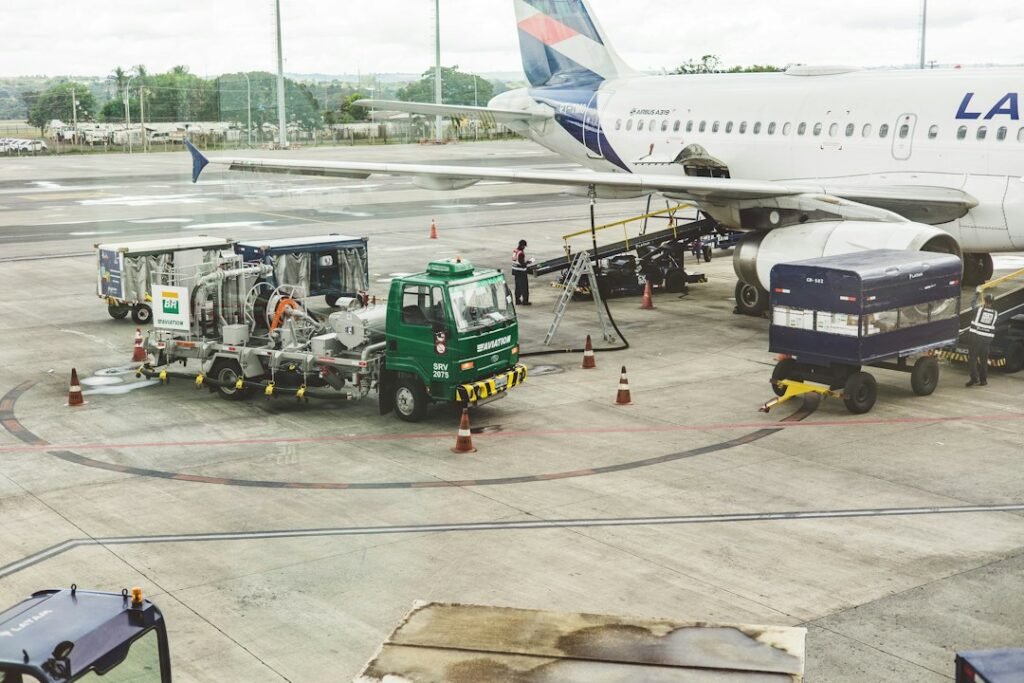
This is the part that does not appear in term sheets, and the reason a signed agreement is not always a working one. A contract can promise a monthly volume delivered into an airport depot, blended to specification, with certificates issued for each batch. For that to happen, a chain of operational steps has to function:
Photo by Red Shuheart on Unsplash
- Exit from the plant. How does the fuel leave: truck, barge, pipeline? What are the lead times and the volumes per shipment?
- Storage and transit. Which terminals will accept the product, and under what handling and quality-control conditions?
- Blending. SAF is blended with conventional jet fuel before it reaches the aircraft. Where is the blending done, by whom, and who owns the batch while it is being blended?
- Specification. The blended product has to meet the applicable fuel standards, and your plant has to be able to produce within the tolerance the contract promises.
- Allocation. Which volume goes to which customer and which airport, and how is it documented?
- Traceability and certification. The chain of custody (mass balance or book and claim) has to match what the buyer needs to claim, under the scheme that applies to them.
If any of these steps is missing, the buyer cannot perform, the producer cannot deliver, or the certificate cannot be issued. Lenders know this. They do not need every answer in the contract, but they do expect the developer to show that someone has gone through the chain and made it work. The most expensive version of this problem is discovering it after the contract is signed, when the only fix is a renegotiation.
This is why I work with an independent offtake specialist with ten years of experience structuring SAF offtake deals. This SAF offtake expert is hands-on: not only drafting the commercial terms, but checking that what is promised can be delivered, from logistics and blending to certificates. That operational layer is what engineers and financial modellers usually do not cover, and it is what makes an offtake credible to the people who have to put money behind it. Their review also connects with the technical review of the plant, so that contractual volumes match what the facility can actually produce.

A method to secure your SAF offtake, step by step
Here is the sequence I use with developers. It is simple on paper and demanding in practice.
Step 1: Diagnose what you hold
Start with an honest inventory: letters of intent, MOUs, draft contracts, buyer conversations, the revenue assumptions in the financial model, and the logistics you have in mind. The aim is to find the gaps before a lender does.
- Contractual gaps: commitments that are vague, conditions that are undefined, exits that are too easy.
- Operational gaps: volumes that the infrastructure cannot handle, a ramp-up that is optimistic, a delivery point nobody has validated.
- Lender-expectation gaps: tenor too short, too much exposure to spot, no feedstock pass-through.
What you get: a clear diagnostic of your offtake position, written so that it plugs into the wider due diligence on your project. It often connects to the feasibility and financial model, because revenue assumptions have to be consistent with what you can actually contract.
Step 2: Design the sales strategy
Before negotiating anything, decide what you want to sell, to whom, and under what structure.
- Which customer segments: airlines, cargo operators, corporates buying certificates, fuel suppliers and traders?
- What mix of physical delivery and book and claim?
- What share of volume under long-term firm contracts, and what share flexible?
- What price structure, and how is the CO2 value shared?
What you get: a written sales strategy that becomes a commercial annex to your business plan, and a target list of buyers to approach in a sensible order.
Step 3: Structure and negotiate
This is the core. It means turning interest into a term sheet or heads of agreement, and then into a contract that can go into the data room.
- Define the key parameters: volume, tenor, price, flexibility, penalties, force majeure, termination.
- Sit at the table with the buyers, to keep the balance between what the producer can run and what the financiers will accept.
- Work with your legal counsel: the commercial logic comes from the offtake expert, and the lawyers put it into legal form.
What you get: term sheets and contracts that are firm enough to show to lenders. Buyers also tend to engage more seriously when they see a counterpart that understands their constraints, which shortens the process.
Step 4: Translate for lenders and support due diligence
A good contract is not enough if the lender cannot see why it works. The last step is a clear explanation of how market and logistics risks are handled, and active support during the questions that follow.
- Short explanatory notes for the credit committee.
- Support on questions about price scenarios, demand and volumes.
- Adjustments after lender feedback, when a clause such as an exit right or an indexation formula blocks the deal.
What you get: an offtake and market pack for the financing file, which reduces the risk of a refusal or a major renegotiation at the last minute. It sits naturally next to the Project Finance work.
Common mistakes I see
- Treating a letter of intent as an offtake. It signals interest. It does not give a lender any revenue to rely on.
- Signing the first contract that is offered. A short, flexible agreement with a well-known name can look attractive and still be unfinanceable.
- Ignoring the physical chain. Volumes and delivery points that nobody has validated with the terminal, the blender and the buyer.
- Pricing without feedstock protection. A fixed selling price against a moving input cost.
- Over-relying on certificates. Short book and claim contracts with no volatility protection do not replace a financeable core agreement.
- Starting too late. Offtake negotiations take time, and the financing calendar rarely waits.
- Selling to the wrong buyer first. Approaching buyers without a strategy wastes your best conversations.
- Confusing the need. Some projects seek debt when they need equity. If your risk profile is not ready for lenders, the right conversation is with equity investors first. See Investor Introductions.
A readiness checklist before you approach buyers
- Product specification and production profile are documented, with a realistic ramp-up.
- Carbon intensity and certification route are understood for the markets you target.
- Feedstock supply and price assumptions are consistent with what you will offer buyers.
- Logistics options (exit, storage, blending, delivery points) have been sketched and checked.
- Your term sheet position is written: minimum volume, tenor, price logic, red lines.
- Your financial model reflects the contracted and uncontracted revenue separately.
- You know what your lenders will ask, and your counsel is briefed.
If you tick fewer than five of these, start with the early screening and concept or the technology maturity and scale-up work, because buyers and lenders will ask the same questions.
Sources
- RMI, Blueprints for Bankability
- S&P Global Energy, Bankers say APAC SAF projects risk serving foreign mandates amid uncertain policies, 8 July 2026
- Mission Possible Partnership, Offtake agreement
- SimpliFlying, Re-thinking the blueprint for financing SAF
- World Energy, Blueprints for Bankability coverage
Frequently asked questions
What is a bankable SAF offtake agreement?
It is a binding, long-term agreement with a creditworthy buyer that defines volume, price, delivery and termination clearly enough for a lender to model the revenue and accept the risks. In practice it also needs to be executable, from logistics and blending to certification.
How long should a SAF offtake agreement be?
Long enough to support your debt. Market guidance ranges from at least five years to ten or more, with seven to ten years often cited for SAF. The right figure depends on your technology and your lenders, so test it early.
Is a letter of intent enough to get project finance?
No. Lenders look for enforceable agreements. A letter of intent shows interest and is a useful first step, but it should lead to a term sheet or heads of agreement and then to a binding contract.
Do I need take-or-pay?
Take-or-pay is the structure lenders prefer because it secures revenue regardless of the buyer’s take. Buyers often resist it. If you accept alternatives such as send-or-pay, understand their effect on your debt service before you sign.
Can book and claim replace physical offtake?
Not on its own, for now. It can add a second revenue stream and broaden your buyer base, but current certificate contracts are often short-term and need robust tracking. Use it alongside a financeable core agreement.
When should I start working on offtake?
As early as your technology and feedstock plan allow. Offtake takes time, shapes your financing timeline, and influences how investors and lenders see the whole project.
Still at the letter-of-intent stage?
Tell me about your project, your volumes and your timeline, and I will tell you which gaps to close first and who should help you close them.
Alex, Founder of WeConnect Asia
I help low-carbon fuel and carbon removal project developers in Southeast Asia secure the commercial and financial partners needed to reach FID.
Related articles

Biomethane: What It Is, How It Is Made and Who Buys It
Biomethane is biogas cleaned to pipeline quality. I explain how it is made, how it differs from biogas and who buys it in Southeast Asia.

Southeast Asia SAF: Policies, Demand and Project Status
Southeast Asia SAF policy is moving country by country. Here is where demand is forming, who the buyers are and what a developer can rely on today.

e-SAF Project Finance: Why the Sub-Mandate Is Not Enough
The synthetic fuel sub-mandate creates demand for e-SAF, but not a bankable project. Here is what e-SAF project finance still needs in Southeast Asia.

SAF Mandates by Country: A Developer’s Comparison
SAF mandates differ by country in scope, target and penalty. Here is a side-by-side comparison and what each one means for project revenue.
