Home » Biomethane: What It Is, How It Is Made and Who Buys It
Biomethane:
What It Is, How It Is Made and Who Buys It
10 min read · Nov 3, 2026 · By Alex
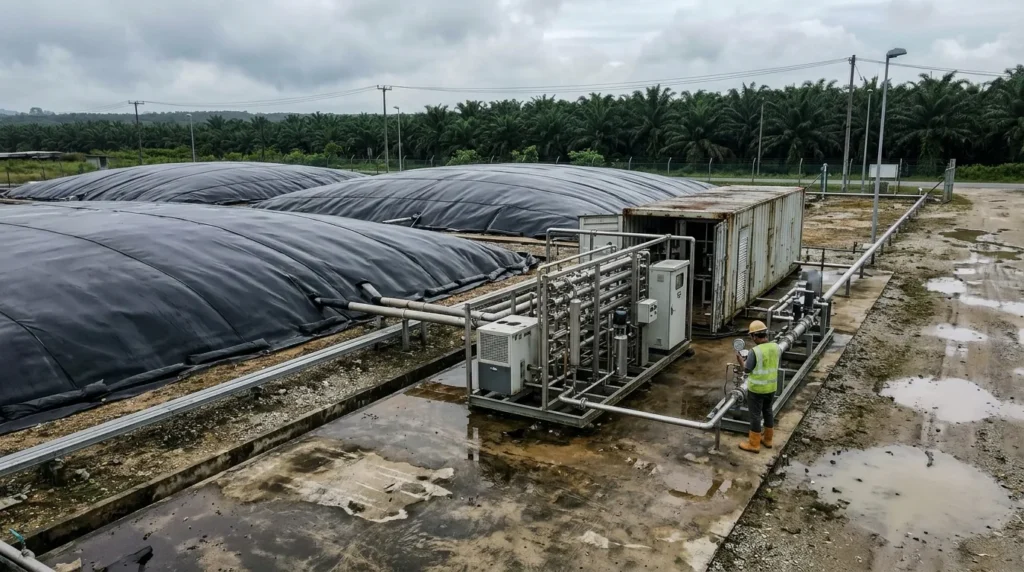
You make biomethane by cleaning biogas until it matches the quality of natural gas. First of all, because it is the same molecule, it can flow through gas pipelines, fuel trucks or feed industrial users, with no change to the equipment that burns it. However, getting from raw biogas to biomethane takes extra equipment, a connection to a buyer and proof that the gas is renewable. So this guide explains the route step by step, then looks at who buys it in Southeast Asia.
In short
- Biomethane comes from upgrading biogas to natural gas quality, which removes CO2 and impurities.
- A developer can inject it into a pipeline, compress or liquefy it for transport, or sell it to an industrial buyer.
- Proof of origin, through certificates, is part of what the buyer pays for.
- Projects work when feedstock, upgrading and a buyer connect, and they fail when one of the three is missing.
In this article
Biomethane in plain terms
Biogas comes from the breakdown of organic material without oxygen. For example, typical sources include palm oil mill effluent, manure, food waste and sewage. Today, raw biogas is mostly methane and CO2, with small quantities of other gases. Upgrading removes the CO2 and the other impurities, and what is left is a near-pure source of methane that is indistinguishable from regular natural gas, so it can be used wherever gas is consumed (IEA). Gasifying solid biomass reaches the same product by another route.
In practice, that is the same composition as the natural gas in a pipeline, which is why it can substitute for it.
For a developer, the difference matters. Indeed, a mill usually burns its biogas near where it is made, for power or heat. Biomethane travels instead, which opens bigger markets. I explain the plant-level difference in what makes a biomethane plant different from a biogas plant.
How biomethane is made from biogas
The process has three main stages.
First, the digester. Organic material breaks down in a sealed tank and releases biogas. Second, cleaning: operators dry the gas and treat it to remove hydrogen sulphide and other contaminants, which can damage equipment. Third, upgrading. A separation process removes the CO2 and leaves methane. Upgrading biogas accounts for around 90% of the biomethane produced worldwide today, and water scrubbing and membrane separation together account for almost 60% of global biomethane production (IEA).
In practice, several upgrading technologies exist. Membranes separate gases using selective materials. Next, water and amine scrubbing use liquids that absorb CO2. Also, pressure swing adsorption uses solid materials, and cryogenic separation cools the gas until CO2 condenses. In short, each option has its own cost, energy use and suitable scale.
Finally, the plant compresses the gas and sends it to the buyer. For the full biogas side of the story, read how a biogas plant works and the four stages behind any digester.
Biomethane and biogas are different products
The distinction decides the market. Biogas is a mixture of methane, CO2 and small quantities of other gases that can generate power and heat or meet cooking demand. Upgrading that mixture produces the pipeline-quality product described above, and the two then sell into different markets even though they come from the same organic feedstocks (IEA).
So a project owner makes a product choice before a technical one. Sell biogas as local power or heat, or upgrade it into a gas that reaches any buyer of natural gas. In practice, upgrading is worth it when there is a gas buyer or a certificate market for the result. Without one, the extra equipment has no revenue behind it.
I cover the comparison of the two plant types in biomethane plant versus biogas plant.
The biomethane resource: large and mostly unused
The feedstock base for biomethane is huge, and projects use only a fraction of it. Biogas and biomethane production in 2018 was around 35 million tonnes of oil equivalent, against a sustainable potential of about 570 million tonnes of oil equivalent for biogas and 730 million for biomethane. Full use of the sustainable potential could cover some 20% of today’s worldwide gas demand (IEA).
The feedstocks include crop residues, animal manure, municipal solid waste, wastewater and, for biomethane by gasification, forestry residues, and the assessment counts only feedstocks that do not compete with food for agricultural land (IEA). The IEA expects the availability of sustainable feedstock to grow by 40% to 2040, and it puts the largest opportunities in the Asia Pacific region, where natural gas consumption and imports have grown rapidly (IEA).
So the resource is not the constraint. The constraint is turning a resource spread across many farms, mills and landfills into a plant with a contract. In practice, I ask a developer for the feedstock map before the plant design: where is it, who owns it and what does the owner want for it.
Biomethane quality, injection and certificates
In practice, a buyer will only take biomethane that meets a defined specification. The gas has to match the methane content, the energy value and the impurity limits that the pipeline or the equipment requires. Therefore, quality control is a continuous task, not a one-time test.
Moreover, there is the question of connection. Also, injecting into a grid needs a pipeline nearby and the operator’s agreement, while compressing the gas into trucks needs a filling point and a buyer who can receive it. As a result, location matters more for biomethane than for biogas.
Then there are certificates. Buyers who want renewable gas need proof that the gas came from renewable sources, and certificates provide it. Traders move those certificates separately from the gas itself, so a buyer can pay for renewable gas without physically taking it. Article 19 of the Renewable Energy Directive defines the guarantee of origin: it tells the end consumer where the renewable gas came from through a book and claim system, and one certificate covers the same amount of renewable gas injected into the network (Gas Networks Ireland). In practice, the certificate is part of the revenue. However, its rules differ by market.
Biomethane feedstock in Southeast Asia
Developing countries in Asia hold around 30% of the global biogas potential (IEA). The production pattern in the region follows its industry. Thailand produces biogas from the waste streams of its cassava starch sector, its biofuel industry and its pig farms (IEA).
So a Southeast Asian biomethane project often starts at a processing site that already has a concentrated waste stream, such as a mill, a starch plant or a farm cluster. The advantage is simple: the site already collects the feedstock. The risk is dependence on one owner, so a feedstock contract with that owner is the first document I look for.
Who buys it in Southeast Asia
Buyers of biomethane fall into a few groups.
- Gas utilities and grid operators. They inject biomethane into the network.
- Industrial users. Factories use it for heat or as a feedstock and want to cut emissions.
- Transport. Compressed or liquefied biomethane fuels trucks and buses.
- Export markets. Some producers look at cross-border sales, where a buyer pays a premium for certified gas.
In Southeast Asia, the market is early. For example, Singapore, which imports most of its energy, has opened a regulatory sandbox for biomethane. I explain what it means in Singapore’s biomethane sandbox. Meanwhile, Malaysia has a feed-in tariff for biogas power, which competes with biomethane for the same feedstock. Singapore’s Economic Development Board appointed Keppel Energy, Sembcorp Utilities and Tuas Power Generation as biomethane aggregators under a 300MW regulatory sandbox that runs for 15 years, with first supplies expected by the end of 2028 (Singapore EDB). In Malaysia, the distribution licensees pay new feed-in approval holders a fixed premium rate for each unit of renewable energy they sell, for 21 years (SEDA Malaysia).
For a developer, the trade-off is real. First, a tariff is a known, local revenue. But biomethane may earn more, and it needs a buyer and a connection. I look at this trade-off in Malaysia’s biogas feed-in tariff and in the biomethane market in Southeast Asia.
What biomethane costs to produce
Costs vary widely. Producing biogas costs between USD 2 and USD 20 per MBtu worldwide, and in Southeast Asia the average is USD 9 per MBtu (IEA). Around 70 to 95% of the total biogas cost is the installation of the biodigesters, and the rest is feedstock collection and processing (IEA).
Feedstock cost can be anything from negative to high. Feedstock can cost nothing, or less than nothing where waste producers have to pay to dispose of their waste, while in other cases gate fees for certain agricultural feedstocks may be as high as USD 100 per tonne in some regions (IEA). Upgrading adds cost too: around USD 2 to USD 4 per MBtu for a facility that upgrades around 3.5 million cubic metres of biogas per year, with the cost varying by size and region (IEA).
Further steps add more. Adding a co-generation unit, a power grid connection and heat recovery can add about 70% to the cost of an integrated project (IEA). Therefore, the choice between biogas power and biomethane is a cost decision as much as a market decision, and the model has to show both.
Economics: what drives the margin
So several elements set the margin of a biomethane project.
- Feedstock. Its cost and its reliability matter more than the digester choice. I explain why in the feedstock economics article.
- Upgrading. The equipment adds cost and uses energy.
- Connection. A pipeline or a filling point may need investment.
- Revenue. Gas price, certificate value and any support scheme all count.
- Scale. Larger plants spread fixed costs, which is why some projects cluster several mills. I look at that in scaling biomethane production.
Above all, the project is only as strong as its weakest link. For instance, a great upgrader with no buyer earns nothing. For the project finance view, read what a bankable biomethane project looks like.
Where biomethane projects break in practice
However, biomethane projects tend to break at the same points.
- Feedstock. The owner has not contracted the supply, or other uses compete for it.
- Connection. There is no pipeline or filling point, or the operator has not agreed.
- Buyer. There is interest but no binding contract.
- Certification. The gas cannot prove its origin under the buyer’s rules.
- Gas quality. The plant does not meet the specification consistently.
- Scale. The project is too small to carry the upgrading cost.
Because the elements depend on each other, one gap can stop the project. For example, a missing buyer makes the connection pointless. So I check the chain from feedstock to buyer before anything else. For the commercial work, see the feedstock service and the offtake service.
How I read a biomethane project
I read a biomethane project from the feedstock to the buyer. First, the feedstock: who owns it, what is it worth to them and how long is the contract? Second, the cost: what share of the budget is the digester, and what do upgrading and connection add? Third, the buyer: who takes the gas or the certificates, and under which contract? Fourth, the alternative: could the same gas earn more as power under an existing tariff? Finally, the structure and the sequence of capital.
In practice, a project with a feedstock contract and a buyer is ready for lenders. A project with only a digester design is not, and I say so early.
Checklist
- The feedstock contract covers the debt tenor.
- The upgrading technology suits the scale and the gas.
- A connection or a delivery route exists, and the operator has agreed to it.
- The buyer has signed or is at term-sheet stage.
- The gas can be certified under the buyer’s rules.
- The project has enough scale to carry the upgrading cost.
- The financing plan covers equipment, connection and working capital.
Next step
If you are looking at biomethane and the buyer, the feedstock or the capital is the open point, book a 30-minute call or send me your project brief. I tell you early if the chain is not ready. You can also read the biogas, biomass and biofuels industry page.
Sources
FAQ
What is biomethane?
Biomethane is what you get when you clean biogas until it matches natural gas quality.
How is biomethane different from biogas?
Biogas stays raw and mixed with CO2, while upgrading turns biomethane into a fuel that works wherever natural gas works.
Who buys biomethane?
Gas utilities, industrial users and transport operators, depending on the market and the connection.
Why do certificates matter?
Buyers pay for renewable gas, and certificates prove the gas is renewable. They can add to the revenue.
Is biomethane profitable in Southeast Asia?
It can be, where feedstock, upgrading and a buyer connect. The market is early, so each project needs its own check.
What is the biggest risk?
A missing link in the chain, most often the buyer or the connection.
Not sure your project would survive a credit conversation?
A short call is usually enough to see where your project stands against what a lender or an equity investor will ask for. Tell me where your project is today, and I will tell you what the next conversation needs to look like.

Alex, Founder of WeConnect Asia
I help low-carbon fuel and carbon removal project developers in Southeast Asia secure the commercial and financial partners needed to reach FID.
Related articles
Southeast Asia SAF: Policies, Demand and Project Status
Southeast Asia SAF policy is moving country by country. Here is where demand is forming, who the buyers are and what a developer can rely on today.
e-SAF Project Finance: Why the Sub-Mandate Is Not Enough
The synthetic fuel sub-mandate creates demand for e-SAF, but not a bankable project. Here is what e-SAF project finance still needs in Southeast Asia.
SAF Mandates by Country: A Developer’s Comparison
SAF mandates differ by country in scope, target and penalty. Here is a side-by-side comparison and what each one means for project revenue.
Sustainable Aviation Fuel: Pathways, Mandates and What Gets Financed
Sustainable aviation fuel has several pathways and sells into mandates. I explain the routes, the demand and what gets financed in Asia.