
Home » Green Methanol Production: Bio-Methanol, E-Methanol and What Each Route Needs
Green Methanol Production:
Bio-Methanol, E-Methanol and What Each Route Needs
7 min read · Apr 13, 2026 · By Alex
Green methanol production follows two routes: bio-methanol from biomass, and e-methanol from captured CO2 and green hydrogen. Both end in the same synthesis step, and both give the same molecule. However, the inputs, the risks and the financing story are very different. So the first decision for a developer is which route the project can actually secure.
In short
- Green methanol production uses a mature synthesis step. The risk sits in the inputs.
- Bio-methanol depends on a reliable biomass supply and a gasification step.
- E-methanol depends on cheap green hydrogen and a credible CO2 source.
- Lenders back the route whose inputs are under contract.
In this article
Green methanol production: two routes, one synthesis step
Conventional methanol plants make the product from synthesis gas, a mixture of hydrogen and carbon oxides, passed over a catalyst. In fact, the same synthesis step works for green methanol production. What changes is where the synthesis gas comes from.
First, on the bio route, the gas comes from biomass or waste that is gasified, or from biogas that is reformed. Second, on the e-route, the plant combines CO2 with hydrogen made by electrolysis. In other words, the two routes differ in the front end and share the back end. Almost identical proven commercial technologies make methanol from fossil syngas and from bio- or e-methanol feedstocks, and the methanol is chemically identical (IRENA and Methanol Institute).
This matters for risk. Because the synthesis step is proven, technology risk concentrates in gasification on the bio route and in electrolysis plus CO2 supply on the e-route. If you understand that split, you understand most of the diligence.
What green methanol production costs today
Price decides which route survives. Fossil methanol still costs USD 100 to 250 a tonne to make (IRENA and Methanol Institute). Since 1995, the European contract price has fluctuated roughly between USD 200 and USD 400 a tonne once analysts adjust for inflation (IRENA and Methanol Institute). Renewable methanol starts higher than that, so every green methanol production plan has to explain how the gap closes.
Two figures explain the slow part. Global methanol capacity already stands at about 150 million tonnes a year, and chemical and plastic industries take about two-thirds of that output (IRENA and Methanol Institute). A carbon credit of USD 50 a tonne of CO2 would cut renewable methanol production cost by about USD 80 a tonne (IRENA and Methanol Institute). In practice, policy, not chemistry, decides when the e-route wins the tender. Therefore, I price the certificate before I compare the two routes.
Bio-methanol: what the biomass route needs
Above all, the bio route stands on feedstock. The plant needs a steady supply of biomass or waste, at a price that holds for years, within a collection radius that makes sense.
First, the supply has to be contracted, not just available. As I wrote about SAF, availability is not the same as bankability, and the same logic applies here. Then the gasification step has to handle a variable feed. For example, biomass and municipal waste change in moisture and composition, and the gas cleaning step has to cope. Finally, the product has to be certified as renewable, which requires traceable feedstock.
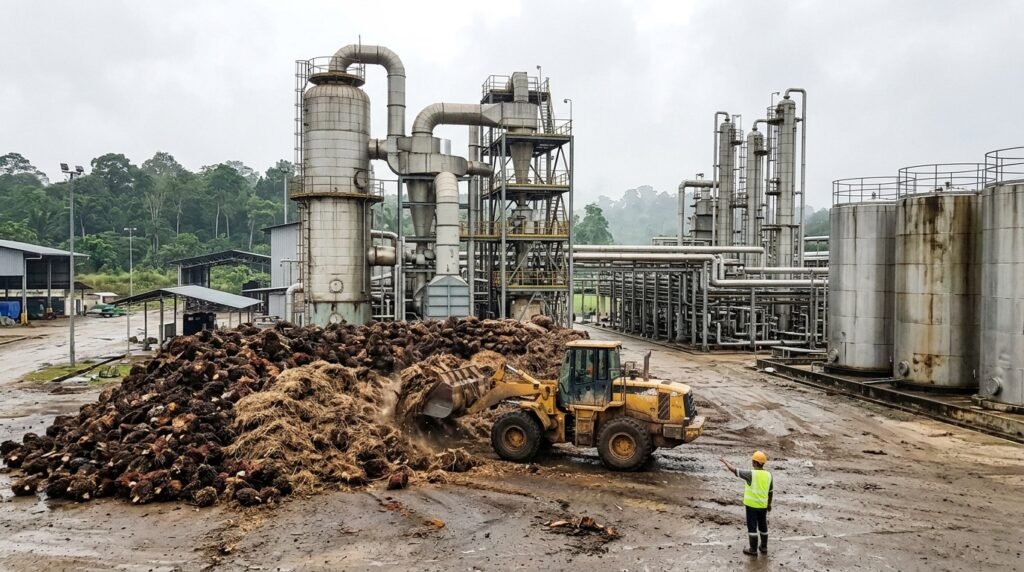
For projects in Southeast Asia, residues from palm oil and agriculture are the obvious candidates. Indonesia’s roadmap counts the country’s largest residues at 9.43 million tonnes of palm oil empty fruit bunches and 2.68 million tonnes of rubber trees a year (Indonesia’s national roadmap). Even so, collection and logistics decide the economics more than the technology does. So I would start the feedstock work early, with the feedstock service in mind.
E-methanol: the hydrogen and CO2 problem
The e-route has two big inputs, and both are demanding. First, green hydrogen: the plant needs a large electrolyser and a cheap, steady power supply. The cost of e-methanol depends to a large extent on the cost of hydrogen and CO2 (IRENA and Methanol Institute). The main drivers are the price of renewable power and how many hours the electrolysers run.
Second, CO2. It has to come from somewhere, and it has to count. In fact, many regulations treat biogenic CO2, for example from a biogas upgrader or a pulp mill, differently from fossil CO2. Meanwhile, direct air capture is an option, but it is costly. As a result, the CO2 source is as much a contract question as an engineering one.
So I ask early: who supplies the CO2, for how long, at what price and with what certificate? If the answer is “we are looking”, the project is not yet an e-methanol project.
Green methanol production and the CO2 source question
The CO2 source deserves its own section, because it quietly decides several things at once. First, it sets the location, because moving CO2 is expensive. Second, it sets the eligibility, because rules differ on which CO2 counts as renewable. Third, it sets the supply risk, because the supplier’s plant has to keep running.
In practice, for green methanol production in Southeast Asia, plausible sources include biogas upgrading, palm oil mills, bioethanol plants and biomass power plants. Then the best sites sit next to such a source, with power available nearby. For a concrete example, I use European Energy’s Kassø facility in Denmark: it makes e-methanol with biogenic CO2 that it sources locally from the Tønder biogas plant (European Energy).
Moreover, the supplier relationship is a long-term contract. A lender will want volume, price and a delivery guarantee, just as for any other input. Still, a handshake with a mill is not a supply agreement.
Where green methanol production breaks in practice
However, the two routes break in different places.
Bio-methanol
- The feedstock is available but not contracted.
- The gasifier cannot handle the real feed.
- The certification chain is incomplete.
E-methanol
- The power price in the model is not backed by a contract.
- The CO2 supplier has not committed.
- The electrolyser supply has no firm delivery date.
Both routes share one more failure: the offtake. In fact, many projects hold an MOU with a shipping company or a chemicals buyer and call it demand. Above all, an MOU is not a contract with volume, term and price. I wrote about that gap in the MOU-to-FID article.
Southeast Asia demand behind green methanol production
Methanol already sits inside the regional industrial base. In 2024, methanol production absorbed 20 percent of Southeast Asia’s 4 million tonnes of hydrogen demand, and 69 percent of that share sat in Malaysia (IEA). The region has three large methanol plants and it also imports methanol (IEA).
Demand for the molecule is moving as well. Singapore’s Maritime and Port Authority will license three companies to supply methanol as marine fuel from 1 January 2026. The authority picked them from 13 applicants and set the licences to run to 31 December 2030 (Maritime and Port Authority of Singapore). So a green methanol production project in the region can point at a licensed buyer channel instead of a single letter of intent.
Which green methanol production route lenders can underwrite
Lenders do not choose a route. Instead, they underwrite a set of contracts. The route that wins is the one whose inputs are the easiest to put under contract.
For a bio route, that usually means a long feedstock agreement and a proven gasification package. For an e-route, it means a power agreement, a CO2 supply contract and an electrolyser guarantee. Otherwise, the lender sees a model without a foundation.
Moreover, I look at the buyer. Shipping demand for methanol is real but uneven: orders for methanol-fuelled vessels fell to 61 in 2025 from 149 in 2024 (DNV). The contract terms vary. Finally, if you want to discuss how to line up the buyer, the offtake service is where we start.
Checklist
- You know which route the project uses and why.
- Bio route: feedstock is contracted for the debt tenor.
- Bio route: the gasifier is proven on a comparable feed.
- E-route: power price is backed by a contract.
- E-route: CO2 supplier has committed in writing.
- The product can be certified as renewable.
- The offtake is a contract, not an MOU.
Next step
If your green methanol production project is moving toward FID and the offtake or the capital is the open point, book a 30-minute call or send me your project brief. I tell you early if the route is not ready. You can also read how hydrogen is produced or look at the green methanol industry page.
Sources
- IRENA and Methanol Institute, Innovation Outlook: Renewable Methanol, 2021.
- DNV, LNG-fuelled container ships sustain alternative fuel share of global orderbook, 2026.
- European Energy, First biogenic CO2 delivered from Tønder Biogas to Kassø Power-to-X facility, 2025.
- IEA, Global Hydrogen Review 2025.
- Maritime and Port Authority of Singapore, Singapore to Award Licences for Methanol Bunkering.
- Indonesia Ministry of Energy and Mineral Resources, National Hydrogen and Ammonia Roadmap.
FAQ
What is green methanol production?
It is the making of methanol from renewable inputs, either biomass or captured CO2 combined with green hydrogen.
What is the difference between bio-methanol and e-methanol?
Bio-methanol comes from biomass or waste. E-methanol comes from CO2 and hydrogen made with renewable power. The synthesis step is the same.
Which route is cheaper?
It depends on the site. The bio route depends on feedstock cost and logistics. The e-route depends on power price and CO2 cost.
Where does the CO2 come from for e-methanol?
Typically from a biogenic source such as a biogas upgrader, a mill or a biomass plant. Direct air capture is possible but costly.
What do lenders want to see?
Contracts for every major input and for the offtake, plus a proven technology package.
Is shipping the main buyer?
It is the most visible one. Chemicals are the other large market, and some projects serve both.
Not sure your project would survive a credit conversation?
A short call is usually enough to see where your project stands against what a lender or an equity investor will ask for. Tell me where your project is today, and I will tell you what the next conversation needs to look like.

Alex, Founder of WeConnect Asia
I help low-carbon fuel and carbon removal project developers in Southeast Asia secure the commercial and financial partners needed to reach FID.
Related articles

Biomethane: What It Is, How It Is Made and Who Buys It
Biomethane is biogas cleaned to pipeline quality. I explain how it is made, how it differs from biogas and who buys it in Southeast Asia.

Southeast Asia SAF: Policies, Demand and Project Status
Southeast Asia SAF policy is moving country by country. Here is where demand is forming, who the buyers are and what a developer can rely on today.

e-SAF Project Finance: Why the Sub-Mandate Is Not Enough
The synthetic fuel sub-mandate creates demand for e-SAF, but not a bankable project. Here is what e-SAF project finance still needs in Southeast Asia.

SAF Mandates by Country: A Developer’s Comparison
SAF mandates differ by country in scope, target and penalty. Here is a side-by-side comparison and what each one means for project revenue.