
Home » Development Finance Institutions: How DFIs Fund Low-Carbon Fuel Projects
Development Finance Institutions:
How DFIs Fund Low-Carbon Fuel Projects
9 min read · Jun 2, 2026 · By Alex
Development finance institutions lend where commercial banks hold back: long tenors, new technology and markets that look risky from far away. For a low-carbon fuel developer in Southeast Asia, a DFI can be the difference between a project that closes and one that waits. However, DFIs are not a shortcut. They ask harder questions than most banks, and they ask them in a fixed order. In practice, three numbers frame the conversation: a process counted in months, a tenor counted in years and a loan sized on the downside case.
In short
- Development finance institutions fund projects that have a development case, a clear structure and contracted revenue.
- They take longer than commercial banks, and they check environmental and social standards in detail.
- Moreover, their money often brings other lenders in, which is why developers want them early.
- Published terms give a workable frame: a tenor of five to 15 years, and an approval path that starts at six months.
- Finally, approach them with a prepared project, not an idea.
In this article
Development finance institutions in plain terms
Development finance institutions are government-backed or multilateral institutions that finance private projects in emerging markets. Some are multilateral, such as the IFC and the Asian Development Bank. By contrast, others are bilateral, such as FMO, Proparco or BII, owned by one country. Still, they share a mandate: put capital where it supports development and where private money is thin.
In practice, that means DFIs can offer things commercial banks often cannot. For example, they lend for longer, they can take more risk on a first-of-a-kind project, and some of them blend in concessional money. The Asian Development Bank, for example, offers senior and subordinated loans, mezzanine financing, equity investments and guarantees, and it blends concessional funds with its own capital to de-risk private sector projects (ADB).
Above all, development finance institutions do not replace a commercial lender. Instead, they sit next to one, and their presence often gives other lenders comfort. In the capital stack, a DFI usually sits in the senior or concessional layer, not in every layer at once.
What a development finance transaction looks like in Southeast Asia
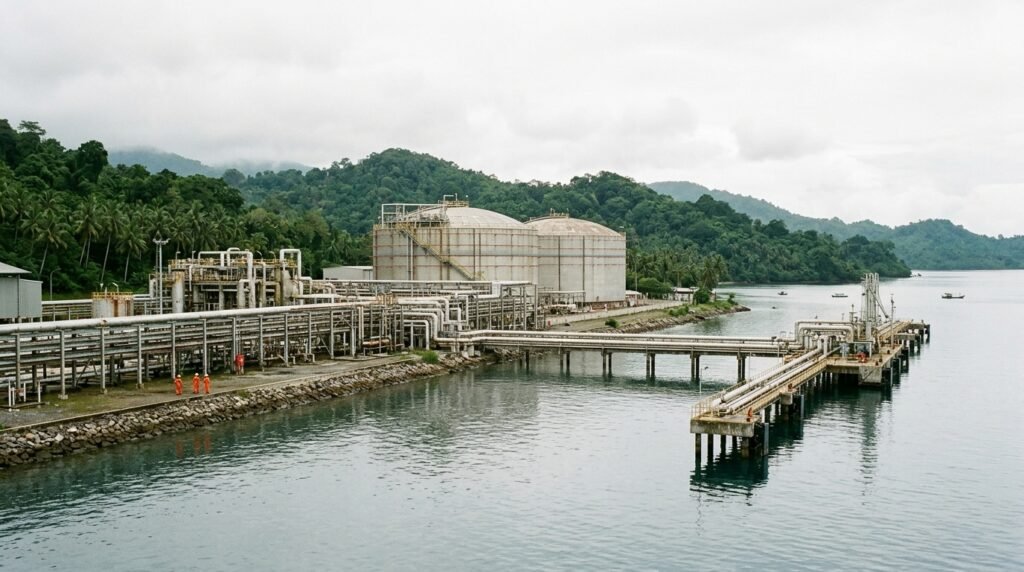
To start, two public examples show the shape of a regional deal. The Asian Development Bank committed a USD 400 million ordinary capital resources loan to the Tangguh liquefied natural gas expansion in Indonesia, with concept clearance in June 2015, credit committee in October 2016 and approval on 1 December 2016 (ADB). The third train reached commercial operation in November 2023, and PLN, the Indonesian state utility, buys 40 percent of its output under a long-term sales contract.
In February 2026, the IFC committed USD 25 million of equity to Seraya Partners Fund II, whose Southeast Asia sleeve targets Indonesia, Malaysia, the Philippines, Thailand and Vietnam (IFC). Above all, both examples matter for a developer. First, tickets range from a USD 25 million anchor commitment to a USD 400 million project loan. Second, the clock matters: the ADB loan took about 18 months from concept clearance to approval, and that was for a sponsor with an operating plant next door.
What development finance institutions fund in Southeast Asia
In practice, development finance institutions fund infrastructure, energy and industry that fit their climate and development goals. Low-carbon fuel projects can qualify when they fit those goals.
However, “can qualify” is not “will fund”. In fact, each DFI has its own strategy, its own country list and its own sector appetite. Some focus on early-stage risk. Others want large, bankable projects. So the first job is to match the project to the right institution, not to approach all of them.
How development finance institutions decide
Development finance institutions follow a staged process. First, an eligibility screen: sector, country, sponsor and project type. Then an early review of the structure. Next, due diligence, which covers technical, commercial, legal and environmental and social points. Finally, credit approval.
Meanwhile, at each stage, they ask the same underlying question: does this project have contracted revenue and sponsors who will see it through? In other words, a DFI wants what any lender wants, plus a development case. So the offtake, the feedstock and the equity commitment matter as much as the technology. On that last point, how to secure offtake agreements decides whether the file opens at all.
Because development finance institutions lend for long tenors, they scrutinise assumptions that stretch over many years. For example, a model that works only if the fuel price stays high for decades will not pass. Instead, they look for downside cases that still cover the debt. For the broader view of how lenders read a fuel project, see what lenders need to see on a hydrogen project.
Tenor, ticket size and the downside case
First, published terms are the fastest way to size the ask. The US International Development Finance Corporation states that loan or guaranty tenor is typically between five and 15 years, and that it will generally consider lending up to 50 percent of project cost, with a higher share possible where offtake agreements are significant (DFC). The same page sets the ticket threshold for escalation: any investment or guaranty with exposure over USD 50 million goes to the board for approval.
Second, coverage is the other half of the sizing. Minimum debt service coverage ratios cluster between about 1.10 and 1.35 times depending on the asset: development finance institutions often accept 1.10 to 1.20 on policy-aligned projects, while renewable infrastructure with a long-term contract sits closer to 1.20 to 1.35 (Projects RH). Lenders then size the loan backwards from that floor: they set the debt so that the stressed case, not the base case, still clears the covenant. The World Bank puts the same idea in plainer words, since operating cash flow has to cover debt service plus an acceptable margin, and lenders simply cut the loan until the margin is acceptable (World Bank).
So a realistic ask for a mid-size fuel project looks like this: senior debt of five to 15 years, no more than about half of project cost from the DFI, and a model that holds a coverage ratio above 1.10 in a downside case that you have already run yourself.
The environmental and social standards that gate DFI debt
In practice, this is where many projects slow down. DFIs apply published environmental and social standards, and the project must meet them before the loan can close. The eight IFC Performance Standards are directed at the clients IFC finances (IFC). Commercial banks that adopt the Equator Principles apply them to project finance with capital costs of USD 10 million or more, and the Equator Principles use the IFC Performance Standards as their core environmental and social standards for projects in low and middle-income countries (Equator Principles).
In short, the standards cover land and resettlement, labour conditions, biodiversity, community health and safety, and pollution. Also, for a fuel project, feedstock sourcing often gets particular attention, because a supply chain with a poor record can block the loan.
Therefore, I would start the environmental and social work before approaching a DFI. In practice, an early gap analysis against the standards saves months. Without it, the process stalls at due diligence, when the schedule is already tight.
How to approach development finance institutions
First of all, preparation decides how the first conversation goes. Here is the sequence I suggest:
- Define the ask. State the amount, the tenor and the role you want the DFI to play.
- Package the basics. Project description, sponsor background, structure, status of offtake and feedstock, and a clear financing plan.
- Match the institution. Choose two or three whose strategy fits your sector, country and size.
- Open the conversation. A short concept note, then a call. Do not send a full data room first.
- Run the standards in parallel. Environmental and social work starts now, not after approval.
In practice, I can help with the matching and the introductions through the project finance service. I do not pretend to deliver the technical studies. I bring in partners for those.
Where DFI processes slow a project down
However, the delays follow a pattern.
- Incomplete documents. The project arrives without a settled structure or an offtake.
- Environmental and social gaps. The sponsor has not done the baseline work.
- Unclear sponsor equity. The DFI cannot see who funds the first loss.
- Timing mismatch. The developer needs money in six months, and a full DFI path often needs a year or more.
- Single-lender thinking. The developer expects the DFI to fund everything.
Moreover, DFIs rarely fund alone. So they expect a mix of equity, commercial debt and sometimes grants. Look at the capital stack for a SAF project to see how the pieces fit, and at grants and incentives for the non-dilutive layer.
Checklist
- The project has a defined structure and a named sponsor.
- Offtake and feedstock are contracted or at term-sheet stage.
- Sponsor equity is identified.
- A gap analysis against the IFC Performance Standards has started.
- You have matched two or three DFIs to your sector and size.
- Your financing plan shows the role of the DFI, not the whole stack.
- The ask sits inside published terms: five to 15 years of tenor, roughly half of project cost.
- A downside case is run, and the coverage ratio holds above the floor you quoted.
- The timeline allows for a process that takes many months.
Next step
If your project is moving toward FID and you are looking at DFI debt, book a 30-minute call or send me your project brief. I tell you early if the project is not ready for that conversation. You can also read the bankability roadmap and how to finance a hydrogen project.
Sources
FAQ
What are development finance institutions?
In short, they are government-backed or multilateral institutions that finance private projects in emerging markets, with a development mandate.
Do DFIs fund low-carbon fuel projects?
In practice, some do, when the project fits their climate strategy and meets their standards. Still, each institution has its own sector appetite.
How long does a DFI process take?
Published guidance from the DFC puts the approval path at a minimum of six to nine months from formal application to commitment, depending on complexity. The ADB’s Tangguh loan in Indonesia ran about 18 months from concept clearance to approval, so I plan on a year and I start the environmental and social work first.
How much can a DFI lend, and for how long?
In practice, two published anchors frame the ask: the DFC will generally consider lending up to 50 percent of project cost, and its loan or guaranty tenor typically runs five to 15 years. Exposure above USD 50 million goes to its board, which is a useful signal of where a ticket starts to look institutional.
What coverage ratio should I quote to a lender?
A defensible range for a fuel project sits between 1.10 and 1.35 times debt service coverage, depending on how firm the revenue is. Development finance institutions often accept 1.10 to 1.20 on policy-aligned projects, and long-term contracted renewable infrastructure is usually tested at 1.20 to 1.35.
Does a DFI really need a downside case?
Yes. Lenders size the loan so that the stressed case still clears the coverage floor. A base case alone answers a question nobody is asking.
What is the biggest obstacle?
Usually the environmental and social standards, and an incomplete offtake or structure.
Can a DFI fund the whole project?
Rarely. Instead, DFIs usually lend alongside equity and commercial debt, and the DFC text is explicit that investors must bring sound debt-to-equity relationships.
Should I approach several DFIs at once?
Still, two or three that fit your project is reasonable. A blanket approach wastes time and weakens your position.
Not sure your project would survive a credit conversation?
A short call is usually enough to see where your project stands against what a lender or an equity investor will ask for. Tell me where your project is today, and I will tell you what the next conversation needs to look like.

Alex, Founder of WeConnect Asia
I help low-carbon fuel and carbon removal project developers in Southeast Asia secure the commercial and financial partners needed to reach FID.
Related articles

Biomethane: What It Is, How It Is Made and Who Buys It
Biomethane is biogas cleaned to pipeline quality. I explain how it is made, how it differs from biogas and who buys it in Southeast Asia.

Southeast Asia SAF: Policies, Demand and Project Status
Southeast Asia SAF policy is moving country by country. Here is where demand is forming, who the buyers are and what a developer can rely on today.

e-SAF Project Finance: Why the Sub-Mandate Is Not Enough
The synthetic fuel sub-mandate creates demand for e-SAF, but not a bankable project. Here is what e-SAF project finance still needs in Southeast Asia.

SAF Mandates by Country: A Developer’s Comparison
SAF mandates differ by country in scope, target and penalty. Here is a side-by-side comparison and what each one means for project revenue.