
Home » Infrastructure Project Finance: How the Structure Works for Fuel Plants
Infrastructure Project Finance:
How the Structure Works for Fuel Plants
9 min read · Sep 15, 2025 · By Alex
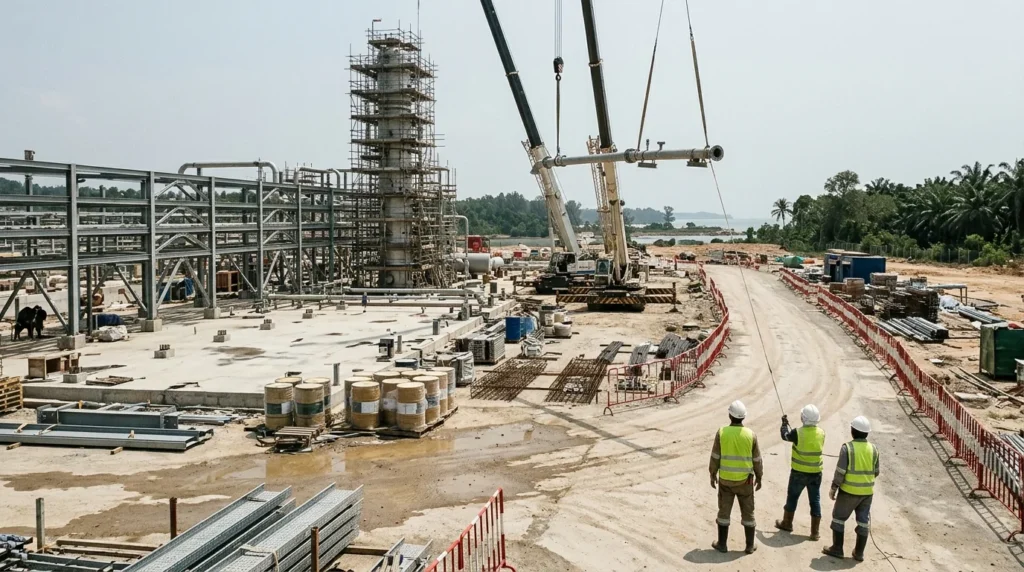
Infrastructure project finance lends against the contracts of a single project, not against the balance sheet of the company behind it. In practice, a new company owns the plant, signs the contracts and pays back the debt from the project’s revenue. For a fuel developer, infrastructure project finance is the structure that most large plants end up using. However, a fuel plant fits it less naturally than a toll road or a power station, and lenders know it. So the numbers behind the structure decide how much money the plant can raise.
In short
- Infrastructure project finance rests on a stand-alone company, contracted revenue and a package of security.
- Equity goes in first. Senior debt follows once the contracts are in place.
- Lenders read the contracts first and the model second.
- Published ranges frame the ask: equity of a quarter to a third of cost, coverage of 1.10 to 1.35 times, senior debt of five to 15 years.
- Fuel plants carry more feedstock, technology and price risk than classic infrastructure, so the contracts have to carry more weight.
In this article
Infrastructure project finance in plain terms
First, the company. Sponsors set up a special purpose vehicle, or SPV, whose only job is to build and run the plant. The SPV owns the assets and signs every contract.
Second, the lenders. They lend to the SPV, and they expect repayment from the plant’s cash flow. If the plant fails, they can take the assets, but they cannot go after the sponsors beyond what the documents allow. In other words, the debt stops at the project.
Because the lenders rely on cash flow, they care about one thing above all: will the plant earn enough, predictably, for long enough? Under non-recourse project finance, lenders draw repayment only from the project company’s revenues, with no recourse to the equity investors: the project company keeps its obligations separate from those of the investors, and the project’s cash flows carry the debt (World Bank).
So everything else follows from that question. The structure, the contracts and the diligence all exist to answer it.
The infrastructure project finance structure: SPV, equity and debt
First of all, the capital stack has layers. Sponsors and equity investors provide the first money and carry the first loss. Senior lenders provide most of the rest and rank first for repayment. Sometimes subordinated debt, mezzanine or grant money sits in between.
Then the plant’s cash flow sizes the debt, not the cost of the plant. In turn, lenders test whether the cash flow covers the debt service with a margin, and they test it under downside cases. So the amount of debt a project can raise depends on how stable the revenue looks.
Moreover, equity has to be real. Lenders want to see committed investors before they commit. For fuel projects, I explain how this works in the SAF capital stack article and, for a very large example, in the NEOM capital stack.
The numbers lenders use: gearing, coverage and tenor
Lenders argue with three numbers, and each one has a published range. Gearing comes first. Conventional renewable projects often target a debt-to-equity ratio of 80:20, while riskier or first-of-a-kind plants carry more equity: NEOM, Stegra and ATOME sit between 65:35 and 75:25, and the planned Freija Clean Fuel plant in Finland targets about 60:40 (IEA). For a fuel plant, that means committed equity of roughly a quarter to a third of project cost.
Coverage comes second. Minimum debt service coverage ratios cluster between 1.10 and 1.35: availability-payment infrastructure at 1.15 to 1.30, contracted renewables at 1.20 to 1.35, and development finance institutions at 1.10 to 1.20 when policy objectives align (Projects RH). Lenders then set the loan so that the stressed case, not the base case, stays above the covenant floor.
Tenor comes third. The DFC quotes a loan or guaranty tenor of typically five to 15 years, and it will generally consider lending up to 50 percent of project cost (DFC). Export credit support under the OECD Consensus caps tenor at 14 years in general (Mintz). Contracts must outlive the debt, because an implementation or concession agreement for energy or infrastructure projects usually runs ten to thirty years (Mintz).
The contracts that make infrastructure project finance work
In infrastructure project finance, the contracts are the real security. Each one covers a risk that the lenders do not want to carry.
- Construction contract. A fixed-price, date-certain contract with penalties for delay. It covers the build risk.
- Operation and maintenance contract. It covers performance after start-up.
- Offtake contract. It fixes who buys the product, at what price, for how long. It covers the revenue risk.
- Supply contract. It fixes the feedstock or power, with volume and price. It covers the input risk.
- Permits and land rights. They cover the right to build and operate.
- Insurance. It covers events that nobody can contract away.
If the set has a gap, the lenders price it or walk away. This is why I tell developers to build the contract set before they build the pitch. Otherwise, the pitch has nothing to stand on. Where the gap is the offtake, the offtake service is where I start.
How fuel plants differ from classic infrastructure
Classic infrastructure project finance funds predictable revenue, such as a toll road or a contracted power plant. However, fuel plants are different in three ways.
First, the product price. A fuel is a commodity, and its price can move. So unless the offtake fixes the price or links it to a clear formula, revenue is uncertain. Second, the feedstock. A plant that depends on waste, residues or hydrogen depends on a supply chain that can break. Third, the technology. Several low-carbon fuel pathways have few operating plants, so lenders ask for extra comfort. The IEA describes the same problem for hydrogen: projects that use new technologies or first-of-a-kind deployments at scale struggle with bankability because of high upfront capital, long project timelines and performance risks, so buyers and financiers often ask developers and equipment suppliers for guarantees (IEA).
As a result, lenders ask for more. For instance, they want longer and firmer contracts, a technology guarantee or an independent review, and sometimes a government support mechanism. Also, policy-linked demand, such as mandates, adds another dependency, because the revenue depends on rules that can change. For that reason, I read the policy side as part of the credit.
A Southeast Asia example: the Tangguh LNG expansion
Tangguh, in West Papua, shows how the pieces combine in Indonesia. After the final investment decision announced in July 2016, the Tangguh production-sharing contractors and SKK Migas signed loan facilities worth US$3.745 billion with international and Indonesian banks, including Mizuho, Bank of China, DBS, UOB, BNP Paribas, Credit Agricole and KfW alongside Bank Mandiri, Bank Negara Indonesia, Bank Rakyat Indonesia and Indonesia Infrastructure Finance (bp).
The loans ran through a trustee borrowing scheme with HSBC as trustee, and the Asian Development Bank committed a USD 400 million loan of its own to the same expansion (ADB). The revenue side explains why the banks moved: 75 percent of Train 3 output went to PLN, the Indonesian state electricity company, and Kansai Electric Power took the remaining volumes (bp). Read the deal as a template. Contracted buyers first, then a syndicate of lenders, then a decade of construction.
Where infrastructure project finance stalls in practice
Deals in infrastructure project finance rarely stall because the structure is wrong. They stall because one part is not ready when the others are.
- Offtake. The buyer has signed an MOU, but the binding contract is not there.
- Feedstock. Supply is available but not contracted for the debt tenor.
- Equity. The sponsors have not secured their share of the cost.
- Technology. There is no guarantee or independent review.
- Permits. One approval is late and blocks a condition precedent.
- Documents. The contracts contradict each other on price, delay or termination.
Because the parts depend on each other, one gap can move the whole schedule. For example, a late offtake pushes back the lenders, which pushes back the construction contract. I wrote about the lender view for hydrogen in what lenders need to see and for waste in the waste-to-energy lender article.
What lenders check before credit committee
Before credit committee on an infrastructure project finance deal, lenders and their advisers do a set of checks. First, they run a technical review of the plant. Second, they run an independent review of the model. Then they read the legal documents, test the insurance and look at the permits. Finally, they check that every condition for the first drawdown holds.
In practice, the credit committee asks short questions: who buys the product, who supplies the input, who builds the plant, what happens in the downside case. If the file answers those four in contracts, the process moves. If it answers them in intentions, it does not.
Checklist
- Sponsors have set up the SPV, or the plan to set it up is clear.
- The equity is committed, not just discussed.
- A binding offtake contract covers volume, term and price.
- Supply contracts cover the input for the whole debt tenor.
- A fixed-price, date-certain construction contract is signed.
- An independent review or guarantee covers the technology package.
- Permits and land rights sit in the file, documented.
- Every contract agrees with the others on price, delay and termination.
Next step
If your project is moving toward a lender conversation, book a 30-minute call or send me your project brief. I tell you early if the contract set is not ready. You can also read about the project finance service and the bankability roadmap.
Sources
FAQ
What is infrastructure project finance?
It funds a project through a separate company whose debt and equity rely on that company’s own cash flow, not on the sponsors’ balance sheet.
What does non-recourse mean?
Lenders can claim the project’s assets and revenue, but not the sponsors’ other assets, beyond what the documents say.
Why do lenders insist on contracts?
Because the contracts turn uncertain revenue and costs into predictable ones. Without them, the cash flow is a forecast.
How is a fuel plant different from a toll road?
A fuel plant has more price, feedstock and technology risk, so lenders want firmer contracts and more guarantees.
How much equity does a project need?
Published hydrogen projects sit between 65:35 and 75:25 debt to equity, and conventional renewable infrastructure often targets 80:20, so a fuel project should show committed equity of roughly 25 to 40 percent of cost. The point is that the equity is committed before the debt is.
What coverage ratio will lenders require?
Between 1.10 and 1.35 times debt service in most cases: 1.15 to 1.30 for availability-payment infrastructure and 1.20 to 1.35 for contracted renewables. The loan is sized so the stressed case holds above the floor.
How long can senior debt run?
Five to 15 years on typical DFI terms, and up to 14 years on export credit support under the OECD Consensus. The offtake and concession terms should outlive that debt.
When should a developer talk to lenders?
Early enough to shape the structure, but only once the main contracts are at least at term-sheet stage.
Not sure your project would survive a credit conversation?
A short call is usually enough to see where your project stands against what a lender or an equity investor will ask for. Tell me where your project is today, and I will tell you what the next conversation needs to look like.

Alex, Founder of WeConnect Asia
I help low-carbon fuel and carbon removal project developers in Southeast Asia secure the commercial and financial partners needed to reach FID.
Related articles

Biomethane: What It Is, How It Is Made and Who Buys It
Biomethane is biogas cleaned to pipeline quality. I explain how it is made, how it differs from biogas and who buys it in Southeast Asia.

Southeast Asia SAF: Policies, Demand and Project Status
Southeast Asia SAF policy is moving country by country. Here is where demand is forming, who the buyers are and what a developer can rely on today.

e-SAF Project Finance: Why the Sub-Mandate Is Not Enough
The synthetic fuel sub-mandate creates demand for e-SAF, but not a bankable project. Here is what e-SAF project finance still needs in Southeast Asia.

SAF Mandates by Country: A Developer’s Comparison
SAF mandates differ by country in scope, target and penalty. Here is a side-by-side comparison and what each one means for project revenue.