
We Connect Asia

SAF

How to Reach FID for a SAF Project:
The Bankability Checklist

18 min read  ·  Aug 17, 2026  ·  By Alex

Aircraft on an airport apron, the physical end point of a SAF offtake and the demand FID financing depends on

When it comes to SAF project FID, the details below decide whether a project gets financed. Most sustainable aviation fuel developers I talk to in Southeast Asia are not stuck because their technology does not work. Their project is not bankable yet, and nobody has told them what that word actually requires.

In short

  • A SAF project reaches final investment decision (FID) when it scores well on four things at once. These are revenue certainty, counterparty creditworthiness, regulatory predictability, and financial viability.
  • In Southeast Asia, each pillar breaks in a specific, recurring way. Mandates are not yet binding, but lenders cannot verify offtaker or feedstock supplier credit. Export restrictions can remove a feedstock overnight, and financing still leans on corporate balance sheets rather than true project finance.
  • The same logic applies to e-SAF and green methanol, with one addition. Both need renewable electricity, and e-SAF also needs green hydrogen, on bankable terms.

This article walks through the four pillars and where they actually fail in this region. It also covers a four-step method to work through them, plus the mistakes I see most often.

Facebook
Twitter
LinkedIn

In this article

Saf project fid: what "bankable" means for a SAF project

Although lenders and equity investors do not evaluate a SAF project the way they evaluate a solar farm. But they ask the same four underlying questions, adapted to a fuels project. Will the revenue arrive reliably? Can the counterparties pay what they promised? Will the rules stay stable long enough to repay the debt? And does the project stand on its own economics once the first three are addressed?

1. Revenue certainty: offtake, not intent

For a power project, revenue certainty usually means a power purchase agreement. For a SAF project, it means a long-term offtake agreement. Ideally, environmental attribute certificates under a book-and-claim system support it. Accordingly, cash flow does not depend on physical delivery alone. Indeed, lenders distinguish an airline’s stated intent to buy SAF from a real contract. Specifically, that contract defines volumes, price mechanism, term, and default consequences. A memorandum of understanding is not an offtake agreement. Therefore, treating it as one is the fastest way to stall a financing process.

Book-and-claim structures do more than separate the environmental attribute from the physical fuel. Additionally, they let a corporate buyer with no refuelling infrastructure near a SAF plant commit multi-year volumes. Consequently, that has started bringing a wider pool of buyers to the table, beyond airlines with routes through SAF-producing hubs. For that commitment to underwrite debt, three things have to hold. First, the registry must track transfers so a lender can verify the cash flow. Second, the contract needs the same policy-risk buffers as a direct fuel sale. Third, the certificates must be tradable, not simply issued and shelved (RMI, 2025). Thus, that lets the project realise their value across the life of the financing.

Southeast Asia still lacks a mandate structure comparable to the EU’s ReFuelEU or the UK’s SAF mandate. Both create a volume floor for demand. Without that floor, a 15-year offtake commitment is difficult to underwrite. Neither national ambition nor individual airline pledges currently substitute for it (S&P Global, July 2026).

2. Creditworthiness: the offtaker and the feedstock supplier

In power projects, lenders scrutinize the utility buying the electricity. By comparison, in a SAF project, that same scrutiny applies twice. Furthermore, it applies once to the offtaker: an airline, a trader, or a fuel supplier. It applies once more to the feedstock supplier, because a SAF plant without secure feedstock has no project. As a result, weak counterparty credit in that chain raises financing costs, whatever the plant’s technology or location.

3. Regulatory predictability: mandates that are not yet law

Indonesia’s SAF Industry Development Roadmap proposes 1 percent blending by 2027, rising to 2.5 percent by 2030. Meanwhile, Malaysia’s Aviation Decarbonisation Blueprint proposes a 1 percent mandate from 2027 at KLIA. Both are meaningful policy signals, but neither is binding law yet. That limits how much investor confidence they can currently carry (White & Case). Regulatory predictability includes feedstock policy, which can move fast in this region. Indonesia has signalled a long-term ban on exports of used cooking oil (UCO) and palm oil mill effluent (POME). These are two of the main SAF feedstocks, banned under Indonesia’s own SAF ambitions (QuantumCommodity Intelligence, February 2026). That kind of policy shift can strengthen domestic feedstock security for one developer. It can remove supply for another that was relying on imports.

4. Financial viability: does the project stand on its own

Even with contracts and stable rules in place, investors still run the numbers independently. That includes feasibility studies, resource and feedstock assessments, and environmental and social impact work. They also want a financial model showing the project can cover debt service under conservative assumptions. Malaysia’s Fathopes Energy delayed the FID for its planned Port Klang SAF refinery in February 2026. The decision came shortly after an independent feasibility study. An independent study is not a formality. It is often the moment that determines whether a project is ready to move forward (QuantumCommodity Intelligence). This is where a structured feasibility and financial model review earns its place. It is not a closing formality.

On cost, the gap between pathways is stark and well documented regionally. HEFA (hydro-processed esters and fatty acids) has the lowest levelised production cost of any SAF pathway in the region. At around 2,000 barrels per day, its cost is still roughly double that of crude-derived jet fuel. Gasification with Fischer-Tropsch, alcohol-to-jet, and hydrothermal liquefaction cost two to three times as much as HEFA. That is four to six times fossil jet fuel. None has reached commercial scale, with technology readiness levels of five to eight. HEFA, by contrast, has full commercial maturity. Scaling a first-of-a-kind facility from 2,000 to 10,000 barrels per day halves capital cost per barrel. That applies across all four pathways, and lenders push developers toward larger, consolidated projects (ASEAN, January 2026).

Saf project fid: the five risks a SAF project carries across its lifecycle

Lenders and development finance institutions trace project risk through five stages. Mapping a SAF project onto that sequence shows why problems compound.

  • Development risk. Before construction, a developer must confirm land, permitting, feedstock supply, and environmental and social studies. Fuel projects add feedstock aggregation agreements with dozens of small collectors rather than one counterparty. Delays here raise preparation costs and can cause early financing commitments to lapse before anything is built.
  • Construction risk. Cost overruns, equipment lead times, and engineering, procurement and construction (EPC) capacity apply to any SAF plant. Several pathways are still first-of-a-kind at commercial scale, raising the premium lenders attach to completion risk.
  • Operational risk. Once running, a plant’s output depends on more than equipment performing as designed. Feedstock quality and availability must hold up over the life of the contract. A plant can be technically ready and still underperform if feedstock aggregation falls short of what the financial model assumed.
  • Market risk. This is where the offtake and certification questions above sit. A long-term, price-protected offtake agreement and verifiable book-and-claim cut market risk materially. Spot sales or an airline’s general decarbonisation commitments do not.
  • Political risk. Retroactive policy change is the risk developers can do least about contractually. That is why it must be addressed at the development stage, not negotiated around later. A mandate that shifts from proposal to binding law sits in this category. So does a feedstock export rule that changes the economics of an existing supply agreement.

These five categories mirror the risk allocation framework in the ASEAN Centre for Energy’s 2026 energy investment report. That report focused on power and grid projects, but the same discipline applies directly to a fuels project.

Saf project fid: revenue certainty mechanisms for e-SAF and green methanol

For e-SAF and green methanol projects specifically, the market risk question above gets harder before it gets easier. Both pathways depend on securing renewable electricity. e-SAF also requires a reliable green hydrogen supply. This adds to the offtake and certification questions facing conventional HEFA-based SAF. That stacks construction and technology risk on top of market risk. The operating track record for commercial-scale e-fuels plants is still thin.

One response gaining traction in SAF project finance is the Revenue Certainty Mechanism (RCM). It fixes or floors the price a producer receives, regardless of how the commodity or certificate market moves. The UK’s guaranteed strike price and the EU’s double-sided auction are built to get first-of-a-kind plants to FID. Both remove price risk from the bankability equation rather than leaving it to negotiation (Green Finance Institute, March 2026). Southeast Asia does not yet have an equivalent regional mechanism. In the near term, e-SAF and green methanol developers here should expect blended finance and multilateral support. Standalone commercial debt will be harder to raise.

Saf project fid: what a lender checks versus what an equity investor checks

Question Lender’s focus Equity investor’s focus
Revenue Contracted, fixed-term offtake with clear default terms Upside from carbon intermediates, EAC value, and growth into e-SAF or new markets
Counterparty risk Offtaker and feedstock supplier credit rating, payment history Sponsor track record, ability to renegotiate commercial terms
Regulatory risk Binding law versus stated policy intent, change-in-law protection Direction of policy travel, first-mover positioning
Capital structure Debt-service coverage ratio, security package, guarantees Return on equity, exit horizon, co-investor quality
Governance Sponsor identity, shareholding structure, decision rights Alignment of incentives, board control

Where it breaks in practice in Southeast Asia

There is no regional volume floor yet

Unlike Europe, Southeast Asia does not have a binding regional mandate that guarantees demand. National targets exist, but as long as they remain proposals rather than law, lenders discount them. The first wave of Southeast Asian SAF production looks likely to be exported to Europe and the UK. Those markets have binding mandates. The region may spend its early capacity supplying someone else’s mandate, not its own (S&P Global, July 2026).

The scale of the mismatch is informative. Regional SAF demand spans Indonesia, the Philippines, Thailand, Malaysia, Vietnam, Cambodia, Laos, Japan, Singapore and South Korea. Demand is projected to grow from around 15,000 barrels per day in 2030 to more than 700,000 by 2050. The region’s own agricultural and forestry waste could support 7.5 million barrels per day by 2030. That figure could rise to 8.5 million barrels per day by 2050 (ASEAN, January 2026). That regional total is a planning number, not a bankable one.

A lender does not finance theoretical regional biomass. It finances one plant’s contracted, de-risked supply. For HEFA, the only commercially mature pathway today, that supply narrows fast to used cooking oil and palm residues. Every other HEFA developer in the region is chasing the same supply. Feedstock security at the project level, not regional abundance, is what investors actually underwrite. It carries the same weight in that underwriting as the offtake agreement on the other side of the ledger. One without the other does not get financed.
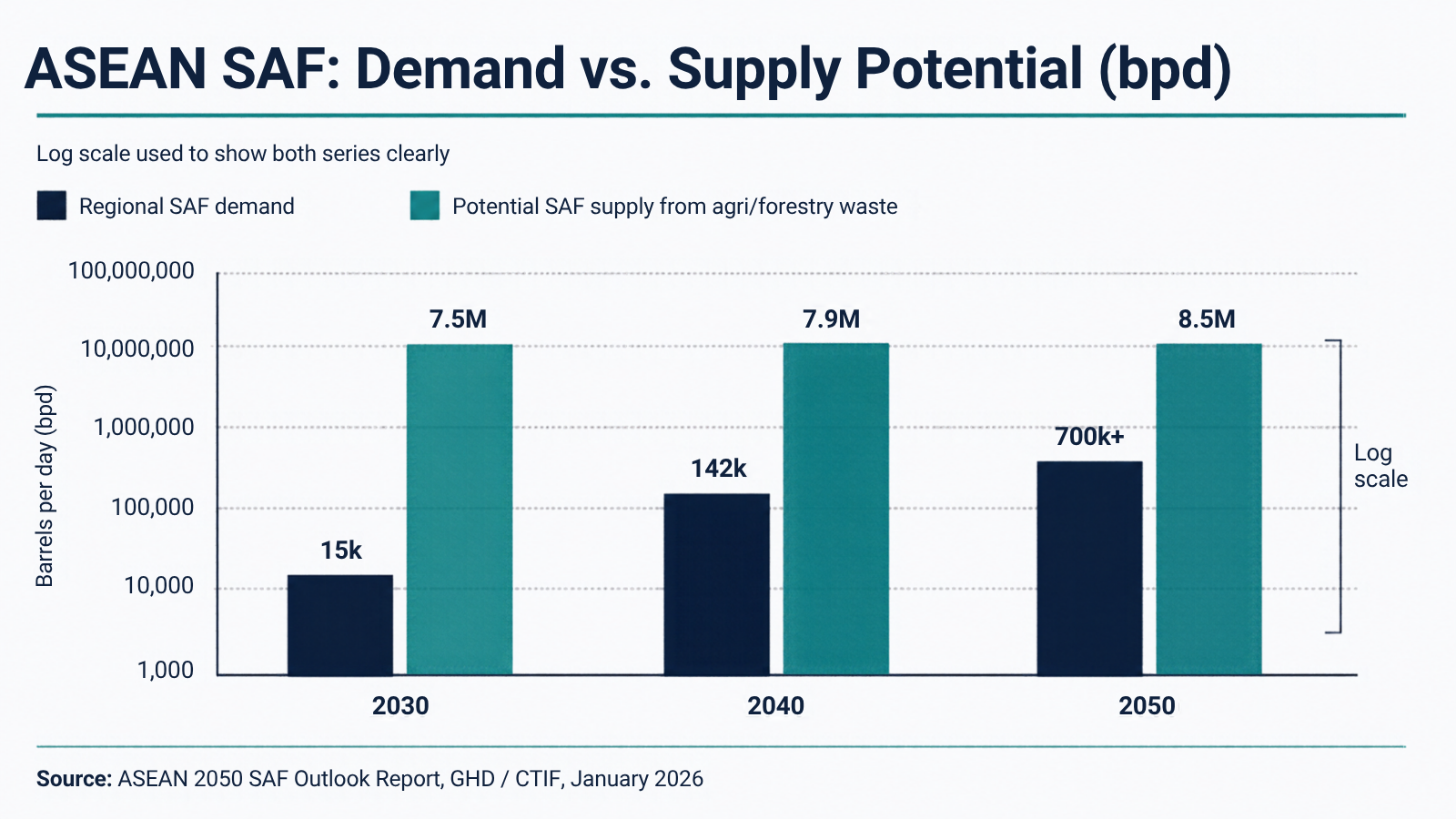
ASEAN SAF demand growing from around 15,000 barrels per day in 2030 to more than 700,000 by 2050, against a regional biomass-based supply potential of 7.5 to 8.5 million barrels per day
Regional SAF demand versus the region’s agricultural and forestry waste-based supply potential, 2030 to 2050 (ASEAN, January 2026).
Stainless steel industrial storage tanks at a fuel production site, the kind of asset a SAF project's feedstock and financial viability depend on
Photo by Richard Williams on Unsplash

Feedstock risk can change overnight

Indonesia and Malaysia together supply a large share of the world’s palm oil. Both have significant volumes of used cooking oil and palm oil mill effluent available as SAF feedstock. But Indonesia’s collection rate for domestic UCO is only about 23 percent. Indonesia exported roughly 95 percent of its 2024 UCO collection before the government signalled the restriction. Malaysia’s own UCO collection rate sits around 30 to 45 percent (White & Case). A feedstock supply agreement without a price and volume pass-through clause leaves the project exposed to policy moves. Feedstock price pass-through is becoming a bankability requirement. Most offtake and supply contracts I review in this region still lack it (S&P Global, July 2026). Feedstock also is not spread evenly across the region. Indonesia and Thailand hold the largest volumes of agricultural and forestry waste suited to SAF production.

Indonesia and the Philippines are archipelagos where feedstock is hardest to aggregate and move. Lao PDR has the least (GHD, April 2025). Where that feedstock sits, country by country, and how saturated the competition already is, deserves its own article. I am covering individual countries in more depth separately. The short version for a bankability conversation: waiting will not solve a shared UCO pool problem. A developer chasing the same UCO pool as three other HEFA projects needs a sourcing strategy now. Fix it before an investor finds the gap first.

I cover this pairing of offtake and supply security in the feedstock supply work.

Governance and sponsor risk is underweighted

Malaysian credit committees reject SAF projects over sponsor identity, shareholding structure, and track record more often than over technology risk. Developers tend to prepare for technical due diligence and underprepare for governance due diligence. The real risk sits elsewhere (S&P Global, July 2026).

The debt versus equity mismatch

Several Malaysian SAF projects that reached financial close relied on corporate balance-sheet financing, not standalone project finance. Several Malaysian SAF developers have gone to the market for a loan when the project needed an equity injection first. Equity should carry early-stage and construction risk, with debt layered in once the asset nears operation (S&P Global, July 2026). Blended finance is starting to appear as a way to bridge that gap. A multilateral development bank absorbs first-loss or junior-tranche risk so a commercial lender can take the senior tranche. This same sequencing problem applies to e-SAF and green methanol projects. They carry higher technology risk and a thinner operating track record. So the equity-before-debt logic applies with even more force there. When the right conversation is with equity first, that is the investor introductions work, not project finance.


A four-step method to reach SAF project FID

  1. Convert intent into contract. Move every offtake conversation from indicative interest to a signed agreement with volume, price mechanism, term, and default terms. If book-and-claim is part of the structure, confirm which certification registry the project will use. Investors need that chain verifiable and transparent, not just described.
  2. Underwrite your counterparties as hard as investors will. Before a lender asks, check the credit profile of your offtaker and your feedstock supplier independently. If either is financially weak, address it in the contract structure with guarantees, escrow, or step-in rights.
  3. Separate what is law from what is policy intent. List every regulatory assumption in your financial model and mark each one as binding law, draft regulation, or stated ambition. Wherever a revenue or feedstock assumption rests on something that is not yet law, build a contingency response. Cover the scenario where policy changes or slips.
  4. Sequence your capital, then commission the independent study. Decide, before approaching anyone, whether the project genuinely needs equity first or whether it can support debt now. Then commission the independent feasibility and financial model review. Treat its findings as the final gate before FID. Do not treat it as a formality before a decision you have already made.

Common mistakes that delay SAF project FID

  • Presenting an airline’s letter of intent or a non-binding mandate as if it were a contracted revenue stream.
  • Signing a feedstock supply agreement with no pass-through clause leaves the project exposed to export restrictions or price spikes.
  • Approaching lenders for debt when only equity should absorb development and construction risk at that stage.
  • Underpreparing for governance and sponsor due diligence while over-preparing for technology due diligence.
  • Treating an independent feasibility study as a closing formality rather than as the test the project needs to pass.
  • Assuming power project bankability logic transfers to a fuels project without adjusting for feedstock and certification risk.

Bankability checklist before approaching SAF project FID

  • Offtake agreement signed, not a letter of intent, with volume, price, term, and default terms defined
  • Book-and-claim or certification registry identified and verifiable
  • Feedstock supply agreement includes price and volume pass-through protection
  • Offtaker and feedstock supplier credit independently assessed
  • Every regulatory assumption in the financial model labelled as law, draft, or ambition
  • Contingency plan in place for each non-binding assumption
  • Capital structure sequenced: equity for early-stage and construction risk, debt layered in afterward
  • Sponsor identity, shareholding structure, and track record documented and ready for governance due diligence
  • Independent feasibility study and financial model commissioned before, not after, investor conversations begin
  • Change-in-law and currency risk allocation defined in draft contracts

Where this leaves you

If your project still treats a letter of intent as revenue certainty, start there, not with the pitch deck. The same applies if its financial model does not separate binding law from policy ambition. I am currently working across SAF projects in the Philippines, Thailand, Vietnam, and Malaysia. The pattern above repeats often enough to be worth writing down. I connect SAF, e-SAF, and green methanol developers in Southeast Asia with investors, lenders, offtakers, and feedstock partners. I also help identify where a project’s bankability gap sits before it reaches a financing conversation.

Discuss your project or book a 30-minute call. You can also look at how I work on offtake agreements, project finance, and feasibility and financial model support. Or read more on the SAF industry and the Roadmap to Bankability. You can also browse other Insights.

Sources

Frequently asked questions

Final investment decision (FID) is the point where a developer and its financiers commit the capital needed to begin construction. Reaching it requires bankable revenue, counterparty credit, regulatory, and financial dimensions, not just technical feasibility.

The region does not yet have a binding regional mandate that creates guaranteed demand. Several national mandates remain proposals rather than law. Feedstock policy can shift quickly, as with Indonesia’s restrictions on used cooking oil and palm oil mill effluent.

A bankable offtake agreement defines volume, price mechanism, term, and default consequences. Where book-and-claim applies, certification and transfer must be verifiable. A non-binding letter of intent does not meet this bar.

Feedstock availability and price can change through export restrictions, collection-rate limits, or competing domestic uses. Lenders want feedstock contracts to protect price and volume, rather than leaving that risk with the project.

Yes. E-SAF and green methanol projects face the same four pillars: revenue certainty, counterparty creditworthiness, regulatory predictability, and financial viability. They must also secure renewable electricity, and for e-SAF green hydrogen, on bankable terms. Because these pathways generally have a thinner operating track record, the sequencing of equity before debt matters even more.

Multilateral development banks and blended finance can absorb first-loss or junior-tranche risk so commercial lenders take the senior tranche. In Southeast Asia, where pure SAF project finance remains limited, several projects have relied on corporate balance-sheet financing instead.

Not sure your project would survive a credit conversation?

A short call is enough to see where your project stands against lender and investor questions. Tell me where your project is today, and I will tell you what the next conversation needs to look like.

Alex, Founder of WeConnect Asia

I am Alex, founder of WeConnect Asia, based in Kuala Lumpur. My work connects low-carbon fuel developers in Southeast Asia with the investors, lenders, offtakers, and feedstock partners they need. I do not provide investment advice or arrange investments. My role is strategic advice and facilitation.

Facebook
Twitter
LinkedIn

Related articles




