
Home » Methanol Bunkering in Southeast Asia: Demand and Hubs
Methanol Bunkering in Southeast Asia: Demand and Hubs
10 min read · May 4, 2026 · By Alex
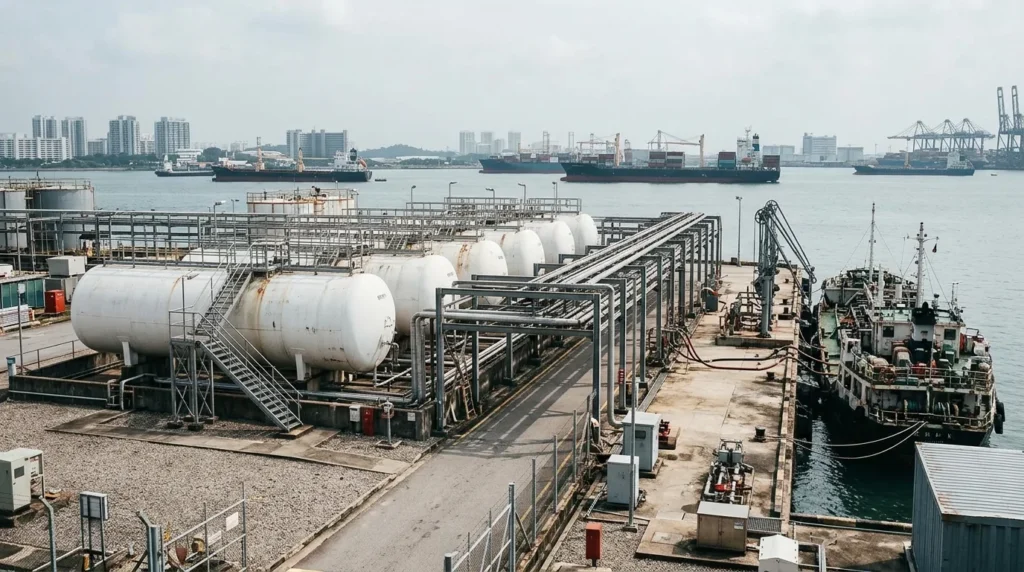
Methanol bunkering is the supply of methanol as a marine fuel to ships at a port, and in Southeast Asia it now has a licence, a price and a queue of suppliers. Today Singapore is the reference hub. Three companies hold licences to deliver methanol in the Port of Singapore from 1 January 2026, and the terms of those licences tell a producer more about the market than any forecast. So this article follows the fuel from the terminal to the ship, and then back to what a project has to prove to sell it.
In short
- In short, methanol bunkering happens at the port, through a licensed supplier, and the licence decides who can sell.
- Moreover Singapore awarded three five-year licences in November 2025, with supply starting on 1 January 2026.
- In addition, a licensee must own or operate an IMO Type 2 chemical tanker and prove a well-to-wake carbon intensity.
- So a producer sells to a licensee, not to a port, and the licensee carries the local obligations.
- Finally the gap is volume: methanol bunkering in Singapore is still measured in thousands of tonnes.
In this article
What methanol bunkering is and why ports matter
Bunkering is the last step of the marine fuel chain. A ship takes fuel at a port, from a supplier, by barge, truck or pipeline. The supplier holds the licence, the storage and the craft. Therefore the supplier decides which fuels a port can physically offer.
Still methanol suits that step better than many alternatives. First it is a liquid at atmospheric pressure, so terminals store it much like conventional bunker fuel. In addition the International Renewable Energy Agency notes that the storage cost is low compared with LNG or hydrogen, and that methanol was already available in more than 100 major ports when it published its outlook in 2021. Moreover the fuel is biodegradable, which simplifies spill response.
However the physical fit is not the constraint. In fact the constraint is commercial and regulatory. So a shipping line will only order methanol-capable ships if the fuel is available on its routes. Then a port will only invest in methanol if a licensed supplier commits to volume. Therefore the port sits in the middle of a circular wait, and the licence is the instrument that breaks it.
How a methanol bunkering operation works
An operation runs through four steps. First the fuel arrives by tanker or truck and goes into a terminal tank. A bunker tanker takes it to the ship at anchor or at berth. Then a surveyor checks quantity and quality. The supplier issues the bunker delivery note with the data the buyer needs for compliance.
Thus Singapore formalised that sequence in two documents. The Technical Reference for Methanol Bunkering, known as TR129, covers custody transfer, safety protocols and crew training. It was developed by the Maritime and Port Authority with Enterprise Singapore and the Singapore Chemical Industry Council. A second standard covers port limit methanol bunker tankers and sets requirements on propulsion redundancy, manoeuvrability and vapour management.
In practice the equipment matters as much as the paperwork. Singapore expects licensed suppliers to adopt mass flow meters and digital bunkering, and it tested both during a 1,340 tonne delivery in May 2024. Thus the data trail starts at the barge, not at the buyer’s spreadsheet.
Methanol bunkering in Singapore starts with a licence
The Maritime and Port Authority opened applications for methanol bunkering licences on 26 March 2025, with a deadline of 28 May 2025. The call followed an expression of interest launched in December 2023, which drew more than 50 proposals, and a series of trials that began in 2023. So the licence ends a two-year design process, not a pilot.
Then the conditions are specific. First a licensee must run an end-to-end supply operation as both bunker supplier and bunker craft operator. That covers securing methanol into Singapore, quality assurance, storage and safe handling, emergency response, and enough trained manpower. In addition a licensee must own and operate at least one IMO Type 2 chemical tanker. The fuel must meet a stated carbon intensity on a well-to-wake basis, with a transparent chain of custody from source to delivery.
So award followed in November 2025. The authority selected Global Energy Trading, Golden Island and PetroChina International (Singapore) from 13 applicants, and it evaluated supply chain reliability, operational readiness, safety systems and the sustainability certification of the fuel. The licences run for five years, from 1 January 2026 to 31 December 2030. Therefore the first licensed methanol bunkering market in the region has a start date and an end date, and both matter to a supply contract.
What the volumes say about methanol bunkering demand
Singapore sold 54.92 million tonnes of bunker fuel in 2024, a record and more than a sixth of the fuel used by global shipping. Alternative fuels passed one million tonnes for the first time, at 1.34 million tonnes, which doubled the 2023 figure. In addition biofuel blends reached 0.88 million tonnes and LNG reached 0.46 million tonnes.
However methanol is a different scale. In fact the port recorded 1,626 tonnes of methanol sold on a commercial basis in 2024, alongside 9.74 tonnes of ammonia in the first trials of their kind anywhere. So methanol bunkering exists, and it is still a rounding error next to the 54.92 million tonne total.
The operations explain why the licence matters. In July 2023 Maersk and Hong Lam Marine completed the world’s first ship-to-containership methanol bunkering in Singapore, with about 300 tonnes of bio-methanol at the Raffles Reserved Anchorage. Then in May 2024 a ship-to-ship operation delivered close to 1,340 tonnes of blended methanol, with 20 % ISCC-certified bio-methanol, in seven hours. The fuel’s producer reported a 31 % CO2e saving on a tank-to-wake basis against VLSFO for that blend. Thus the technical case works, and the commercial case still depends on volume.
Methanol bunkering beyond Singapore: the regional hubs
Today Singapore is the only port in Southeast Asia where I can point to a licence, a named licensee list and a start date. Elsewhere the public record is thinner, and it is mostly policy rather than supply. That matters, because a hub needs a supplier with a licence before it needs a marketing brochure.
Still Malaysia is the closest to a framework. It launched a green bunkering regulatory roadmap at Malaysia Maritime Week 2026, with nine actions covering digital licensing, safety standards, fuel handling, green port investment and clean fuel rules. The roadmap includes safety frameworks for methanol and ammonia bunkering, and it sets a single-window licensing process from February 2027 to replace approvals from about eight agencies. Thus a Malaysian port could offer licensed methanol supply from 2027, and no licensee has been named yet. For the ammonia side, see The Green Ammonia Market in Southeast Asia.
Therefore this creates a sequencing question for a producer. A project that signs with a Singapore licensee reaches a market with a five-year licence and a compliance motive. A project that waits for a second hub gains optionality and loses time. In practice most projects need both: a Singapore offtake for volume and a second port for resilience.
Who buys at the port
In practice four types of buyer meet at a bunkering hub, and each one wants something different from a methanol producer.
| Buyer | What they want |
|---|---|
| Licensed bunker supplier | Consistent volume, specification compliance, a certification file the buyer accepts. |
| Shipping line | Availability on its routes, a price against VLSFO, and a compliance value under FuelEU Maritime. |
| Trader | Volume, a margin, and a quality guarantee it can pass down the chain. |
| Terminal operator | Throughput, safe handling, and a tank that is not stranded for years. |
So the licensee is the buyer that matters most in Singapore, because the licence makes it the gatekeeper. A producer that signs with a licensee gains access to every ship the licensee serves. By contrast, a producer that sells directly to one shipping line carries the port obligations itself, and that is rarely the right structure for a first project.
What a producer must show a bunker supplier
Overall five items decide whether a licensee will sign. First, fuel quality against the agreed specification, with a tolerance band and a test protocol. Second, a carbon intensity value on a well-to-wake basis, supported by a chain of custody that a verifier can follow. Third, a volume band, because a licensee cannot commit to a single annual figure when ship orders move.
Fourth, a delivery schedule that fits the port. A licensee needs to know when the cargo arrives, where it is stored and how it moves to the barge. Fifth, a price formula that survives a change in the regulation. In addition, the producer should bring a safety dossier and a named contact for incidents, because a methanol release at a terminal is a reputational event for the licensee.
The contract terms that decide the margin
Methanol bunkering deals live or die on five clauses. The first is the carbon intensity warranty, because the licensee must pass that number to the ship. The second is the chain of custody, because a certificate without a traceable chain is worth nothing to a verifier. The third is the volume band, with a make-up mechanism for the years when ships are late.
The fourth is the price formula. Most contracts will index methanol to a conventional benchmark and add a green premium, and the premium should move with the compliance value rather than with the producer’s cost. The fifth is the term. The Singapore licences end on 31 December 2030, so a supply contract that runs past that date needs a renewal clause or a second port. Therefore the tenor of the offtake and the tenor of the licence must be read together.
Gaps in methanol bunkering infrastructure
The first gap is the fleet of bunker tankers. A licensee must own or operate an IMO Type 2 chemical tanker, and that requirement limits the number of suppliers who can enter. Then the second gap is storage. Methanol needs dedicated tankage and a terminal willing to commit capacity for a fuel that still trades in thousands of tonnes.
The third gap is demand visibility. A shipping line will not order methanol-capable ships without fuel on the route, and a supplier will not hold stock without ships. The licence breaks the loop only partly, because it creates an obligation to supply and not an obligation to buy. Moreover the competition is real: biofuel blends and LNG are cheaper abatement today, and a shipowner with a compliance gap will take the cheaper option first.
Then there is the certification cost. Every cargo needs a sustainability file, and a small project carries that fixed cost across a small volume. Consequently the first plants will sell into a premium market, not a commodity one.
What methanol bunkering in Southeast Asia means for revenue and debt
Therefore for a project, the revenue line is volume multiplied by the premium, and the premium is set at the port. A Singapore licence gives a producer a route to market with a named counterparty and a compliance motive, which is more than most clean fuel projects have. However the volumes are small, and a single 1,340 tonne delivery does not support a plant.
Still the debt side is harder. Then a lender will ask whether the offtake outlives the licence, whether the port can absorb the volume, and whether a second hub exists if Singapore changes its rules. A five-year licence against a fifteen-year loan is a mismatch that needs a contractual answer, such as a renewal option or an export route to Europe. See Maritime Fuel Bankability and Green Methanol in Southeast Asia for that structure.
Sources
Sources
- Maritime and Port Authority of Singapore, Singapore opens applications for methanol bunkering licence, 26 March 2025 (licence conditions, IMO Type 2 tanker, carbon intensity, chain of custody, TR129).
- MPA, Singapore to award licences for methanol bunkering, 24 November 2025 (three licensees, 13 applicants, term to 31 December 2030).
- MPA, Successful first methanol bunkering operation in the Port of Singapore, 27 July 2023 (about 300 tonnes of bio-methanol).
- MPA, Ship-to-ship bunkering of close to 1,340 tonnes of blended methanol, 24 May 2024 (20 % bio-methanol, seven hours, mass flow meters).
- MPA, Strong growth momentum for Maritime Singapore, 15 January 2025 (54.92 million tonnes of bunker sales, 1.34 million tonnes of alternative fuels, 1,626 tonnes of methanol).
- IRENA, Innovation Outlook: Renewable Methanol, 2021 (storage, port availability, biodegradability).
- Ship and Bunker, Malaysia launches green bunkering regulatory roadmap, 2026 (nine actions, methanol and ammonia safety frameworks, single window from February 2027).
FAQ
What is methanol bunkering?
Methanol bunkering is the delivery of methanol as a marine fuel to a ship at a port, usually by barge from a licensed supplier.
Where does methanol bunkering happen in Southeast Asia?
Mainly in Singapore, where three licensees supply methanol from 1 January 2026, with Malaysia preparing a licensing framework from 2027.
Who buys?
Licensed bunker suppliers, shipping lines, traders and terminal operators, and the licensee is the gatekeeper at the port.
Is green methanol available at scale?
No. Singapore sold 1,626 tonnes of methanol in 2024 against 54.92 million tonnes of total bunker sales.
What does a producer need?
A specification-compliant fuel, a well-to-wake carbon intensity with a chain of custody, a volume band and a price formula a licensee can pass on.
Next step
A short call is usually enough to see where your project stands before a lender or an offtaker looks at it.
So if you want to connect a methanol project to the right port buyers, book a 30-minute call or read about offtake agreements. For the compliance driver behind the licence, see What Is FuelEU Maritime?
I do not provide investment advice or arrange investments. I act as a strategic advisor and facilitator.

Alex, Founder of WeConnect Asia
I help low-carbon fuel and carbon removal project developers in Southeast Asia secure the commercial and financial partners needed to reach FID.
Related articles

Biomethane: What It Is, How It Is Made and Who Buys It
Biomethane is biogas cleaned to pipeline quality. I explain how it is made, how it differs from biogas and who buys it in Southeast Asia.

Southeast Asia SAF: Policies, Demand and Project Status
Southeast Asia SAF policy is moving country by country. Here is where demand is forming, who the buyers are and what a developer can rely on today.

e-SAF Project Finance: Why the Sub-Mandate Is Not Enough
The synthetic fuel sub-mandate creates demand for e-SAF, but not a bankable project. Here is what e-SAF project finance still needs in Southeast Asia.

SAF Mandates by Country: A Developer’s Comparison
SAF mandates differ by country in scope, target and penalty. Here is a side-by-side comparison and what each one means for project revenue.

Sustainable Aviation Fuel: Pathways, Mandates and What Gets Financed
Sustainable aviation fuel has several pathways and sells into mandates. I explain the routes, the demand and what gets financed in Asia.

ReFuelEU Offtake: Who Actually Buys Your SAF?
The ReFuelEU mandate sits on fuel suppliers, not airlines. Here is what that means for ReFuelEU offtake contracts and what lenders expect to see.