
Home » Green Ammonia Plant: What Is Inside and Where the Capex Sits
Green Ammonia Plant:
What Is Inside and Where the Capex Sits
9 min read · Jan 22, 2026 · By Alex
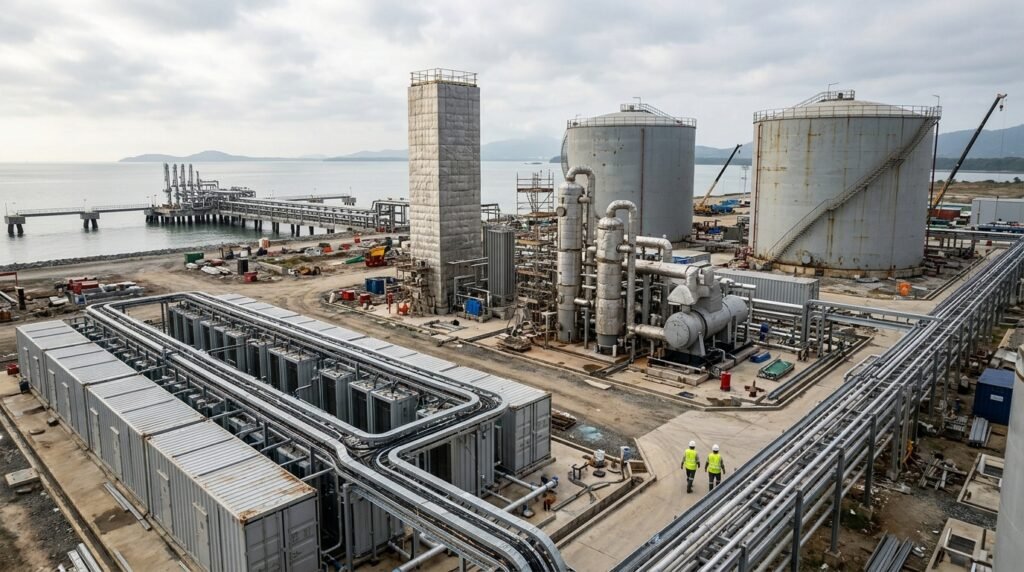
Five blocks wired together make a green ammonia plant: renewable power, an electrolyser, an air separation unit, a Haber-Bosch synthesis loop and storage with loading. Only one of those blocks is new. The rest is mature industrial equipment. So the real question for a developer is not whether the chemistry works, but how the blocks behave together when the power supply moves.
In short
- A green ammonia plant makes hydrogen from water, nitrogen from air, then combines them in a synthesis loop.
- The electrolyser and the renewable power behind it drive most of the cost and most of the risk.
- A hydrogen buffer lets the synthesis loop run steadily while the power varies. It also adds capex.
- Lenders look at the contracts around the plant at least as hard as the plant itself.
In this article
Green ammonia plant: the five blocks in plain terms
First, the power block. It is a solar, wind or hydro supply, or a grid connection backed by certificates. In practice, its size and profile set how many hours a year the plant runs at full rate.
Second, the electrolyser. It splits water into hydrogen and oxygen using that power. It is the block people talk about most, because it is the newest and the most expensive per unit of output.
Third, the air separation unit. It pulls nitrogen out of the air. However, this is standard equipment that has run in industrial plants for decades.
Fourth, the Haber-Bosch loop. Hydrogen and nitrogen react over a catalyst at high temperature and pressure, and the ammonia is condensed out. Also, the reaction is old and well understood.
Finally, storage and loading. Operators store ammonia as a refrigerated liquid or in pressurised tanks, then load it onto ships, trucks or a pipeline. In other words, the plant ends where the buyer’s specification begins.
Why the electrolyser decides the capex of a green ammonia plant
Today, on a conventional ammonia plant, hydrogen comes from natural gas. On a green ammonia plant, it comes from the electrolyser, and that changes the cost structure completely. The electrolyser, its power electronics and the renewable supply behind it make up the largest part of the investment. On an islanded site, the levelised cost of ammonia can reach about USD 473 per tonne (Nayak-Luke et al.). The electrolyser’s capex and operation sit at the top of that number.
However, the stack is only part of the electrolyser system. Water treatment, cooling, compression, controls and the civil works around it add up. As a result, a quote for “the electrolyser” and the real cost of the hydrogen block can differ a lot. I always ask what the number includes before I compare two offers.
Moreover, the electrolyser sets the size of everything else. A bigger electrolyser means more hydrogen, so a bigger synthesis loop, a bigger air separation unit and a larger storage tank. As a result, if the electrolyser slips, the whole schedule slips with it.
Green ammonia plant: orders of magnitude in Southeast Asia
A conventional world-scale ammonia train runs between 2,000 and 3,300 tonnes a day, which is 0.7 to 1.2 million tonnes a year. The largest single train reaches 3,760 tonnes a day (IRENA and Ammonia Energy Association). Most green projects start smaller, because the first train has to match a contract that already exists. Scale is a decision a developer takes once, and it fixes the size of every block behind it.
Cost frames the pace. IRENA puts renewable ammonia at about USD 720 a tonne at the sites with the best solar and wind. Fossil ammonia still costs USD 110 to 340 a tonne (IRENA and Ammonia Energy Association). The same outlook puts renewable ammonia at USD 480 by 2030 and USD 310 by 2050 (IRENA and Ammonia Energy Association). In practice that spread is a commercial problem before it is an engineering one, so I price the offtake before I study the flowsheet.
Indonesia shows the regional scale. Pupuk Indonesia plans hybrid green ammonia at Aceh for 33,000 tonnes a year with start-up in 2027 (Indonesia Ministry of Energy and Mineral Resources). Gresik follows in 2028 at 82,500 tonnes a year (Indonesia Ministry of Energy and Mineral Resources). The Garuda Hidrogen Hijau project pairs 600 MW of wind and solar with 150,000 tonnes of ammonia a year (Ammonia Energy Association). The schedule targets start-up in 2026, and estimated costs sit above USD 1 billion (Ammonia Energy Association). So the pattern across Southeast Asia is phased capacity, state partners on both sides of the contract, and a first train sized to the buyer it already has.
So the order of decisions holds across projects: offtake first, power second, loop guarantees third, loading route last. Once the team signs those four, the rest of the work can move.
The hydrogen buffer: the cost of running on variable power
A synthesis loop prefers to run steadily. But solar and wind do not. The usual answer is a hydrogen buffer: the plant oversizes the electrolyser and stores the surplus hydrogen, so the loop keeps running when the power dips. At the best locations, that flexibility raises the levelised cost of ammonia by 56% (Nayak-Luke et al.).
Still, this is a trade-off, and it is where many early models go wrong. A bigger buffer protects the synthesis loop, but it costs capex and land. Then again, a smaller buffer saves money, but it forces the loop to ramp up and down, and some loops cannot do that quickly. In practice, the right size depends on the power profile, on how far the loop can turn down and on how much ammonia the offtaker expects each month.
So when I read a model, I look for the buffer first. If the model assumes steady output from a variable power supply and shows no storage, the numbers do not add up.
Haber-Bosch and the air separation unit: mature, but not free
Haber-Bosch is the most proven block in the plant. That is good news for technology risk. It is not a reason to skip diligence.
Also, green plants run smaller than the giant gas-based ammonia plants. They also run on a feed that varies. Designers build some loops for steady operation, and those tolerate only a limited turndown. Therefore, the choice of loop supplier and the agreed operating range matter, and the technical review should test both.
The air separation unit is simpler. It is a known package, and delivery is usually predictable. Still, it needs power and a place in the layout, and it has to match the hydrogen flow. Above all, it should be sized together with the loop, not bought separately.
Where a green ammonia plant breaks in practice
In practice, most green ammonia plants do not fail on chemistry. They stall on the chain around the plant. This is the sequence in which projects tend to trip:
- Power. The renewable supply is not contracted yet, or the grid connection date is uncertain.
- Electrolyser. The supply agreement has no firm delivery date or performance guarantee.
- Water. The source and the permit are assumed, not secured.
- Loop. The supplier has not confirmed the turndown the power profile requires.
- Offtake. The buyer has signed an MOU but not a contract with volume, term and price.
- Port or pipeline. The loading route is not permitted or not funded.
So any one of these can hold up financial close. Because they depend on each other, a delay in one usually moves the others. For example, a late offtake contract pushes back the lenders, which pushes back the equipment order.
If your plant is in Southeast Asia, the offtake link is often the weakest one. I cover that in Green Ammonia in Southeast Asia: Why Offtake, Not Production, Is the Bottleneck. If you are looking at an existing ammonia site instead, the retrofit route changes the capex picture.
What lenders check on a green ammonia plant before FID
Above all, lenders read the plant as a set of contracts and guarantees. Here is what I expect them to ask for, area by area:
- Power. The lender checks the supply contract and the profile. An assumed PPA stays weak until a signed agreement carries a delivery date.
- Electrolyser. The lender checks performance and delivery. A budget quote stays weak until the contract carries guarantees.
- Loop. The lender checks turndown and ramp. The line reads “not confirmed” until the supplier puts the operating range in writing.
- Offtake. The lender checks volume, term, price and credit. An MOU stays weak until a creditworthy buyer signs.
- Water and permits. The lender checks sources and approvals. Nothing counts until the approvals sit in hand.
Next, they look at who carries each risk. A technology wrap, a fixed-price construction contract and a creditworthy buyer move a project forward. A list of “to be agreed” items does not. I explain how I think about that in the bankability roadmap and in the project finance service page.
Checklist
- The power supply has a contract, not a pricing assumption.
- The electrolyser quote states what it includes and what it guarantees.
- The model shows a hydrogen buffer sized to the power profile.
- The loop supplier has confirmed the operating range in writing.
- Water source and permit are secured.
- The offtake is a binding contract with volume, term and price.
- The loading route is permitted and funded.
If you cannot tick most of these, the next step is not more modelling. It is the offtake and the power, and I can open those conversations through the offtake service.
Next step
If your green ammonia plant is moving toward FID and the offtake or the capital is the open point, book a 30-minute call or send me the project brief. I look at the same things lenders look at, and I tell you early if the project is not ready. You can also read how hydrogen plants are built across the region.
Sources
- Energy & Environmental Science, Nayak-Luke and Bañares-Alcántara, Techno-economic viability of islanded green ammonia, 2020.
- Danish Energy Agency, Technology catalogues for energy technologies.
- IRENA and Ammonia Energy Association, Innovation Outlook: Renewable Ammonia, 2022.
- Indonesia Ministry of Energy and Mineral Resources, National Hydrogen and Ammonia Roadmap.
- Ammonia Energy Association, Headway in ACWA Power’s renewable ammonia projects.
FAQ
What is a green ammonia plant?
It is a plant that makes ammonia from renewable hydrogen and nitrogen from air. An electrolyser splits water, an air separation unit extracts nitrogen, and a Haber-Bosch loop combines them.
What is the difference between a green ammonia plant and a conventional one?
The hydrogen source. Conventional plants make hydrogen from natural gas. A green ammonia plant makes it from water and renewable power, so the power supply and the electrolyser drive the economics.
Why does a green ammonia plant need a hydrogen buffer?
Renewable power varies, and the synthesis loop prefers to run steadily. The buffer stores surplus hydrogen so the loop keeps going when the power dips.
Can an existing ammonia plant be converted?
Parts of it can, mainly the synthesis loop and the storage. That is why a retrofit can change the capex. The electrolyser and the renewable supply still have to be added.
What do lenders ask for first?
The contracts: power, electrolyser, construction and offtake. They want to see who carries each risk before they look at the model.
Where should a developer start?
With the offtake and the power. Without those two, the plant has nothing to finance.
Not sure your project would survive a credit conversation?
A short call is usually enough to see where your project stands against what a lender or an equity investor will ask for. Tell me where your project is today, and I will tell you what the next conversation needs to look like.

Alex, Founder of WeConnect Asia
I help low-carbon fuel and carbon removal project developers in Southeast Asia secure the commercial and financial partners needed to reach FID.
Related articles

Biomethane: What It Is, How It Is Made and Who Buys It
Biomethane is biogas cleaned to pipeline quality. I explain how it is made, how it differs from biogas and who buys it in Southeast Asia.

Southeast Asia SAF: Policies, Demand and Project Status
Southeast Asia SAF policy is moving country by country. Here is where demand is forming, who the buyers are and what a developer can rely on today.

e-SAF Project Finance: Why the Sub-Mandate Is Not Enough
The synthetic fuel sub-mandate creates demand for e-SAF, but not a bankable project. Here is what e-SAF project finance still needs in Southeast Asia.

SAF Mandates by Country: A Developer’s Comparison
SAF mandates differ by country in scope, target and penalty. Here is a side-by-side comparison and what each one means for project revenue.