
Home » Sustainable Maritime Fuels: What They Are and Who Buys Them
Sustainable Maritime Fuels: What They Are and Who Buys Them
14 min read · Oct 16, 2026 · By Alex
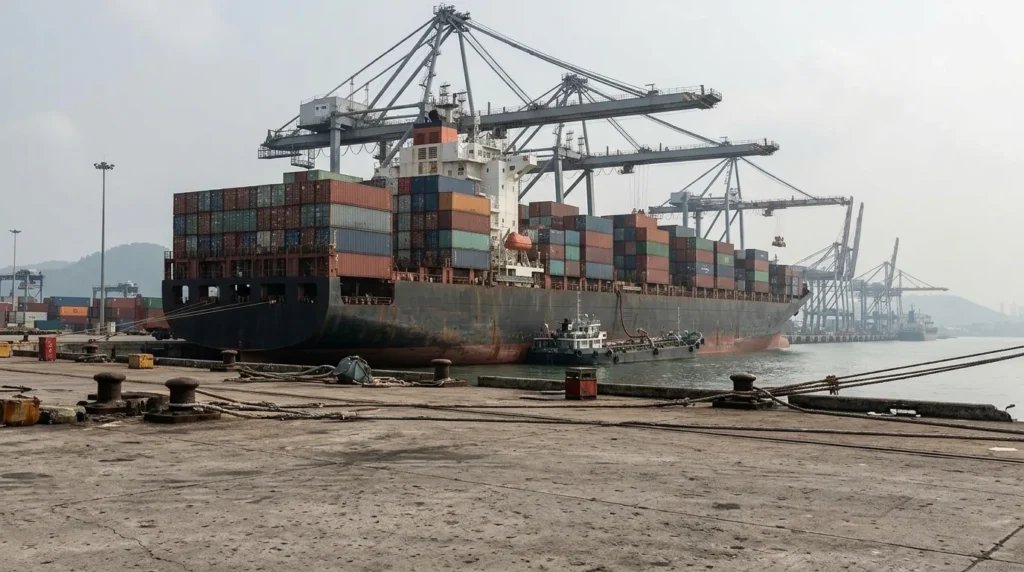
In essence, sustainable maritime fuels (SMF) are low-carbon fuels that power ships: green methanol, green ammonia, bio-LNG, biodiesel and, in some cases, hydrogen. For a developer in Southeast Asia, the region matters twice. Besides hosting some of the busiest ports in the world, it has the feedstock and renewable power to make these fuels. This guide explains what sustainable maritime fuels are, which rules create demand, and who actually signs the contract.
In short
- Basically, sustainable maritime fuels are a family of fuels, not one product. Each has its own technology, buyer and risk.
- Moreover, demand comes from rules on the carbon intensity of shipping fuel, in Europe and at the IMO, plus customers’ own targets.
- Meanwhile, buyers are fragmented: shipping lines, charterers, traders and bunker suppliers.
- Ultimately, for a lender, the question is the same as in aviation: who signs, for how long, at what price.
In this article
What counts as a sustainable maritime fuel
| Fuel | Typical origin | Developer’s main question |
|---|---|---|
| Green methanol, e-methanol | Biogenic CO2 or captured CO2 plus green hydrogen | Who buys at scale? |
| Green ammonia | Green hydrogen plus nitrogen | Is the ship and bunkering ready? |
| Bio-LNG, biodiesel | Waste and residue feedstocks | Is the feedstock certified? |
| Hydrogen | Electrolysis | Is the use case real for ships? |
In particular, I cover the first two in depth in Green Methanol in Southeast Asia and The Green Ammonia Market in Southeast Asia. The cost gap against fossil fuel is the reason the rest of this article talks about contracts. IRENA puts fossil methanol at USD 100 to 250 per tonne. E-methanol costs USD 800 to 1,600 per tonne when a plant captures biogenic CO2 at USD 10 to 50 per tonne. With direct air capture, at USD 300 to 600 per tonne of CO2, e-methanol moves to USD 1,200 to 2,400 per tonne.
Ammonia shows the same pattern. IRENA estimated renewable ammonia at USD 720 to 1,400 per tonne in 2020, against USD 110 to 340 per tonne for fossil ammonia. By 2030 the renewable range falls to USD 475 to 950 per tonne. Therefore, the fuel a developer chooses decides the size of the premium that an offtaker has to accept.
Why shipping needs sustainable maritime fuels
Shipping runs mostly on fossil fuel oil. Bunkering accounts for around 2.5 % of global final energy demand, yet it absorbs more than 6 % of global annual oil use, according to the IEA Global Hydrogen Review 2025. In 2018, global shipping emitted 1,076 million tonnes of CO2, or about 2.9 % of emissions from human activity, on the European Commission’s figures. The sector has few alternatives at scale, which is why fuel substitution carries most of the near-term abatement. Within Europe, maritime transport accounts for 3 to 4 % of the EU’s total CO2 emissions, or more than 124 million tonnes in 2021. A European rule therefore reaches a global fleet, because the ship that calls at Rotterdam or Singapore is often the same ship.
The order book shows shipowners already moving. DNV recorded 19.8 million gross tonnes of alternative-fuelled vessels ordered in the first half of 2025, 78 % more than in the same period of 2024. That volume came from 151 ships. LNG took 87 vessels and 14.2 million GT, methanol 40 vessels and 4.6 million GT, ammonia three vessels and hydrogen four. In addition, owners ordered 13 LNG bunkering vessels, against 62 in operation worldwide. Consequently, the constraint has shifted from the ship to the fuel and the port.
The rules behind demand for sustainable maritime fuels
Three regimes now shape demand, and each one prices a different part of the gap. Under FuelEU Maritime, the yearly average greenhouse gas intensity of energy used on board must fall against a 2020 baseline. The limit is 2 % lower in 2025, 6 % in 2030, 14.5 % in 2035, 31 % in 2040, 62 % in 2045 and 80 % in 2050. The rule covers ships above 5,000 gross tonnes that call at EU ports, whatever their flag. Those ships are 55 % of the fleet and 90 % of the sector’s CO2, according to the European Commission. It counts methane and nitrous oxide over the full life cycle, not only CO2 at the funnel.
FuelEU also rewards early buyers of renewable fuels of non-biological origin. A reward factor of two applies until 2033, so one unit of RFNBO energy counts as two in the ship’s average. Moreover, a sunrise clause adds a 2 % RFNBO quota by 2034 if the fleet stays below 1 % in 2031. In practice, that clause is the part a producer should model, because it converts a voluntary fuel into a required one.
The EU ETS adds a second cost. Since January 2024 it covers CO2 from large ships entering EU ports, with 50 % of emissions on voyages in or out of the EU and 100 % on intra-EU voyages and in port. Methane and nitrous oxide joined the scheme in 2026. Shipping companies surrender allowances for 40 % of 2024 emissions, 70 % of 2025 emissions and 100 % from 2027. Therefore, a ship using fossil fuel now pays twice: once for the intensity gap and once for the carbon.
Where the IMO Net-Zero Framework stands
The global layer is still moving. The IMO approved its Net-Zero Framework at MEPC 83 in April 2025. It combines a fuel standard with a two-tier price on emissions above set thresholds, initially USD 380 and USD 100 per tonne of CO2 equivalent. In October 2025, members voted 57 to 49 to adjourn adoption for a year. The resumed session should meet on 4 December 2026, after MEPC 85. Entry into force would follow 16 months after adoption, so the earliest date is around March 2028. For the current status, see IMO Net-Zero Framework.
What sustainable maritime fuels cost today
Cost decides which of these fuels can carry a project finance structure this decade. E-methanol at USD 800 to 1,600 per tonne sits three to ten times above fossil methanol. Renewable ammonia at USD 475 to 950 per tonne by 2030 sits two to four times above the fossil range. By contrast, bio-LNG and biodiesel depend on a feedstock market that already trades, which makes their premium easier to index but harder to predict.
The compliance regimes narrow the gap but do not close it. A FuelEU penalty and an ETS allowance together put a price on the difference in carbon intensity. However, neither pays for the full premium on a first-of-a-kind plant. Consequently, the developer needs a buyer who values the fuel for a reason beyond compliance, such as a cargo owner with a Scope 3 target or a port building a green corridor. In addition, the fuel’s own emissions count. The IMO treats a fuel as zero or near-zero only below 19.0 gCO2eq/MJ, against an average of 93.3 gCO2eq/MJ today. A methanol made from grid hydrogen can miss that line, which is why the power source is a commercial issue and not only an engineering one.
Who buys sustainable maritime fuels
- Shipping lines: own the compliance exposure and order dual-fuel ships. They sign the longest contracts, but only for routes where the fuel is available.
- Charterers and cargo owners: may pay for low-carbon transport through green corridors or book-and-claim schemes.
- Traders: aggregate supply and carry price risk. They can bridge a volume gap, at a cost.
- Bunker suppliers: sit at the port and decide what is physically available. In Singapore, they now need a licence for methanol.
In other words, the buyer is rarely a single large counterparty. The book-and-claim route has grown to fill that gap. The Katalist platform, launched in late 2024 by the Mærsk Mc-Kinney Møller Center and RMI, lets a freight customer buy emission savings from a ship it did not charter. In addition, the Zero Emission Maritime Buyer Alliance opened its second e-fuel tender in February 2025, with delivery from 2027 and demand in the hundreds of kilotonnes. Meanwhile, a classic producer-to-buyer deal still happens: Mitsubishi Gas Chemical agreed in July 2026 to take about 100,000 tonnes a year of green methanol from ACME Group’s Indian project, from commercial operation in 2030. I describe what each will sign in Marine Fuel Offtake.
How a sustainable maritime fuels offtake is priced
Most marine fuel offtakes I see are built on a conventional bunker index plus a premium. That structure gives the buyer a familiar reference and gives the lender a hedge against the fuel oil market. However, it leaves the plant exposed to the premium, which is the part that has to cover the extra capital.
Therefore, the negotiation usually moves to four terms. The first is a floor on the premium, fixed in dollars per tonne rather than left to a quarterly review. The second is a take-or-pay volume, with a ramp that starts below nameplate and reaches it after two or three years. The third is an indexation clause for the feedstock or the power, so that a cost shock does not sit entirely with the producer. The fourth is a certification and chain-of-custody obligation, because the buyer cannot claim the FuelEU benefit without proof of the fuel’s pathway.
Tenor is where most discussions fail. Bunker supply contracts run for months, and a shipping line will not sign fifteen years on a route it may reroute. Consequently, projects often need two counterparties: a strategic buyer for the long tenor and a trader for the residual volume. A public scheme can also carry part of the risk, as Singapore’s levy-funded SAF purchases do in aviation. Without one of those three, the debt tenor and the contract tenor do not match.
The Southeast Asia bunkering base for sustainable maritime fuels
Singapore is the reference point, and the numbers explain why. The port supplied 54.9 million tonnes of marine fuel in 2024, about one fifth of global demand, and sales rose 6 % that year. In 2025 they reached 56.77 million tonnes. Alternative fuels accounted for 1.95 million tonnes of that total. Bio-oils made up 1.38 million tonnes, LNG 571,400 tonnes and methanol 3,013 tonnes. Therefore, methanol today is a pilot volume, not a market.
The regulatory base is moving faster than the volume. The Maritime and Port Authority of Singapore opened methanol bunkering licence applications in March 2025 and awarded three licences in November 2025, from 13 applicants. The licensees are Global Energy Trading, Golden Island and PetroChina International (Singapore), and their licences run from 1 January 2026 to 31 December 2030. Each must supply methanol that meets a carbon intensity limit on a well-to-wake basis, hold at least one IMO type 2 chemical tanker and follow the TR129 technical reference. A first ammonia bunkering trial authorisation came in May 2026. In October 2026, MPA and Enterprise Singapore added TR148:2026, a code of practice for ammonia bunkering.
Supply is the weak link. The IEA estimates that Singapore has only about 130 ktpa of announced low-emissions hydrogen capacity within 500 km. That is less than 700 ktpa of methanol, or 1.2 % of its current bunkering volume in mass terms. By contrast, Rotterdam, with 10 million tonnes of sales, sits near 3.8 Mtpa of announced hydrogen, equivalent to 20 Mtpa of methanol. Consequently, a Southeast Asian producer sells into a hub that will import most of what it needs. That is an opportunity for the region’s projects and a reason to lock shipping and storage early. The full detail is in Methanol Bunkering in Southeast Asia.
The three contracts behind a marine fuel project
A marine fuel project is not one deal. It is three, and each one carries a different risk. The first is the input contract: a residue feedstock, a CO2 stream or a power supply, with a volume, a quality specification and a price formula. The second is the offtake, which converts the fuel into revenue. The third is the port agreement, which gives the project a place to store, blend and deliver.
Lenders read them in that order, because a weak input contract makes the offtake impossible to perform. For example, a methanol plant that relies on a single palm oil mill for CO2 has a supply risk that no buyer will accept, however strong the offtake. Moreover, the input contract usually runs shorter than the debt, which is why developers aggregate several sources or add a storage buffer.
The port agreement is the one developers leave late, and it is often the hardest. In Singapore, a methanol supplier must hold an IMO type 2 chemical tanker, meet a well-to-wake carbon intensity limit and follow TR129. Those conditions turn a commercial arrangement into an operational one, with a licence, a tank and a trained crew. Consequently, a project that signs the offtake before it secures the berth can miss its first delivery window.
Alignment is the point. If the input runs for ten years, the offtake for fifteen and the storage lease for five, the structure has two renewal cliffs inside the debt tenor. I therefore treat the three contracts as one package, and I test them against the same maturity date.
What a developer needs before FID
- In the first place, a named buyer category and a first conversation with them, not a market study.
- Then, a feedstock or hydrogen source with a supply agreement and a price formula.
- After that, a certification route that the buyer and the flag state both accept.
- Next, a delivery route to a port that can handle the fuel, with storage and a bunker vessel identified.
- Finally, a compliance model that shows the value of the fuel under FuelEU, the EU ETS and any IMO regime, year by year.
Timing belongs on that list too. A plant takes three to four years to build, so a project that reaches FID in 2027 delivers in 2030 or 2031. That is the year the FuelEU limit tightens to 6 % and the year the first synthetic aviation quotas bite in Europe. In addition, the IMO framework would apply from around 2028 at the earliest. Consequently, a developer who waits for the rules to settle before signing the offtake will build into a market that has already allocated its supply.
My view on how these fit together is in Maritime Fuel Bankability. The order matters, because a project that starts with the plant and looks for the buyer later usually ends up with a design that no one contracted for.
What I check before I call a sustainable maritime fuels project bankable
First, I check whether the buyer has a compliance obligation it cannot avoid. A shipping line with EU routes has one. A regional ferry operator may not. Second, I check whether the price formula survives a low fossil fuel market, because the premium is the first thing a buyer renegotiates. Third, I check the fuel’s actual carbon intensity against the 19.0 gCO2eq/MJ threshold, since a fuel that misses it loses the reward and most of its premium.
Fourth, I check the port. A licence is not a berth, and a berth is not a storage tank. In Singapore, the methanol licence conditions already tell you what a supplier must own. Fifth, I check the tenor match between the offtake and the debt, and I look for the second buyer. In my experience, a sustainable maritime fuels project that passes all five is rare, and the ones that pass tend to close on a smaller first phase. That is not a weakness. It is how a new fuel market gets built.
Sources
Sources
- Regulation (EU) 2023/1805 on the use of renewable and low-carbon fuels in maritime transport: eur-lex.europa.eu/eli/reg/2023/1805/oj
- European Commission, Decarbonising maritime transport, FuelEU Maritime, with the GHG intensity schedule and scope: transport.ec.europa.eu
- European Commission, Reducing emissions from the shipping sector, EU ETS coverage and phase-in: climate.ec.europa.eu
- IMO, The IMO Net-Zero Framework, FAQs, scope, GFI and zero-or-near-zero threshold: imo.org
- IEA, Global Hydrogen Review 2025, maritime demand, IMO pricing tiers and bunkering chapter: iea.org
- DNV, Alternative Fuels Insight, alternative-fuelled orderbook for the first half of 2025: dnv.com
- IRENA, Renewable Methanol: Innovation Outlook, 2021, cost ranges for e-methanol and CO2: IRENA report (PDF). IRENA, Renewable Ammonia: Innovation Outlook, 2022, cost ranges for renewable ammonia
- MPA, Singapore to Award Licences for Methanol Bunkering, 24 November 2025: mpa.gov.sg
- MPA and Enterprise Singapore, New Bunkering Standards Enhance Fuel Quality Assurance, 14 October 2026, TR148:2026 on ammonia bunkering: mpa.gov.sg
- Mitsubishi Gas Chemical, agreement to purchase green methanol from ACME Group, 3 July 2026: mgc.co.jp
FAQ
What does SMF stand for?
Sustainable maritime fuels. For instance, some sources use “marine fuels” or “alternative marine fuels”.
Which fuel will win?
I do not think one fuel wins. Methanol is more mature today, ammonia has scale potential, and biofuels are the easiest drop-in. So a project should be financed on its own contract, not on a bet on the winner.
Is bio-LNG a sustainable maritime fuel?
It can be, if the feedstock and the lifecycle emissions meet the applicable criteria. In practice, the certification route decides the answer, not the fuel name.
Who signs offtake for marine fuels?
Shipping lines, traders and bunker suppliers, depending on the structure. Cargo owners can also pay through book-and-claim, but they rarely sign the supply contract.
How is this different from SAF?
Same logic, different buyers. See SAF vs Methanol.
How long does a marine fuel offtake run?
Longer than the bunker contract it replaces. A project usually needs ten to fifteen years, while a bunker supply agreement runs for months, which is why many projects need two buyers.
Next step
A short call is usually enough to see where your project stands before a lender or an offtaker looks at it.
If you develop a marine fuel project in Southeast Asia, book a 30-minute call or read about offtake agreements.
I do not provide investment advice or arrange investments. I act as a strategic advisor and facilitator.

Alex, Founder of WeConnect Asia
I help low-carbon fuel and carbon removal project developers in Southeast Asia secure the commercial and financial partners needed to reach FID.
Related articles

Biomethane: What It Is, How It Is Made and Who Buys It
Biomethane is biogas cleaned to pipeline quality. I explain how it is made, how it differs from biogas and who buys it in Southeast Asia.

Southeast Asia SAF: Policies, Demand and Project Status
Southeast Asia SAF policy is moving country by country. Here is where demand is forming, who the buyers are and what a developer can rely on today.

e-SAF Project Finance: Why the Sub-Mandate Is Not Enough
The synthetic fuel sub-mandate creates demand for e-SAF, but not a bankable project. Here is what e-SAF project finance still needs in Southeast Asia.

SAF Mandates by Country: A Developer’s Comparison
SAF mandates differ by country in scope, target and penalty. Here is a side-by-side comparison and what each one means for project revenue.

Sustainable Aviation Fuel: Pathways, Mandates and What Gets Financed
Sustainable aviation fuel has several pathways and sells into mandates. I explain the routes, the demand and what gets financed in Asia.

ReFuelEU Offtake: Who Actually Buys Your SAF?
The ReFuelEU mandate sits on fuel suppliers, not airlines. Here is what that means for ReFuelEU offtake contracts and what lenders expect to see.