
Home » Export SAF to Europe: What a Southeast Asia Plant Needs
Export SAF to Europe: What a Southeast Asia Plant Needs
10 min read · Jan 16, 2026 · By Alex
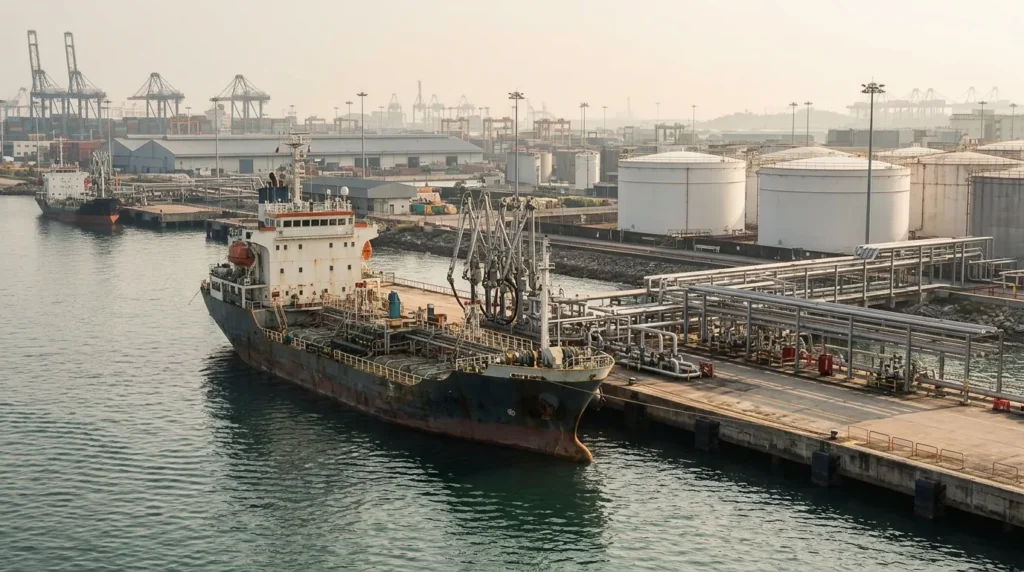
If you want to export SAF to Europe from a plant in Southeast Asia, the EU mandate is attractive and the distance is real. In fact the regulation creates demand at EU airports, while your plant sits several thousand kilometres away. Moreover the obligation lands on a fuel supplier at an EU airport, not on you. Therefore the export SAF question is not whether Europe wants the fuel. It is whether you can reach a supplier with certified product at a price that survives the journey.
In short
- For one thing, EU demand is regulated and long-dated, but it applies to fuel made available at EU airports.
- Moreover your export SAF must meet the sustainability criteria of the Renewable Energy Directive and be certified.
- In effect the buyer is a fuel supplier, a refiner, a blender or a trader, and rarely an airline.
- In addition freight, storage, blending and certification sit in the delivered price, so they belong in the base case.
- By contrast a regional contract may be the better first deal, and it can anchor an EU contract later.
In this article
Why EU export SAF demand matters to an Asian plant
Under ReFuelEU Aviation, a supplier must ensure that fuel made available at each Union airport contains a minimum share of SAF. Moreover Annex I of Regulation (EU) 2023/2405 fixes the ladder. The share runs from 2 % in 2025 to 6 % in 2030, 20 % in 2035, 34 % in 2040, 42 % in 2045 and 70 % in 2050. Inside that curve synthetic aviation fuels carry their own sub-share, from an average of 1.2 % over 2030 and 2031 to 35 % in 2050.
Consequently a supplier that misses the share faces a fine. Specifically Article 11(4) sets the floor at twice the price gap between conventional fuel and SAF. That gap is multiplied by the volume that falls short. In addition Article 11(8) requires the supplier to make up the shortfall in the following period. Paying the fine does not remove that duty.
Therefore the demand is not optional for the buyer, which is the strongest part of the export SAF case. However the obligation does not travel with the molecule. In practice it applies at the airport, to the party that places fuel on the market there. As a result an overseas producer is a source for an obliged supplier, and the credit risk you underwrite is the supplier’s.
Who buys export SAF: from plant gate to EU airport
The IATA SAF Handbook names four types of seller in a SAF transaction. They are the producer, a refinery, a blender and an oil or fuel trader. Moreover the buyer on the other side is usually one of those same parties. An airline appears only where it procures directly.
In reality a producer with no trading arm sells to a trader or to a refiner with an EU supply position. That buyer then blends, moves the fuel to an airport and reports it to the competent authority. Consequently the buyer needs your batch to carry the right documents at the right moment. The value of your export SAF depends on that administrative fit as much as on the molecule.
Moreover the contract horizon differs from a conventional fuel deal. In practice jet fuel contracts run one to three years. The SAF market pushes buyers toward two to ten year offtakes, because a producer needs the term to raise finance. That is good news for an export project and bad news for liquidity, since a single buyer carries more weight. For the contract mechanics, see ReFuelEU Offtake.
Export SAF checklist
- Certification. The fuel meets the sustainability and greenhouse gas criteria and a recognised scheme certifies it. See SAF Sustainability Criteria for the thresholds and the feedstock lists.
- Feedstock traceability. Every batch traces back to eligible feedstock with documents an auditor accepts, and the chain of custody survives a change of owner.
- Fuel quality. The neat product meets the relevant annex of ASTM D7566, and the blend meets the specification the airport receives.
- Logistics. A route from plant to an EU supply chain: storage, shipping, receiving terminal and inland transport to the blending point.
- A buyer. A named supplier, refiner, blender or trader, with a term sheet and a delivery basis that matches your cost structure.
In practice most files I see are strong on items two and three and weak on items one and five. However the lender reads the list from the bottom. A contract with a named buyer is what converts a certified fuel into revenue.
Fuel quality and blending limits for export SAF
Fuel quality is the part of the export case that has nothing to do with carbon, and it still stops projects. Specifically neat SAF must meet the relevant annex of ASTM D7566 before it can enter a jet fuel supply chain. Moreover ASTM D7566 carries no sustainability requirements. A certified molecule and a specification-compliant molecule are two different tests.
After that first test the producer blends the neat fuel with conventional jet fuel. The blend is then re-tested against ASTM D1655 or UK Defence Standard 91-091. Generally the maximum blend rate depends on the production pathway. The current ceiling is up to 50 % SAF.
Consequently no aircraft is certified to fly on neat synthetic fuel today, and your export SAF plan has to include a blender. In addition the specification decides who can receive your product. A plant that ships neat blend component to a terminal without blending capacity has created a storage problem, not a sale. Therefore I check blending capacity at the receiving end before I check the freight rate.
Documentation an EU buyer needs for export SAF
Documentation is where a distant producer usually loses value, because the buyer cannot claim what the seller cannot prove. Specifically IATA identifies three documents that a procurement contract should always specify. A Proof of Sustainability carries the sustainability characteristics of a delivery. A Proof of Compliance plays that role where the first document must go to a regulator. A Product Transfer Document proves the transfer of ownership.
Moreover the timing is regulated. Article 9(2) of ReFuelEU requires the supplier to give operators accurate information on the SAF supplied, free of charge, by 14 February of each reporting year. Consequently your batch data has to reach the supplier before that deadline. That is a supply chain obligation dressed as an administrative one.
In addition Article 9(1) forbids a claim for the same batch under more than one greenhouse gas scheme. Therefore an export SAF contract must state which scheme the batch is claimed under. It must also exclude a second claim on the same molecules. Indeed I see this clause missing in draft term sheets, and it is the clause a buyer’s auditor finds first.
Furthermore the sustainability data has to reach the Union database under Article 30 of the Renewable Energy Directive. That entry starts at the point of production. As a result the exporter feeds a European registry, and the entry is part of the delivery.
Cost of getting export SAF to Europe
Cost decides most export cases, and it has three layers. Firstly the product. IATA reports SAF prices at two to five times the price of conventional jet fuel, depending on pathway and feedstock. Secondly the logistics. Thirdly the certification and administration that make the batch bankable.
Moreover logistics is a named cost driver in the IATA cost breakdown, not a rounding item. In practice a pricing structure often shows it as a separate line: a benchmark price, a SAF premium, and a logistics charge on top. That structure helps an exporter, because the buyer sees freight as a pass-through rather than as part of a margin negotiation.
However a public benchmark for a Southeast Asia to Europe route is hard to find, and I do not invent one. Instead I build the delivered cost from four quotes a lender can audit. The four are ocean freight with tank cleaning, terminal throughput and storage, inland transport to the blending point, and certification plus mass balance administration. Consequently the number in the model is traceable, and the sensitivity table shows what happens when freight moves.
Contract terms that make export SAF bankable
Three contract terms carry most of the bankability in an export SAF deal. Firstly duration, because a two to ten year offtake supports debt while a spot sale does not. Secondly the price mechanism, because a formula tied to a published benchmark survives a rate movement. Thirdly the delivery basis, because the point where risk and title transfer decides who pays for the voyage.
Moreover the sustainability terms belong in the contract, not in a side letter. In effect a lender will look for four things. The scheme is named. The batch documentation is allocated. The no-double-claim clause is present. The cure period for a certification failure is long enough to fix a document.
In addition Article 4(6) of ReFuelEU allows a supplier to show compliance through the mass balance system under Article 30 of the directive. Therefore the contract should say that the batch transfers on that basis. Consequently the negotiation is less about the last cent per tonne and more about which risks move with the molecule. A seller who accepts a delivered basis takes the freight and terminal risk, and should price both.
The alternative: sell to regional demand
A first contract with a regional airline, refiner or supplier may be easier to close than an EU one. Moreover it can anchor the export SAF case later. In practice a regional buyer removes the freight from the equation and shortens the working capital cycle. That is often the difference between a plant that reaches FID and a plant that waits for a European term sheet.
In addition book and claim offers a middle route. Specifically IATA describes book and claim as a way to enable production where it is most efficient. It also minimises logistics costs and avoids additional emissions from transport. Therefore a Southeast Asian plant can sell the environmental attribute into a European claim while the physical fuel serves a nearer market. However the registry rules and the double counting rules decide whether a lender accepts that structure. For the mechanism, read Book and Claim for SAF.
Risks I flag before FID
Four risks come up in almost every export SAF file I review. Firstly buyer concentration, because one offtake with one trader exposes the project to that trader’s credit. Secondly specification risk, because a pathway approval and a blend limit can change. Thirdly certification risk, because a scheme suspension upstream breaks the batch. Fourthly logistics risk, because a single terminal or a single route has no redundancy.
Moreover each of those risks has a contractual answer, and none of them has a technical one. In practice the answer is a second buyer, a second terminal, a scheme with a broad scope and a longer cure period. Therefore I put the four risks on one page and ask the sponsor to price them before the model goes to a lender. For the financing view, see ReFuelEU Bankability and offtake agreements.
Sources
Sources
- Regulation (EU) 2023/2405 (ReFuelEU Aviation), Article 4, Article 9, Article 11 and Annex I, EUR-Lex: https://eur-lex.europa.eu/eli/reg/2023/2405/oj/eng
- Directive (EU) 2018/2001 (RED II), Article 29 and Article 30 on sustainability criteria, certification and the Union database, EUR-Lex: https://eur-lex.europa.eu/eli/dir/2018/2001/oj/eng
- IATA, SAF Handbook, May 2024 (blending limits, ASTM D7566 and D1655, Proof of Sustainability, Proof of Compliance, Product Transfer Document, offtake duration, price range of two to five times conventional fuel, cost drivers, book and claim): https://www.iata.org/contentassets/d13875e9ed784f75bac90f000760e998/saf-handbook.pdf
- European Commission, “Voluntary schemes” (recognised certification schemes and their scope): https://energy.ec.europa.eu/topics/renewable-energy/bioenergy/voluntary-schemes_en
- European Parliamentary Research Service, “ReFuelEU Aviation initiative”, PE 698.900, November 2023 (supplier obligation, schedule, penalties): https://www.europarl.europa.eu/thinktank/en/document/EPRS_BRI(2022)698900
FAQ
Can an Asian plant sell export SAF to the EU?
Yes, if the fuel is certified, meets the fuel specification and reaches an EU supply chain through a supplier that carries the obligation.
Who buys?
In general a fuel supplier, a refiner, a blender or a trader, and sometimes an airline directly.
Is distance a deal-breaker?
No, but it adds freight, storage and working capital, and those belong in the delivered price.
Do I need an EU entity?
It depends on the contract structure and on who reports the batch. Either way the buyer answers that question, and the answer belongs in the term sheet.
Should I start with Europe?
Firstly a regional contract is usually faster, and it can support the export SAF case later.
Can I sell the attribute without shipping the fuel?
Yes, through book and claim, provided the registry rules and the no-double-claim clause hold.
Next step
A short call is usually enough to see where your project stands before a lender or an offtaker looks at it.
To test whether Europe is the right first market for your plant, book a 30-minute call. Also see Southeast Asia SAF and feedstock supply.
I do not provide investment advice or arrange investments. I act as a strategic advisor and facilitator.

Alex, Founder of WeConnect Asia
I help low-carbon fuel and carbon removal project developers in Southeast Asia secure the commercial and financial partners needed to reach FID.
Related articles

Biomethane: What It Is, How It Is Made and Who Buys It
Biomethane is biogas cleaned to pipeline quality. I explain how it is made, how it differs from biogas and who buys it in Southeast Asia.

Southeast Asia SAF: Policies, Demand and Project Status
Southeast Asia SAF policy is moving country by country. Here is where demand is forming, who the buyers are and what a developer can rely on today.

e-SAF Project Finance: Why the Sub-Mandate Is Not Enough
The synthetic fuel sub-mandate creates demand for e-SAF, but not a bankable project. Here is what e-SAF project finance still needs in Southeast Asia.

SAF Mandates by Country: A Developer’s Comparison
SAF mandates differ by country in scope, target and penalty. Here is a side-by-side comparison and what each one means for project revenue.

Sustainable Aviation Fuel: Pathways, Mandates and What Gets Financed
Sustainable aviation fuel has several pathways and sells into mandates. I explain the routes, the demand and what gets financed in Asia.

ReFuelEU Offtake: Who Actually Buys Your SAF?
The ReFuelEU mandate sits on fuel suppliers, not airlines. Here is what that means for ReFuelEU offtake contracts and what lenders expect to see.