
Home » Maritime Fuel Bankability: Turning Rules into Revenue
Maritime Fuel Bankability: Turning Rules into Revenue
9 min read · Apr 29, 2026 · By Alex
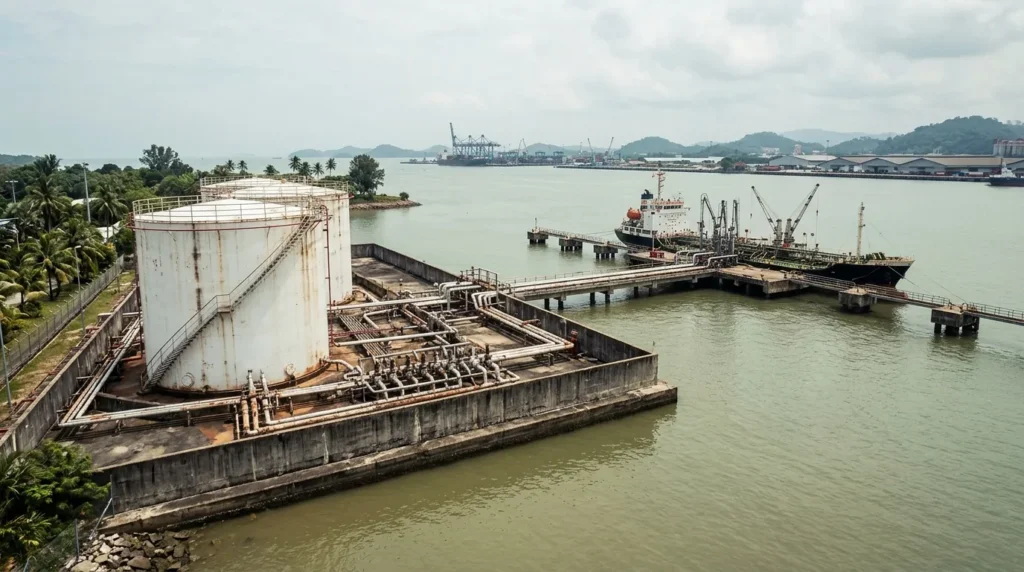
In fact maritime fuel bankability is the test a green methanol, green ammonia or biofuel project must pass before lenders will finance it. In principle the rules that drive demand, such as FuelEU Maritime and the IMO framework, matter a great deal. However they do not sign a contract. As in aviation, a project becomes bankable when a buyer, a price, a feedstock and a delivery route sit in writing. Accordingly this guide mirrors the chain I use for SAF, adapted to shipping and to the ports of Southeast Asia.
In short
- Regulation gives shipowners a reason to buy lower-carbon fuel. However it gives you no contract.
- By comparison the buyer side is more fragmented than in aviation: shipping lines, charterers, traders and bunker suppliers.
- Either way the chain is the same: obliged party, contract, feedstock or hydrogen, certification, price, delivery.
- Therefore a project that documents the chain moves toward FID. By contrast, one that relies on the rules alone does not.
In this article
What FuelEU Maritime gives a project
To begin with, FuelEU Maritime gives a compliance reason to use lower-intensity fuel on voyages linked to the EU. Regulation (EU) 2023/1805 applies from 1 January 2025 to ships above 5,000 gross tonnage that call at European ports, whatever their flag. In practice it sets a maximum yearly average greenhouse gas intensity on a well-to-wake basis, covering carbon dioxide, methane and nitrous oxide. Moreover the limit falls by 2 % in 2025, 6 % in 2030, 14.5 % in 2035, 31 % in 2040, 62 % in 2045 and 80 % in 2050 against a 2020 baseline. For example the Commission notes that ships above 5,000 gross tonnage represent 55 % of all ships and 90 % of the carbon dioxide emissions of the maritime sector, which is why the scope starts there.
What the EU ETS and IMO add
In addition, the EU emissions trading system for shipping puts a price on the emissions that remain. The system has covered maritime transport since 1 January 2024, and therefore the surrender obligation phases in at 40 % of verified emissions for 2024, 70 % for 2025 and 100 % from 2026. Moreover from 2026 the scope also includes methane and nitrous oxide. Moreover the shipping company remains the entity that surrenders the allowances, although the Commission’s maritime ETS guidance confirms that a company can recover the cost from whoever bought the fuel or operates the ship, if the contract says so.
Later the IMO framework could extend this logic globally. The 2023 IMO strategy targets net-zero greenhouse gas emissions from international shipping by or around 2050, with indicative checkpoints of at least 20 % by 2030 and at least 70 % by 2040 against 2008. Consequently member states finalised the draft legal text, the Net-Zero Framework, at MEPC 83 in April 2025. However the second extraordinary session in October 2025 adjourned adoption for one year by 57 votes to 49, so the earliest possible entry into force is now 2028, because the framework applies 16 months after adoption.
What the rules change in the revenue line
In practice all three instruments change a cost. By contrast, none of them changes a price that a producer receives. A shipowner who burns a compliant fuel avoids a penalty or an allowance purchase, and that avoided cost is what makes a premium defensible. Therefore the commercial question is not whether the rule exists. It is whether the saving is large enough, and stable enough, for a buyer to sign a premium for ten years.
Consequently the first number I ask for in a maritime fuel project is not the carbon intensity of the plant. Instead it is the compliance cost the buyer avoids per tonne of fuel, at each step of the schedule. As a result that number gives the ceiling for the green premium. Moreover it explains why so many projects stall after a good feasibility study: the engineering is sound, but the saving per tonne is thin against a fossil bunker price that moves.
What none of them gives
Above all, a named buyer, a price, a volume for your plant. Therefore these come from a contract. In effect a rule creates the reason to talk, and the contract creates the cash flow that a lender can size a loan against.
The maritime fuel bankability chain
| Link | What reassures a lender | What worries a lender |
|---|---|---|
| Demand rule | Binding rule with a penalty | Delay or weakening |
| Buyer | Rated shipping line or bunker supplier | Several small buyers, no anchor |
| Contract | Term, volume, price formula | MOU only |
| Inputs | Contracted feedstock, power or hydrogen | Unsecured supply |
| Certification | Accepted by the buyer | Not started |
| Delivery | Route to a port that handles the fuel | No bunkering path |
In effect the chain is sequential. For example a strong rule does not compensate for a weak buyer, and a strong buyer does not compensate for an uncertified fuel. Therefore I test each link on its own before I let a project describe itself as bankable.
Why shipping demand fragments maritime fuel bankability
In contrast aviation has a clear obliged party in the fuel supplier under ReFuelEU. Meanwhile the compliance exposure sits with shipowners and operators in shipping, who vary widely in size and in appetite for long contracts. In practice the numbers show why. For instance IRENA counts around 183 million tonnes of ammonia produced in 2020, of which only 18 to 20 million tonnes move by ship. In addition it counts around 98 million tonnes of methanol demand in 2019, of which less than 0.2 million tonnes was renewable. Therefore a producer faces a market of many small users rather than a single blending pool.
Moreover, the fuel itself is not yet chosen. In addition the same IRENA work projects 197 million tonnes of ammonia demand from the maritime sector by 2050 in a 1.5 °C scenario, while methanol has its own pathway. However those are scenario numbers, not orders. Consequently the demand case has to be built buyer by buyer. See Marine Fuel Offtake for how the buyer map looks in practice.
What a Southeast Asian project can prove about maritime fuel bankability
In practice a regional project can prove the delivery link earlier than it can prove the demand link. Singapore opened applications for methanol bunkering licences on 26 March 2025, after a framework that drew more than 50 proposals under its expression of interest. In addition a licensee must secure methanol supply to Singapore, run quality assurance, provide storage and safe handling, hold emergency response measures and own or operate at least one IMO Type 2 chemical tanker. Moreover the licence period runs from 1 January 2026 to 31 December 2030, and the licensee must supply methanol that meets a specified carbon intensity on a well-to-wake basis, with a chain of custody that tracks emissions from source to delivery.
Therefore a producer who can show a licensed bunker supplier a certified parcel, a mass balance and a route into the port has already answered a question that most projects leave to the end. See Methanol Bunkering in Southeast Asia.
What lenders price in maritime fuel bankability
In addition, the lender prices the country and the currency before it reads the contract. The IEA’s World Energy Investment 2025 puts the cost of capital in emerging market and developing economies outside China at two to three times the level in developed countries. Moreover it finds that 80 % of utility-scale solar and wind investment in 2024 was met through debt, and that clean energy project finance outside China rose 46 % to USD 37 billion. Therefore a project in Southeast Asia rarely fails on the quality of its rule. Instead it fails on the spread between its revenue and the cost of money.
Consequently the contract has to do two jobs at once. Therefore it has to fix a volume, and it has to allocate the risks that the lender cannot price: feedstock, freight, certification and change in law. Consequently that is why I treat the term sheet as a financing document, not a sales document.
A four-step method for maritime fuel bankability
- To begin with, find the anchor buyer. What you get: a first term sheet. For example Maersk signed a green methanol offtake with Goldwind for 500,000 tonnes a year to serve its first 12 methanol-enabled vessels, with first volumes expected in 2026.
- Then secure inputs. What you get: a supply base a lender can read. In practice IRENA puts the capital intensity of a 0.5 million tonne renewable ammonia plant near USD 4,800 per tonne of annual capacity, falling to about USD 3,000 at 10 million tonnes, so scale is a financing argument, not only an engineering one.
- After that choose a certification route the buyer accepts. What you get: eligibility proof. Under the EU rules, a renewable fuel of non-biological origin must show at least 70 % greenhouse gas savings against the fossil comparator.
- Finally link the project to a port. What you get: a delivery path. For instance X-Press Feeders took green methanol from OCI in Rotterdam from 2024, which connected its new feeder ships to an existing bunkering point rather than a future one.
Mistakes that cost maritime fuel bankability
- Building a case on the rule and no buyer.
- Moreover counting on the IMO framework as base case, when the October 2025 session adjourned adoption for a year.
- Also choosing a fuel before testing who will buy it.
- Finally forgetting the delivery route, which in this region means the bunkering licence and the tanker, not the jetty.
Maritime fuel bankability checklist
- I know who my anchor buyer is.
- I have a term sheet, not just an MOU.
- My inputs are contracted.
- Equally my fuel can be certified in a way the buyer accepts.
- I know how the fuel reaches a ship.
Likewise the aviation version is in ReFuelEU Bankability. Moreover my project finance, offtake and strategic partnership work covers the upstream steps.
Sources
Sources
- European Commission, Decarbonising maritime transport: FuelEU Maritime (Regulation (EU) 2023/1805, targets and scope).
- European Commission, FAQ on maritime transport in the EU ETS (phase-in at 40 %, 70 % and 100 %).
- International Maritime Organization, IMO’s work to cut GHG emissions from ships (2023 strategy and Net-Zero Framework).
- SAFETY4SEA, IMO MEPC ES.2: key outcomes, 20 October 2025 (adjournment by 57 votes to 49, entry into force 16 months after adoption).
- Maersk, green methanol offtake agreement with Goldwind, 22 November 2023.
- Maritime and Port Authority of Singapore, first methanol bunkering operation, 27 July 2023, and the methanol bunkering licence release of 26 March 2025.
- IRENA, Innovation Outlook: Renewable Ammonia (2022) and Innovation Outlook: Renewable Methanol (2021).
- IEA, World Energy Investment 2025 (cost of capital and debt finance in emerging economies).
FAQ
What makes a marine fuel project bankable?
In short it is a documented chain from buyer and contract to inputs, certification and delivery. In effect the rule is the reason the chain exists, not a substitute for it.
Do maritime rules guarantee demand?
In effect they create a reason to buy. However they do not guarantee a contract, and the size of the compliance saving decides how much premium a buyer can accept.
Is shipping harder to finance than aviation?
In practice the buyer side is more fragmented, so the anchor contract matters even more. In addition the IMO rule is still pending, which leaves the global demand case open.
Which fuel is easiest to finance?
Therefore it depends on the buyer and the input. See SAF vs Methanol for the comparison on feedstock, buyer concentration and rule maturity.
Where do I start?
In practice you start with the buyer, then with the compliance saving that buyer can measure.
Next step
A short call is usually enough to see where your project stands before a lender or an offtaker looks at it.
If your marine fuel project is pre-FID, book a 30-minute call.
I do not provide investment advice or arrange investments. I act as a strategic advisor and facilitator.

Alex, Founder of WeConnect Asia
I help low-carbon fuel and carbon removal project developers in Southeast Asia secure the commercial and financial partners needed to reach FID.
Related articles

Biomethane: What It Is, How It Is Made and Who Buys It
Biomethane is biogas cleaned to pipeline quality. I explain how it is made, how it differs from biogas and who buys it in Southeast Asia.

Southeast Asia SAF: Policies, Demand and Project Status
Southeast Asia SAF policy is moving country by country. Here is where demand is forming, who the buyers are and what a developer can rely on today.

e-SAF Project Finance: Why the Sub-Mandate Is Not Enough
The synthetic fuel sub-mandate creates demand for e-SAF, but not a bankable project. Here is what e-SAF project finance still needs in Southeast Asia.

SAF Mandates by Country: A Developer’s Comparison
SAF mandates differ by country in scope, target and penalty. Here is a side-by-side comparison and what each one means for project revenue.

Sustainable Aviation Fuel: Pathways, Mandates and What Gets Financed
Sustainable aviation fuel has several pathways and sells into mandates. I explain the routes, the demand and what gets financed in Asia.

ReFuelEU Offtake: Who Actually Buys Your SAF?
The ReFuelEU mandate sits on fuel suppliers, not airlines. Here is what that means for ReFuelEU offtake contracts and what lenders expect to see.