
Home » Marine Fuel Offtake: What Shipping Lines Will Sign
Marine Fuel Offtake: What Shipping Lines Will Sign
8 min read · Apr 23, 2026 · By Alex
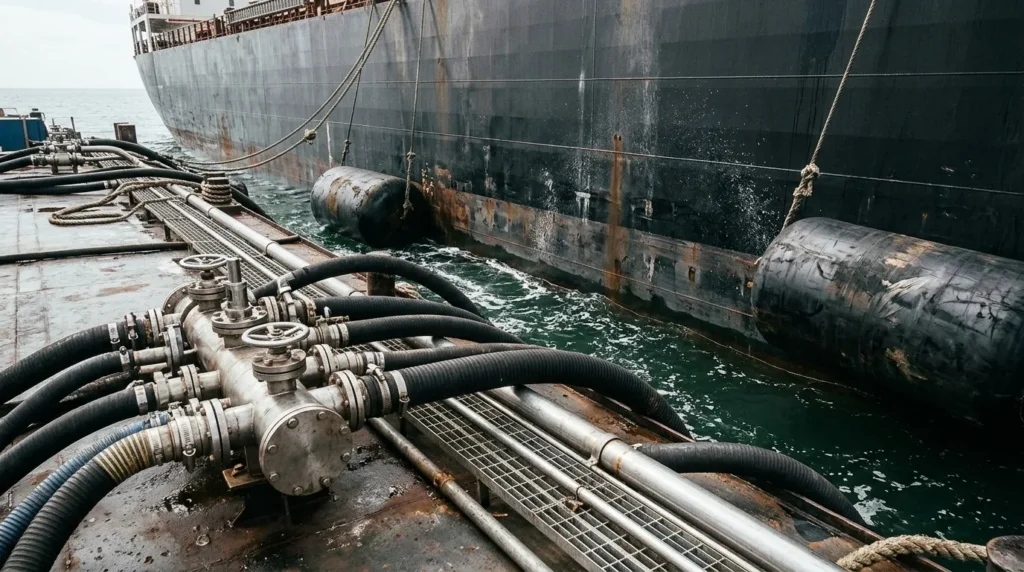
In fact marine fuel offtake is the contract that sells your green methanol, ammonia or biofuel to a buyer in shipping. Above all it is the document lenders ask for first, and for most developers it is the hardest to get. Meanwhile the buyer side is fragmented across shipping lines, charterers, traders and bunker suppliers, and each one will sign something different. Therefore this guide explains who they are, what they have signed in public, and what a lender needs to see.
In short
- Basically there are four types of buyer: shipping lines, charterers or cargo owners, traders and bunker suppliers.
- Still each has a different appetite for term, volume and price risk.
- Of course lenders read the same things as in any offtake: counterparty, term, volume, price formula.
- Therefore an anchor contract usually comes first, and the rest of the demand follows.
In this article
The four types of marine fuel offtake buyer
| Buyer | Why they buy | What they have signed in public |
|---|---|---|
| Shipping line | Compliance with fuel rules, customer targets | Maersk signed a green methanol offtake with Goldwind for 500,000 tonnes a year, to serve its first 12 methanol-enabled vessels from 2026. |
| Charterer or cargo owner | Low-carbon transport for their own customers | ZEMBA, a buyers alliance, ran a tender for its members and selected Hapag-Lloyd for a two-year service at least 90 % below fossil emissions on a lifecycle basis. |
| Trader | Margin and aggregation | OCI sells green methanol through its HyFuels division, including supply to X-Press Feeders in Rotterdam from 2024. |
| Bunker supplier | Supplying ships at the port | Hong Lam Marine delivered about 300 tonnes of bio-methanol to a Maersk vessel in Singapore on 27 July 2023, the first such operation in the port. |
Indeed I fill the right-hand column only with public examples I have opened. Therefore I do not describe deals I cannot source, and I do not present an MOU as a contract.
What each buyer will actually sign
In practice the shipping line signs the longest contract, because it has a ship to fill and a compliance position to protect. Maersk’s agreement with Goldwind reaches into the next decade. It covers 12 large methanol-enabled vessels and combines bio-methanol and e-methanol from a plant in Hinggan League, northeast China. Moreover the announcement states that Goldwind expected to confirm its final investment decision on the plant by the end of that year. That sequence is the one lenders want to see: contract first, FID second.
By contrast the cargo owner signs a service contract, not a fuel contract. The ZEMBA tender bought container-miles with a certified emissions reduction. Its members committed to more than one billion twenty-foot container-miles on a Singapore to Rotterdam route in 2025 and 2026. In addition the estimated saving was around 82,000 tonnes of carbon dioxide, delivered through a waste-based biomethane service rather than methanol. Consequently a fuel producer who wants that buyer has to work through the carrier, not around it.
Traders and bunker suppliers sit in between. A trader such as OCI aggregates volume and takes margin on the spread. It can sign a supply agreement with a carrier before the production asset is complete. A bunker supplier signs at the port, where the obligation is operational: storage, quality, safe handling and a licensed delivery. Therefore the same project may need two contracts, one for volume and one for delivery.
Marine fuel offtake terms a lender reads
- To begin with, volume: minimum and maximum, with delivery windows. A take-or-pay floor is worth more than a larger optional number.
- Also, term: long enough to cover the debt tenor, with an extension that does not depend on a new negotiation.
- Then price: a formula, ideally with input cost pass-through, so that a move in hydrogen, power or feedstock does not destroy the margin.
- Moreover, quality and certification: specification, sustainability proof and the chain of custody that the buyer will accept.
- Finally change in law and termination: what happens if a rule shifts, and who carries the cost of a delay in the IMO process.
For aviation, I have a longer guide at How to Secure SAF Offtake Agreements That Lenders Will Back. Therefore the same logic applies, with one difference: in shipping the buyer often owns the fuel risk through a charter party, so the offtake has to line up with the charter.
What a marine fuel offtake looks like in practice
In practice the public deals share three features. First, a named production asset, not a trading book. Second, a first delivery year that sits inside the ship delivery schedule. Third, a volume that is large enough to anchor the plant but small enough for one buyer to absorb.
For example, X-Press Feeders took supply in Rotterdam from 2024, which matched the arrival of its methanol dual-fuel feeder ships and used an existing port with a bunker barge being retrofitted for methanol. In addition the deal was the first green methanol agreement with a feeder carrier, which shows that a smaller operator can be a first mover when the port is ready. By contrast, a project that waits for a global rule before it approaches a buyer usually finds that the ships have already been ordered elsewhere.
Moreover, the size of the first contract matters less than its bankability. A 50,000 tonne contract with a rated counterparty, a five-year term and a pass-through price can support more debt than a 200,000 tonne MOU with a special purpose buyer. Therefore I look at the credit, not the headline.
Price risk in marine fuel offtake
In addition, price is where most marine fuel offtake negotiations stall. IRENA estimates the production cost of e-methanol at USD 800 to 1,600 per tonne when the carbon dioxide comes from bioenergy with capture at USD 10 to 50 per tonne, and USD 1,200 to 2,400 per tonne when it comes from direct air capture at USD 300 to 600 per tonne. Against a fossil marine fuel that moves with oil, that gap has to be carried by someone.
Consequently the contract needs a mechanism, not a promise. A formula that indexes the green premium to the compliance cost the buyer avoids is easier to defend than a fixed premium, because it moves with the rule. However a formula that passes all input risk to the buyer is hard to sign. In practice the workable structure shares the risk: a floor for the producer, a cap for the buyer, and a review trigger when the regulation changes.
Where the first marine fuel offtake contract comes from
In general I see it most often from a buyer who already has a ship order or a corridor project and needs fuel to make it work. Even so that buyer is worth more than ten buyers who are only interested. Meanwhile I am not the one who has negotiated these contracts, so I bring in an experienced offtake practitioner when the structure needs to be built. See offtake agreements.
Therefore the search starts with the ship order book and the port, not with the plant. A carrier that has ordered methanol dual-fuel tonnage has a date, a route and a compliance gap. In addition a port that has issued a bunkering licence has already solved the delivery question. Consequently a project that maps both lists has a shortlist of buyers who can sign within the year.
What a bunker supplier needs before signing
In practice a bunker supplier signs later than a carrier, and it asks different questions. Singapore’s methanol bunkering licence has been open for applications since 26 March 2025. A licensee must secure methanol supply to Singapore, run quality assurance, provide storage and safe handling, hold emergency response measures and own or operate at least one IMO Type 2 chemical tanker. Moreover the licence runs from 1 January 2026 to 31 December 2030 and requires methanol that meets a specified carbon intensity on a well-to-wake basis, with a chain of custody from source to delivery.
As a result a producer who approaches a licensed supplier without a certified parcel, a mass balance and a delivery schedule is asking for a favour, not a contract. In addition the supplier will test whether the volume can be stored and blended at the terminal, and whether the quality specification holds across parcels.
How a marine fuel offtake becomes bankable
In practice a lender runs three tests on a marine fuel offtake before it sizes a loan. First, does the contracted volume cover the debt service in the weakest year? Second, does the price formula protect the margin if the feedstock or the power price moves? Third, can the lender step into the contract if the producer fails?
As a result the negotiation is not only about price. A buyer with a strong balance sheet but no step-in rights is less useful than a smaller buyer who accepts assignment. Moreover a contract that runs three years against a ten-year loan leaves a refinancing hole that the sponsor has to fill with equity.
Therefore I read the term sheet with the debt schedule next to it. That is also why the maritime case borrows from the aviation one: see ReFuelEU Offtake for the terms that repeat across both markets, and Sustainable Maritime Fuels for the fuel definitions that the contract has to reference.
Sources
Sources
- Maersk, Maersk signs landmark green methanol offtake agreement, 22 November 2023.
- X-Press Feeders, OCI Global and X-Press Feeders sign green methanol offtake agreement, 28 July 2023.
- Maritime and Port Authority of Singapore, Successful first methanol bunkering operation in the Port of Singapore, 27 July 2023.
- Maritime and Port Authority of Singapore, media release on the methanol bunkering licence, 26 March 2025.
- Brookes Bell, Zero Emissions Alliance reveals first tender winner (ZEMBA tender and Hapag-Lloyd contract).
- IRENA, Innovation Outlook: Renewable Methanol (2021), production cost ranges for e-methanol.
- IEA, World Energy Investment 2025 (cost of capital in emerging economies).
FAQ
Who buys marine fuel from a new producer?
In short shipping lines, charterers, traders and bunker suppliers, depending on the structure. In practice the first signature usually comes from the party that already has a ship or a port obligation.
Do shipping lines sign long-term contracts?
Some do. For example Maersk signed a multi-year green methanol offtake for 500,000 tonnes a year, and the first volumes are expected in 2026.
What do lenders need?
Term, volume, price formula and a creditworthy buyer. In addition they need the contract to survive a change in the rule that created the demand.
Is an MOU enough?
No. It is a start, not a financeable contract. Therefore I treat an MOU as evidence of interest, never as collateral.
Where do I find buyers?
Mostly buyers come through ports, ship orders and corridor projects. Consequently the ship order book and the licensed bunker suppliers are the two lists I check first.
Next step
A short call is usually enough to see where your project stands before a lender or an offtaker looks at it.
If you are looking for your anchor buyer, book a 30-minute call or read Maritime Fuel Bankability and Methanol Bunkering in Southeast Asia.
I do not provide investment advice or arrange investments. I act as a strategic advisor and facilitator.

Alex, Founder of WeConnect Asia
I help low-carbon fuel and carbon removal project developers in Southeast Asia secure the commercial and financial partners needed to reach FID.
Related articles

Biomethane: What It Is, How It Is Made and Who Buys It
Biomethane is biogas cleaned to pipeline quality. I explain how it is made, how it differs from biogas and who buys it in Southeast Asia.

Southeast Asia SAF: Policies, Demand and Project Status
Southeast Asia SAF policy is moving country by country. Here is where demand is forming, who the buyers are and what a developer can rely on today.

e-SAF Project Finance: Why the Sub-Mandate Is Not Enough
The synthetic fuel sub-mandate creates demand for e-SAF, but not a bankable project. Here is what e-SAF project finance still needs in Southeast Asia.

SAF Mandates by Country: A Developer’s Comparison
SAF mandates differ by country in scope, target and penalty. Here is a side-by-side comparison and what each one means for project revenue.

Sustainable Aviation Fuel: Pathways, Mandates and What Gets Financed
Sustainable aviation fuel has several pathways and sells into mandates. I explain the routes, the demand and what gets financed in Asia.

ReFuelEU Offtake: Who Actually Buys Your SAF?
The ReFuelEU mandate sits on fuel suppliers, not airlines. Here is what that means for ReFuelEU offtake contracts and what lenders expect to see.