
Home » Green Hydrogen Production Plant: A Site Checklist for Southeast Asia
Green Hydrogen Production Plant:
A Site Checklist for Southeast Asia
8 min read · Nov 20, 2025 · By Alex
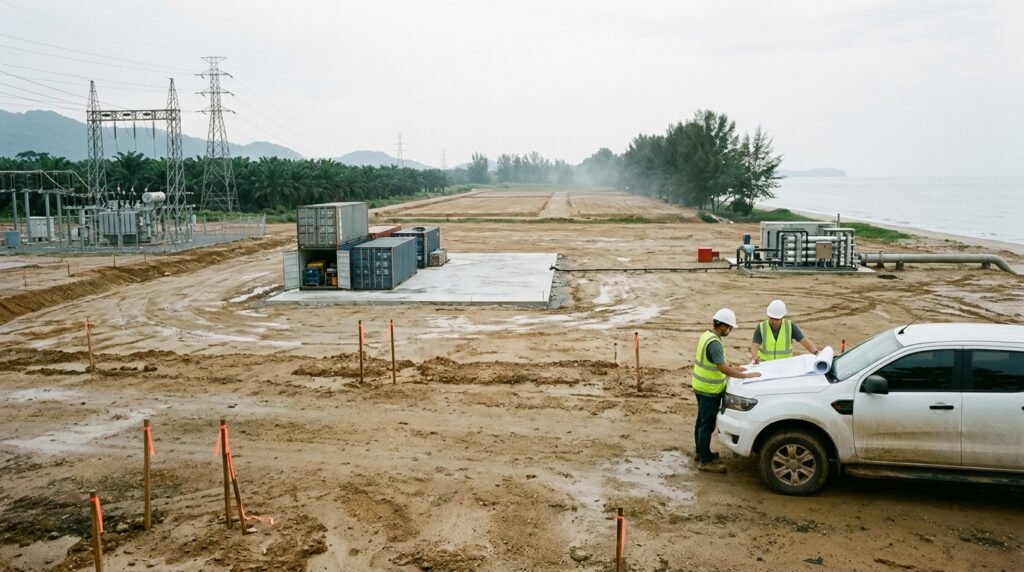
A hydrogen production plant lives or dies on its site. Indeed, the electrolyser is a catalogue item, but the power connection, the water source, the land, the permits and the route to the buyer are specific to one place. So before any model, I ask five site questions. If a developer cannot answer them, lenders will not either.
In short
- A hydrogen production plant needs five things from its site: power, water, land, permits and a route to the offtaker.
- Power is the first filter. A site without a credible supply has no plant.
- Early budgets leave out water more often than any other input.
- A site is bankable when each of the five answers is a contract or a permit, not an assumption.
In this article
Hydrogen production plant: the five site questions
Here are the questions, in the order I ask them.
- Power. Where does the electricity come from, at what price and for how many hours a year?
- Water. What is the source, what treatment does it need and who grants the right to use it?
- Land. Who owns the plot, what is the lease and is there room to expand?
- Permits. Which approvals does the plant need, and which ones does the team already hold?
- Offtake route. How does the hydrogen, or the molecule made from it, reach the buyer?
First, these questions look basic. In practice, they are where a project stalls. For instance, a developer can spend a year on technology selection and still have no power agreement. Also, the answers depend on each other. For example, a site far from the buyer makes the offtake route expensive, and that changes the power price the project can afford.
If you want the process view instead, I wrote about how green hydrogen is produced. This article is about the place, not the chemistry.
Power: why the grid connection sets the hydrogen production plant
Because the electrolyser turns electricity into hydrogen, the power supply sets the plant. First of all, three things matter: how much power is available, what it costs and how steady it is.
A hydrogen production plant that runs only on its own solar or wind will run fewer hours than one backed by the grid. In other words, fewer hours means higher cost per kilogram, because the electrolyser sits idle part of the time. I find the same link in the IEA Global Hydrogen Review 2025. That review ties cost to the electricity price, the electrolyser CAPEX, the cost of capital, the efficiency of the electrolyser and its utilisation rate (IEA).
However, a grid connection is not automatic. In many markets, the connection takes years, and the rules on renewable certificates differ by country. Therefore, I want to see a signed agreement or a documented connection date. A line in the model that says “power at a fixed price” is not enough.
For cost context, the benchmark guide shows how much the power price moves the result.
Water: the input nobody budgets early enough
A hydrogen production plant consumes water through electrolysis. The plant needs treated, steady feed, and a permit has to cover the source. Developers tend to treat this as a detail, because the volume looks small next to the power.
Still, water decides several things. For example, a coastal site may need desalination, which adds cost and a brine discharge permit. By contrast, an inland site may rely on a river or a municipal supply, and other users contest it in dry months. As a result, the water plan can change the capex and the schedule.
So my rule is simple. Water goes in the first budget, with a source, a treatment step and a permit date. If it is missing, the budget is incomplete.
Land, permits and the offtake route
Land is a quieter risk for a hydrogen production plant. In fact, a lease nobody has signed, a plot with a disputed title or a site without room for storage can all stop financing. Moreover, lenders look for room to expand, because the first phase is rarely the last.
Permits come next. In most markets, a hydrogen production plant needs environmental approval, a construction permit and a safety review, and the sequence differs by country. Because the rules for hydrogen are still new in several markets, approvals can take longer than they do for a conventional plant. I check Indonesia for status. The Ministry of Energy and Mineral Resources is still drafting the regulation on hydrogen governance, permits included, and it targets completion by 2030 (MEMR, National Hydrogen and Ammonia Roadmap).
Finally, the offtake route. However, hydrogen is hard to move, so many projects convert it on site, for example to ammonia or methanol, or they sit next to the buyer. In other words, the route to the customer shapes where a developer can build. A site with no credible route has no offtake, and a project without offtake does not reach FID. I explain the commercial side in the offtake service page.
The Southeast Asia pipeline behind every hydrogen production plant
The region already runs on hydrogen it mostly makes from gas. Southeast Asia consumed 4 million tonnes of hydrogen in 2024, with Indonesia taking more than a third, Malaysia 22 percent, Viet Nam 15 percent and Singapore 12 percent (IEA). Ammonia, refining and methanol absorb that volume today, and ammonia alone takes close to half of it.
Announcements look larger than the steel. The region has 25 low-emissions hydrogen projects under development, adding up to almost 480 kilotonnes a year by 2030 (IEA). More than 90 percent of that capacity sits in Indonesia and Malaysia (IEA). Nearly 40 percent of the projects carry an electrolyser smaller than 300 MW, and only 6 percent of the announced capacity has reached FID (IEA). So contracts, not megawatts, mark the gap between a slide and a hydrogen production plant.
One project shows the sequence the region actually follows. Sembcorp and PT PLN Energi Primer Indonesia signed a joint development agreement in October 2024 for a Sumatra green hydrogen facility of 100,000 tonnes a year (Sembcorp). The scheme aims at a hub linking Sumatra, the Riau Islands and Singapore (Sembcorp). Their first feasibility phase covered site selection, risk assessment, mitigation analysis and technical schematics, and the next phase moves into detailed engineering and commercial structuring (Sembcorp). Therefore the site question settles before the technology question, which is why I start with the five answers above.
Where a hydrogen production plant site fails in practice
Sites rarely fail for one big reason. Instead, they fail on a short list of gaps that nobody owns.
- Power connection. The model assumes a connection date that the utility has not agreed.
- Water permit. The team plans construction before the approval exists.
- Land. The lease runs shorter than the debt tenor.
- Permit sequence. The plant waits on an approval that depends on one it does not yet hold.
- Buyer route. Everything works except delivery, and nobody owns that last step.
Above all, these gaps compound. A late connection delays the permits, which delays the lenders, which delays the equipment order. So I check the site list before I look at the technology, because it is cheaper to find a gap early. For a view of what the region builds right now, see the developer’s map of hydrogen projects.
Site checklist for lenders and equity investors
- Power: a signed agreement or a documented connection date, with price and hours.
- Water: a named source, a treatment plan and a permit the team already holds.
- Land: a signed lease or a title that outlasts the debt tenor.
- Permits: a map of every approval, with status and dates.
- Offtake route: a contract or a credible plan, including transport or conversion.
- Expansion: room for a second phase and for storage.
If more than two of these are open, the project is not ready for investors. Then equity partners and lenders will ask the same questions, and they will price the gaps. I can help close them through investor introductions and the project finance work, but only once the site basics are real.
Next step
If your hydrogen production plant has a site and you are now looking for investors, lenders or an offtaker, book a 30-minute call or send me your project brief. I tell you early if the site is not ready. You can also read how hydrogen plant economics work.
Sources
- IRENA, Green Hydrogen Cost Reduction, 2020.
- IRENA and Bluerisk, Water for Hydrogen Production, 2023.
- IEA, Global Hydrogen Review 2025.
- Sembcorp and PT PLN EPI, Joint Development Agreement for Southeast Asia’s Largest Green Hydrogen Project, 2024.
- Energy Market Authority of Singapore, Is Singapore considering the use of hydrogen for electricity generation, 2022.
- Energy Commission of Malaysia, Energy Malaysia, Volume 26, 2025.
FAQ
What does a hydrogen production plant need from its site?
Power, water, land, permits and a route to the buyer. Each one needs a contract or a permit before FID.
Why does the grid connection matter so much?
Because the electrolyser runs on electricity, and the connection sets the price, the hours and the schedule. Without it, the plant has nothing to run on.
How much water does a green hydrogen plant use?
It depends on the size, but the water source and treatment still need a permit and a budget early. I take the figures from IRENA and Bluerisk. PEM electrolysis consumes about 17.5 litres of water per kilogram of hydrogen on average, and alkaline electrolysis about 22.3 litres (IRENA and Bluerisk).
Can a hydrogen production plant sit far from the buyer?
It can, if the project converts the hydrogen on site or has a transport plan. A site with no route to the buyer is not bankable.
What is the most common site mistake?
Assuming the power connection date. The model uses a date the utility has not agreed.
When is a site ready for investors?
Document power, water, land and permits, then clear the route to the offtaker.
Not sure your project would survive a credit conversation?
A short call is usually enough to see where your project stands against what a lender or an equity investor will ask for. Tell me where your project is today, and I will tell you what the next conversation needs to look like.

Alex, Founder of WeConnect Asia
I help low-carbon fuel and carbon removal project developers in Southeast Asia secure the commercial and financial partners needed to reach FID.
Related articles
Biomethane: What It Is, How It Is Made and Who Buys It
Biomethane is biogas cleaned to pipeline quality. I explain how it is made, how it differs from biogas and who buys it in Southeast Asia.
Southeast Asia SAF: Policies, Demand and Project Status
Southeast Asia SAF policy is moving country by country. Here is where demand is forming, who the buyers are and what a developer can rely on today.
e-SAF Project Finance: Why the Sub-Mandate Is Not Enough
The synthetic fuel sub-mandate creates demand for e-SAF, but not a bankable project. Here is what e-SAF project finance still needs in Southeast Asia.
SAF Mandates by Country: A Developer’s Comparison
SAF mandates differ by country in scope, target and penalty. Here is a side-by-side comparison and what each one means for project revenue.