
Home » Sustainable Aviation Fuel: Pathways, Mandates and What Gets Financed
Sustainable Aviation Fuel:
Pathways, Mandates and What Gets Financed
13 min read · Oct 21, 2026 · By Alex
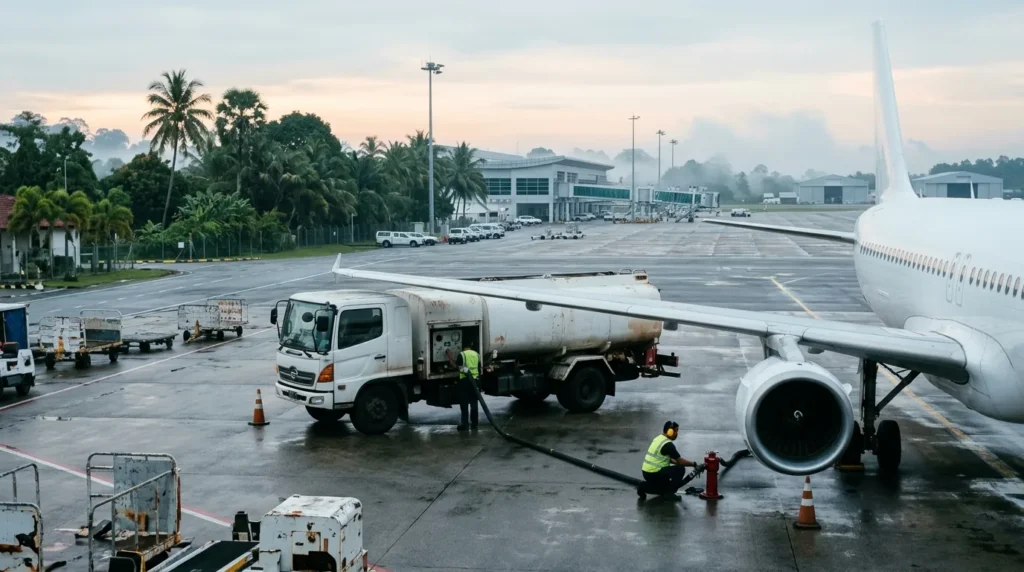
Refiners make sustainable aviation fuel from renewable or waste-based sources, and it works in today’s aircraft and engines without modification. As a result, it cuts lifecycle emissions compared with fossil jet fuel. However, it costs more to make, and it sells mostly because rules require airlines to buy it. So anyone building a plant has to answer two questions at once: how to make the fuel, and why anyone buys it.
In short
- Sustainable aviation fuel is a drop-in fuel, and several certified pathways produce it.
- Most supply today comes from fats, oils and greases. Other pathways use waste, biomass or power and CO2.
- Mandates and levies drive most demand, not the market price.
- Lenders and investors look for a feedstock contract, an offtake and a clear view of the policy behind the revenue.
In this article
Sustainable aviation fuel in plain terms
First, aircraft burn liquid fuel, and there is no easy substitute. Instead, batteries are too heavy for long flights, and hydrogen aircraft are far from commercial service. Sustainable aviation fuel is the option that works now, because it is chemically similar to fossil jet fuel. However, it stays small, and the volumes below put a number on it.
In practice, airlines blend it with fossil jet fuel, and the blend flies in standard aircraft. Then regulators certify the fuel against technical standards before airlines use it. In other words, a plant has to produce fuel that passes the same specification as fossil jet.
Because the fuel is a drop-in, airports and airlines do not need new infrastructure. Instead, the challenge sits upstream: producing enough fuel, from enough sustainable feedstock, at a price that buyers can accept.
The sustainable aviation fuel pathways that exist today
In practice, several production routes are certified, and each turns a different input into jet fuel.
- HEFA. It converts fats, oils and greases, such as used cooking oil and tallow, into fuel. It is the most mature route and supplies most of today’s volume.
- Alcohol-to-jet. It converts ethanol or other alcohols into jet fuel.
- Gasification and Fischer-Tropsch. It turns biomass or municipal waste into gas, then into liquid fuel.
- Power-to-liquid. It combines green hydrogen with CO2 and synthesises e-SAF. I cover it in power-to-liquid explained.
- Co-processing. Refineries process small shares of renewable feedstock alongside fossil crude.
Moreover, ICAO’s cleaner energy tracker counts 11 approved SAF conversion processes, with more under evaluation (ICAO).
In fact, each pathway has different strengths. For example, operators have run HEFA at scale for years, but its feedstock supply stays limited. Meanwhile, the newer routes can use more kinds of waste or renewable power, but they have fewer plants in operation. As a result, lenders treat them differently, and the financing story changes with the route.
For one feedstock example in the region, see SAF feedstock in Southeast Asia.
How much sustainable aviation fuel exists today
IATA expects global production to reach about 2.4 million tonnes in 2026, up from about 1 million tonnes in 2024 and 1.9 million tonnes in 2025 (IATA). Those volumes cover 0.8% of annual jet fuel consumption, and IATA expects growth to slow during 2026 (IATA).
In practice, announcements run far ahead of output. So announced capacity is not production, and a high portion of the identified SAF capacity will not materialise (IATA). ICAO’s tracker lists 599 announced SAF facilities and USD 72.6 billion of announced investment, against 187 airports that distribute SAF today (ICAO).
So I treat any announced capacity figure as a list of intentions. Therefore, the relevant number for a lender is the volume under contract, with a feedstock behind it. For example, ICAO counts 55.4 billion litres of SAF under offtake agreements (ICAO). However, the figure sizes the contracted market without saying anything about price or counterparty quality.
Why sustainable aviation fuel demand is policy demand
However, sustainable aviation fuel costs more than fossil jet fuel. So airlines buy it mainly because rules or targets require it. In practice, I checked the size of that gap. SAF prices run at about twice the price of fossil jet fuel, and up to five times in mandated markets (IATA). The 1.9 million tonnes available in 2025 came with USD 2.9 billion in premiums, of which USD 1.4 billion was the standard price premium over conventional fuel (IATA).
First, mandates. The European Union requires fuel suppliers to blend a minimum share of SAF on a rising schedule that runs through 2050 (ReFuelEU Aviation). The rule also sets a separate sub-share for synthetic aviation fuels inside those totals (ReFuelEU Aviation). Second, levies and incentives. Singapore applies a levy on departing passengers, and the proceeds go to a statutory fund that buys SAF and its environmental attributes (CAAS). Third, international schemes. The aviation industry’s offsetting scheme, CORSIA, creates demand for eligible fuels on international flights.
Moreover, corporate buyers add demand, because large companies buy SAF to cut the emissions of business travel and freight. However, policy can change. As a result, a plant that relies on one rule carries that exposure, and lenders know it. So I read the policy side as part of the credit.
The distance to 2050 for sustainable aviation fuel
The target is far away. For net zero CO2 from aviation by 2050, annual SAF supply has to reach roughly 500 million tonnes (IATA). In other words, production has to increase by more than 250 times (IATA). Moreover, IATA’s own feedstock assessment puts potential supply near 400 million tonnes in 2050 (IATA).
Moreover, ICAO sets the policy frame. Its member states set a long-term global aspirational goal: net-zero carbon emissions for international aviation by 2050 (ICAO). They also set a vision to cut CO2 emissions in international aviation by 5% by 2030 through SAF and other cleaner energies (ICAO). So reaching it requires 23 million tonnes of cleaner energies in 2030 (ICAO).
In other words, the market has to grow by orders of magnitude, and nobody expects one pathway to do it alone. So for a developer, that is the reason a new plant can find buyers. It is also the reason lenders ask whether this plant will be one of the few that reach construction.
The European path for sustainable aviation fuel to 2050
In practice, the European mandate gives the clearest schedule. The schedule starts at 2% in 2025, then rises through 6% in 2030, 20% in 2035, 34% in 2040 and 42% in 2045 (ReFuelEU Aviation). Finally, suppliers reach 70% by 2050 (ReFuelEU Aviation).
Inside those totals sits a separate share of synthetic aviation fuels. It starts at 1.2% on average over 2030 and 2031, then 2.0% on average over 2032 to 2034 (ReFuelEU Aviation). From 2035 it climbs through 5%, then 10% in 2040, 15% in 2045 and 35% in 2050 (ReFuelEU Aviation).
Moreover, the schedule explains the cost logic. ReFuelEU estimated in 2023 that synthetic aviation fuel costs three to six times the market price of conventional aviation fuel (ReFuelEU Aviation). So the rule sets a floor for demand in the most expensive segment. A developer of e-SAF reads that as a long-dated, regulated buyer. A developer of a cheaper pathway reads it as the benchmark the buyer compares against.
How Singapore's sustainable aviation fuel levy works
Instead, Singapore uses a levy rather than a blending mandate. The levy attaches to tickets and services sold from 1 October 2026, for flights departing from 1 January 2027 (CAAS). CAAS announced the deferment in March 2026 (CAAS). It covers origin-destination passengers and general and business aviation flights (CAAS).
As a result, the proceeds go to a statutory SAF Fund, which buys SAF and related environmental attributes and covers administration costs. In practice, a non-profit company owned by CAAS, SAFCo, collects the levy and procures the fuel (CAAS). In August 2026, SAFCo completed procurement for a first voluntary trial with nine companies and two airlines (CAAS). Then it plans to launch a Request for Proposal for levy-funded SAF by the end of 2026 and to deliver the first batch in mid-2027 (CAAS).
CAAS deferred the cargo levy by a further year: cargo services sold from 1 October 2027 pay it, for flights departing from 1 January 2028 (CAAS). For a producer, the practical point is that Singapore is building a central buyer. In other words, a central buyer with a procurement process is a different counterparty from an airline with a spot need.
Sustainable aviation fuel certificates: the environmental attribute
Part of what a buyer pays for is a claim, not only a fuel. A SAF environmental attribute represents the difference in CO2 emissions between SAF and the same quantity of conventional aviation fuel over their life cycles. For example, a buyer may use the attribute to meet offsetting requirements under CORSIA or other similar programmes (CAAS). It also lets an organisation report a reduction in carbon emissions from SAF (CAAS).
CORSIA includes methodologies that let aircraft operators reduce their offsetting requirements through SAF, together with globally accepted sustainability criteria and life cycle methodologies (ICAO). Moreover, Singapore ties its own system to those standards. SAFCo manages the attributes separately from the physical fuel, in a way that complies with sustainability requirements, including CORSIA eligible fuels certification standards (CAAS).
The attributes have two components, one covering Scope 1 emissions and one covering Scope 3 emissions. SAFCo allocates the Scope 1 attributes to aircraft operators in proportion to their levy contributions, above a minimum threshold of 0.01% of total levies collected (CAAS). It makes the Scope 3 attributes available to organisations that want to reduce the emissions of business travel and air freight (CAAS).
For a producer, the lesson is simple. In other words, a producer can sell the fuel and the attribute separately, and each carries its own rules, certification and buyer. So a term sheet should say which of the two it covers.
Sustainable aviation fuel in Southeast Asia
In short, Southeast Asia has two things going for it: abundant feedstock and fast-growing aviation. For instance, palm oil residues, used cooking oil and agricultural waste are available in several countries. Airports in the region, especially Singapore, are important hubs. For example, ASEAN’s own analysis argues that the region can turn feedstock potential into real SAF output (ASEAN Centre for Energy).
However, the rules differ by country. Some governments have binding rules, while others still work on proposals. Also, feedstock exports can compete with local use, and certification requirements for international buyers are strict. In practice, a plant in the region needs a feedstock contract that survives scrutiny and an offtaker that is compliant with its own jurisdiction’s rules.
For an investor view of the region, read what equity investors are underwriting. For a project at the Philippine scale, the questions are the same.
What Singapore and Malaysia decided on sustainable aviation fuel
Four markets matter to a developer in the region, and each has chosen a different instrument.
Singapore: what the sustainable aviation fuel levy costs
In practice, Singapore funds its target with a per-passenger charge that varies by destination band and cabin, from S$1.00 to S$41.60 per passenger (CAAS). CAAS set a 1% SAF uplift target that starts in 2027 and aims for 3% to 5% by 2030 (CAAS).
Malaysia: blend targets for sustainable aviation fuel
However, Malaysia has commercial production but no blending rule in force. The government is developing a proposal to mandate a 1% SAF blend on international flights departing Kuala Lumpur International Airport (International Trade Administration). January 2027 is the possible start date for that mandate (International Trade Administration). Its Aviation Decarbonisation Blueprint and National Energy Transition Roadmap set a long-term target of a 47% blend by 2050 (International Trade Administration). For example, EcoCeres started commercial SAF production at its Johor biorefinery in October 2025, with capacity of 350,000 tonnes a year (International Trade Administration).
What Indonesia and Thailand decided on sustainable aviation fuel
Indonesia: a 1% blend at two airports
Instead, Indonesia starts narrow. The Ministry of Transportation will apply a 1% bioavtur blend on international flights from Soekarno-Hatta and I Gusti Ngurah Rai, targeted to begin in 2027 (Antara). It will then evaluate engine performance before raising the ratio (Antara). As a result, the government aims for roughly 30% to 50% SAF by 2060 (Antara).
Thailand: specification rules and the 1% target
Thailand moved first in the region. As a result, the Department of Energy Business set a Jet A-1 specification that allows blending SAF at up to 50% (CAAT). The rule took effect on 1 January 2026 (CAAT). Meanwhile, CAAT signed an MOU with eight Thai airlines on 17 November 2025 (CAAT). The MOU targets 0.5% to 1% of fuel use on designated international routes from 2026, and CAAT expects about 60,000 tonnes of CO2 equivalent cut that year (CAAT). The national schedule starts at a 1% blend from 1 January 2026 and moves to 5% to 8% from 2033 (Nation Thailand).
What sets the price, in one paragraph
First, the price of sustainable aviation fuel reflects the feedstock cost, the processing cost, the certification premium and the value of the policy support. In other words, fossil jet fuel sets the floor, and the premium sits on top. For a developer, the contract matters more than the spot price, because the contract decides what the project receives. In practice, I go through this in what sets SAF prices.
What lenders and investors check on a SAF project
In practice, lenders and investors ask a consistent set of questions.
- Feedstock. Does the supply contract run for the tenor of the debt, with certification?
- Offtake. Is there a binding contract with volume, term and a price mechanism?
- Technology. Has the pathway run at scale, and does a supplier guarantee performance?
- Policy. Which mandate or incentive supports the revenue, and how stable is it?
- Structure. Are equity, debt and any grants lined up?
Start with how to finance a SAF project. Then read how to secure SAF offtake agreements and how to reach FID for a SAF project. For the services around them, see the SAF industry page, offtake and feedstock supply.
How I read a sustainable aviation fuel project
In practice, I read a SAF project in a fixed order. First, the feedstock: does a contract cover the debt tenor, and does it carry certification? Second, the pathway: has it run at the scale of the plant? Third, the buyer: who signs, for how long, and with what price mechanism? Fourth, the policy: which mandate or levy supports the revenue, and what happens if it changes? Finally, the structure: who comes in first.
So I stop at the first gap. As a result, a project without a feedstock contract is not ready for an offtaker, and a project without an offtake is not ready for a lender. I say that early, because it saves the developer months of the wrong conversations.
Common mistakes on a sustainable aviation fuel project
Four mistakes come up again and again. The first is to count on announced capacity as a sign of a market. For example, announcements say little about production, as the figures above show. The second is to model revenue on a single rule. A mandate, a levy or a tax credit can change, and a plant that depends on one of them carries that risk alone.
The third is to treat the feedstock as a procurement detail. For most pathways, feedstock drives the largest cost and the largest risk, and lenders review it first. The fourth is to forget the attribute. A project that sells fuel but has not thought about who owns the environmental claim leaves value on the table, and may confuse its buyer.
In practice, each of these mistakes is cheaper to fix on paper than after the first offtake discussion. So I raise them early, and I ask the developer to show the answer in the model, not only in the narrative.
Checklist
- You know which pathway the plant uses and why.
- The feedstock contract runs the debt tenor and carries certification.
- The offtake is a binding contract, not an MOU.
- The revenue maps to a named mandate, levy or incentive.
- The technology supplier gives performance guarantees.
- The financing plan shows equity, debt and grants in order.
I also opened the certified routes. Moreover, ICAO lists 11 approved conversion processes (ICAO). Most ASTM D7566 pathways stop at a 50% blend, while SIP and HC-HEFA stop at 10% and co-processing at 5 to 10% (ICAO).
Next step
If you are developing a SAF project and the offtake, the feedstock or the capital is the open point, book a 30-minute call or send me your project brief. I tell you early if the project is not ready.
Sources
- IATA, Sustainable Aviation Fuels
- ICAO, Sustainable Aviation Fuels (SAF)
- CAAS, SAF levy deferral announced on 25 March 2026
- ReFuelEU Aviation, Regulation (EU) 2023/2405
- CAAS, SAF Levy for origin-destination passengers, 3 September 2026
- CAAS, Airline domain sustainability initiatives, updated 20 October 2026
- US International Trade Administration, Malaysia Energy Sustainable Aviation Fuel
- ANTARA, RI to launch one-percent SAF blend on international flights by 2027
- CAAT, Thailand’s Aviation Sector Unites to Advance SAF, 6 February 2026
FAQ
What is sustainable aviation fuel?
Refiners make it from renewable or waste sources, so it works in existing aircraft and emits less over its life cycle than fossil jet.
Which pathways produce sustainable aviation fuel?
Through several certified pathways, including HEFA from fats and oils, alcohol-to-jet, gasification with Fischer-Tropsch, and power-to-liquid.
Why does sustainable aviation fuel cost more?
Because feedstock and processing cost more than fossil jet. Mandates and levies create demand despite the premium.
Who buys sustainable aviation fuel?
Airlines and fuel suppliers that must meet mandates, plus corporate buyers with emissions targets.
Is Southeast Asia a good place to produce it?
It has feedstock and aviation demand. However, policy and certification vary, so each project needs its own check.
What do lenders ask first?
Whether the developer has contracted the feedstock and the offtake. Without both, the project is not ready for debt.
Not sure your project would survive a credit conversation?
A short call is usually enough to see where your project stands.

Alex, Founder of WeConnect Asia
I help low-carbon fuel and carbon removal project developers in Southeast Asia secure the commercial and financial partners needed to reach FID.
Related articles

Biomethane: What It Is, How It Is Made and Who Buys It
Biomethane is biogas cleaned to pipeline quality. I explain how it is made, how it differs from biogas and who buys it in Southeast Asia.

Southeast Asia SAF: Policies, Demand and Project Status
Southeast Asia SAF policy is moving country by country. Here is where demand is forming, who the buyers are and what a developer can rely on today.

e-SAF Project Finance: Why the Sub-Mandate Is Not Enough
The synthetic fuel sub-mandate creates demand for e-SAF, but not a bankable project. Here is what e-SAF project finance still needs in Southeast Asia.

SAF Mandates by Country: A Developer’s Comparison
SAF mandates differ by country in scope, target and penalty. Here is a side-by-side comparison and what each one means for project revenue.