
Home » Power-to-Liquid: How E-Fuels Are Made and What Makes Them Bankable
Power-to-Liquid:
How E-Fuels Are Made and What Makes Them Bankable
9 min read · Oct 6, 2025 · By Alex
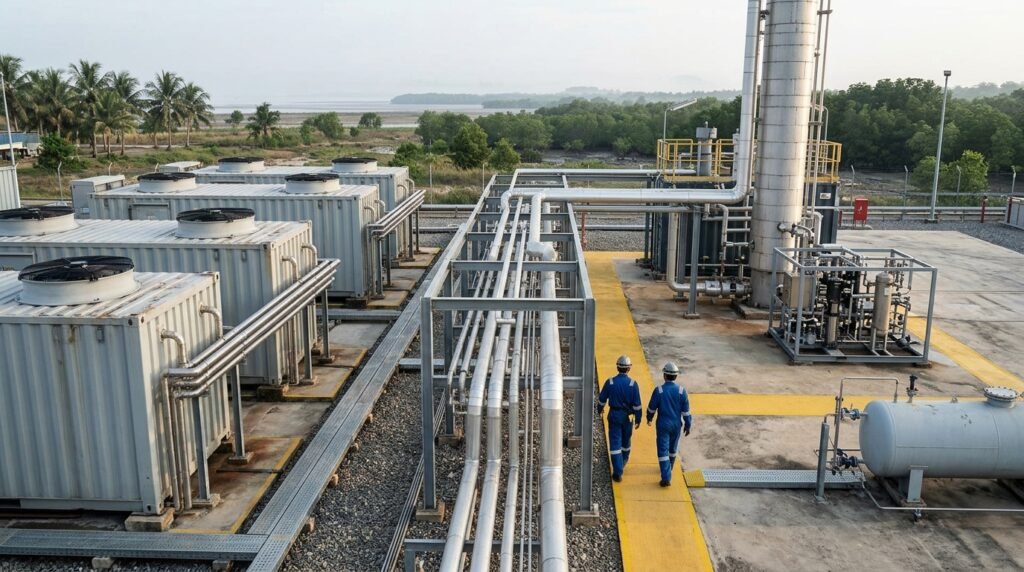
Power-to-liquid turns renewable electricity, water and CO2 into liquid fuels that can replace fossil diesel, jet fuel or methanol. Engineers call the output an e-fuel. Because it is chemically close to the fossil product, it can use today’s engines and infrastructure. However, it needs a lot of renewable power and a source of CO2, and it costs far more than fossil fuel. So the question for a developer is who pays the difference, and for how long.
In short
- Power-to-liquid is a chain: electrolysis for hydrogen, a CO2 supply, a synthesis step and upgrading.
- Its cost is mostly a power and CO2 problem.
- Mandates for synthetic fuels in aviation and shipping create most of the demand.
- In particular, investors and lenders look for a binding buyer, contracted power and CO2, and a technology guarantee.
In this article
Power-to-liquid in plain terms
The idea is simple. First, renewable electricity splits water into hydrogen. Then the hydrogen reacts with CO2 to make a liquid fuel. As a result, the fuel comes from power, not from oil. In other words, you store renewable electricity in a molecule that planes, ships and trucks can burn.
Also, people use several names for the same family: e-fuels, synthetic fuels and Power-to-X. Power-to-liquid is the branch that makes liquids, such as e-SAF for aircraft, e-methanol for ships and e-diesel. The European Commission’s Joint Research Centre groups power-to-liquid with e-fuels and Power-to-X, and it describes the chain as conversion steps that start from renewable electricity and a non-biological carbon source such as CO2 (JRC).
In practice, the appeal is the match with existing systems. For example, airlines do not need new aircraft, and shipping lines can use dual-fuel engines. For that reason, policymakers who want rapid aviation and shipping decarbonisation favour e-fuels. I look at the SAF side in sustainable aviation fuel.
The power-to-liquid chain, step by step
In short, a power-to-liquid plant has four stages.
First, electrolysis. The plant makes hydrogen from water and renewable power. Second, CO2 supply. Then the plant captures CO2 from an industrial or biogenic source, or from the air. Third, synthesis. Established chemical processes, such as Fischer-Tropsch or methanol synthesis, convert hydrogen and CO2 into a hydrocarbon or methanol. Finally, upgrading. A final refining step turns the raw product into fuel that meets the buyer’s specification.
Each stage has its own supplier, permits and risks. However, the synthesis and upgrading steps are close to proven. Meanwhile, electrolysis is scaling, and CO2 capture at scale is still developing. As a result, lenders focus on the integration, where the pieces have to work together. For the hydrogen side, read the green hydrogen production process. For methanol, see green methanol production. I read the technical detail in the JRC report: Fischer-Tropsch turns CO2-derived syngas into hydrocarbons, refinery units then upgrade the raw product with hydrocracking, isomerisation and distillation, and those units already run at large scale in refineries. The methanol route converts methanol into hydrocarbons through DME synthesis, olefin synthesis, oligomerisation and hydrotreating, and producers had not yet made jet fuel that way, with approval under ASTM D7566 still pending when the report was written (JRC).
The power-to-liquid cost stack
Three inputs set the cost of a power-to-liquid fuel: electricity, the electrolyser and CO2. The cost of e-methanol depends to a large extent on the cost of hydrogen and CO2, and the main drivers are the price of renewable power and how many hours the electrolysers run (IRENA and Methanol Institute). For ammonia, hydrogen represents 90% of the production cost, and locations where wind and solar complement each other can yield electrolyser capacity factors of up to 70% (IRENA).
The electrolyser adds capital. Making and installing an electrolyser outside China cost USD 2,000 to 2,600 per kilowatt in 2024, against USD 600 to 1,200 per kilowatt in China, and more than half of the total corresponds to engineering, procurement, construction and contingency (IEA).
E-methanol shows what this adds up to. Estimates put current production costs at USD 800 to 1,600 per tonne with CO2 from bioenergy with carbon capture, and at USD 1,200 to 2,400 per tonne with CO2 from direct air capture (IRENA and Methanol Institute). IRENA expected the cost of e-methanol to fall to USD 250 to 630 per tonne by 2050, with lower renewable power prices (IRENA and Methanol Institute).
In practice, the question I ask first is the power price and the operating hours. Everything else in the model follows from them.
Why the fuel price follows power, CO2 and capital
Two of those three inputs do most of the work in the model: electricity and CO2. The plant needs a large amount of renewable power to make the hydrogen, so the power price and the hours of operation matter most. Regulators estimated in 2023 that synthetic aviation fuel production costs three to six times the market price of conventional aviation fuel (ReFuelEU Aviation).
Second, CO2 is a driver. Capturing it from a concentrated industrial source is cheaper than from the air, and biogenic CO2 often counts better under renewable fuel rules. Therefore, the CO2 source affects both the cost and the eligibility of the product. For example, a plant next to a biogas upgrader or a bioethanol facility has an advantage over one that needs direct air capture.
Moreover, the plant is capital-intensive: the electrolyser, the synthesis unit and the upgrader all need investment, and the financing cost matters. In other words, cheap power with expensive capital can still produce an expensive fuel. I explain how lenders view this in the power-to-liquid investing article.
Why regulators favour power-to-liquid fuels
The EU gives power-to-liquid fuels their own place in the aviation mandate, and it says why. When produced from renewable electricity and carbon captured directly from the air, synthetic aviation fuels can achieve as much as 100% emissions savings compared with conventional aviation fuel. They also have notable advantages in resource efficiency, in particular for the water needs of the production process (ReFuelEU Aviation).
The same text names the problem: the fuel costs far more than conventional jet fuel, which is why the regulation sets dedicated minimum shares for it instead of leaving it to compete on price (ReFuelEU Aviation).
So the logic is plain. The fuel is expensive, the emissions saving is high, and a mandate creates the buyer. A developer reads that as a regulated demand floor for as long as the mandate stands.
Demand: mandates and buyers
E-fuels do not sell on price. Instead, they sell because rules require them.
For example, in aviation, the European Union’s ReFuelEU rules include a separate requirement for synthetic aviation fuels, rising over time: 1.2% on average over 2030 and 2031, 5% from 2035 and 10% from 2040 (ReFuelEU Aviation). Meanwhile, in shipping, regulations on fuel greenhouse gas intensity push operators toward low-carbon fuels. As a result, airlines, fuel suppliers and shipping companies become buyers.
However, a mandate is only a signal. Still, a buyer has to sign a binding contract, with volume, term and a price that covers the cost. Without one, lenders cannot lend. I explain the buyer logic in how to secure offtake agreements and in how to secure SAF offtake agreements.
CO2 for power-to-liquid: three sources, three prices
CO2 is the second input, and it comes at very different prices. Estimates put CO2 capture from bioenergy plants at USD 10 to 50 per tonne, and direct air capture currently costs USD 300 to 600 per tonne (IRENA and Methanol Institute). As a result, the difference alone moves the cost of e-methanol by hundreds of dollars per tonne.
Rules decide which source counts. The EU delegated rules on renewable fuels of non-biological origin allow three origins for that CO2: air captured directly, biomass that already meets the sustainability criteria, or an industrial process that pays for its emissions under the EU ETS. In that last case, the carbon has to enter the fuel before 2036, and before 2041 in most situations outside power generation (Delegated Regulation (EU) 2023/1185).
So the CO2 source is a commercial and legal choice. A cheap industrial source may qualify only for a limited period, and the air is eligible but expensive. I ask a developer to name the source, its price, its eligibility window and the contract that secures it.
E-fuels in Southeast Asia
Today, Southeast Asia has renewable resources, growing aviation and shipping demand and several CO2 sources, especially from biomass processing and industry. In principle, the region can host e-fuel projects. One example is Singapore: PTTEP, Air Liquide, YTL PowerSeraya, Oiltanking Asia Pacific, Kenoil Marine Services and Maersk signed a memorandum to study a green e-methanol pilot plant with a minimum capacity of 50,000 tonnes a year, the first of its kind in Southeast Asia, and the Maritime and Port Authority of Singapore welcomed the partnership (Advario).
In practice, projects are early. First, few have contracted power at the needed price. Second, some lack a committed CO2 source. Finally, most lack a binding buyer, because the regional policy signals are still forming. Therefore, a developer should look at which of the three, power, CO2 or offtake, they can contract first, and build the rest around it.
For the hydrogen side of that story, see the hydrogen guide and the investment landscape.
What investors check on a power-to-liquid project
In practice, investors and lenders ask a consistent set of questions.
- Offtake. Is there a binding contract with volume, term, price and a creditworthy buyer?
- Power. Have they contracted the renewable supply at a price that works, and does it meet the rules?
- CO2. Have they committed a source of the right type for the debt tenor?
- Technology. Does a supplier guarantee the integrated plant, or has an independent party reviewed it?
- Policy. Which mandate supports the revenue, and how stable is it?
- Structure. Are equity, debt and any grants lined up?
Above all, they check that the project does not depend on a single unsecured assumption. For the structure, read infrastructure project finance and how to finance a hydrogen project. For the services around it, see the hydrogen, PtX and e-fuels industry page and the SAF industry page.
How I read a power-to-liquid project
I read a power-to-liquid project in the order of the cost stack. First, the power: who has contracted it, at what price and for how many hours a year? Second, the CO2: which source, at what price, and for how long does it qualify under the buyer’s rules? Third, the buyer: which mandate or contract creates the demand, and does the price reach the plant? Fourth, the capex: is the electrolyser quote complete, and does the model include contingency? Finally, the integration: who is responsible when the electrolysis, the capture and the synthesis do not work together?
In practice, a project that has the power and the buyer is a project I take seriously. One that has only a technology partner is early, and I tell the developer which gap to close first.
Checklist
- You know which fuel the plant makes and for which buyer.
- The offtake is a binding contract.
- The team has contracted renewable power at a price that works.
- The project has committed an eligible CO2 source.
- The integrated plant has a technology guarantee or independent review.
- The revenue maps to a named mandate.
- The financing plan shows equity, debt and grants in order.
Next step
If you are developing a power-to-liquid project and the offtake or the capital is the open point, book a 30-minute call or send me your project brief. I tell you early if the project is not ready.
Sources
FAQ
What is power-to-liquid?
It is a process that turns renewable electricity, water and CO2 into liquid fuels, called e-fuels.
What is the difference between power-to-liquid and Power-to-X?
Power-to-X is the wider family, including gases and chemicals. Power-to-liquid is the branch that makes liquid fuels.
Why are e-fuels expensive?
They need a lot of renewable power, a CO2 source and capital-intensive equipment.
Who buys e-fuels?
Airlines, fuel suppliers and shipping companies, mainly because mandates require synthetic fuels.
Are there power-to-liquid projects in Southeast Asia?
Projects are early. So developers need contracted power, CO2 and a binding buyer, and few have all three.
What do lenders ask first?
Who buys the fuel, at what price and for how long.
Not sure your project would survive a credit conversation?
A short call is usually enough to see where your project stands against what a lender or an equity investor will ask for. Tell me where your project is today, and I will tell you what the next conversation needs to look like.

Alex, Founder of WeConnect Asia
I help low-carbon fuel and carbon removal project developers in Southeast Asia secure the commercial and financial partners needed to reach FID.
Related articles

Biomethane: What It Is, How It Is Made and Who Buys It
Biomethane is biogas cleaned to pipeline quality. I explain how it is made, how it differs from biogas and who buys it in Southeast Asia.

Southeast Asia SAF: Policies, Demand and Project Status
Southeast Asia SAF policy is moving country by country. Here is where demand is forming, who the buyers are and what a developer can rely on today.

e-SAF Project Finance: Why the Sub-Mandate Is Not Enough
The synthetic fuel sub-mandate creates demand for e-SAF, but not a bankable project. Here is what e-SAF project finance still needs in Southeast Asia.

SAF Mandates by Country: A Developer’s Comparison
SAF mandates differ by country in scope, target and penalty. Here is a side-by-side comparison and what each one means for project revenue.