
Home » Green Methanol: What It Is, Who Buys It and How a Project Gets Financed
Green Methanol:
What It Is, Who Buys It and How a Project Gets Financed
11 min read · Mar 31, 2026 · By Alex
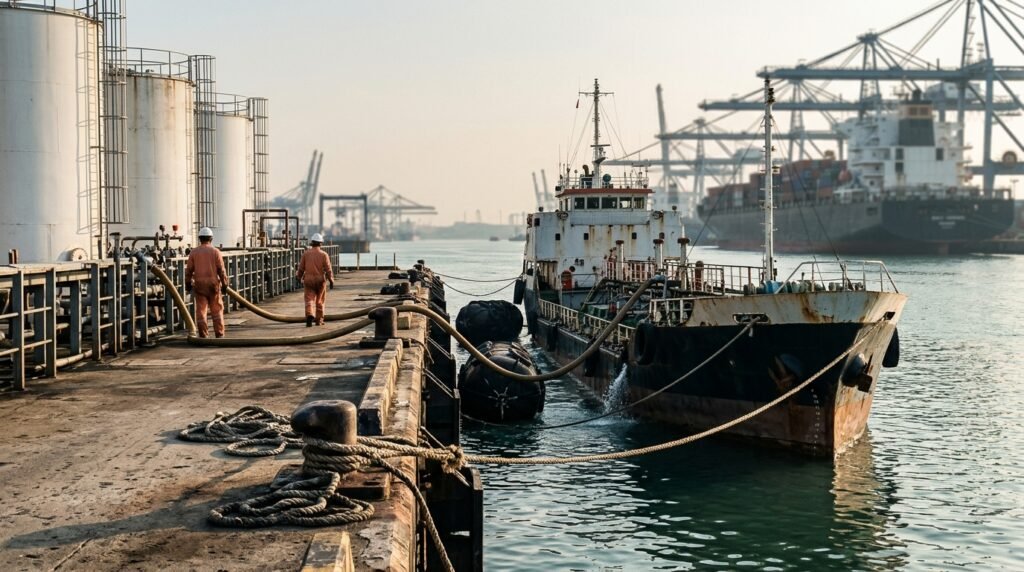
Green methanol is methanol that a plant makes from renewable sources, either from biomass or from captured CO2 and green hydrogen. It works as a liquid fuel for ships and as a feedstock for chemicals, and existing tanks, ships and ports store and move it. However, builders only start a green methanol plant if a buyer commits first. This guide therefore covers the product and the routes briefly, then spends its time on demand and financing.
In short
- Green methanol is chemically the same as conventional methanol, made from renewable inputs.
- Two routes exist: bio-methanol from biomass, and e-methanol from CO2 and green hydrogen.
- Shipping is the most visible new demand. Chemicals are the other large market.
- Lenders want a binding offtake contract. An MOU is not enough.
In this article
Green methanol in plain terms
First of all, methanol is a simple liquid chemical. Today, the industry turns almost all of it out of natural gas or coal, then makes plastics, paints, fuels and many other products from it (IRENA and Methanol Institute). Green methanol is the same molecule, made from renewable inputs instead.
Instead, the difference between green and conventional methanol sits in the paperwork, not in the product. Buyers pay for proof that the methanol is renewable, through certification of its feedstock and its emissions. In other words, buyers pay for the certificate along with the fuel.
Also, because it is a liquid at normal temperature, methanol is easier to handle than hydrogen or ammonia. Ships, tanks and ports can use it with modest changes. As a result, it has become a leading candidate for shipping decarbonisation. For the route comparison, I wrote about green methanol production.
How green methanol is made
Green methanol follows two routes. The bio route turns biomass, waste or biogas into synthesis gas and then into methanol. The e-route combines CO2 with hydrogen from electrolysis. Both end in the same synthesis step, and the methanol from either route is chemically identical to fossil methanol (IRENA and Methanol Institute).
However, the inputs differ. First, the bio route needs a secure, long-term biomass supply and a gasification step. Second, the e-route needs cheap renewable power and a committed CO2 source. Accordingly, the route depends on what the site can contract. For the detail of each route, read the green methanol production article, and for hydrogen, the green hydrogen guide.
The green methanol market today
Methanol is already a large market. Producers turned out around 98 million tonnes a year in 2019, nearly all from natural gas or coal, and about two-thirds went into other chemicals such as formaldehyde, acetic acid and plastics (IRENA and Methanol Institute). Most of the rest is fuel for vehicles, ships, industrial boilers and cooking. Production nearly doubled over the past decade, and IRENA expected demand to pass 120 million tonnes by 2025 (IRENA and Methanol Institute).
Green methanol is a sliver of that. A handful of plants produce less than 0.2 million tonnes of renewable methanol each year (IRENA and Methanol Institute). Those plants use waste and by-product streams, which give the best economics today: municipal solid waste, low-priced biomass, biogas and black liquor from pulp mills. A plant in the Netherlands makes bio-methanol from biomethane, a plant in Canada uses municipal waste, and a plant in Iceland makes e-methanol from renewable hydrogen and CO2 from a geothermal power plant (IRENA and Methanol Institute).
The pattern is clear. The first plants sit where feedstock is cheap, where an industrial site already exists or where power is very inexpensive. The question for a developer is then which of those advantages the project has.
What green methanol costs
Green methanol costs more than fossil methanol, which producers turn out at USD 100 to 250 per tonne. Estimates put bio-methanol from feedstock costing up to USD 6 per gigajoule at USD 320 to 770 per tonne. Estimates put e-methanol at USD 800 to 1,600 per tonne with CO2 from bioenergy with carbon capture, and at USD 1,200 to 2,400 per tonne with CO2 from direct air capture (IRENA and Methanol Institute).
Costs should fall. With lower renewable power prices, IRENA expected the cost of e-methanol to drop to USD 250 to 630 per tonne by 2050 (IRENA and Methanol Institute). Policy also moves the number: a carbon credit of USD 50 per tonne of CO2 would lower the production cost of renewable methanol by about USD 80 per tonne (IRENA and Methanol Institute).
In other words, the price gap is real, and it closes through feedstock, power and policy, not through the plant alone. Therefore, the buyer’s willingness to pay a premium is the main variable in the business case. The main barrier to uptake remains the higher cost against fossil alternatives, and that gap will persist for some time (IRENA and Methanol Institute).
A gradual route to green methanol: co-feeding
Not every project starts from a blank site. Operators can co-feed renewable inputs, such as biomass, CO2 and green hydrogen, into natural gas or coal-based methanol plants. This is a way to introduce green methanol gradually and to cut the carbon intensity of conventional output. Buyers sometimes call the product of these hybrid plants low-carbon methanol (IRENA and Methanol Institute).
This route has a second benefit. The demand it creates can help the early scale-up of electrolysers, CO2 capture and other technologies that later large-scale green methanol plants need (IRENA and Methanol Institute). However, a hybrid product may not meet every buyer’s definition of renewable. So I ask early which certification the buyer accepts, before the project commits to a design.
Certification: what a green methanol buyer pays for
A buyer of green methanol pays for a claim, so the claim has to hold. To qualify as renewable, all feedstocks and all energy used to make the methanol need to be of renewable origin, such as biomass, solar, wind, hydro or geothermal (IRENA and Methanol Institute). For the e-route, CO2 captured from the air counts, as does CO2 captured from bioenergy plants.
European rules add detail. Under the EU methodology for renewable fuels of non-biological origin, captured CO2 qualifies if it comes from a carbon-priced industrial activity covered by the EU ETS (incorporated in the fuel before 2036, or before 2041 in most cases other than power-generation combustion), from the air, or from biomass fuels that meet the sustainability criteria (Delegated Regulation (EU) 2023/1185).
So the CO2 source is a commercial decision as much as a technical one. A project that picks a source the buyer’s rules do not accept has a product it cannot sell at the green price. In practice, I ask for the buyer’s certification requirements in writing before the project fixes its CO2 supply.
Why green methanol travels well
The product is practical. Methanol is a liquid at ambient temperature and pressure, so it is straightforward to store, transport and distribute, and it is compatible with existing distribution infrastructure (IRENA and Methanol Institute). It also works as a fuel in internal combustion engines, and in hybrid and fuel cell vehicles and vessels.
Better still, the production technology is not experimental. Almost identical proven commercial technologies make methanol from fossil syngas, and the same ones apply to bio-methanol and e-methanol (IRENA and Methanol Institute). Technology risk is therefore lower than for several other low-carbon fuels. The risk sits in the inputs, the certification and the buyer, which is where a developer should spend the time.
Green methanol demand: shipping first, chemicals second
Demand comes from two places.
First, shipping. The maritime industry has set decarbonisation goals, and several shipping companies have ordered vessels that can run on methanol. Consequently, those ships create a need for renewable methanol at ports. Orders for methanol-fuelled vessels reached 149 in 2024 and 61 in 2025, behind LNG with 188 orders in 2025 (DNV).
For scale, more than 60 methanol-powered vessels were on the water in June 2025, and nearly 300 more were on order. Singapore alone supplies around one-fifth of global marine fuel bunkering demand (IEA).
Second, chemicals. Producers of plastics, resins and other products want lower-carbon inputs, and some brands are willing to pay for them. By contrast, chemicals demand is steadier, while shipping demand is bigger and less certain in timing.
Moreover, each shipping buyer has its own procurement process and its own timeline. Therefore, a developer should map the specific buyers, not assume a general market. I look at the buyer logic in how to secure offtake agreements.
Green methanol in Southeast Asia
In short, Southeast Asia is home to major ports, large biomass and waste resources and growing renewable power. For example, Singapore’s port authority awarded methanol bunkering licences to three companies, selected from 13 applicants, valid from 1 January 2026 to 31 December 2030 (MPA).
Meanwhile, producing countries in the region have palm oil residues, agricultural waste and biogenic CO2 sources. The region can therefore supply both routes in principle. However, projects need a contracted feedstock or power supply, a buyer and a financing structure, and few have all three.
For a broader view, see the green methanol industry page.
From memorandum to signed contract
Most green methanol projects announce a partnership before they sign anything, and the announcement fixes no volume, no price and no term, so a lender cannot lend against it. The gap between that intent and a binding contract is where projects stall, and closing it takes a defined specification, a price mechanism that suits both buyer and lender, a creditworthy buyer and a delivery plan tied to construction milestones. I describe the regional pattern in Green Methanol in Southeast Asia: From MOU to FID, the process in how to secure offtake agreements and the commercial work in the offtake service.
Where green methanol projects break in practice
Most failures follow the same pattern. First, the offtake stays at MOU stage, and the lenders have nothing to lend against. Second, nobody has contracted the inputs for the debt tenor: a biomass supply that covers three years does not support a loan of fifteen. Third, the CO2 source is vague. An e-methanol plant without a named, certified CO2 supplier has an open question in the model.
Fourth, the buyer is not ready. A shipping company that has ordered a methanol vessel still has to arrange bunkering and fuel specifications before it can sign a supply contract. As a result, timing mismatches between the buyer and the plant delay many deals.
So I test each project on these four points before I introduce it to anyone. A project with a gap does not need more introductions. It needs the gap closed.
What lenders check on a green methanol project
In short, lenders look at a project through a few questions.
- Offtake. Is there a binding contract with volume, term, price and a creditworthy buyer?
- Inputs. Is the biomass, or the power and CO2, contracted for the debt tenor?
- Technology. Has the route proved itself at the project’s scale and on its inputs?
- Certification. Can the product be certified as renewable under the buyer’s rules?
- Structure. Are equity, debt and any grants lined up in the right order?
Those answers decide whether a project reaches financial close. For the full e-route financing logic, read e-methanol project finance. For the general structure, see infrastructure project finance and the project finance service.
How I read a green methanol project
I start with the buyer and the route, in that order. Who buys, for how long, and with which certification? Then the inputs: which route does the site support, and are biomass, power or CO2 contracted? After that, the cost position: how far is the project from the buyer’s price, and who carries the premium? Finally, the structure, meaning who invests first and what the lenders need to see.
In practice, a project that answers the buyer and the inputs is ready for a serious conversation with investors. For the e-route, I add one more check: whether the CO2 source meets the rules the buyer works under. I explain that logic in e-methanol project finance.
Checklist
- You know which route the project uses and why.
- The team has contracted the inputs for the debt tenor.
- The offtake is a binding contract, not an MOU.
- The product can be certified for the buyer.
- Suppliers have proved the technology for your inputs and scale.
- The financing plan shows equity, debt and grants in order.
Next step
If you are developing a green methanol project and the offtake or the capital is the open point, book a 30-minute call or send me your project brief. I tell you early if the project is not ready.
Sources
FAQ
What is green methanol?
You make it from renewable sources: biomass, or captured CO2 combined with green hydrogen.
How is green methanol different from conventional methanol?
The molecule is the same. The difference is the source and the carbon footprint, proven by certification.
How big is the green methanol market today?
Small. A handful of plants turn out less than 0.2 million tonnes of renewable methanol a year, against around 98 million tonnes of methanol overall (IRENA and Methanol Institute).
How much does green methanol cost?
Estimates put e-methanol at USD 800 to 1,600 per tonne with CO2 from bioenergy with carbon capture, against USD 100 to 250 per tonne for fossil methanol (IRENA and Methanol Institute).
Who buys green methanol?
Shipping companies, which run vessels on methanol, and chemical producers that want lower-carbon inputs.
Why is green methanol expensive?
Renewable inputs and the plant cost more than fossil gas, and certified supply stays limited.
Is Southeast Asia a good place to produce it?
The region has ports, biomass and renewable resources. Each project still needs contracted inputs and a buyer.
What is the main reason projects stall?
The gap between an MOU and a binding offtake contract.
Not sure your project would survive a credit conversation?
A short call is usually enough to see where your project stands against what a lender or an equity investor will ask for. Tell me where your project is today, and I will tell you what the next conversation needs to look like.

Alex, Founder of WeConnect Asia
I help low-carbon fuel and carbon removal project developers in Southeast Asia secure the commercial and financial partners needed to reach FID.
Related articles

Biomethane: What It Is, How It Is Made and Who Buys It
Biomethane is biogas cleaned to pipeline quality. I explain how it is made, how it differs from biogas and who buys it in Southeast Asia.

Southeast Asia SAF: Policies, Demand and Project Status
Southeast Asia SAF policy is moving country by country. Here is where demand is forming, who the buyers are and what a developer can rely on today.

e-SAF Project Finance: Why the Sub-Mandate Is Not Enough
The synthetic fuel sub-mandate creates demand for e-SAF, but not a bankable project. Here is what e-SAF project finance still needs in Southeast Asia.

SAF Mandates by Country: A Developer’s Comparison
SAF mandates differ by country in scope, target and penalty. Here is a side-by-side comparison and what each one means for project revenue.