
Home » Green Hydrogen: What It Is, Who Builds It and Who Finances It
Green Hydrogen:
What It Is, Who Builds It and Who Finances It
11 min read · Jan 12, 2026 · By Alex
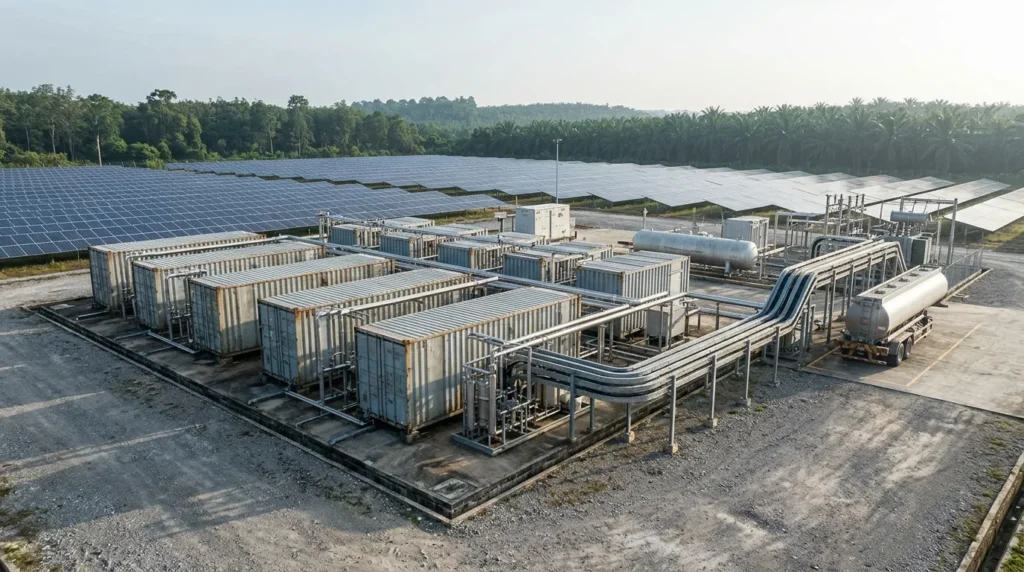
Green hydrogen is hydrogen that people make by splitting water with renewable electricity. It releases no carbon when it runs, and it can replace fossil hydrogen in industry or become the base for fuels such as ammonia and methanol. However, the gap between the promise and the projects that reach final investment decision is wide. So this guide explains the basics, then looks at the projects that actually secure financing in Southeast Asia.
In short
- Green hydrogen comes from electrolysis of water, powered by renewable electricity.
- Power drives the largest share of the cost. The load factor of the electrolyser decides how much of that power the plant uses.
- Demand today is mostly in refining, ammonia and chemicals. New demand comes through derivatives such as ammonia, methanol and e-fuels.
- Investors and lenders check the offtake first, then power, technology and structure.
In this article
Green hydrogen explained in plain terms
First of all, hydrogen is a gas that burns without carbon. Today, producers make most hydrogen from natural gas or coal, and the process releases CO2. So people use colours to describe it. Grey hydrogen comes from fossil fuels. Blue hydrogen comes from fossil fuels with carbon capture. Green hydrogen comes from water and renewable power. In 2024, global hydrogen demand reached almost 100 million tonnes (IEA). Fossil fuels still dominate supply, and low-emissions hydrogen stays below 1% of production (IEA).
In practice, colours are a shorthand. Instead, regulators and buyers care about the carbon intensity and the proof behind it, not the colour. Therefore, a green hydrogen project needs certification that shows where the power came from and when.
Why does this matter for a developer? Because the buyer pays for the proof as much as for the molecule. In other words, the green premium exists only if the project can document its power and its emissions. I look at how that connects to price in the cost benchmark.
In practice, a certificate follows the electricity, not the molecule. So I check three things when a developer sends me a scheme. First, the hours of renewable generation must match the load. Second, the guarantee of origin must travel with the power. Third, the emissions factor must match what the buyer accepts. In other words, the choice of scheme becomes a commercial decision, because the buyer’s market sets the standard. As a result, a project that leaves the certificate to the end usually has to redesign its power contract.
How green hydrogen production works, in short
In practice, the method does not change: an electrolyser passes electricity through water and splits it into hydrogen and oxygen. For the step-by-step walk-through and the technology comparison, read the green hydrogen production process and the technology choices article.
Where people use green hydrogen
In practice, demand for green hydrogen comes in two groups. The first is existing uses that switch from fossil hydrogen. Refineries, ammonia and fertiliser plants, and chemical producers already use hydrogen at scale. Moreover, the second group covers new uses that need low-carbon molecules, such as steelmaking, shipping and aviation.
For the new uses, the route is usually a derivative. For example, ships can burn ammonia or methanol. Aircraft need liquid fuel, so e-SAF and other power-to-liquid fuels start from hydrogen. As a result, a hydrogen project often sells a derivative, not the gas itself. I cover those routes in power-to-liquid explained and the green ammonia guide.
Meanwhile, direct use in vehicles and power generation exists, but the volume stays small compared with industry. So for a developer, the offtake question is simple: which buyer signs a long-term contract, and at what price?
In practice, I ask a developer to write one page per buyer: volume, delivery point, derivative, contract length and index. Refineries and ammonia plants already buy hydrogen, so the talk starts from a spec sheet. Steelmakers and shipping lines start from a pilot, so the talk starts from a standard. Therefore, the same molecule needs two different sales processes. For example, a methanol producer cares about purity at the gate, while a bunkering supplier cares about a jetty. So the first conversation belongs with an ammonia or methanol producer, a steel maker or a bunkering supplier, before an investor.
Where green hydrogen stands today
Hydrogen is a big market, and green hydrogen is a small part of it. Low-emissions production grew by 10% in 2024 (IEA). The IEA expects 1 million tonnes in 2025, still below 1% of global production (IEA).
However, the pipeline has shrunk. Announced potential for 2030 fell to 37 million tonnes a year, from 49 million tonnes a year in the previous edition (IEA). Delays and cancellations caused the drop. Even so, the number of projects that reached a final investment decision grew by almost 20% over the same period (IEA). Those projects now represent 9% of the pipeline to 2030 (IEA). From those projects, the IEA expects 4.2 million tonnes a year by 2030, five times the 2024 level (IEA).
So the story is slower, but it is not dead. Another 6 million tonnes of projects could be operating by 2030 if policies create demand and make offtake easier (IEA). For a developer, that last condition is the point. The projects that move are the ones that find a buyer.
In practice, I read a pipeline in three layers: projects with an offtake contract, projects with permits and land, and projects that live only on a slide. Only the first two deserve a financing calendar. So a shrinking headline can still hide a healthy set of projects, and I ask which layer a number belongs to before I compare it with anything else.
What green hydrogen costs, in short
In practice, the power price and the yearly running hours set the cost per kilogram. I work the numbers in the 2026 cost benchmark and in plant economics at USD 3 per kg.
What the electrolyser costs in a green hydrogen plant
So no cost item draws more attention than the electrolyser. Global installed water electrolysis capacity reached 2 GW in 2024, and the industry added more than 1 GW through July 2025 (IEA). China accounts for 65% of installed capacity and of capacity that has reached FID (IEA).
Therefore, installed cost differs sharply by location. In 2024, making and installing an electrolyser outside China cost USD 2,000 to 2,600 per kilowatt (IEA). The same work in China cost USD 600 to 1,200 per kilowatt (IEA). However, equipment is only part of the bill. More than half of the total corresponds to engineering, procurement, construction and contingency costs, which depend on the project location. The stack is only 15 to 20% of the total investment (IEA).
So buying a cheaper stack does not fix the economics. Using imported Chinese stacks in Europe, for example, would lower costs by just 3 to 13% compared with domestic stacks (IEA). Analysts also expect the cost decline for electrolysis to be much more gradual than for solar PV or batteries (IEA). The bulk of the capex is standard equipment with less room for cost reductions.
Moreover, I check the power side of the model the same way. Power at USD 50 per MWh equals about USD 2.5 per kilogram of hydrogen (IEA). Therefore, cheaper power with a longer running window does more for the cost than a cheaper stack.
In practice, I ask a developer to show the capex split in the model: stack, balance of plant, engineering and construction, and contingency. A model that assumes a stack-price cut will fix the case is a model I question.
Green hydrogen offtake: who has actually signed
In practice, offtake is where the market has slowed. New offtake agreements signed in 2024 reached 1.7 million tonnes a year, against 2.4 million tonnes a year in 2023 (IEA). Existing uses in refining and chemicals, plus hydrogen-based fuels in shipping, aviation and power, cover almost all firm offtake agreements to date (IEA). The same uses drive 80% of investment in committed production projects (IEA).
However, tenders gave mixed results. Europe’s steel tenders stalled or went on hold (IEA). By contrast, tenders for refining and fertilisers led to final investment decisions for production plants in Europe and India (IEA). Policy is moving, but slowly. Europe leads with sectoral quotas for hydrogen use in transport and industry and with mandates for aviation (IEA). India, Japan and Korea have started ambitious programmes of their own (IEA).
Therefore, the buyers that sign are the buyers that already use hydrogen or that face a rule. A developer who targets a new use, such as steel or power, without a policy behind it, is betting on a market that has not yet formed. I read that bet carefully, and I say so early.
In practice, I read a policy before I read a model. A quota creates a buyer, a subsidy lowers the price, and a mandate fixes a date. So I check which of the three is in force, who enforces it, and whether the obligation sits on the producer or on the buyer. Only then do I look at the premium the project can claim.
Who builds green hydrogen in Southeast Asia
In practice, Southeast Asia’s hydrogen demand reached 4 million tonnes a year in 2024, and unabated natural gas still meets nearly 80% of it (IEA). I keep the money view in the investment landscape article and a large reference case in the NEOM capital stack.
The green hydrogen pipeline in Southeast Asia
However, the pipeline could reach 480 thousand tonnes a year by 2030, yet only 6% of it has reached a final investment decision (IEA). For the country-by-country picture and the developer list, read the developers map.
How investors and lenders judge a green hydrogen project
In practice, they ask the same questions in the same order: offtake, power, technology, site and structure. I explain the sequence in what lenders need to see.
Common mistakes on green hydrogen projects
So most projects that stall share the same traps, and few of them fail for a technical reason.
- Starting from technology, not the buyer. The project has an electrolyser and no offtake, so the model prices a product that nobody ordered.
- Assuming cheap power. The model runs on a price that no contract supports, and the gap appears the day the parties sign the power agreement.
- Ignoring certification. The product cannot prove it is green under the buyer’s rules, so the premium disappears.
- Underestimating water and permits. The site list is incomplete, and the schedule slips at the first authority review.
- Chasing lenders too early. The file goes out before the contracts exist, and lenders decline on the offtake rather than on the technology.
- Treating the load factor as an engineering detail. The plant runs few hours, the fixed cost spreads over few kilograms, and the cost per kilogram rises.
In practice, I find the first three in most files that reach my desk, and I ask for the buyer before I ask for the model. If you want the site view, read the site checklist for a hydrogen production plant.
How I read a hydrogen project
So I read a hydrogen project from the buyer backwards. First, who takes the hydrogen or its derivative, under which contract and from which date? Second, the power: have I contracted it, and how many hours will the electrolyser run? Third, the capex: is the split between stack, balance of plant and construction credible? Fourth, the support: which grant or mandate closes the cost gap? Finally, the sequence of capital.
In other words, I turn that reading into five points, and investors and lenders ask the same five in this order:
- Offtake. Who buys the hydrogen or its derivative, at what price, and for how long?
- Power. Have I contracted the supply, and does it meet the rules for green certification?
- Technology. Do I have a proven electrolyser supplier, with guarantees?
- Site. Have I secured land, water and permits?
- Structure. Have I lined up the equity, the debt and any grants in the right order?
Soon after, I look at the load factor, because an electrolyser that runs few hours a year spreads its fixed cost over little hydrogen. The cost of capital follows. The IEA finds that a higher cost of capital adds 45 to 55% to the levelised cost against a case at 3% (IEA).
Finally, I check that the project does not depend on one unsecured assumption. I explain how lenders read these points in what lenders need to see and the sequence of capital in how to finance a hydrogen project.
Checklist
- You know your buyer and the product they will take.
- You have contracted power that meets the certification rules.
- The electrolyser supplier gives delivery and performance guarantees.
- You have documented land, water and permits.
- Your financing plan shows equity, grants and debt in order.
- You have a calendar that aligns the steps.
- Your model uses a load factor you can defend with the power contract.
- You choose the certification route before you sign the power contract.
I open IRENA for the cost logic. Electricity drives much of the production cost of green hydrogen. The molecule still costs two to three times more than blue hydrogen today (IRENA). Moreover, scale also helps: moving a plant from 1 MW to 20 MW cuts costs by more than a third (IRENA).
Next step
If the offtake or the capital is the open point on your green hydrogen project, book a 30-minute call. You can also send me your project brief. I tell you early if the project is not ready. Moreover, you can read the hydrogen industry page and the project finance service.
Sources
FAQ
What is green hydrogen?
People make it by splitting water with renewable electricity, so the process emits no carbon.
How is green hydrogen different from grey and blue hydrogen?
Grey comes from fossil fuels with emissions. Blue adds carbon capture. Green uses water and renewable power.
Why is green hydrogen expensive?
Mainly because of the cost of renewable power and the electrolyser, and because the plant has to run enough hours to spread its fixed costs.
What are the main types of electrolyser?
Alkaline and PEM units are the common choices today. Solid oxide units run hot enough to use heat, and anion exchange units are still moving toward scale. The US Department of Energy lists the operating temperature ranges for each family (US Department of Energy).
What can I use green hydrogen for?
Today, refining, ammonia and chemicals. New uses include steel, shipping and aviation, often through derivatives.
Does Southeast Asia have green hydrogen projects?
Yes, at various stages. So the ones that move have a buyer and a defined site.
What do lenders ask first?
Who buys the product. Without an offtake contract, there is nothing to finance.
Not sure your project would survive a credit conversation?
A short call is usually enough to see where your project stands.

Alex, Founder of WeConnect Asia
I help low-carbon fuel and carbon removal project developers in Southeast Asia secure the commercial and financial partners needed to reach FID.
Related articles

Biomethane: What It Is, How It Is Made and Who Buys It
Biomethane is biogas cleaned to pipeline quality. I explain how it is made, how it differs from biogas and who buys it in Southeast Asia.

Southeast Asia SAF: Policies, Demand and Project Status
Southeast Asia SAF policy is moving country by country. Here is where demand is forming, who the buyers are and what a developer can rely on today.

e-SAF Project Finance: Why the Sub-Mandate Is Not Enough
The synthetic fuel sub-mandate creates demand for e-SAF, but not a bankable project. Here is what e-SAF project finance still needs in Southeast Asia.

SAF Mandates by Country: A Developer’s Comparison
SAF mandates differ by country in scope, target and penalty. Here is a side-by-side comparison and what each one means for project revenue.