
Home » Waste to Energy: How the Technologies Compare for Southeast Asian Cities
Waste to Energy:
How the Technologies Compare for Southeast Asian Cities
12 min read · Sep 8, 2025 · By Alex
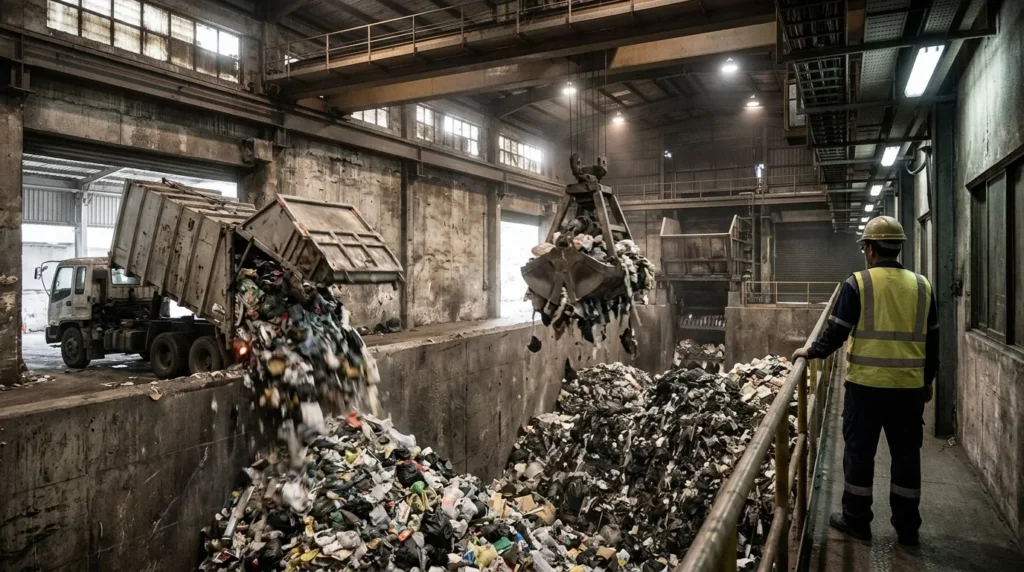
Waste to energy turns municipal and industrial waste into power, heat or fuel. For a growing city, it is a way to cut landfill and generate electricity at the same time. However, a waste to energy plant is only as good as its waste supply, its revenue contracts and its technology choice. So this guide compares the main technologies, and then looks at what each one means for lenders.
In short
- Waste to energy includes incineration with energy recovery, gasification, pyrolysis and biological routes such as anaerobic digestion.
- The waste supply, not the technology, is the largest risk for most plants.
- Revenue comes from a mix of tipping fees, power sales and sometimes heat or recovered materials.
- Lenders want a long-term waste supply agreement and a power or heat offtake before they commit.
In this article
Waste to energy in plain terms
First, a waste to energy plant takes waste that would otherwise go to landfill and converts the energy inside it. Some plants burn the waste and use the heat to make steam and electricity. Others convert the waste to gas or oil first. Still others use bacteria to break down the organic part and capture biogas. The field covers a short list of routes: incineration, pyrolysis, conventional and plasma arc gasification, anaerobic digestion, and landfilling with gas extraction (IEA Bioenergy Task 36).
In practice, every plant has the same three needs: a steady supply of waste, a technology that can handle its composition and a buyer for the energy. If one of the three is weak, the whole plant is weak.
Why does it matter in Southeast Asia? Because cities in the region generate growing volumes of waste, and many still rely on landfill and open dumping. In other words, the demand is there, but the economics depend on who pays to treat the waste. I covered the lender view in the waste-to-energy project finance article.
The waste to energy technologies and where each fits
First of all, each technology suits a different kind of waste and a different scale.
- Incineration with energy recovery. Mixed municipal waste burns on a grate, and the heat makes steam and electricity. It is the most proven route and works at large scale.
- Refuse-derived fuel. Operators sort and process waste into a more uniform fuel, which can feed a dedicated plant or a cement kiln.
- Gasification. Operators heat waste with limited oxygen to make a gas, which can power an engine or turbine. The gas can also become a fuel.
- Pyrolysis. Operators heat waste without oxygen to make oil, gas and char. It suits specific streams such as plastics.
- Anaerobic digestion. Bacteria break down organic waste into biogas, which can make power, and operators can upgrade it to biomethane. I explain the route in how a biogas plant works.
I compare them on scale. Incineration, pyrolysis and plasma gasification need above 100 tonnes of waste a day to keep the boiler running, while anaerobic digestion starts at 25 tonnes a day. Capital cost for an incinerator runs from USD 190 to 400 per annual tonne in China against USD 600 to 1,000 in Europe (MDPI, World Bank). Anaerobic digestion in Europe costs from USD 345 to 600 per annual tonne (MDPI, World Bank).
However, maturity differs a lot. For example, incineration has decades of operation. Gasification and pyrolysis have fewer large plants running reliably on mixed municipal waste. As a result, lenders look harder at the newer routes, and they may ask for guarantees or an independent technical review.
What each waste to energy technology leaves behind
Every technology produces something besides energy, and that residue has a cost and a permit. Incineration yields high-pressure steam, ash and exhaust gases. Pyrolysis yields raw syngas, bio-oil, ash, char and metals. Conventional gasification yields raw syngas, bio-oil, ash, slag and metals, and plasma arc gasification yields raw syngas, inorganic materials and vitrified slag. Anaerobic digestion yields methane gas, hydrogen and digestate (IEA Bioenergy Task 36).
So a lender reading a waste to energy plant reads two flows: the energy the plant sells and the residue it must send somewhere. Ash, slag, char and digestate each need a disposal route or a buyer, and the route has to be in the permit and in the model. In practice, I ask where the residue goes before I ask about the efficiency of the boiler.
This is also why technology choice follows the waste. A wet, organic stream points to digestion and its digestate. A mixed, dry stream points to thermal treatment and its ash. The match between the waste and the technology matters more than the technology’s name.
How much waste feeds waste to energy
Start with the raw material. The world generated 2.01 billion tonnes of municipal solid waste in 2016 (World Bank). Analysts expect generation to reach 3.40 billion tonnes by 2050 (World Bank). East Asia and the Pacific generated the most in absolute terms: an estimated 468 million tonnes in 2016 (World Bank). That equals an average of 0.56 kilograms per person per day (World Bank).
Most of that waste does not go to energy recovery. Landfills take almost 40% of waste worldwide, and open dumping still handles 33% (World Bank). Recycling and composting recover about 19%, and modern incineration treats 11% (World Bank). So the volume exists, and the competition for it is the question.
In practice, a waste to energy plant does not compete with other plants for waste. It competes with the landfill, and the landfill is usually cheaper. That is where the economics start, and it is the reason the next section matters.
Why cheap landfill blocks waste to energy
Low disposal fees are the main barrier in many markets. In South Africa, planners favour landfilling because disposal is easy and gate fees stay low, and that view can deter waste to energy projects (IEA Bioenergy Task 36). A plant that must charge a higher fee than the landfill needs a rule, a tax or a ban to make that fee acceptable.
Policy and permitting add cost. The absence of decisive national policy on thermal treatment led to late or conflicting decisions on authorising incineration. Legal costs apply regardless of plant size. In 2021, a Basic Assessment cost approximately R100,000 (IEA Bioenergy Task 36). An Environmental Impact Assessment cost approximately R170,000, without counting specialist studies (IEA Bioenergy Task 36). Contract terms also matter. Municipalities there cap contracts at 36 months, while some offtakers require commitments of ten to fifteen years (IEA Bioenergy Task 36).
So the first diligence question on a waste to energy plant is not the technology. It is whether the rules let the waste supplier sign a long contract at a fee that covers the plant.
How policy builds waste to energy markets elsewhere
Other countries show what changes the picture. Germany banned landfilling of organics in 2005 (IEA Bioenergy Task 36). Since then, Germany recycles residual waste or sends it to waste to energy plants, and it harvests landfill gas from old landfills (IEA Bioenergy Task 36). Sweden has had a landfill ban on combustible waste since 2001, and on organics since 2005 (IEA Bioenergy Task 36).
Norway shows the other side. It ships large quantities of municipal waste to Sweden, because it lacks treatment capacity at home (IEA Bioenergy Task 36). Swedish waste to energy plants recover that waste, and Norway has applied a waste incineration tax since 2022 (IEA Bioenergy Task 36).
The lesson for Southeast Asia is not that one model fits every country. It is that a waste to energy market follows a rule. Where a country limits or taxes landfill, plants find waste. Where disposal stays cheap and open, plants struggle. I look at the rule in the project’s country before I look at the plant.
Waste supply: the number every waste to energy plant lives on
In fact, for most waste to energy plants, the largest risk is not the technology. It is the waste. The plant needs a steady quantity, a stable composition and enough energy content, for the full life of the debt.
First, quantity. If the city sends less waste than planned, the plant under-runs and the revenue drops. Second, quality. For instance, waste that is wetter or lower in energy than assumed burns badly. Third, contract. A municipality may promise waste, but a binding supply agreement with penalties is different from a letter of intent. Moreover, informal collectors and competing facilities can divert waste.
Therefore, I would start the waste work early. A waste characterisation study, a signed supply agreement and a plan for sorting all belong in the file before the lenders see it. For the commercial side, the feedstock service is where I start. The waste itself is what I check first. Municipal waste in Thailand has a calorific value of 5.2 to 6.1 MJ per kg (MDPI, World Bank). Waste in developed countries reaches 8.4 to 17 MJ per kg on the same measure (MDPI, World Bank). A high organic share and high moisture drag that value down and raise operating costs per tonne (MDPI, World Bank).
Tipping fees, power sales and the revenue stack
Waste to energy plants usually earn from several sources.
- Tipping fees. The municipality or the waste generator pays to take and treat the waste.
- Power sales. Electricity goes to the grid under a power purchase agreement or a tariff.
- Heat sales. Where there is a nearby user, steam or hot water adds revenue.
- Recovered materials. The plant sells metals and some ash products.
In practice, the tipping fee often carries the most weight, because it pays for a service the city needs. A tariff or a power purchase agreement then adds a second stream. Together, they make the project bankable, and each stream needs its own signed contract. For that reason, I look at both. I wrote about the offtake side in what a WtE or biogas project needs.
Waste to energy plants in Southeast Asia
However, waste to energy plants in the region have developed unevenly. Some countries promote them with tariffs and programmes, while others restrict incineration or have not yet defined clear rules. Here is the regional picture. Thailand plans 79 plants with 619 MW and contracts of at least 20 years (Mongabay). Indonesia has at least 17 projects of 134.9 MW, and local opposition stopped a 7.9 MW plant in Thalang (Mongabay). A regional review rates policy support as high in Singapore, medium in Indonesia, Malaysia, Thailand and Vietnam, and low in the Philippines (MDPI).
Moreover, financing is a recurring challenge. For example, municipal counterparties can have weak credit, and tariffs may not cover the costs. As a result, projects often need a government support mechanism, a guarantee or development finance. In fact, plants that reach financial close usually have a creditworthy payer behind the tipping fee.
If you want to see what a plant looks like in practice, read how a waste-to-energy plant actually works. For the broader industry context, see the waste-to-energy industry page.
How I read a waste to energy project
I read a project from the waste contract outward, and I follow the same order every time.
- Supply. Who delivers the waste, how much, how sorted, and for how many years?
- Tipping fee. What does the supplier pay per tonne, and what makes that fee binding beside the landfill next door?
- Offtake. Is the power or heat sold under a contract, and at what price?
- Technology. Which route fits the waste, and who guarantees performance at the promised scale?
- Structure. Where does equity come from, and does the plan need a guarantee or a support mechanism?
In practice, most projects can answer the technology question, and fewer can answer the first two. So I ask for the waste agreement early. A project without it does not have a revenue line, and no lender treats it as having one.
What lenders check on a waste to energy project
In short, lenders do not read the story, they read the file, and the file has to answer each question with a document.
- Waste supply agreement. Binding volume, composition and penalties for the full term of the debt.
- Offtake contract. Power or heat sold at a defined price, plus evidence that the payer can pay. I set out the requirements in the offtake requirements.
- Studies. A waste characterisation study and, for the newer routes, an independent technical review.
- Permits. Environmental approvals with emissions limits, and the rule that sets plant size and licensing.
- Financial model. One model that runs the tipping fee, the offtake and the debt terms together.
Above all, lenders check that the project does not depend on one unsecured assumption. I explain the general logic in infrastructure project finance, the project finance service in project finance, and the lender view in how project finance works in Southeast Asia.
Checklist
- I confirm that the waste characterisation study matches the waste the city actually sends.
- Volume, composition and penalties are what I look for in the supply agreement.
- For the payer, I check who pays the tipping fee and whether lenders accept that credit.
- Back upstream, I trace the energy offtake back to a signed contract.
- On technology, I match the route to waste that looks comparable.
- Permits and emission limits appear in my list with their status.
- Finally, I show equity, debt and support in the financing plan.
I close with the size of the regional market. Southeast Asia counts more than 323 MW of capacity from landfill biogas, incineration, anaerobic digestion and gasification (MDPI). Six countries could realise 17.26 TWh a year from municipal waste by 2030 (MDPI).
Next step
If the financing, the feedstock or the buyer is the open point on your waste to energy plant, book a 30-minute call. Or send me your project brief, and I tell you early if the project is not ready.
Sources
FAQ
What is waste to energy?
It is the conversion of waste into electricity, heat or fuel, through burning, gasification, pyrolysis or biological processes.
Which waste to energy technology is best?
It depends on the waste and the scale. Incineration is the most proven for mixed waste. Biological routes suit organic waste.
What is the main risk of a waste to energy plant?
The waste supply: quantity, composition and the strength of the supply contract.
How does a waste to energy plant earn money?
Mostly from tipping fees and power sales, sometimes with heat and recovered materials.
Are waste to energy plants common in Southeast Asia?
They exist in several countries, but policy and financing vary widely, and many projects are still developing.
What do lenders ask first?
Who supplies the waste, who pays for treatment and who buys the energy.
Not sure your project would survive a credit conversation?
A short call is usually enough to see where your project stands against what a lender or an equity investor will ask for. Tell me where your project is today, and I will tell you what the next conversation needs to look like.

Alex, Founder of WeConnect Asia
I help low-carbon fuel and carbon removal project developers in Southeast Asia secure the commercial and financial partners needed to reach FID.
Related articles

Biomethane: What It Is, How It Is Made and Who Buys It
Biomethane is biogas cleaned to pipeline quality. I explain how it is made, how it differs from biogas and who buys it in Southeast Asia.

Southeast Asia SAF: Policies, Demand and Project Status
Southeast Asia SAF policy is moving country by country. Here is where demand is forming, who the buyers are and what a developer can rely on today.

e-SAF Project Finance: Why the Sub-Mandate Is Not Enough
The synthetic fuel sub-mandate creates demand for e-SAF, but not a bankable project. Here is what e-SAF project finance still needs in Southeast Asia.

SAF Mandates by Country: A Developer’s Comparison
SAF mandates differ by country in scope, target and penalty. Here is a side-by-side comparison and what each one means for project revenue.