
Home » What Is an RFNBO? e-SAF, e-Methanol and the EU Rules
What Is an RFNBO? e-SAF, e-Methanol and the EU Rules
10 min read · Mar 9, 2026 · By Alex
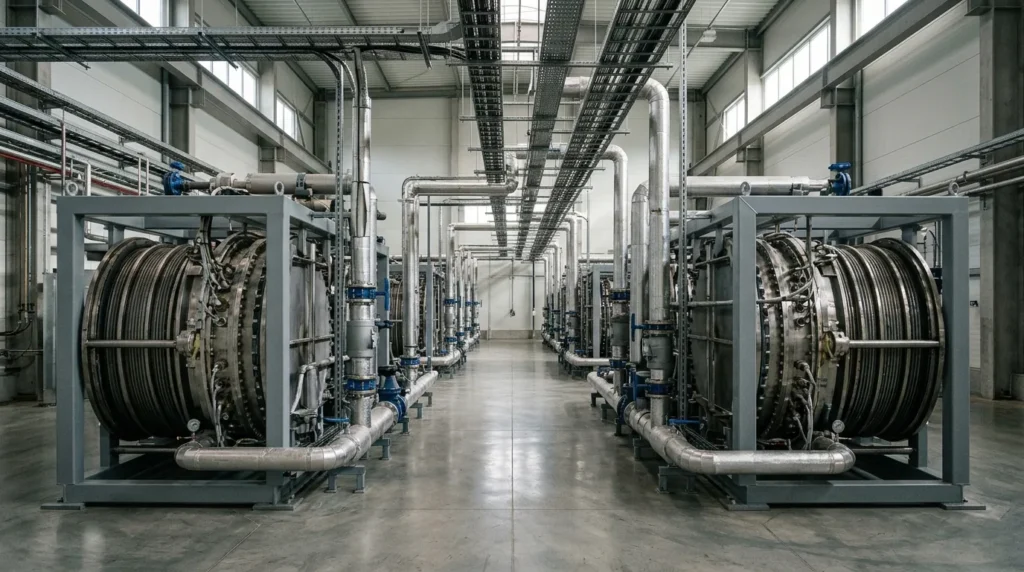
An RFNBO is a renewable fuel of non-biological origin, which means a liquid or gaseous fuel whose energy comes from renewable sources other than biomass. In practice the label decides which EU rules apply to a project. Moreover the term is often mistyped as “RFBO”, and the missing N matters. Therefore I treat RFNBO as a legal test with a paper trail behind it, not as a marketing category.
In short
- For one thing, RFNBO stands for renewable fuel of non-biological origin, a term defined in Article 2 of the EU Renewable Energy Directive.
- Moreover typical RFNBOs come from renewable electricity, green hydrogen and captured CO2 or nitrogen.
- In aviation the EU calls these fuels synthetic aviation fuels, and ReFuelEU Aviation pushes their share to 35 % by 2050.
- By contrast biomethane sits outside the label, because its energy comes from biomass.
- For lenders the label only matters through the documents that prove each input qualifies.
In this article
Definition: RFNBO, e-fuel, synthetic fuel, e-SAF
Actually these terms overlap, and I see them used interchangeably in pitch decks. In reality each one points to a different part of the same chain. For that reason I keep the vocabulary table below in every data room.
| Term | Meaning |
|---|---|
| RFNBO | Legal EU term for a renewable liquid or gaseous fuel whose energy is not from biomass |
| e-fuel | Common name for fuels made with renewable electricity |
| Synthetic aviation fuel | Aviation fuel produced from green hydrogen and captured CO2 (the ReFuelEU Aviation term) |
| e-SAF | Industry shorthand for synthetic aviation fuel |
| e-methanol | Methanol made from green hydrogen and captured CO2 |
Specifically ReFuelEU Aviation defines synthetic aviation fuels by reference to the RFNBO definition in the Renewable Energy Directive. Consequently a fuel that fails the EU electricity rules cannot enter the market as a synthetic aviation fuel, however green the plant looks on a site visit. In addition the same regulation creates a separate category, synthetic low-carbon aviation fuels, which come from non-fossil low-carbon hydrogen and must reach a 70 % lifecycle saving.
What makes a fuel an RFNBO
For aviation, EU documents describe synthetic liquid fuels as a two-step product. Firstly a plant converts renewable electricity into green hydrogen through electrolysis of water. Secondly it combines that hydrogen with CO2 captured from the air, from a biogenic source or from an industrial process. The result is a liquid hydrocarbon that drops into existing engines and tanks.
Moreover the electricity side carries its own test, and that test sits in the Renewable Energy Directive. In effect Article 27 asks a producer to show that the power is genuinely additional. It also asks for proof that the power was generated at the same time as the fuel and came from a connected market. Therefore the label rests on two numbers: the carbon intensity of the process and the provenance of every megawatt hour.
In practice the greenhouse gas side is a threshold, not an opinion. An RFNBO must save at least 70 % against a fossil comparator of 94 gCO2eq/MJ. Delegated Regulation (EU) 2023/1185 sets the calculation method. As a result the CO2 source and the electrolyser load profile end up in the same spreadsheet, and a lender will ask to see both.
RFNBO rules: additionality and temporal correlation
Three conditions turn renewable electricity into RFNBO electricity, and Delegated Regulation (EU) 2023/1184 writes them down. Firstly additionality. Secondly temporal correlation. Thirdly geographic correlation. For a developer, these three words decide where the plant sits and what the power contract must say.
Additionality for RFNBO electricity
Additionality means the renewable generator must be new, and the regulation gives the test a precise shape. In practice the generator must have come into operation no earlier than 36 months before the fuel plant. It must also have taken no operating or investment aid. However the rule carves out support for land, for grid connection and aid that a project fully repays. Consequently a plant that signs a PPA with a ten-year-old solar farm fails the test, even if the electrons are renewable.
Temporal correlation for RFNBO electricity
Temporal correlation ties production and generation to the same period, and the period tightens over time. Until 31 December 2029 the fuel must be produced in the same calendar month as the electricity under the PPA. From 1 January 2030 the match becomes hourly, although a Member State may apply the hourly rule from 1 July 2027. Moreover the regulation treats the condition as met whenever the day-ahead price sits at or below EUR 20 per MWh. It also accepts a price below 0.36 times the EU ETS allowance price.
Geographic correlation for RFNBO electricity
Geographic correlation keeps the generator close to the electrolyser, and here the regulation accepts three situations. The generator may sit in the same bidding zone as the electrolyser. It may sit in an interconnected zone where the day-ahead price is equal or higher. Alternatively it may satisfy the direct-line conditions. In practice this clause rules out a virtual PPA with a generator three countries away, unless the price condition holds.
Therefore a project with a captive solar farm and a direct line clears all three tests more easily than a grid-connected one. However a fully grid-connected plant can still qualify if it sits in a bidding zone where renewables exceed 90 % of generation in the previous year. For Southeast Asia that exception rarely applies, and the direct-line route becomes the practical default.
How ReFuelEU Aviation uses the RFNBO category
In aviation the RFNBO label feeds a sub-obligation inside the main SAF mandate of ReFuelEU Aviation. Moreover the schedule is fixed in Annex I of Regulation (EU) 2023/2405, and the synthetic share rises on its own ladder.
| From 1 January | Minimum SAF share | Minimum synthetic share |
|---|---|---|
| 2025 | 2 % | None |
| 2030 | 6 % | 1.2 % average over 2030 to 2031, with 0.7 % each year |
| 2035 | 20 % | 5 % |
| 2040 | 34 % | 10 % |
| 2045 | 42 % | 15 % |
| 2050 | 70 % | 35 % |
However Article 4(1) contains a nuance that matters to an e-SAF developer. A supplier may meet the headline SAF share with renewable hydrogen for aviation or with low-carbon aviation fuels. Neither of those counts toward the synthetic sub-share. Therefore your e-SAF competes with cheaper low-carbon options for the 6 % and 20 % rungs, and it competes alone for the synthetic rungs. That distinction is the first thing I check in a demand study.
In addition Article 11 sets the consequence of missing the target. A Member State must fine a supplier at least twice the gap between the yearly average price of synthetic fuel and conventional fuel, multiplied by the shortfall volume. As a result the sub-share behaves less like an aspiration and more like a penalty exposure. That is exactly what a lender wants to see in the obliged party.
RFNBO in shipping: the FuelEU Maritime multiplier
Outside aviation the same label opens a second regulated market. In practice FuelEU Maritime (Regulation (EU) 2023/1805) rewards RFNBO use with a multiplier of 2 in the greenhouse gas intensity calculation. That multiplier runs from 1 January 2025 to 31 December 2033. Furthermore Article 5 sets a 2 % RFNBO sub-target from 1 January 2034. It applies only if the Commission finds that the RFNBO share stayed below 1 % in the reporting period 2031.
Consequently one plant with one certified molecule can serve an aviation buyer and a maritime buyer, provided the batch documentation holds for both schemes. Moreover that optionality is worth money in a negotiation, because it widens the pool of buyers who can absorb an outage. However the two markets use different sustainability frameworks, so the certificate must name the scheme and the end use.
The paper trail: certification and the Union Database
For a lender, the RFNBO label only exists once a recognised scheme certifies it. In practice the Commission has formally recognised 18 voluntary and national certification schemes, and a recognition usually runs for five years. Moreover each scheme checks the full production chain with an external auditor. The audit covers the origin of the raw material and the electricity, then the fuel producer or trader.
In addition Article 30 of the Renewable Energy Directive requires a Union database for liquid and gaseous transport fuels. Consequently economic operators must enter their transactions and the sustainability characteristics of each batch, including lifecycle emissions. The entry starts at the point of production. As a result an Asian producer has to feed a European registry from day one, and a missing entry becomes an audit finding rather than a paperwork delay.
What lenders ask an RFNBO developer to prove
- For one thing, that the renewable electricity supply meets the additionality, temporal and geographic tests, backed by a power purchase agreement and metering data.
- Also that the CO2 source is identified, secure, eligible and contracted for the debt tenor.
- Moreover that the plant has an offtaker for a fuel that costs more than its fossil equivalent, on a contract long enough to repay the debt.
- In addition, that the electrolyser and synthesis technology have a track record at the proposed scale.
- Furthermore that a recognised certification scheme covers the plant and the chain, with a scope that includes RFNBO.
- Finally that the greenhouse gas calculation reaches the 70 % threshold on actual, not default, values.
Most projects I see have the first item half-done and the last one not started. In effect the electricity file is usually a term sheet rather than a signed PPA. The carbon file is usually a letter of intent rather than a supply contract. Therefore I ask for the two contracts before I ask for the financial model. For the financing view, see e-SAF Project Finance and Power-to-Liquid Investing: What I Check Before FID.
Why it matters in Southeast Asia
The region has renewable electricity potential, port access and CO2 sources from gas processing, cement and fermentation. However the power price and the CO2 source decide the economics, and the RFNBO rules decide whether those inputs count. Generally a grid-connected plant in a market with a low renewable share falls back on the national average. That average is measured two years before the production year, and it rarely clears the 70 % saving.
Moreover the additionality rule changes the capex story. A developer who builds a captive solar farm and a direct line pays for generation up front. That cost lands in the financing plan before the first litre of fuel. By contrast a developer who leans on the grid saves capex and risks the label. As a result the choice between the two is a financing decision as much as an engineering one, and it belongs in the information memorandum. For the wider hydrogen picture, read The Green Hydrogen Investment Landscape in Southeast Asia.
Sources
Sources
- Directive (EU) 2018/2001 (RED II), Article 2(36), Article 25(2), Article 27(3), Article 29a and Article 30, EUR-Lex: https://eur-lex.europa.eu/eli/dir/2018/2001/oj/eng
- Commission Delegated Regulation (EU) 2023/1184 of 10 February 2023 on the production of renewable liquid and gaseous transport fuels of non-biological origin, Articles 3 to 7, EUR-Lex: https://eur-lex.europa.eu/eli/reg_del/2023/1184/oj/eng
- Commission Delegated Regulation (EU) 2023/1185 of 10 February 2023 on the greenhouse gas methodology and the 70 % threshold, Articles 1 to 3 and Annex, EUR-Lex: https://eur-lex.europa.eu/eli/reg_del/2023/1185/oj/eng
- Regulation (EU) 2023/2405 (ReFuelEU Aviation), Article 3(7), Article 3(12), Article 4, Article 11 and Annex I, EUR-Lex: https://eur-lex.europa.eu/eli/reg/2023/2405/oj/eng
- Regulation (EU) 2023/1805 (FuelEU Maritime), Article 5, EUR-Lex: https://eur-lex.europa.eu/eli/reg/2023/1805/oj/eng
- European Commission, “Voluntary schemes” (18 recognised schemes, five-year validity, RFNBO scope): https://energy.ec.europa.eu/topics/renewable-energy/bioenergy/voluntary-schemes_en
- European Parliamentary Research Service, “ReFuelEU Aviation initiative”, PE 698.900, November 2023 (definitions of RFNBO and synthetic aviation fuels): https://www.europarl.europa.eu/thinktank/en/document/EPRS_BRI(2022)698900
FAQ
What does RFNBO stand for?
Renewable Fuels of Non-Biological Origin, and the N refers to the exclusion of biomass.
Is e-SAF an RFNBO?
Specifically synthetic aviation fuel is the aviation case of an RFNBO, and “e-SAF” is the industry shorthand for it.
Is biomethane an RFNBO?
No. The label excludes fuels whose energy comes from biomass, however that biomass was produced.
Does an RFNBO need green hydrogen?
For synthetic fuels, yes. The hydrogen comes from electrolysis powered by renewable electricity.
Can an RFNBO plant use grid electricity?
Partly. It can use the grid if the bidding zone exceeds 90 % renewables, or if it meets the additionality, temporal and geographic conditions through a PPA.
Why do lenders care about the label?
In effect the label decides which regulated demand your fuel can serve, so it drives the revenue case and the contract structure.
Next step
A short call is usually enough to see where your project stands before a lender or an offtaker looks at it.
If you are developing a project in this space and want to test the offtake and financing story, book a 30-minute call or see my project finance work.
I do not provide investment advice or arrange investments. I act as a strategic advisor and facilitator.

Alex, Founder of WeConnect Asia
I help low-carbon fuel and carbon removal project developers in Southeast Asia secure the commercial and financial partners needed to reach FID.
Related articles

Biomethane: What It Is, How It Is Made and Who Buys It
Biomethane is biogas cleaned to pipeline quality. I explain how it is made, how it differs from biogas and who buys it in Southeast Asia.

Southeast Asia SAF: Policies, Demand and Project Status
Southeast Asia SAF policy is moving country by country. Here is where demand is forming, who the buyers are and what a developer can rely on today.

e-SAF Project Finance: Why the Sub-Mandate Is Not Enough
The synthetic fuel sub-mandate creates demand for e-SAF, but not a bankable project. Here is what e-SAF project finance still needs in Southeast Asia.

SAF Mandates by Country: A Developer’s Comparison
SAF mandates differ by country in scope, target and penalty. Here is a side-by-side comparison and what each one means for project revenue.

Sustainable Aviation Fuel: Pathways, Mandates and What Gets Financed
Sustainable aviation fuel has several pathways and sells into mandates. I explain the routes, the demand and what gets financed in Asia.

ReFuelEU Offtake: Who Actually Buys Your SAF?
The ReFuelEU mandate sits on fuel suppliers, not airlines. Here is what that means for ReFuelEU offtake contracts and what lenders expect to see.