
Home » E-Methanol Project Finance: What Methanol Lenders Look For
E-Methanol Project Finance:
What Methanol Lenders Look For
9 min read · Jan 13, 2026 · By Alex
E-methanol project finance rests on three contracts: a CO2 supply, a power supply and an offtake with a buyer who can pay. If those three are solid, lenders will talk about the rest. If one is soft, they will not. So in e-methanol project finance, before I discuss any model, I check which of the three is the weakest, because that is where the project will stall.
In short
- E-methanol project finance depends on CO2, power and offtake, in that order of difficulty.
- The CO2 supply contract is the one developers underestimate most.
- Lenders want the shipping or chemicals buyer under a binding contract, not an MOU.
- Approach lenders in a deliberate order, starting with those who know the technology.
In this article
E-methanol project finance: what the lender underwrites
First, a reminder of what e-methanol is. In short, a plant combines CO2 with green hydrogen and turns them into methanol through a standard synthesis step. Almost identical commercial technologies make methanol from fossil syngas, and that same synthesis step runs on CO2 and hydrogen (IRENA and Methanol Institute). I covered the two production routes in the green methanol production article.
Then the lender’s view. A lender does not underwrite a technology. Instead, it underwrites a cash flow that depends on contracts. In other words, the question is: can this plant buy its inputs and sell its output at prices that cover the debt, for as long as the debt runs?
So lenders break the plant into risks. Technology risk covers the electrolyser, the synthesis loop and their integration. Input risk covers the power and the CO2. Revenue risk covers the offtake and the product price. Also, each risk needs a contract or a guarantee. For the general structure, read how infrastructure project finance works.
The CO2 supply contract in e-methanol project finance
In e-methanol project finance, CO2 is the input that surprises developers. Hydrogen gets the attention, but the plant cannot run without carbon, and the carbon has to be the right kind.
First, the source. Many rules treat biogenic CO2 differently from fossil CO2, and some mandates require a defined origin. For example, typical biogenic sources include biogas upgraders, bioethanol plants, pulp mills and biomass power stations. The EU methodology for renewable fuels of non-biological origin sets those rules for fuel sold into Europe. Under it, captured CO2 qualifies if it comes from a carbon-priced industrial activity covered by the EU ETS. The fuel must incorporate that CO2 before 2036, or before 2041 in most cases other than power-generation combustion (Delegated Regulation (EU) 2023/1185). It also qualifies when the CO2 comes from the air, or from biomass fuels that meet the sustainability criteria.
Second, the contract. The supplier has to commit volume, quality and duration, and the term should match the debt. A supplier who can close its plant, or change its process, is a risk the lender will price. So I ask early who supplies the CO2, for how long and what happens if they stop.
Third, the location. Because moving CO2 is expensive, the best e-methanol sites sit near a source. As a result, the CO2 contract often decides where the plant can be built. A site chosen for power alone may fail on carbon.
CO2 sources in Southeast Asia for e-methanol project finance
Regional context comes first, because most of the plants I see are sited here. The largest CO2 capture prospects in the region sit inside industrial clusters in Indonesia, Malaysia, Thailand and Viet Nam. The IEA expects regional capture to reach more than 200 million tonnes a year by 2050, which needs almost USD 1 billion a year of investment between 2025 and 2030 (IEA, CCUS in Southeast Asia). Cement, steel and gas processing sit close together in those clusters, so one capture project can serve several plants at once.
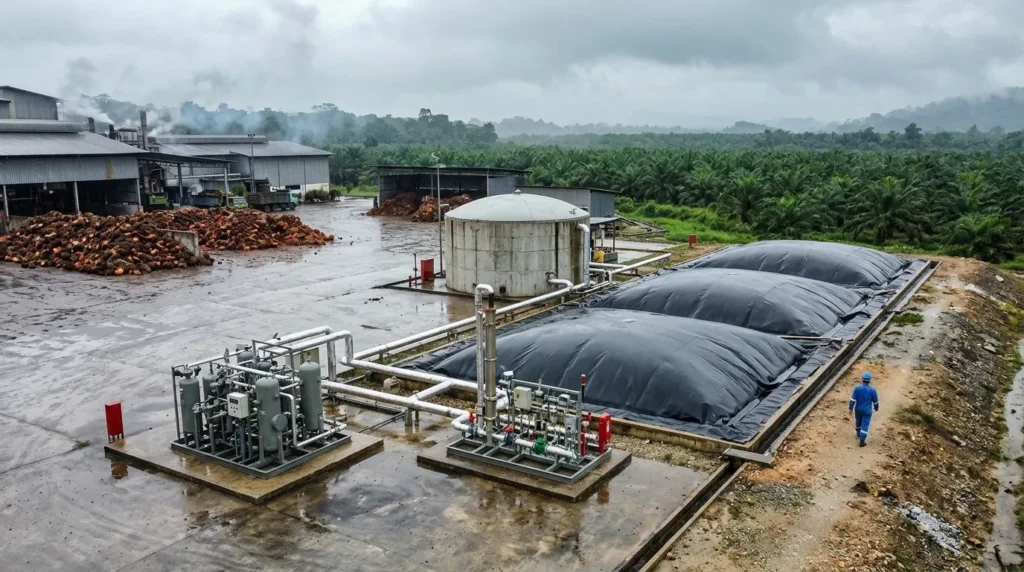
Biogenic carbon follows a different path. Palm oil mill effluent releases biogas that is 30 to 40 per cent CO2, and Malaysia and Indonesia together supply close to 90 per cent of world palm oil (Energy Studies Institute, National University of Singapore). However, less than a tenth of Indonesian mills captured that biogas as of 2019 (ESI Policy Brief 34). A mill district can therefore become a certified biogenic source, but only when the supplier commits the volume and the certificate matches the buyer’s rules.
Transport cost sets the radius around the site. For networks moving 1 to 20 million tonnes a year, onshore pipeline transport is estimated at about EUR 10 to 20 per tonne over 100 kilometres (EMIS, pipeline transport). Over 500 kilometres, the same estimate rises to about EUR 18 to 57 per tonne (EMIS). Truck and rail stay flexible for short distances, at a higher operating cost. So I ask three questions early: where the source sits, how far it is, and who pays for the line.
Power cost and the hydrogen side of the model
On the hydrogen side, the question is the cost of electricity and the hours the electrolyser runs. The power contract carries a lot of weight. The cost of e-methanol depends to a large extent on the cost of hydrogen and CO2. Current production costs are estimated at USD 800 to 1,600 per tonne when the CO2 comes from BECCS (IRENA and Methanol Institute). With CO2 from direct air capture, the estimate is USD 1,200 to 2,400 per tonne (IRENA and Methanol Institute).
In practice, lenders want to see a power purchase agreement, or a firm plan to build dedicated generation, with a price and a duration. So a model that assumes cheap power without a contract is a model without a foundation. Moreover, the regulations on renewable fuels may require the power to be new, local and matched in time, which narrows the options. Therefore, I check the rules early.
Then the electrolyser. Here, the supplier has to give a delivery date and performance guarantees, because a late or underperforming unit moves everything. For the hydrogen economics behind this, see the benchmark cost guide.
Offtake: the shipping buyer a methanol lender accepts
However, methanol demand from shipping is real, but it is uneven: orders for methanol-fuelled vessels fell to 61 in 2025 from 149 in 2024 (DNV). Each shipping and charter company has its own procurement process. Meanwhile, chemicals buyers are the other large market.
For a lender, the contract has to be more than interest. Above all, the lender looks for volume, term, price mechanism and a counterparty with credit strength. A shipping MOU does not meet that standard. I wrote about this gap in the MOU-to-FID article.
Moreover, the product has to meet the buyer’s specification and carry the right certification. If the certificate is missing, the buyer cannot count the fuel, and the contract loses value. So certification belongs in the plan from the start, not at commissioning. For the buyer side, the offtake service is where I start.
Where e-methanol project finance stalls in practice
In e-methanol project finance, deals tend to stall on the same few points.
- CO2 not contracted. The plant has a site and a power plan but no committed carbon source.
- Power price assumed. The model uses a price that nobody has agreed.
- MOU instead of offtake. The buyer has not signed a binding contract.
- Certification gap. The product cannot yet be certified under the buyer’s rules.
- First-of-a-kind doubt. Lenders have few operating plants to compare with.
- Misaligned timing. The three contracts mature at different dates.
Because the contracts depend on each other, a delay in one often moves the rest. For example, a late CO2 agreement delays the technical review, which delays the lenders. As a result, developers should line up the three contracts in parallel, not in sequence.
In practice, the regional version of the same pattern starts with carbon. A site is picked for cheap renewables, then the developer looks for a CO2 source and discovers that the nearest industrial cluster sits on another island or another coast. Therefore, I ask for the carbon map before the power model, and I treat an unlocated source as an open risk rather than a detail.
Which methanol lenders to approach and in what order
However, not every lender suits an e-methanol project. So the order I suggest is simple.
First, the lenders and development institutions that already finance renewable fuels or hydrogen. They know the technology and the risks. Second, commercial banks with shipping or energy exposure, which understand the buyer side. Third, export credit agencies when major equipment comes from their home countries. Finally, equity investors who can take first loss, since lenders will ask who stands behind the project.
Also, I explain how development institutions think in the DFI article, and how the capital stack works for another fuel in the SAF capital stack article. The pattern repeats across fuels, with different details. If you want the lender view for hydrogen, read what lenders need to see.
Checklist for e-methanol project finance
- The CO2 supplier has committed volume, quality and term in writing.
- The CO2 source meets the rules the buyer’s certification needs.
- The power supply is under contract, with a price and a duration.
- The electrolyser contract has a delivery date and performance guarantees.
- The offtake is a binding contract with volume, term and price.
- The product can be certified for the buyer.
- You have a ranked list of lenders and equity investors to approach.
Next step
If your e-methanol project finance process is stuck on CO2, power or offtake, book a 30-minute call or send me your project brief. I tell you early which contract is blocking the lenders. You can also look at the green methanol industry page and the project finance service.
Sources
- IRENA and Methanol Institute, Innovation Outlook: Renewable Methanol, 2021
- Commission Delegated Regulation (EU) 2023/1185
- DNV, LNG-fuelled container ships sustain alternative fuel share of global orderbook, 2026
- IEA, Carbon capture, utilisation and storage: the opportunity in Southeast Asia, 2021
- Energy Studies Institute, NUS, Producing Biogas from Palm Oil Mill Effluent in Southeast Asia, Policy Brief 34, 2020
- EMIS, Pipeline transport (CO2 transport costs)
- ETFuels, Our solution (e-fuels project timeline)
- Oceans North and Arup, Port of Vancouver E-Methanol Study, 2025
FAQ
What is e-methanol project finance?
It is the financing of a plant that makes methanol from captured CO2 and green hydrogen, using project debt and equity that rely on the plant’s contracts.
What do lenders check first?
CO2 supply, power supply and offtake. Without all three under contract, the project is not ready for debt.
Why is CO2 such a problem?
Because the plant needs a committed source of the right kind, and moving CO2 is expensive. The contract often decides the site.
Is shipping demand enough to finance a plant?
Only if a buyer signs a binding contract. Interest and MOUs do not support debt.
Which lenders should I approach?
Start with those that already finance renewable fuels, then commercial banks with shipping exposure, then export credit agencies.
How long does the process take?
Published schedules point to a range rather than a single figure. One e-fuels developer puts development at 6 to 8 years, and it expects offtake signed at least four years before production starts (ETFuels). An independent port study plans about six years from early-stage engineering to commissioning of a first phase (Port of Vancouver e-methanol study). So the three contracts have to run in parallel, because in sequence they do not fit inside that window.
Not sure your project would survive a credit conversation?
A short call is usually enough to see where your project stands against what a lender or an equity investor will ask for. Tell me where your project is today, and I will tell you what the next conversation needs to look like.

Alex, Founder of WeConnect Asia
I help low-carbon fuel and carbon removal project developers in Southeast Asia secure the commercial and financial partners needed to reach FID.
Related articles

Biomethane: What It Is, How It Is Made and Who Buys It
Biomethane is biogas cleaned to pipeline quality. I explain how it is made, how it differs from biogas and who buys it in Southeast Asia.

Southeast Asia SAF: Policies, Demand and Project Status
Southeast Asia SAF policy is moving country by country. Here is where demand is forming, who the buyers are and what a developer can rely on today.

e-SAF Project Finance: Why the Sub-Mandate Is Not Enough
The synthetic fuel sub-mandate creates demand for e-SAF, but not a bankable project. Here is what e-SAF project finance still needs in Southeast Asia.

SAF Mandates by Country: A Developer’s Comparison
SAF mandates differ by country in scope, target and penalty. Here is a side-by-side comparison and what each one means for project revenue.