
Home » UCO Export Restrictions: What a Permit Pause Does to a SAF Project
UCO Export Restrictions: What a Permit Pause Does to a SAF Project
10 min read · Nov 2, 2026 · By Alex
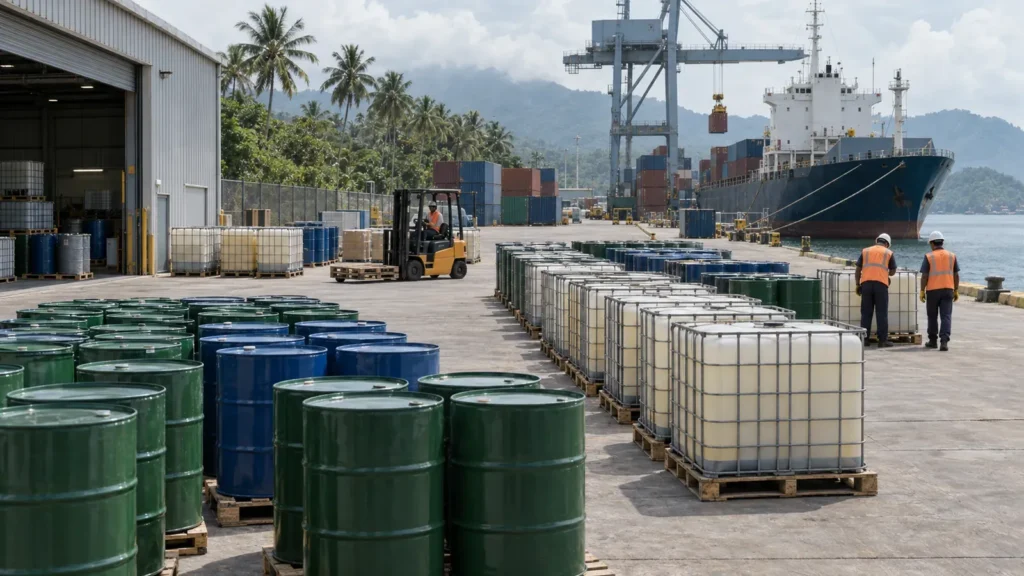
Yes: an export restriction can cut the supply of a feedstock, and it has already happened. Indonesia’s Ministry of Trade issued Regulation No. 2/2025 in early January 2025, and that rule requires exporters of used cooking oil (UCO) and palm residues to obtain an export allocation. The allocation is a state permission for tonnes that may leave. Jakarta has not lifted the suspension of permits since. One rule, one date, no reopening announced. Against uco export restrictions, what protects a project is not a second supplier. It is an allocation clause, more than one jurisdiction, and a price tied to a published reference. That is why I start from the regional feedstock picture.
This is a structuring note for a developer at pre-FID stage, not a forecast. I use only the published record cited in the sources block at the end. In addition, I keep each claim attached to its source. The question stays narrow: what does an export allocation rule do to my supply contract?
In short
- The rule: Ministry of Trade Regulation No. 2/2025 requires an export allocation for UCO, POME and HAPOR.
- The gap: Indonesia has yet to resume issuing export permits since 8 January.
- The volume: exports of UCO and palm residue reached 3.95 million metric tons from January to November 2024, still 13.75% down on the same period of 2023.
- The draft: an allocation obligation, a volume warranty built around state permission, a specification clause and also a published price reference.
- The watchlist: export levies, dated blending mandates and also the record of allocations.
In this article
The short answer: yes, one regulation moved the market
The Indonesian Ministry of Trade started to curb exports of UCO, palm oil mill effluent (POME) and high acid palm residue (HAPOR) in early January 2025 through Ministry of Trade Regulation No. 2/2025. Its aim is to keep enough raw material at home. That covers domestic cooking oil and biodiesel under the new B40 blend mandate. The regulation takes effect immediately and requires every exporter of palm oil residue and UCO, including POME, to acquire an export allocation at a meeting of officials of ministries such as trade and the ministry coordinating food affairs. Indonesia has yet to resume issuing export permits since the suspension started on 8 January.
Exports of UCO and palm oil residue from January to November 2024 stood at 3.95 million metric tons, down 13.75% from the corresponding period of 2023 (USDA Foreign Agricultural Service; Reuters; Argus).
What this means for you: I do not model this as a temporary outage. This is because it arrived with a stated reason, a stated scope and no announced reopening date.
What an allocation rule actually changes for a contract
An export allocation is a state permission, not a volume a seller can promise. The Ministry of Trade assesses reasonable capacity for palm waste exports at around 300,000 MT and treats exports above that benchmark as a mixture practice, blending crude palm oil with POME to circumvent the export levy. In September 2024 the export levy for palm waste products rose to the CPO levy level. That came four months before the curb. Mill operators report that the price of HAPOR has dropped significantly. In addition, they have had trouble selling their oil (USDA Foreign Agricultural Service). A volume warranty written on ownership alone fails: the seller still owns the tonnes.
However, the state decides how many may leave. I write the warranty around the permission and keep the chain readable through mass balance. The method mixes certified material, and the chain tracks the qualifying volume. The sustainability criteria then decide what counts as waste, including under Annex IX, the EU list of waste and residue feedstocks.
What this means for you: I sign no warranty that outruns the allocation the ministry has actually granted.
Where Indonesian volumes sit in world UCO trade
Indonesia does not ship UCO into a vacuum. Its UCO export destinations shown for 2019 to January-November 2024 were Malaysia, Singapore, the Netherlands, the United States and Spain. China, Indonesia and Malaysia together increased collection of waste cooking oil to around 4 million tonnes in 2023, with over three-quarters supplied by China alone, and Malaysia already exports three times more UCO than it collects. Across the six major Asian collectors, annual collection sits at an estimated 3,700 to 5,000 kilotonnes. In addition, intra-Asia trade makes origins hard to trace because Malaysia acts as a hub that both imports and exports large quantities.
Imports reached 80% of the EU’s UCO biofuels, mostly from China and Malaysia (USDA Foreign Agricultural Service; Transport & Environment; ICCT). The pull behind those flows comes from the SAF mandates each buyer jurisdiction writes into law.
What this means for you: I map every origin against every intermediate hub before I agree a delivery point. This is because the documentation will describe the hub rather than the mill.
How I would read the warning signs before they arrive
Domestic fuel mandates are dated and public, which makes them the easiest signal to watch. Indonesia moved to a 40pc blend under B40 starting from February 2025 and targets B50 for the second half of 2026. A food programme under pressure matters as much: the Minyakita programme’s prices soared by 20 percent over the last 12 months. In addition, protecting it was one of the stated reasons for the export curbs. The levy change of September 2024 came four months before the export ban, so the fiscal step preceded the trade step. Domestic absorption grows as well: Pertamina has been trialling SAF production through co-processing UCO at its Cilacap refinery since the second quarter of 2025, and Indonesia targets the production of 1mn kilolitres/yr SAF by 2030 (Argus; USDA Foreign Agricultural Service). I read all of it as policy risk with a public calendar.
What this means for you: I put these dates in the risk register with an owner against each one. In addition, I re-read them whenever a levy or a blend target moves.
What the buyer's market requires regardless of the export rule
The buyer’s market is written in law, not in a supply contract. ReFuelEU aviation sets a 2% SAF share at EU airports from 2025, rising to 70% from 2050, and 1.2% synthetic aviation fuel from 2030, rising to 35% from 2050. Its definition of sustainable aviation fuel covers advanced biofuels from part A of annex IX of the RED, biofuels from oils and fats in part B, synthetic aviation fuels and recycled carbon aviation fuels, with volumes reported through the Union database for biofuels. Under RED II, annex IX part B caps waste oils such as UCO at 1.7%. That limit applies to road and rail energy, and the revision would extend it to all transport energy.
Singapore targets 1% SAF for all departing flights from 2026, rising to 3 to 5% by 2030, South Korea and Indonesia require 1% from 2027. In addition, Japan sets 10% for domestic airlines by 2030 (European Commission; ICCT; IATA). The dates are fixed, so the price I underwrite is the variable.
What this means for you: I treat the mandate dates as the floor of demand and price the feedstock against them, never against a single origin.
Three ways a supply promise fails after a restriction
First, the tonne is physically there and cannot leave. Indonesia has issued no permit for crude POME or UCO since 8 January. In addition, the export pause helped drive waste oil prices in the region to three-year highs in September. Second, the seller substitutes the material. Refined POME oil exports totalled 440,000t in January to November. By contrast, no refined POME oil left the country in 2024 before the pause. As a result, the specification on the contract changes hands. Third, the paperwork cannot follow the tonne: intra-Asia trade makes origins hard to trace because Malaysia acts as a hub for large volumes, and Malaysia exports three times more UCO than it collects (Argus; ICCT; Transport & Environment). None of these arrives as a clean force majeure event, and a supplier can be willing, solvent and certified and still fail on any one of them.
What this means for you: I write three separate protections. One covers the permit. Another covers the specification. A third covers the origin record, because no single clause covers all three.
The order I would run the work in
I start from the permission, not from the price. First I confirm which ministry issues the export allocation, and how often. Second I split the contracted volume across at least two jurisdictions, so one suspension does not stop the plant. Third I tie the price to a published assessment instead of a fixed number. Only after those three steps do I match volume to the plant’s throughput. In addition, I keep the feedstock supply work sequenced behind them. Two facts anchor the order. The Ministry of Trade treats exports above around 300,000 MT of palm waste product as a mixture practice. As a result, a headline volume can be the wrong number to underwrite.
The EU market alone takes a 2% SAF share from 2025 rising to 70% from 2050. Therefore, demand does not disappear when one origin closes (USDA Foreign Agricultural Service; European Commission).
What this means for you: I settle permission, jurisdiction split and price reference in that order. In addition, I sign the volume only after all three are on paper.
How I would run this if it were my file
I check my own assumptions against the published record before I send a term sheet. From January to November 2024 Indonesia exported 3.95 million metric tons of UCO and palm oil residue, down 13.75%. Indonesia has issued no permit for crude POME or UCO since 8 January. Meanwhile, refined POME oil exports totalled 440,000t over January to November, and none shipped in 2024 before the pause. The Ministry of Trade’s reasonable capacity benchmark sits at around 300,000 MT. In addition, the levy on palm waste products has been aligned with the crude palm oil levy since September 2024. Collection across the six major Asian collectors runs at an estimated 3,700 to 5,000 kilotonnes a year. On the demand side, 2% of SAF at EU airports is required from 2025, rising to 70% from 2050 (Reuters; Argus; USDA Foreign Agricultural Service; ICCT; European Commission).
What this means for you: I keep these figures next to the term sheet. I refresh them whenever a levy, a blend target or an allocation decision moves.
Sources
- USDA Foreign Agricultural Service, 12 February 2025.
- Reuters (Advanced BioFuels USA reprint), 8 January 2025.
- Argus, 15 December 2025.
- ICCT, February 2022.
- Transport & Environment, June 2024.
- European Commission, 16 November 2026.
- IATA, September 2025.
Frequently asked questions
Can an export ban really stop my SAF feedstock from arriving?
In practice, yes. Since early January 2025 exporters of UCO, POME and HAPOR must obtain an export allocation under Ministry of Trade Regulation No. 2/2025, Indonesia has yet to resume issuing export permits since the suspension started on 8 January, and that pause was a key factor in driving waste oil prices in the region to three-year highs in September. A restriction does not have to be called a ban to stop a shipment.
Which country put my project at risk from UCO export restrictions?
Indonesia is the concrete case: its exports of UCO and palm oil residue reached 3.95 million metric tons from January to November 2024, down 13.75%, with destinations in Malaysia, Singapore, the Netherlands, the United States and Spain. Malaysia is the structural case, because it already exports three times more UCO than it collects, so a rule at either origin moves the same molecules.
What clause covers an export allocation in a supply agreement?
Four things. The allocation obligation itself, stated as a condition precedent. A volume warranty drafted around what the state permits rather than what the seller owns. A specification clause covering substitution with refined material. A price reference tied to a published assessment instead of a fixed number.
How do I monitor this between FID and start of operations?
I watch three public series: export levies on palm waste products, which have been aligned with the crude palm oil levy since September 2024; dated blending mandates, from B40 starting February 2025 to B50 targeted for the second half of 2026; and the tender record of allocations issued by the ministries.
Not sure your project would survive a credit conversation?
A short call is usually enough to see where your project stands.
If you are at pre-FID stage, that work runs through investor introductions and the conversations around them. The supply side settles before the term sheet, and I start from the permission rather than from the price.
I do not provide investment advice or arrange investments. I act as a strategic advisor and facilitator.

Alex, Founder of WeConnect Asia
I help low-carbon fuel and carbon removal project developers in Southeast Asia secure the commercial and financial partners needed to reach FID.
Related articles

Pitching a Climate Tech Company to Strategic Investors: What the Corporate Has to Believe Before It Writes a Cheque
How to pitch a climate tech company to strategic investors: the metric cluster, the readiness evidence and the ask that corporates fund.

Biomethane: What It Is, How It Is Made and Who Buys It
Biomethane is biogas cleaned to pipeline quality. I explain how it is made, how it differs from biogas and who buys it in Southeast Asia.

CO2 Sourcing for e-SAF Projects: What the Rules Allow and What the Contract Must Say
Biogenic CO2, direct air capture or industrial flue gas: which sources an e-SAF plant may use, what they cost and which contract terms make the fuel certifiable.

Operating Performance Guarantees for SAF Plants: What Lenders Ask For
Minimum guarantees, performance damages, retesting and who stands behind them: the operating guarantees a SAF plant needs to keep debt and offtake intact.

EPC and Construction Risk in SAF Plants: What a Lender Actually Tests
FEED scope, convertible EPC, performance guarantees and damages caps: the construction risk questions a SAF project must answer before financial close.

Matching Feedstock and Offtake Risk Back-to-Back in a SAF Project: How Lenders Read the Chain
Lenders do not buy a feedstock plan and an offtake plan separately. They buy the link between the two, and the link is where most SAF files break.