
Home » EPC and Construction Risk in SAF Plants: What a Lender Actually Tests
EPC and Construction Risk in SAF Plants: What a Lender Actually Tests
10 min read · Nov 2, 2026 · By Alex
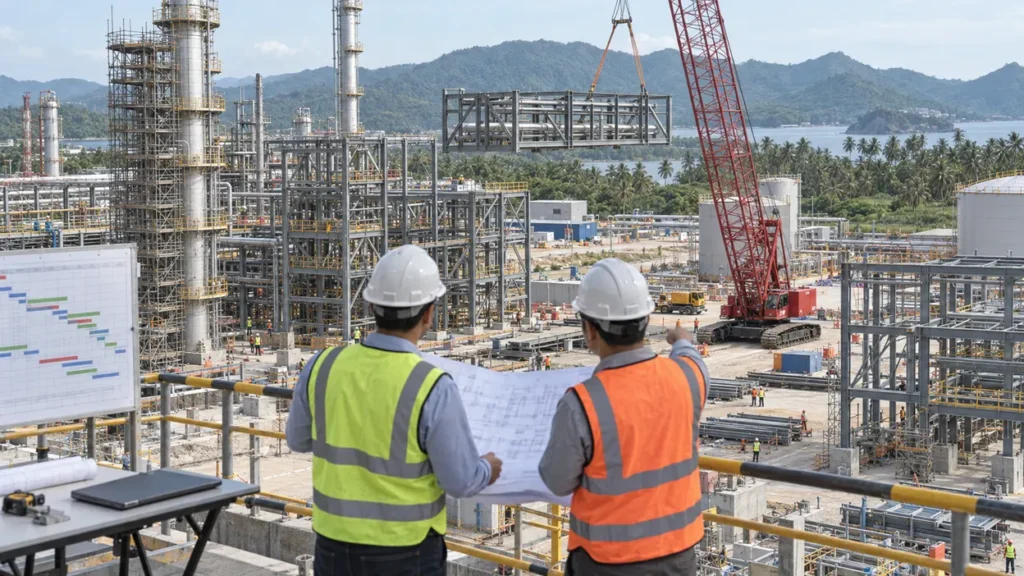
A SAF plant is a process plant, and it gets financed on the strength of its construction contracts. Furthermore, The risks that decide whether the debt closes are scope and interface gaps between the FEED (front-end engineering design), the process licence. Also, the EPC (engineering, procurement and construction contract) packages. In fact, Schedule and cost overrun; whether the contractor’s guarantees match what the offtake (the contract under which a buyer takes the plant’s output). Also, the lenders need; and who pays when the technology disappoints. In addition, I set those questions against the way risk is allocated across a SAF project. However, That is the frame for SAF EPC construction risk at FID (final investment decision) stage.
I write for a developer or project director in Southeast Asia holding limited recourse debt. Also, a contractor’s draft; three of the five sources are older than two years or undated, and I flag them where I use them.
In short
- Contracting model: decide before tender whether you run a classic FEED then bid or a two-stage conversion, because that choice sets who holds pricing power.
- Process licence: confirm the IP grant covers the intended use and life of the plant, carries performance guarantees, and does not lock out FEED and EPC bidders.
- Conversion point: a sole-source contractor can push price and risk onto the sponsor exactly when you sign the EPC.
- Guarantees: baseline guarantee, minimum guarantee, damages rate, cap and retest window on one page, matched to the financial model.
- Credit test: bankable process guarantees at commissioning and offtake covering 70 to 80 percent of annual capacity.
In this article
What construction risk means on a SAF plant
A green fuel project is a process plant, so downstream oil and gas practice on folding the process technology into the subsequent construction contracts applies here (Clifford Chance, July 2024, a source more than two years old). Therefore, That is why I test boundaries before price: who owns the design, who owns the guarantees, and who owns the consequence when the plant misses its rate. Moreover, Where clear boundaries between the scopes of the licensor, the FEED engineer. Also, the builder cannot be maintained, sponsors must stay alert to the risk of merging the roles (Clifford Chance, July 2024). Therefore, A merged role is where a lender sees a hole: the party that shaped the design would answer for it.
What this means for you: draw the interface map before you price the job, because a scope gap that survives to financial close turns into a condition, a reserve, or less debt.
FEED, process licences and the shape of the contract
In power and oil and gas the works are typically split into single or multiple EPC packages. Therefore, This requires basic engineering, called a Minimum Functional Specification or front-end engineering design, before the EPC contract can be tendered for a lump sum. Furthermore, A FEED study can take 9 to 15 months (Clifford Chance, July 2024). For example, For established technologies the process is protected by third-party intellectual property held by licensors such as Haldor Topsoe, Johnson Matthey, Honeywell UOP and Axens. Instead, A competitive tender for the process technology is rare, licensors often insist on their own standard forms, and because they enter early with feasibility work or long lead equipment they may hold a strong negotiating position (Clifford Chance, July 2024).
I insist the licence keeps an IP grant broad enough for the intended use and the intended life of the plant without hair-trigger termination, carries performance guarantees covering production, product quality and utility consumption, protects the project company from third-party IP claims, and does not unduly restrict the pool of FEED and EPC contractors.
What this means for you: negotiate the process licence inside the construction risk package, as set out in how I read technology risk on a SAF project, because harmonised liability caps across the licence, the equipment supply and the catalysts set the ceiling on what the plant’s guarantees are worth.
Fast-track procurement: pre-construction services and convertible EPC
Two-stage contracting, or convertible EPC, appoints a single contractor to carry out the FEED under a separate pre-construction services contract (PCSA), during which it develops the design, runs site investigations for ground conditions and produces open-book estimates with cost breakdowns; at a pre-agreed point the parties agree a lump sum price on the latest estimate and sign the EPC covering design, construction, commissioning and completion (Clifford Chance, July 2024, a source more than two years old). Meanwhile, It condenses the procurement timetable by removing the separate tender and evaluation phase, which can last on average 3 to 12 months. Also, The conversion is where sponsors lose ground.
In a sole-source position the contractor can push price and risk onto the sponsor, including failures in the process technology, while the lump sum EPC with guaranteed productivity and yield stays out of reach where the technology is novel or untested at scale (Clifford Chance, July 2024). In addition, I hold competitive tension with deviations tendered on both contracts, a fixed EPC margin, part of the pre-construction fee withheld until the EPC price is agreed, negotiation milestones during that phase, retained rights in the FEED deliverables, and a no-loss right to walk away if talks collapse.
What this means for you: agree the conversion mechanics before the FEED starts, using the SAF project timeline to FID as the sequence, because the price is then set when you have least bargaining power.
Guarantees, damages and caps
Performance guarantees and performance liquidated damages (PLD) are an essential element of most EPC contracts. Meanwhile, They make guaranteed performance, quality and output enforceable and set baseline capacity, output or efficiency expectations that reassure owners, financiers and offtakers the plant will operate as intended so financing obligations can be paid and offtake volumes generated (Husch Blackwell, May 2025). Most contracts carry a minimum performance guarantee, the absolute lowest acceptable level, tested against 98 percent of nameplate capacity with a minimum of 93 percent. Damages are a fixed sum for each fraction of a percentage point below it, 10,000 US dollars per fraction of a point in the worked example. This gives 120,000 US dollars of exposure (Husch Blackwell, May 2025).
Contractors cap that exposure at 5 to 25 percent of the contract price, with most projects at 10 to 15 percent of the EPC price. Also, a cap usually does not free a contractor that misses the minimum guarantee, because that failure triggers reperformance instead (Husch Blackwell, May 2025). Missing the guarantee is often a condition to substantial completion. Therefore, the same failure also starts delay damages and possible double liability. Meanwhile, lenders want bankable process guarantees from the licensors and EPC contractors at commissioning (World Economic Forum with Kearney, February 2025).
What this means for you: put the guarantee, the minimum, the damages rate. Also, the cap on one page and test them against the financial model before signature.
What the credit committee tests
During construction, delays, cost overruns and technical difficulties persist, revenue risk continues, and overruns could strain the developer’s financial resources and affect investor confidence (World Economic Forum with Kearney, February 2025). A deal must be structured for a risk profile that supports limited recourse, highly geared debt, and certain SAF risks may represent a deviation from core project finance risk allocation principles, so sponsors manage them with tailored feedstock, construction and offtake strategies (Akin Gump, an undated source consulted in 2026), keeping the base case economics of the borrower SPV (special purpose vehicle) credible across downside scenarios. Offtake must be reliable: investors often want 70 to 80 percent of annual capacity covered and some lenders want 100 percent of production across the loan tenor, since airline credit ratings are on average lower.
The five phases of the SAF refinery lifecycle end with construction and commissioning, and first-of-a-kind (FOAK) facilities can take up to 8 years to become operational (World Economic Forum with Kearney, February 2025).
What this means for you: check your equity case for SAF in Southeast Asia against the offtake you hold, because a construction overrun lands on the sponsor first.
What the EPC does not cover
Interfaces keep their own risk: the processing and refining facilities needed at the anticipated scale do not currently exist. Therefore, supply chain dependencies must be strong enough for early projects, especially where the producer is not building a full-chain integrated solution (Akin Gump, undated). Getting the fuel to the offtaker is separate work. No dedicated SAF pipeline infrastructure exists, early volumes are uncertain, and weak logistics raise the risk that the offtaker fails to take neat SAF at the point of production (Akin Gump, undated). Capital intensity also differs by route, with power-to-liquid (PtL) carrying the highest requirements because it depends on renewable electricity, electrolysis and CO2 capture. Meanwhile, HEFA is the most mature. However, feedstock constrained (World Economic Forum with Kearney, February 2025), and e-SAF production costs run 4 to 10 times conventional jet fuel (Renewable Carbon News, November 2024, older than two years).
What this means for you: budget for e-SAF project finance as a separate workstream, because logistics, third-party refining capacity and route capital cost all sit outside the EPC price.
Contracting strategy, and the people I want in the room
The construction package is negotiated once and lived with for years. Therefore, i put four things in writing early: the interface matrix between licensor, FEED engineer, equipment suppliers and builder; the harmonised liability caps; the flow-through of performance guarantees from an equipment supplier responsible for a critical component into the EPC contract, or direct guarantees where the owner buys that equipment itself (Husch Blackwell, May 2025); and the alignment of every guarantee with the financial model and the financing agreements so no liability gap falls back on the owner (Husch Blackwell, May 2025).
I also finish the testing exhibit before signature: when the test begins, how long it lasts, and the reporting conditions. On the market side, expect fast-track structures to remain a feature of this sector for the next 12 to 18 months, given the dominant position of licensors and equipment suppliers (Clifford Chance, July 2024).
What this means for you: I keep contracting and risk management on one page with the interface matrix. The caps and the guarantee flow-through, so nothing is negotiated twice.
How I would run this if it were my file
I would decide the contracting model before the lenders ask. Classic FEED then tender, or pre-construction services with a conversion, and be honest about which one keeps competitive tension. Price the schedule as carefully as the price: a FEED of 9 to 15 months plus a tender phase of 3 to 12 months is a real part of the timetable, and compressing it has a cost. I put the performance guarantee, the minimum guarantee, the damages rate, the cap. Also, the retest window on one page, then check it against the offtake volumes and the lender’s coverage expectation of 70 to 80 percent of annual capacity. Where the technology is unproven at scale. The answer is not a stronger guarantee but a stronger balance sheet behind it or a support instrument.
The World Economic Forum identifies ten financial levers for that, including strategic investments by airlines, airports, OEMs and energy players that provide demand assurance and long-term binding offtake agreements that provide stable revenue and reduce demand uncertainty (World Economic Forum with Kearney, February 2025).
What this means for you: write the guarantee schedule. Also, the schedule itself into the same model, because on a SAF file the date. Also, the rate are one risk.
Sources
- Akin Gump, undated, consulted 15 November 2026.
- Clifford Chance, July 2024, older than two years.
- World Economic Forum with Kearney, February 2025.
- Renewable Carbon News, 15 November 2024, older than two years.
- Husch Blackwell, May 2025.
Frequently asked questions
Is a lump sum EPC contract enough for a SAF project to get financed?
It is the starting position lenders want for limited recourse project finance: one lump sum contract covering all the works with the contractor guaranteeing productivity and yield. It is hard to obtain where the technology is novel or untested at scale or where few credible bidders work on genuine EPC terms, and it still has to sit alongside reliable offtake covering 70 to 80 percent of annual capacity.
What is the difference between a pre-construction services contract and a convertible EPC?
A pre-construction services contract is the first stage of two-stage or convertible procurement: one contractor does the FEED, develops the design, runs site investigations and produces open-book estimates. The conversion is the point at which a lump sum price is agreed on the latest estimate and the EPC is signed, and it is also the point where the contractor, holding a sole-source position, can push price and risk onto the sponsor.
Who should give the performance guarantees, the licensor or the EPC contractor?
Saf epc construction risk: performance guarantees
Both, with flow-through. The process licence should carry performance guarantees covering production, product quality and utility consumption, the EPC carries the capacity and output guarantees with liquidated damages, and where an equipment supplier provides a critical component the guarantees must either come from that supplier and flow through the EPC or be negotiated directly with it if the owner buys the equipment.
What happens if the plant misses its performance guarantee?
The usual pattern is a minimum guarantee that is a hard obligation: failing it can make the contractor pay all costs to reach the minimum, including a replacement contractor, and it is often a condition to substantial completion, so failure also triggers delay damages. A cap of 10 to 15 percent of the EPC price is common, but caps generally do not cover a missed minimum guarantee, and owners should align the guarantee with the financial model so no gap falls on them.
Not sure your project would survive a credit conversation?
A short call is usually enough to see where your project stands.
If you want a read on where your construction package stands before financial close, I work through it alongside investor introductions and tell you plainly which of these risks is still open.
I do not provide investment advice or arrange investments. I act as a strategic advisor and facilitator.

Alex, Founder of WeConnect Asia
I help low-carbon fuel and carbon removal project developers in Southeast Asia secure the commercial and financial partners needed to reach FID.
Related articles

Pitching a Climate Tech Company to Strategic Investors: What the Corporate Has to Believe Before It Writes a Cheque
How to pitch a climate tech company to strategic investors: the metric cluster, the readiness evidence and the ask that corporates fund.

Biomethane: What It Is, How It Is Made and Who Buys It
Biomethane is biogas cleaned to pipeline quality. I explain how it is made, how it differs from biogas and who buys it in Southeast Asia.

CO2 Sourcing for e-SAF Projects: What the Rules Allow and What the Contract Must Say
Biogenic CO2, direct air capture or industrial flue gas: which sources an e-SAF plant may use, what they cost and which contract terms make the fuel certifiable.

Operating Performance Guarantees for SAF Plants: What Lenders Ask For
Minimum guarantees, performance damages, retesting and who stands behind them: the operating guarantees a SAF plant needs to keep debt and offtake intact.

EPC and Construction Risk in SAF Plants: What a Lender Actually Tests
FEED scope, convertible EPC, performance guarantees and damages caps: the construction risk questions a SAF project must answer before financial close.

Matching Feedstock and Offtake Risk Back-to-Back in a SAF Project: How Lenders Read the Chain
Lenders do not buy a feedstock plan and an offtake plan separately. They buy the link between the two, and the link is where most SAF files break.