
Home » CO2 Sourcing for e-SAF Projects: What the Rules Allow and What the Contract Must Say
CO2 Sourcing for e-SAF Projects: What the Rules Allow and What the Contract Must Say
10 min read · Nov 2, 2026 · By Alex
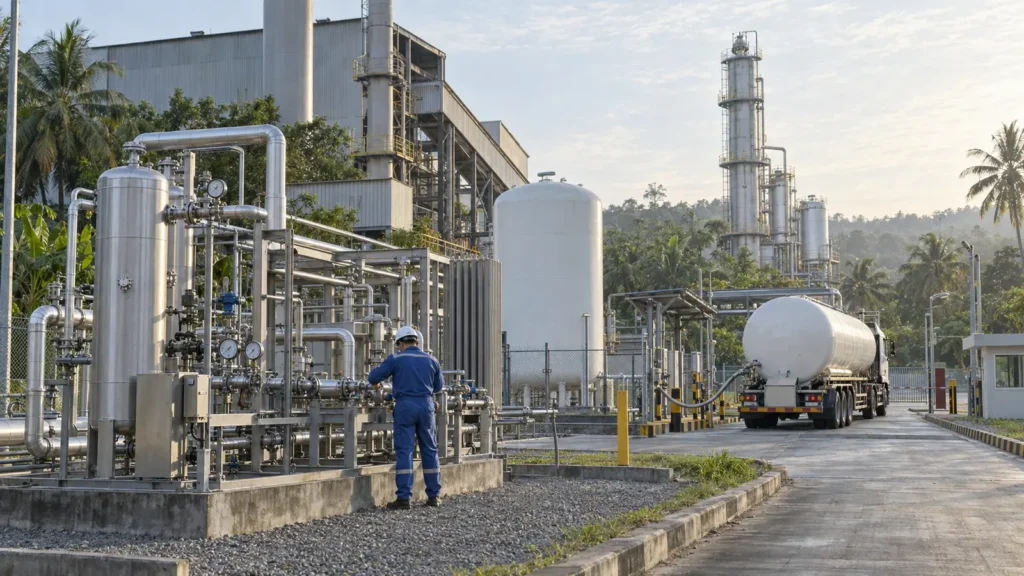
The carbon you buy for an e-kerosene plant comes from capture, contracted well before the plant runs. It is not a commodity you pick up on the spot market. The EU delegated acts decide whether your fuel qualifies as a renewable fuel of non-biological origin (RFNBO). Under those rules, the CO2 must come from biogenic sources or from direct air capture (DAC). Industrial point-source CO2 is only temporarily eligible. It qualifies until 2036 for power generation sources and until 2041 for other industrial processes. It applies only when an effective carbon pricing system covered the emissions. That is the direct answer to e saf co2 sourcing. Also, I give it before anything else because it decides who you can legally sign with.
The wider funding question sits on its own parent page, e-SAF project finance, which carries that question with the drawdown structure behind it. However, on my file the carbon question comes before the money question.
I write this for a developer standing before FID, where FID means final investment decision. I write it also for the project CFO. That CFO has to show a lender that the carbon is real, contracted and certifiable in sustainable aviation fuel. Two terms I use throughout. An offtake is the contract under which a buyer takes the plant’s output. CapEx means capital expenditure.
The rules at a glance
In short
- Eligible sources: biogenic CO2 and DAC qualify under the delegated acts. Industrial point-source CO2 qualifies only until 2036 for power generation sources and until 2041 for other industrial processes. The condition: an effective carbon pricing system must cover those emissions.
- Cost ladder: capturing biogenic CO2 sits under 100 euros per tonne. DAC costs 600 to 1,000 US dollars per tonne captured.
- Contract form: a supply and transport agreement with a capture operator or an aggregator. It sets volume, delivery point, transport, purity and claims.
- Title and claims: each tonne carries a single claim only, written as a warranty that survives an audit.
- Scale pressure: total demand across e-methanol, e-ammonia and e-fuels could reach between 430 and 600 million tons by mid-century.
In this article
What an e-SAF plant actually buys when it buys carbon
The carbon you buy comes from capture, contracted in advance. It is not a commodity picked up on the spot market. The EU delegated acts govern whether your fuel counts as an RFNBO. Under those acts, the CO2 must come from biogenic sources or from direct air capture. Industrial point-source CO2 is only temporarily eligible. It qualifies until 2036 for power generation sources and until 2041 for other industrial processes. It applies only when an effective carbon pricing system covered the emissions. For example, the Commission treats that system as the EU ETS, the UK ETS and the Swiss ETS.
Industrial CO2 lacks long-term regulatory certainty, and DAC stays costly and commercially limited. As a result, most e-kerosene developers worldwide currently rely on biogenic CO2. The commercial form of the deal is a supply and transport agreement with a capture operator or an aggregator. The aggregator builds, owns and operates capture units at waste and biomass incineration sites. It liquefies the gas and delivers it to your gate on a schedule your plant can run against.
What this means for you: write the eligibility category into your longlist before you compare prices. Instead, drop any source whose category you cannot defend to a certifier.
The three routes to a tonne of CO2, and what each one costs
Biogenic sources are the main commercial route. Specifically, bioethanol fermentation is the main commercial source today. Biogas upgrading, biomass-fired power plants, pulp and paper mills and waste incinerators are also eligible. The capture cost of biogenic CO2 sits under 100 euros per tonne. The CO2 qualifies provided the biomass meets the sustainability and greenhouse gas saving criteria of the Renewable Energy Directive.
By contrast, DAC is fully eligible, infinitely scalable, and costs 600 to 1,000 US dollars per tonne captured. Industrial point sources such as cement and steel are temporarily eligible under the conditions above. In practice, that puts an EU-compliant project drawing on a non-European flue gas on thin ground. The funding route around this choice is set out in how to finance a SAF project.
What this means for you: I would price the three routes as one portfolio question. Biogenic supply can carry the early years, while DAC absorbs the growth volumes your mandate will eventually demand.
The supply contracts that are already on the record
Norsk e-Fuel signed a CO2 supply and distribution agreement with Carbon Centric for its Alpha plant in Mosjoen, Norway. It covers 130,000 tons of CO2 annually. Logistics run over road and rail on a build, own and operate model at waste and biomass incineration sources. The deal is part of a target to secure an annual supply of 700,000 tons by 2030. Carbon Centric’s chief commercial officer also described a related commitment to biogenic CO2 volumes exceeding 1 million tons. I flag that this report dates from March 2024 and is now older than two years.
Developer Hy2gen has secured half of the biogenic CO2 required for its 75,000 tonne-per-year e-SAF plant in southern France. Sources describe it as a 390MW project. That July 2026 page sits behind a paywall, so I have used only its headline and opening paragraph. Where feedstock contracts sit in your own file: feedstock supply.
What this means for you: read both deals as templates for volume commitment and delivery method. Then check that your own agreement names the road and rail legs. The logistics clause decides landed cost as much as the capture plant does.
Carbon title, claims and the double-counting trap
In fact, the cheapest, highest-purity biogenic CO2 is fermentation off-gas from existing ethanol plants. The industry widely treats it as waste. The work in a supply agreement centers on carbon title. Assign each ton strictly to a single claim: 45Q, fuel carbon intensity or durable removal. One ton claimed twice fails certification. 45Q sets an 85 US dollars per ton value floor. Developers must therefore secure explicit ownership allocations in supply agreements before transport constraints or pipelines consolidate the market.
What this means for you: I ask for title and claim allocation as a warranty rather than as a recital. A certification team can then trace each tonne back to one owner and one claim years after signature.
Why CO2 turns into a bottleneck as the plants scale
The same rules that decide your supplier therefore decide the market. Europe has a substantial theoretical biogenic CO2 supply, estimated at around 334 million tons a year by 2050. Analysts expect the ReFuelEU e-kerosene mandate to require roughly 120 million tons of CO2. Total market demand across e-methanol, e-ammonia and e-fuels could reach between 430 and 600 million tons by mid-century. Meanwhile, carbon capture and storage competes with carbon capture and utilisation for the same sources. A Commission report assessing credits for negative emissions is due by 31 July 2026. After that date, emitters may need a higher price to sell their CO2 for fuel instead of storing it.
The wider conversion chain is explained in power-to-liquid explained.
What this means for you: treat the CO2 counterparty as a scarce asset. Sign before the neighbouring e-methanol and e-ammonia plants do. Assume the storage option will bid your feedstock price up after the Commission report lands.
What I would put in the supply agreement
My list, in the order I would negotiate it: annual volume and delivery profile stated next to the price. A shortfall then has a remedy. Next come a defined delivery point and transport responsibility. Road and rail logistics decide landed cost as much as capture does. Then purity and moisture specification with rejection rights. Explicit carbon title and single-claim allocation comes next, written as a warranty that survives an audit. Also, add a term long enough to cover the plant’s ramp-up, with an alternate supplier named. Finish with change-in-law language covering the eligibility rules above.
The readiness file that this contract feeds is how to reach FID for a SAF project, and the certification chain behind it is renewable fuels of non-biological origin.
What this means for you: I negotiate the claim clause and the change-in-law clause before I negotiate the price. Those are the two clauses a certifier and a lender will test first.
What a lender tests in a CO2 file
Three questions start from the financing itself. First, does the volume stay contracted for the life of the debt? Second, is the supplier creditworthy enough to survive a price shock? Third, does the contract deliver certifiable claim allocation?
IATA reports that no commercial-scale e-SAF facilities are currently in operation. Also, that the risk of insufficient supply, particularly by 2030, is increasing. Meanwhile, analysts expect e-SAF to account for over 40 percent of total SAF needs by 2050. Production costs can be up to 12 times higher than conventional aviation fuel. Moreover, the same source notes that 40 of the 46 announced commercial-scale e-SAF facilities sit in Europe. Also, that globally only one project has reached FID to date.
European Business Magazine states the same point from the lender’s side. Power and CO2 supply risk need contracts, while price and duration risk need a market mechanism. By contrast, technology and execution risk belong with developers and equity.
What this means for you: in a credit paper, the CO2 file must answer those three questions itself. Attach the supply agreement rather than cross-reference it from the offtake section.
How I would run the CO2 workstream if it were my file
I would start with the rules before the price. A cheap tonne that fails the delegated acts is worthless in the blend. Specifically, I would qualify two suppliers, one fermentation-led and one aggregator across incineration and fermentation. Also, I would sign the first one early enough that nobody else has already committed the capture capacity. I would put the claim allocation clause in the supply agreement rather than in a side letter. I would also treat the CO2 file as part of the offtake conversation. A buyer’s certification team will read both.
What this means for you: fix the source, title and claim allocation on paper before you price the fuel. Instead, let the PPA and the offtake follow the carbon, not the other way round.
Sources
- gasworld, July 2026 (paywalled page: headline and opening paragraph read).
- Carbon Herald, March 2024 (older than two years).
- Biofuels Digest, undated 2026 guide, consulted 15 Nov. 2026.
- Transport and Environment, June 2025.
- IATA, 20 February 2026.
- European Business Magazine, updated 28 August 2026.
Frequently asked questions
Which CO2 sources can an e-SAF plant actually use?
Under the RFNBO delegated acts, biogenic sources and DAC qualify. Industrial point sources are temporarily eligible, until 2036 for power generation sources and until 2041 for other industrial processes, provided the emissions were covered by an effective carbon pricing system, which the Commission treats as the EU ETS, the UK ETS and the Swiss ETS.
Is biogenic CO2 cheaper than direct air capture?
Yes. Capturing biogenic CO2 costs under 100 euros per tonne, while DAC costs 600 to 1,000 US dollars per tonne captured, and DAC remains both costly and commercially limited.
What happens if the CO2 supplier sells the same tonnes to someone else?
That is the double-counting failure the contract must prevent: each ton has to be assigned to a single claim, such as 45Q, fuel carbon intensity or durable removal, so ownership allocations are written into the supply agreement. 45Q sets an 85 US dollars per ton value floor.
Can industrial flue gas CO2 be used in e-SAF?
Only temporarily and only under conditions. The source is eligible until 2036 for power generation sources and until 2041 for other industrial processes, and only when the emissions were accounted for upstream in an effective carbon pricing system, which for practical purposes excludes industrial point sources outside Europe.
Not sure your project would survive a credit conversation?
A short call is usually enough to see where your project stands.
If you are building an e-SAF project and you need a CO2 counterparty, a feedstock route or the supply picture behind them, start here: feedstock availability in Southeast Asia.
I do not provide investment advice or arrange investments. I act as a strategic advisor and facilitator.

Alex, Founder of WeConnect Asia
I help low-carbon fuel and carbon removal project developers in Southeast Asia secure the commercial and financial partners needed to reach FID.
Related articles

Pitching a Climate Tech Company to Strategic Investors: What the Corporate Has to Believe Before It Writes a Cheque
How to pitch a climate tech company to strategic investors: the metric cluster, the readiness evidence and the ask that corporates fund.

Biomethane: What It Is, How It Is Made and Who Buys It
Biomethane is biogas cleaned to pipeline quality. I explain how it is made, how it differs from biogas and who buys it in Southeast Asia.

CO2 Sourcing for e-SAF Projects: What the Rules Allow and What the Contract Must Say
Biogenic CO2, direct air capture or industrial flue gas: which sources an e-SAF plant may use, what they cost and which contract terms make the fuel certifiable.

Operating Performance Guarantees for SAF Plants: What Lenders Ask For
Minimum guarantees, performance damages, retesting and who stands behind them: the operating guarantees a SAF plant needs to keep debt and offtake intact.

EPC and Construction Risk in SAF Plants: What a Lender Actually Tests
FEED scope, convertible EPC, performance guarantees and damages caps: the construction risk questions a SAF project must answer before financial close.

Matching Feedstock and Offtake Risk Back-to-Back in a SAF Project: How Lenders Read the Chain
Lenders do not buy a feedstock plan and an offtake plan separately. They buy the link between the two, and the link is where most SAF files break.