
Home » Corporate SAF Buyers: Cargo, Logistics and Business Travel
Corporate SAF Buyers: Cargo, Logistics and Business Travel
10 min read · Oct 2, 2026 · By Alex
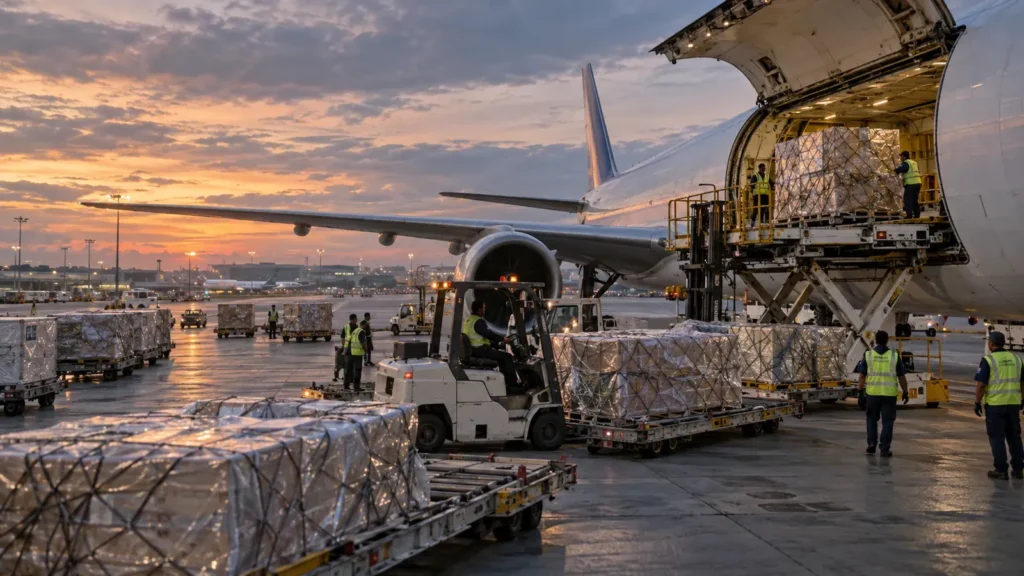
I track who pays for sustainable aviation fuel they never receive. Three kinds of business do it, and none of them takes delivery of a tanker. Book and claim is the accounting method that makes it possible: it separates the fuel from its environmental benefit. Corporate SAF buyers act in three roles: cargo and logistics companies that buy the Scope 3 reduction (the indirect emissions they cause outside their own operations) for freight they move, business travel programmes that buy certificates for their people’s flights, and buying platforms that aggregate many small buyers into one purchase. Every one of them buys a certificate rather than the physical fuel, and the signature only counts if the purchase survives the accounting rules that bind the buyer.
The demand side of aviation decarbonisation is where the money actually moves, and it moves through certificates rather than through tanker loads. I read it as a structuring question before I read it as a commercial one.
In short
- Three roles: cargo and logistics companies, business travel programmes, and platforms that gather many small buyers.
- The instrument: one certificate per metric ton of unblended, certified fuel, claimed only once.
- The trigger: the Science Based Targets initiative standard effective 1 February 2027, alongside compliance mandates.
- The premium: fuel priced at a factor of two above jet fuel, and higher where mandates apply.
- The proof: a dated record of issuance, transfer and retirement in the buyer’s name.
In this article
Three roles a corporate buyer plays
Book and claim lets the buyer and seller skip a shared physical supply chain. The buyer books a specific quantity of sustainable fuel at purchase, then claims the emissions reduction toward its sustainability targets.
Three roles fall out of that mechanism. Cargo and logistics companies buy the value of indirect reductions for the freight they move and pass those claims on to customers. Business travel programmes cover employee travel, which the World Economic Forum places in category 6 of scope 3 emissions. Shippers and freight forwarders can play a big role in cutting the carbon footprint of products shipped by air; the role of other players such as financiers, lessors or airports with scope 3 is also being explored.
Direct and indirect claims are bought separately: vehicle operators who purchase the fuel and receive certificates claim the reduction in their own direct emissions, while logistics companies buy the indirect reduction for their customers.
What this means for you: match the buyer to the claim it can retire. A freight buyer retires against goods it shipped, a travel programme against its own flights. Know which of the three roles sits behind a signature before you count it as demand.
What a corporate buyer actually purchases
A sustainable aviation fuel certificate (SAFc) represents the environmental attributes associated with one metric ton of unblended, certified sustainable aviation fuel. It conveys certified information about the associated physical fuel, such as its carbon intensity and its emission reductions compared with fossil jet fuel.
The physical product moves on a separate path. Sustainable aviation fuel is blended with conventional jet fuel to power aircraft, so the corporate buyer owns the benefit without ever owning the fuel. Under book and claim the fuel goes into the supply where it is delivered, while the reduction is sold as a certificate retired on the buyer’s behalf, so no one else can claim it.
That separation is the point. Corporate customers of aviation services able to pay the premium for SAF do not always have physical or financial control of their supply chains, and that gap is the reason the certificate is sold separately.
What this means for you: your buyer pays for one metric ton of certified environmental attribute at a time, not for a delivery. Ask for the carbon intensity figure and the certification scheme behind it before you count the demand.
What obliges them to buy
Two forces pull a corporate into this market. The Science Based Targets initiative published its Corporate Net-Zero Standard V2.0 on 11 June 2026, and it takes effect on 1 February 2027. Compliance mandates are the other force, and a buyer must confirm before purchase that the fuel behind a certificate was not already used to meet one.
The new standard introduces an implementation hierarchy. Direct action comes first: companies assess and implement direct action where feasible, such as flying less or booking shares of physical SAF, before relying on book-and-claim certificates, and only when activity-level solutions are structurally limited, with those limits evidenced, may they move to certificates.
Certificates are reported separately from the target itself. Targets and reduction claims rest on the physical inventory, which certificates sit outside, so they support a claim that the company contributes to decarbonizing aviation alongside direct action. That initiative is used by more than 11,000 companies worldwide.
What this means for you: a corporate signature now carries conditions. Expect the buyer to evidence that it flew less where it could, to report the certificate outside its target inventory, and to hold a retired record rather than an intention.
What the premium looks like on their budget
In 2025 SAF output is expected to reach 1.9 million tonnes, only 0.6% of total jet fuel consumption, and the premium adds USD 3.6 billion in fuel costs for the industry. SAF prices exceed fossil-based jet fuel by a factor of two, and by up to a factor of five in mandated markets.
No single buyer absorbs that alone, so the premium is spread. Book-and-claim attracts players throughout the value chain, allowing revenue diversification, and it spreads the SAF premium across a wider range of stakeholders. It is a carbon inset: the payment funds reduction inside the aviation sector, unlike an offset that funds work outside it.
For a project, long-term offtake agreements are the lever that carries a refinery to its final investment decision, and certificate revenue sits beside them. Supplier-corporate partnerships and collective procurement platforms are both gaining traction.
What this means for you: price the certificate premium before you set the budget, since certificates and carbon credits draw on the same money. Then separate a contracted corporate stream from a single pilot year.
What makes a corporate signature credible
The published risks on this side of the file are creditworthiness, the risk of buyers or producers defaulting, and lack of alignment on book-and-claim systems. All three sit against the price premium over conventional jet fuel, so the payment record matters as much as the claim.
The structural answer is a registry: a database that records the issuance, transfer and retirement of SAF certificates, thereby logging transactions. A registry is often needed for book-and-claim to deliver consistency and transparency, which is what prevents double-claiming and double-counting.
One registry has published volume behind it. Launched in December 2023 by RMI and the Environmental Defense Fund with the Sustainable Aviation Buyers Alliance and Energy Web, the SAFc Registry has onboarded more than eight fuel providers, five airlines and more than 30 corporate customers, facilitating the issuance of over 31,000 metric tons of SAFc representing more than 140,000 metric tons of abated aviation-related emissions.
What this means for you: ask for the registry record, not a sales deck. A credible signature shows issuance, transfer and retirement in the buyer’s name, with the volume tied to a stated period.
Where corporate demand breaks down
Three weak points sit in the demand column.
The accounting treatment is unsettled first. Whether the reported footprint stays the same when certificates are used is described as a gray area, with the Science Based Targets initiative expected to update on it, and no registry has its recognition yet.
Certificates are also not interchangeable. A certificate can carry the airline’s Scope 1 claim, the end user’s Scope 3 claim, or both, and many airline programs and intermediaries sell the Scope 3 part only. The reduction depends on certified carbon intensity and on the fossil baseline: CORSIA uses 89 gCO2e/MJ while the EU’s RED II, which ReFuelEU Aviation relies on, uses 94 gCO2e/MJ, so the same fuel shows a larger reduction against the EU baseline.
Supply is the third gap. Many airlines that have committed to use 10% SAF by 2030 will be forced to reevaluate those commitments, because SAF is not being produced in sufficient amounts.
What this means for you: a row like this is a weak input to bankability work until the footprint question is answered, the claim type is named and the baseline is stated.
The questions I ask before counting a corporate buyer
I run the same list on every row. I ask who retires the certificate and in whose name, whether the claim is Scope 1, Scope 3 or both, whether the fuel was already tied to a compliance mandate, which certification scheme sits behind the carbon intensity, and whether the activity falls inside the 12 months window unless a longer period is justified.
I ask for the registry record rather than a sales deck, and I check that the volume claimed never exceeds the buyer’s own activity. Certificates must match the fuel in the buyer’s inventory, come from a relevant fuel system, be quantified conservatively, and be serialized and retired in a secure registry.
Then I write the answer in one line per buyer. The line names the role, the claim type, the registry and the retirement date, and nothing else.
What this means for you: a buyer that cannot answer those questions in writing is not demand yet, it is a conversation. Keep the row, mark it open, and move on.
How I would build this list if it were my file
I sort the buyers by role first: cargo and logistics, business travel, then platforms, because the role decides which claim the buyer can retire. A freight forwarder and a travel programme do not retire the same thing.
I then mark the buyers whose purchase already passed an integrity check, because those are the rows that survive an audit. Matching the fuel, conservative quantification, serialization and retirement in a secure registry are the marks I look for.
I test the rows against published registry evidence rather than against announcements, since a registry shows issuance, transfer and retirement while an announcement shows intent.
I keep only the buyers whose payment can be shown to a lender as a documented, retired certificate, with a record that links back to the volume and the period.
What this means for you: build the list in that order and it becomes usable twice, once as a demand forecast and once as evidence in a financing file.
Sources
- RMI, 8 May 2025.
- Sylvera, 9 October 2026.
- DHL, updated July 2026.
- IATA, 9 December 2025.
- World Economic Forum, February 2025.
Frequently asked questions
What does a corporate SAF buyer actually purchase?
It purchases a sustainable aviation fuel certificate, which represents the environmental attributes associated with one metric ton of unblended, certified sustainable aviation fuel. Under book and claim the fuel goes into the aviation fuel supply where it is delivered, while the reduction is sold as an environmental attribute certificate and retired on a registry on the buyer’s behalf, so no one else can claim the same Scope 1 or Scope 3 reduction.
Do corporates sign long-term supply contracts or only buy certificates?
Both routes exist in the published record. Supplier-corporate partnerships and collective procurement platforms are both gaining traction, and book-and-claim allows buyers in one part of the world to pay for the green premium and receive the associated credit even though the physical SAF is used in another location. The certificate route still starts with a specific booking: the buyer books a quantity at the time of purchase and then claims the reduction toward its targets.
How much of a corporate aviation footprint can a certificate cover?
Up to its own activity, and no further. A certificate must never exceed the buyer’s activity volume, it must relate to activity within 12 months unless a longer period is justified, and it must match the fuel in the buyer’s inventory. Sylvera bought certificates for around 10% of its aviation emissions as a pilot, which is a fair picture of the scale a first purchase usually takes.
What disqualifies a corporate buyer during a credit review?
The published risks are creditworthiness, the risk of buyers or producers defaulting, and lack of alignment on book-and-claim systems. A reviewer also wants the registry record of issuance, transfer and retirement in the buyer’s name, so a claim without that record does not survive the review. Certificates that were already used to meet a compliance mandate, or that exceed the buyer’s activity, fail the same test.
Not sure your project would survive a credit conversation?
A short call is usually enough to see where your project stands.
If you want to test which of these buyers could actually carry a purchase for your project, request an introduction and I will walk the rows with you, role by role and claim by claim. I apply the same questions and the same registry test used above, then return a short list with every open item marked.
I do not provide investment advice or arrange investments. I act as a strategic advisor and facilitator.

Alex, Founder of WeConnect Asia
I help low-carbon fuel and carbon removal project developers in Southeast Asia secure the commercial and financial partners needed to reach FID.
Related articles

Pitching a Climate Tech Company to Strategic Investors: What the Corporate Has to Believe Before It Writes a Cheque
How to pitch a climate tech company to strategic investors: the metric cluster, the readiness evidence and the ask that corporates fund.

Biomethane: What It Is, How It Is Made and Who Buys It
Biomethane is biogas cleaned to pipeline quality. I explain how it is made, how it differs from biogas and who buys it in Southeast Asia.

CO2 Sourcing for e-SAF Projects: What the Rules Allow and What the Contract Must Say
Biogenic CO2, direct air capture or industrial flue gas: which sources an e-SAF plant may use, what they cost and which contract terms make the fuel certifiable.

Operating Performance Guarantees for SAF Plants: What Lenders Ask For
Minimum guarantees, performance damages, retesting and who stands behind them: the operating guarantees a SAF plant needs to keep debt and offtake intact.

EPC and Construction Risk in SAF Plants: What a Lender Actually Tests
FEED scope, convertible EPC, performance guarantees and damages caps: the construction risk questions a SAF project must answer before financial close.

Matching Feedstock and Offtake Risk Back-to-Back in a SAF Project: How Lenders Read the Chain
Lenders do not buy a feedstock plan and an offtake plan separately. They buy the link between the two, and the link is where most SAF files break.