
Home » Philippines SAF Policy: Incentives and a Plan, No Obligation Yet
Philippines SAF Policy: Incentives and a Plan, No Obligation Yet
10 min read · Nov 2, 2026 · By Alex
Across Southeast Asia I hear one question about the Philippines: is there a binding sustainable aviation fuel obligation I can count on? No. There is no commercial SAF manufacturer in the country, no official SAF policy support in place, and no domestic SAF production. The Philippines SAF policy I can rely on today is a set of incentives plus a plan: a roadmap (a published plan setting out routes and dates) covering four conversion pathways is still being drafted under the National Biofuels Board’s SAF Committee. The Department of Energy’s 2026 Fuel Transition Plan targets a 1% blending mandate (a required minimum share in uplifted fuel) by 2030 and 50% SAF use by 2050, so no legal obligation carries a date yet.
An incentive in this market is a tax or customs benefit offered by the state, and I count it as cost relief rather than as demand. That split, between what is signed and what sits only as a target inside a plan, decides everything at concept stage.
In short
- In force: The Biofuels Act of 2007 can carry a blending framework, and no SAF obligation is written into it.
- In drafting: The SAF roadmap covers four pathways and is still not finalized, after an initial mid-2024 target.
- State target: The Fuel Transition Plan aims at a 1% blending mandate by 2030 and 50% SAF use by 2050.
- Carrier demand: Philippine Airlines, Cebu Pacific and Air Asia have published SAF commitments, none of them statutory.
- Incentives: CREATE Act benefits cover tax and import costs, and I count them as cost relief, not revenue.
In this article
What the Philippines has actually put in force
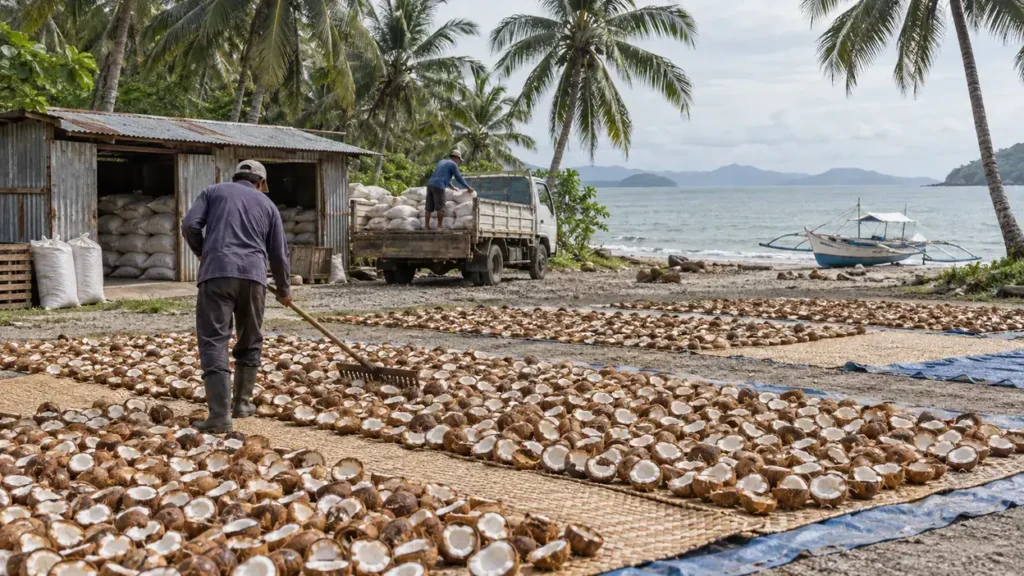
The Biofuels Act of 2007, cited as RA 9367, is the legal base I find. The Board of Investments states that it establishes a legal framework for SAF blending, and the Department of Energy issues its policies mostly in the form of Department Circulars. Its own purpose is narrower than aviation: it seeks to reduce dependence on imported fuels by promoting the development of and mandating the use of locally sourced biofuels, specifically bioethanol and biodiesel. What the country has not put in force is an aviation obligation. There is no commercial SAF manufacturer established in the Philippines, and there is no sustainable aviation fuel production at all. The USDA Foreign Agricultural Service reports that the country is exploring coconut oil as a potential feedstock (the raw material a fuel is made from) for future production, and that no official SAF policy support is in place while a roadmap is being developed. What this means for you: a biofuels statute can carry a blending framework and a set of tax benefits, but neither carries a SAF obligation today, so I do not underwrite one.
The roadmap, the committee and what is still unsigned
The country is developing a SAF roadmap covering four pathways: hydroprocessed esters and fatty acids, alcohol-to-jet technology, power-to-liquid, and fermentation-based SAF. The USDA Foreign Agricultural Service notes that the roadmap is yet to be finalized to craft the policies and framework that will help advance SAF in the country, and that it was initially targeted for mid-2024. The SAF Committee, established under the National Biofuels Board, includes DOE, CAAP, DOTr, DTI-BOI, PCA, SRA and DOST, with the Department of Energy leading it. The Civil Aviation Authority of the Philippines is currently assessing the potential SAF feedstock in the country for viability based on ICAO sustainability criteria. In its Fuel Transition Plan the Department of Energy is targeting a 1% SAF blending mandate by 2030. That is the shape of a blending mandate here: a target inside a plan, ahead of the instrument that would impose it. What this means for you: I treat the roadmap as a drafting exercise and wait for the signed instrument before I model compliance revenue.
What the airlines are already doing
Philippine Airlines, the country’s flag carrier, announced a 1 percent SAF target for 2026. That is a company commitment, not a state rule. In 2023 the airline operated an inaugural passenger flight using SAF from Singapore to Manila on an Airbus A321neo, utilizing a 35% SAF blend supplied by Shell Eastern Petroleum and produced by Neste. Cebu Pacific established a long-term strategic partnership with Shell Eastern Petroleum in 2022, and its SAF supply network today includes Shell Aviation, Itochu Corp. and Neste Corp. Air Asia aims to increase SAF usage across the entire group, including in the Philippines, from 2% (40.62 tonnes) in 2025 to 70% (1.90 million tonnes) by 2050. The Board of Investments also records 29 planned SAF production facilities in the Asia-Pacific region, of which only one is planned in the Philippines. Demand expressed by sustainable aviation fuel buyers in this market is a carrier commitment first, a state requirement second. What this means for you: I read these commitments as evidence of a buyer base, not as an obligation on paper.
Feedstock, and the biodiesel share already claimed
Domestic bioethanol uses sugarcane, mostly molasses, as a feedstock, while biodiesel is produced from coconut oil transesterified into coco methyl ester. At the National Biofuels Board meeting of 29 May 2025, members agreed to suspend the B4 blend in 2025 because of the high international price of coconut oil. As of March 2025 there were 14 accredited bioethanol producers with 508 million liters per year of capacity, and 14 accredited biodiesel producers with 815 million liters per year. The Philippine Coconut Authority investigates coconut oil as a potential SAF feedstock. I read that against feedstock availability across Southeast Asia, because a fuel mandate that competes with an existing biodiesel mandate meets the same pool of raw material. Norton Rose Fulbright adds the regional rule: feedstock-rich countries such as Indonesia, Malaysia and Thailand have the natural potential to become major SAF producers but currently lack the infrastructure or support mechanisms necessary to develop SAF projects at scale. What this means for you: I price feedstock against the biodiesel offtake already using the same pool, and I do not assume it is free.
What a finance plan has to survive
IATA states that any SAF mandates should be introduced only where the necessary market conditions, production capacity, infrastructure readiness and supportive policy measures are sufficiently in place. White & Case notes that government mandates for SAF usage may be a critical lever to drive investment by ensuring ongoing domestic demand, and that SAF remains more costly than conventional jet fuel. Norton Rose Fulbright observes that there is no established wholesale market for SAF with a predictable market price, so long-term offtake agreements with airlines stay critical. Bankability, for me, is when a lender lends against contracted revenue rather than a target. The Board of Investments offers incentives under the CREATE Act: an income tax holiday of 5 to 7 years, a 5% special corporate income tax after the holiday, enhanced net operating loss carry over, duty free importation and VAT zero rating on the sale of fuel or power generated. In the way I take a file to final investment decision, a plan target and an incentive schedule are two inputs, neither of them contracted revenue. What this means for you: incentives are a cost line, the target is a scenario, and only the offtake contract is revenue.
Where the risk sits today
SAF currently represents less than 1% of global aviation fuel use and is several times more expensive than conventional aviation fuel (IATA, June 2026). The Department of Energy’s Fuel Transition Plan sets out an oil dependence reduction of at least 30% by 2030, 50% by 2040 and more than 50% by 2050 against a 2022 baseline, with targets of B20 biodiesel blending, 50% SAF use and 30% alternative-fuel use in the maritime sector by 2050; transport accounts for 70% of the country’s oil demand. Domestic SAF production has yet to begin, though a multi-stakeholder working group and a partnership to produce SAF from coconut waste are building momentum. Sustainable Aviation Futures records that SAF produced in Asia has tended to flow to Europe, where mandates create a price premium, raising concerns that APAC could face shortages or higher costs if it lags in policy. The policy risk I watch is that a target inside a plan gets read as a mandate before any instrument has been signed. What this means for you: I model the target as unsigned until an instrument exists, and I price the gap if it slips.
What I would ask before signing
I ask four questions in writing. First, is there a signed instrument, and on what date, because a roadmap, a plan and an act are three different things with three different forces. Second, which authority issues the rule and which one enforces it, because the department that leads the committee and the regulator that supervises fuel quality are not the same office. Third, what the first compliance date is for the 1% figure, and I record it with the date the target was published. Fourth, what volume the plant can sell if the mandate slips, and I take that answer from signed contracts rather than from the plan. I also check the country’s CORSIA voluntary phase participation since December 2018 when I set the compliance calendar. I do not average a plan date with an act date; I keep each with its source. What this means for you: these written answers are what I put in the credit memo, each with its source and its date.
How I would model it if it were my file
I put the incentive row, the demand row and the obligation row on separate lines and I date every entry. The incentive row carries the income tax holiday, the special corporate income tax and the duty free importation. The demand row carries the carrier commitments and the existing supply agreements. The obligation row carries 1% by 2030 and 50% by 2050 as published targets. I add a certification row for ASTM D7566 and CORSIA eligibility, because a fuel that cannot be certified cannot be sold into a mandate. I run the model twice, once with the mandate enacted on the published target and once without it, and I show the lender the difference in one line. My last row is the contracted volume, because that is the only row a lender will count. Every row carries the date of its source, so a lender can see which line moved and when. What this means for you: I show the lender two cases and one contracted number, dated and sourced.
Sources
- USDA Foreign Agricultural Service, 24 June 2025.
- Board of Investments, July 2024.
- Klean Industries, 12 October 2026.
- IATA, June 2026.
- White & Case, consulted 16 November 2026.
- Sustainable Aviation Futures, 2025.
- Norton Rose Fulbright, October 2025.
Frequently asked questions
Does the Philippines have a SAF mandate?
No obligation is in force. There is no official SAF policy support in place, the roadmap covering four pathways is still to be finalized, and the SAF Committee under the National Biofuels Board is still working on the framework. The Biofuels Act of 2007 establishes only a legal framework for SAF blending. The 1% figure sits in the Department of Energy’s Fuel Transition Plan as a target for 2030, so I treat it as a plan rather than a rule.
When could a 1% SAF blend start in the Philippines?
The Department of Energy is targeting a 1% SAF blending mandate by 2030, while the flag carrier has announced its own 1% SAF target for 2026. The two are separate things: one is a state plan, the other a company commitment. The roadmap itself was initially targeted for completion in mid-2024 and is still not final.
How much SAF does the Philippines produce today?
None. There is no commercial SAF manufacturer established in the country and no domestic production, though one facility is planned and coconut oil is being explored as a feedstock. The country is also exploring coconut oil as a potential feedstock for future production, and momentum is building through a multi-stakeholder working group and a partnership to produce SAF from coconut waste.
Does the Philippines' SAF policy make a project bankable?
It helps, because the Biofuels Act provides a legal framework for blending and the CREATE Act incentives reduce the cost of building. The demand line stays a scenario until an instrument exists, and there is no established wholesale market with a predictable price for SAF. Norton Rose Fulbright notes that long-term offtake agreements with airlines remain the critical requirement, so I leave that row unsolved.
Not sure your project would survive a credit conversation?
A short call is usually enough to see where your project stands.
If you are sizing a SAF file in the Philippines, I can help you separate the signed layer from the drafted layer before you commit front-end spend. The first document I ask for is an offtake agreement, because that is where a target either becomes a contract or stays a plan.
I do not provide investment advice or arrange investments. I act as a strategic advisor and facilitator.

Alex, Founder of WeConnect Asia
I help low-carbon fuel and carbon removal project developers in Southeast Asia secure the commercial and financial partners needed to reach FID.
Related articles

Pitching a Climate Tech Company to Strategic Investors: What the Corporate Has to Believe Before It Writes a Cheque
How to pitch a climate tech company to strategic investors: the metric cluster, the readiness evidence and the ask that corporates fund.

Biomethane: What It Is, How It Is Made and Who Buys It
Biomethane is biogas cleaned to pipeline quality. I explain how it is made, how it differs from biogas and who buys it in Southeast Asia.

CO2 Sourcing for e-SAF Projects: What the Rules Allow and What the Contract Must Say
Biogenic CO2, direct air capture or industrial flue gas: which sources an e-SAF plant may use, what they cost and which contract terms make the fuel certifiable.

Operating Performance Guarantees for SAF Plants: What Lenders Ask For
Minimum guarantees, performance damages, retesting and who stands behind them: the operating guarantees a SAF plant needs to keep debt and offtake intact.

EPC and Construction Risk in SAF Plants: What a Lender Actually Tests
FEED scope, convertible EPC, performance guarantees and damages caps: the construction risk questions a SAF project must answer before financial close.

Matching Feedstock and Offtake Risk Back-to-Back in a SAF Project: How Lenders Read the Chain
Lenders do not buy a feedstock plan and an offtake plan separately. They buy the link between the two, and the link is where most SAF files break.