
Home » From Plant to Wing: The SAF Supply Chain
From Plant to Wing: The SAF Supply Chain
10 min read · Nov 2, 2026 · By Alex
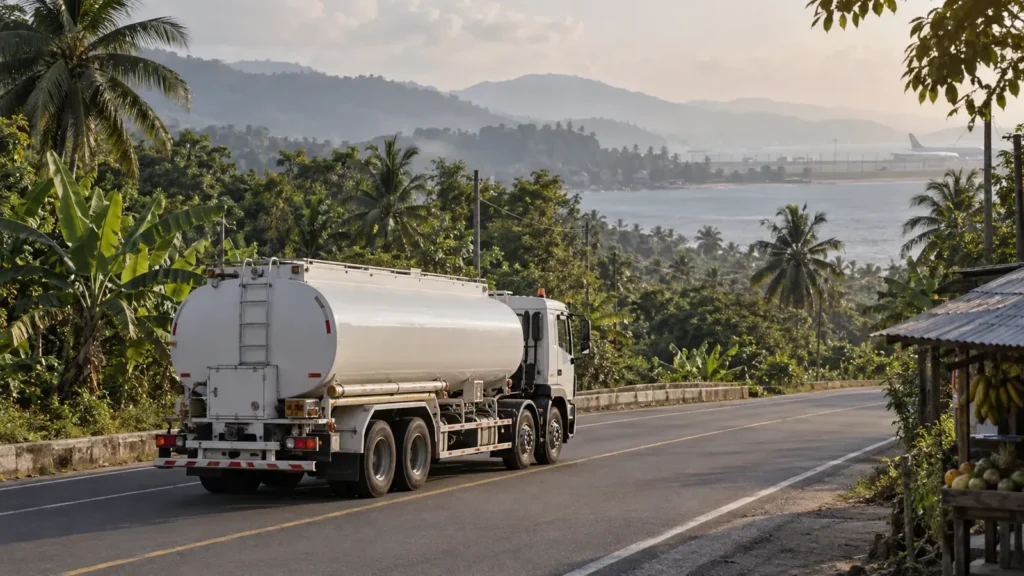
Between a sustainable aviation fuel plant and an aircraft wing, I count five handovers: a batch certificate at the refinery, cargo leaving the plant, blending with Jet A at a terminal, the certified blend moving through the pipelines, trucks and tank farms that already carry jet fuel, and the sustainability claim carried by documents because the molecules mix. Each handover has one owner, one document and one cost, and the chain fails on a missing document long before it fails on a missing pipe. This is how I read the sustainable aviation fuel supply chain when a developer, an offtaker and an investor sit at the same table.
I write this page for one reader at the feasibility stage, asking a physical question rather than a policy question. The framing is simple: follow the cargo and follow the paperwork, and keep them separate in your head.
In short
- Five handovers: refinery certificate, plant certificate, terminal blend, pipeline movement, claim document.
- One owner per handover: feedstock producer, SAF producer, terminal, transporter, offtaker.
- One document per handover: certificate of quality, certificate of analysis, certificate of compliance, proof of sustainability, proof of compliance, product transfer document.
- One cost per handover: feedstock, capital, terminal lease, transport, claim administration.
- One failure mode that matters first: a missing certificate stops the claim before a missing pipe stops the fuel.
In this article
The short answer: five handovers, one claim
SAF is a drop-in fuel, fully fungible with conventional jet fuel and delivered through the existing systems (IATA, SAF Handbook, May 2024). SAF must be blended with Jet A before use in an aircraft; the fuel from approved pathways is specified by ASTM D7566 before blending, and the blended fuel is redesignated as meeting ASTM D1655, so it can be transported in pipelines and used in aircraft (National Renewable Energy Laboratory, September 2024).
Each handover carries a document: each batch of jet fuel leaving a refinery gets a batch number and a refinery certificate of quality, a certificate of analysis is generated for each batch as it moves through the supply chain with retesting of key properties, and the SAF plant generates a certificate of compliance to the applicable ASTM annex (National Renewable Energy Laboratory, September 2024). Entities must be certified wherever significant changes in properties or environmental attributes occur, which covers feedstock producers and processors, transporters, feedstock traders, SAF producers, blenders and SAF suppliers (IATA, SAF Handbook, May 2024).
What this means for you: before I model a single tonne, I write the five handovers on one page and I name the certificate that closes each one.
The first handover is a feedstock decision
Developing a full SAF ecosystem involves upstream actors (feedstock producers and processors), collectors and traders, biomass and fuel converters, and retailers and offtakers such as airports and airlines (IRENA, December 2024). The distribution of feedstocks is uneven against the mandates, and Southeast Asia has historically been a key supplier of biogenic feedstocks to other regions (IRENA, December 2024). Singapore, the region’s largest aviation fuel consumer with more than 5 million tonnes of fuel per year, sits centrally in Asia-Pacific and may attract a disproportionate share of available feedstocks (IRENA, December 2024). Where the feedstock sits decides where the plant sits, and where the plant sits decides which terminal has to be able to receive neat SAF. The regional feedstock picture sits on SAF feedstock availability in Southeast Asia.
What this means for you: I do not start with the plant, I start with the feedstock map and I ask which terminal can take the cargo on day one.
The blend is decided before the airport, and so is the claim
Blending of SAF from a stand-alone facility with Jet A happens upstream of an airport at a terminal, and terminals already hold the equipment, software and staff because they are designed to blend on-highway transportation fuels (National Renewable Energy Laboratory, September 2024). Because the molecules mix at that point, the environmental claim is carried by accounting rather than by the pipe: the two chain of custody approaches are mass balance, which allows mixing in shared infrastructure but requires the user to draw fuel from that same infrastructure, and book and claim, which gives operators access to SAF without drawing the physical molecule (IATA, SAF Handbook, May 2024). CORSIA already recognizes book and claim by allowing SAF use to be reported on the basis of purchase documents (IATA, SAF Handbook, May 2024). Segregation of SAF from conventional fuel is technically not needed at the airport, nor is additional blending or recertification there (ICAO, ACT-SAF Series 7, consulted 16 November 2026). I set out the mechanism on book and claim.
What this means for you: I decide the claim mechanism at the same meeting where I decide the terminal, because the two decisions share one signature.
The contract moves the cargo, not the delivery instruction
Purchasing options run from spot buying (small volumes, short term, higher price) through long-term offtake agreements, which are often 2 to 10 years or longer while conventional jet fuel contracts cover 1 to 3 years, to an equity stake or a joint purchase agreement where airlines group their volumes (IATA, SAF Handbook, May 2024). Pricing options include a SAF premium indexed to a jet fuel index, a cost-plus model, and evaluations from price reporting agencies such as Platts and Argus (IATA, SAF Handbook, May 2024). Airlines secure their supply by working with airline fuel groups at various airports and with fuel suppliers, terminals and distributors, they share refuelling infrastructure, and if one or more airlines buy the blend, all of them must agree to its use because fuel is generally not directed at a specific airline or flight (National Renewable Energy Laboratory, September 2024). I read the contract structure on how to secure SAF offtake agreements.
What this means for you: I check that the contract names the terminal, the certificate set and the party that absorbs a failed delivery, before I check the price.
The crossing leg is a terminal decision
Blending can take place at a terminal directly connected to an airport by pipeline or hundreds of miles away, with the fuel then moved by pipeline or barge (US Department of Energy, Alternative Fuels Data Center, consulted 16 November 2026). In the coming years most airports will receive blended SAF by pipeline, rail, barge or fuel truck (ICAO, ACT-SAF Series 7, consulted 16 November 2026). The 10 largest airports in the United States are all connected to major pipelines, while many smaller airports have no pipeline access (ICAO, ACT-SAF Series 7, consulted 16 November 2026). Cross-border trade and foreign investment are crucial to meeting regional SAF targets because feedstocks and land resources vary across the region (IRENA, December 2024). The compliance side of exports, what counts as an export under a given regulation, is a separate reading, and the regulatory question is handled on export SAF; in this section I only look at the physical leg.
What this means for you: I map the crossing leg as a terminal choice first, then I check whether the airport end of that leg is pipeline, rail, barge or truck.
What the handovers cost, and who carries the cost
SAF can cost 2 to 5 times the cost of conventional jet fuel depending on the technology pathway and the feedstock (IATA, SAF Handbook, May 2024). Cost is driven mainly by the feedstock, and capital cost by pathway: HEFA with residual lipids is operationally high and capital low, alcohol-to-jet and Fischer-Tropsch with agricultural and forestry wastes are operationally low to medium and capital high, power-to-liquid with industrial CO2 is operationally low to medium and capital high, and power-to-liquid with direct air capture is operationally high and capital very high (IATA, SAF Handbook, May 2024). On the infrastructure side, the lowest-cost and quickest option is using existing tanks at a terminal that already stores jet fuel; costs increase if new tanks are added, and capital investment is significant with a long timeline for a new terminal (National Renewable Energy Laboratory, September 2024). Terminals charge lease fees for tanks and associated equipment, and lease terms are generally at least one year (National Renewable Energy Laboratory, September 2024). I read the cost stack against bankability before I sign anything.
What this means for you: I put the feedstock cost, the terminal lease and the transport cost on three separate lines, and I never let one of them hide inside another.
Where I draw the line
I do not price a chain, I price handovers. Before I sign anything I ask three questions at each transfer: who owns the molecule now, which document proves it, and which party carries the cost if the document is missing. I treat any sentence that says “the fuel will be delivered” without naming the terminal as unsupported, and I write assumed in the margin whenever a certificate cannot be named. My test for the whole chain is whether a regulator, a lender and an offtaker would read the same document set from the plant to the wing.
What this means for you: I refuse to model a handover I cannot document, and I stop the file there rather than carry an assumption forward.
How I would write it into my own file
I draw the chain as a sequence of custody transfers and I put a document, a cost and an owner on every arrow. I list the infrastructure my project does not own and I mark whether it exists today, is contracted, or is assumed, and I treat assumed as a gap. I check that the blending location in my logistics plan is certified upstream of the airport and that the claim mechanism matches the way the revenue is booked. My last line is the document trail: if I cannot name the certificate produced at each transfer, the model describes a fuel that cannot be proved.
What this means for you: I hand over a file where every arrow carries a certificate name, and I treat a blank arrow as an open risk rather than a rounding error.
Sources
- IATA, SAF Handbook, May 2024.
- ICAO, ACT-SAF Series 7, consulted 16 November 2026.
- National Renewable Energy Laboratory, September 2024.
- US Department of Energy, Alternative Fuels Data Center, consulted 16 November 2026.
- IRENA, December 2024.
Frequently asked questions
What are the physical steps between a SAF plant and an aircraft?
The plant produces SAF that is certified to the applicable ASTM annex, the fuel is blended with Jet A at a terminal upstream of the airport, the blend is redesignated as meeting ASTM D1655, and from there it travels by pipeline, rail, barge or truck into the airport tank farm and to the aircraft (National Renewable Energy Laboratory, September 2024; US Department of Energy, Alternative Fuels Data Center, consulted 16 November 2026).
Does SAF need its own distribution network?
No dedicated network is needed for the blend: it moves in the pipelines, trucks and tank farms that already carry jet fuel, and SAF can be stored in general fuel storage tanks with minimal infrastructure modifications (ICAO, ACT-SAF Series 7, consulted 16 November 2026; National Renewable Energy Laboratory, September 2024).
Which document proves the fuel is sustainable at each step?
A batch number and refinery certificate of quality at the refinery, a certificate of analysis for each batch as it moves with retesting, a certificate of compliance to the applicable ASTM annex from the SAF plant, and proof of sustainability, proof of compliance and product transfer documents along the chain (National Renewable Energy Laboratory, September 2024; IATA, SAF Handbook, May 2024).
Where does the sustainability claim survive once the molecules mix?
In the accounting, not in the pipe: mass balance and book and claim are the two chain of custody options, and CORSIA already allows SAF use to be reported on the basis of purchase documents (IATA, SAF Handbook, May 2024).
Not sure your project would survive a credit conversation?
A short call is usually enough to see where your project stands.
If you want me to pressure-test your own handover map against this document set, start with offtake agreements.
I do not provide investment advice or arrange investments. I act as a strategic advisor and facilitator.

Alex, Founder of WeConnect Asia
I help low-carbon fuel and carbon removal project developers in Southeast Asia secure the commercial and financial partners needed to reach FID.
Related articles

Pitching a Climate Tech Company to Strategic Investors: What the Corporate Has to Believe Before It Writes a Cheque
How to pitch a climate tech company to strategic investors: the metric cluster, the readiness evidence and the ask that corporates fund.

Biomethane: What It Is, How It Is Made and Who Buys It
Biomethane is biogas cleaned to pipeline quality. I explain how it is made, how it differs from biogas and who buys it in Southeast Asia.

CO2 Sourcing for e-SAF Projects: What the Rules Allow and What the Contract Must Say
Biogenic CO2, direct air capture or industrial flue gas: which sources an e-SAF plant may use, what they cost and which contract terms make the fuel certifiable.

Operating Performance Guarantees for SAF Plants: What Lenders Ask For
Minimum guarantees, performance damages, retesting and who stands behind them: the operating guarantees a SAF plant needs to keep debt and offtake intact.

EPC and Construction Risk in SAF Plants: What a Lender Actually Tests
FEED scope, convertible EPC, performance guarantees and damages caps: the construction risk questions a SAF project must answer before financial close.

Matching Feedstock and Offtake Risk Back-to-Back in a SAF Project: How Lenders Read the Chain
Lenders do not buy a feedstock plan and an offtake plan separately. They buy the link between the two, and the link is where most SAF files break.