
Home » SAF Storage, Pipelines and Fuel Farms: What Already Exists
SAF Storage, Pipelines and Fuel Farms: What Already Exists
10 min read · Nov 2, 2026 · By Alex
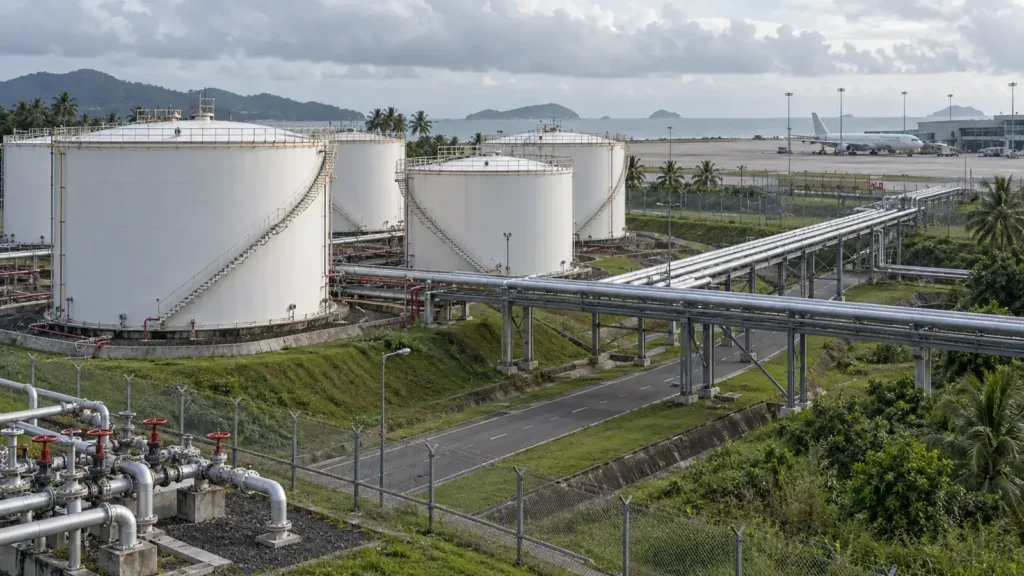
Sustainable aviation fuel can sit in general fuel storage tanks with minimal infrastructure modifications and travel in the pipelines, trucks and fixed airport fuel systems that already carry jet fuel, because the blend is redesignated as meeting ASTM D1655 upstream of the airport. The capital that is genuinely needed sits at a terminal, meaning the storage and distribution site away from the airport, and the question that decides the model is whether the pipeline your plan assumes actually reaches the airport you have contracted for. Everything else in the file follows from it. For SAF storage and pipelines I start from sustainable aviation fuel, then work down to the tanks, the pipe and the last shared tank before the wing.
Most of the debate about SAF infrastructure assumes new construction. The published guidance from ICAO, IATA and the National Renewable Energy Laboratory points the other way: the network is largely in place, and the work sits at one point in the chain.
In short
- Storage: SAF can be stored in general fuel storage tanks with minimal infrastructure modifications, and the cheapest case is existing tanks at a terminal that already holds jet fuel.
- Pipelines: The blend meets ASTM D1655, so it moves in the pipe network that already carries jet fuel. The map, not the chemistry, is the constraint.
- Terminal: The capital sits upstream, at the terminal that receives neat SAF and blends it to specification.
- Fuel farm: The airport holds the last shared tank before the wing, and it does not buy the fuel.
- Proof: I write assumed in the margin wherever a capacity has no owner and no document.
In this article
The short answer: the fuel fits the system that exists
In the years to come most aerodromes will receive blended SAF via pipeline, rail, barge or fuel truck, and SAF can be stored in general fuel storage tanks with minimal infrastructure modifications (ICAO, ACT-SAF Series 7, consulted 16 November 2026). SAF must be blended with Jet A prior to use in an aircraft, and the blended fuel is redesignated as meeting ASTM D1655, which is what allows it to travel in the existing pipeline network (National Renewable Energy Laboratory, September 2024). In plain words: a tank farm is storage tanks holding fuel before uplift, a fuel farm is that same storage function at or near an airport, blending is mixing SAF with Jet A to a certified ratio, and a hydrant is the fixed pipe that carries fuel from the fuel farm to the aircraft stand. The infrastructure question for SAF is therefore not a question of new networks, it is a question of which terminal receives the blend and which pipeline reaches the airport.
What this means for you: I model one terminal, one pipe and one tank farm, and I check that all three exist on the day your fuel is scheduled to move.
Tanks: the cheapest option is the one already there
The lowest-cost and quickest-timeline option for blending capacity is to use existing tanks at a terminal that currently stores jet fuel; costs increase if new tanks are added to an existing terminal, and the capital investment is significant with a long timeline to build a new terminal (National Renewable Energy Laboratory, September 2024). A terminal that has never handled jet fuel needs dedicated pipes, pumps and off-loading equipment, with a longer lead time. Around 1 200 terminals store refined petroleum products in the United States, though not all of them store jet fuel; by number of terminals 33 percent are refinery owners, 36 percent are midstream companies with pipelines and 31 percent are midstream companies owning one or more terminals (National Renewable Energy Laboratory, September 2024). Terminals charge lease fees for tanks and associated equipment, and lease terms are generally at least one year. I read a tank as a contract before I read it as steel, and that is where bankability is decided.
What this means for you: I ask who owns the tank, what the lease term is, and whether it has held jet fuel before. An existing tank under a signed lease is a short path, and a tank that has to be built is a different project.
Pipelines: what the map connects, and what it misses
The 10 largest airports in the United States are all connected to major pipelines, but many smaller airports do not have pipeline access (ICAO, ACT-SAF Series 7, consulted 16 November 2026). In Europe the blended volumes are largely delivered by pipeline to the aerodrome (National Renewable Energy Laboratory, September 2024). The blend can be produced at a terminal directly connected to an airport by pipeline or hundreds of miles away, with transport by pipeline or barge afterwards (US Department of Energy, Alternative Fuels Data Center, consulted 16 November 2026). In Southeast Asia the picture is a regional one: Singapore is the largest aviation fuel consumer of the region with more than 5 million tonnes of fuel per year and a central geographical position in Asia-Pacific (IRENA, December 2024), and the regional market and policy picture is set out in my Southeast Asia SAF overview.
What this means for you: I draw the pipe on the map before I draw the revenue line. If the endpoint is not the airport named in my offtake, the fuel moves by truck, rail or barge instead, and I price that case.
The fuel farm: the last shared tank before the wing
Airport fuel infrastructure can belong to fuel providers, airlines or airline groups, and the airport operator often owns at least part of the distribution infrastructure, which it can lease or operate directly (IATA, SAF Handbook, May 2024). Supplying aviation fuel has never been a core function of airport operators and should not become one for SAF (IATA, SAF Handbook, May 2024). Airports do not buy jet fuel; their role is preparation, with airports such as San Francisco International, Seattle-Tacoma and the Port Authority of New York and New Jersey having carried out studies of their local infrastructure (National Renewable Energy Laboratory, September 2024). Once fuel enters a fuel farm it is unlikely to be delivered to specific flights or airlines, and extra fuel truck deliveries may occur when a specific SAF delivery is requested (ICAO, ACT-SAF Series 7, consulted 16 November 2026). The volume that a mandate requires has to land in this shared tank, which is why SAF mandates are the next read.
What this means for you: I never write the airport into a model as the buyer. I write who owns the fuel farm, who controls the hydrant, and how the required volume reaches that shared tank.
What is genuinely new: the terminal that receives neat SAF
SAF produced at a biofuels facility is expected to be blended with Jet A at existing fuel terminals and then delivered to airports by pipeline or truck (US Department of Energy, Alternative Fuels Data Center, consulted 16 November 2026). Terminals already hold the equipment, the software and the staff to blend, because they are designed to blend on-highway transportation fuels (National Renewable Energy Laboratory, September 2024). Blending at an airport is not preferred: it would be the first certification of the SAF and Jet A blend as ASTM D1655 at that location, it needs significant capital investment in blending equipment, software and additional off-spec tanks, it impacts airport tank farm insurance, it increases truck traffic to airports, and it needs additional staff, testing and certification (National Renewable Energy Laboratory, September 2024). Where the feedstock sits decides where the plant sits, and where the plant sits decides which terminal has to be able to receive neat SAF, which is the question SAF feedstock availability in Southeast Asia answers.
What this means for you: I locate the plant first, then the terminal, then the pipe. If no terminal on that route can receive neat SAF and blend to specification, the project has an infrastructure gap before it has a financing gap.
What I prove before I sign the infrastructure
The infrastructure test comes before the financial close, because SAF can cost 2 to 5 times the cost of conventional jet fuel depending on the pathway and the feedstock (IATA, SAF Handbook, May 2024). The SAF Handbook records that aviation must scale by a factor of 1 000 between 2023 and 2050, with thousands of new or converted production facilities needed by 2050 (IATA, SAF Handbook, May 2024). The airport side of the test is practical: what exists locally, what is available, what capacity is there, which constraints apply (ICAO, ACT-SAF Series 7, consulted 16 November 2026). I run that list as a written test before I look at any return, and the sequence I use is set out on how to reach FID on a SAF project.
What this means for you: I sign the storage and transport line only after the airport questions are answered in writing, because a cost premium of that size has no meaning if the fuel cannot reach the tank that uplifts it.
Where I draw the line
I do not accept a storage assumption without a name. Before I sign anything I ask which terminal receives the blend, who owns the tanks, what the lease term is, and whether the pipeline in my model reaches the airport in my offtake. I write assumed in the margin whenever a capacity has no owner and no document, and I price the dedicated equipment case rather than the existing tank case when the terminal has never handled jet fuel. My test is the rainy day: on a day when my own cargo is not the cargo being uplifted, does the storage plan still hold.
What this means for you: a plan that only works when my volume is the only volume in the tank is not a plan, it is a hope. I ask for the shared case before I ask for the price.
How I would run this if it were my file
I put four lines in the technical review: existing tanks and their owner, the pipeline and its actual endpoint, the terminal equipment that does not exist yet, and the fuel farm at the destination. On each line I write whether the capacity exists today, is contracted, or is assumed, and I treat assumed as a gap. I ask for the lease term and the certificate produced at each transfer before I accept the number. My last line is the terminal: if it cannot receive neat SAF and blend to specification, the rest of the model describes a fuel that cannot arrive.
What this means for you: I hand back a review where every storage and transport line is marked exists, contracted or assumed, and where the terminal is named. That is the document I am willing to stand behind.
Sources
- IATA, SAF Handbook, May 2024.
- ICAO, ACT-SAF Series 7, consulted 16 November 2026.
- National Renewable Energy Laboratory, September 2024.
- US Department of Energy, Alternative Fuels Data Center, consulted 16 November 2026.
- IRENA, December 2024.
Frequently asked questions
Can SAF be stored in the tanks we already have?
Yes for the blend: SAF can be stored in general fuel storage tanks with minimal infrastructure modifications, and the cheapest infrastructure case is using existing tanks at a terminal that already stores jet fuel (ICAO, ACT-SAF Series 7, consulted 16 November 2026; National Renewable Energy Laboratory, September 2024). The condition is that the terminal has the equipment and the staff to blend.
Does SAF need dedicated pipelines?
No: the fuel from approved pathways is specified by ASTM D7566 before blending, the blend is redesignated as meeting ASTM D1655, and in that form it can be transported in pipelines and used in aircraft (National Renewable Energy Laboratory, September 2024). The constraint is coverage, because many smaller airports do not have pipeline access (ICAO, ACT-SAF Series 7, consulted 16 November 2026).
Who owns the tanks at an airport?
Airport fuel infrastructure can belong to fuel providers, airlines or airline groups, the airport operator often owns at least part of the distribution infrastructure, and in Europe airport tank farms belong to airports or to joint ventures among fuel suppliers (IATA, SAF Handbook, May 2024; National Renewable Energy Laboratory, September 2024). The airport does not buy the fuel.
What happens if my airport has no pipeline access?
It is delivered by pipeline, rail, barge or fuel truck instead, which is how most aerodromes will receive blended SAF in the years to come, and many smaller airports already live without pipeline access (ICAO, ACT-SAF Series 7, consulted 16 November 2026). I price the truck case rather than assuming the pipe.
Not sure your project would survive a credit conversation?
A short call is usually enough to see where your project stands.
If you want a second set of eyes on the tanks, the pipe and the terminal in your own model, I run a technical review that marks every storage and transport line as exists, contracted or assumed: technical review.
I do not provide investment advice or arrange investments. I act as a strategic advisor and facilitator.

Alex, Founder of WeConnect Asia
I help low-carbon fuel and carbon removal project developers in Southeast Asia secure the commercial and financial partners needed to reach FID.
Related articles

Pitching a Climate Tech Company to Strategic Investors: What the Corporate Has to Believe Before It Writes a Cheque
How to pitch a climate tech company to strategic investors: the metric cluster, the readiness evidence and the ask that corporates fund.

Biomethane: What It Is, How It Is Made and Who Buys It
Biomethane is biogas cleaned to pipeline quality. I explain how it is made, how it differs from biogas and who buys it in Southeast Asia.

CO2 Sourcing for e-SAF Projects: What the Rules Allow and What the Contract Must Say
Biogenic CO2, direct air capture or industrial flue gas: which sources an e-SAF plant may use, what they cost and which contract terms make the fuel certifiable.

Operating Performance Guarantees for SAF Plants: What Lenders Ask For
Minimum guarantees, performance damages, retesting and who stands behind them: the operating guarantees a SAF plant needs to keep debt and offtake intact.

EPC and Construction Risk in SAF Plants: What a Lender Actually Tests
FEED scope, convertible EPC, performance guarantees and damages caps: the construction risk questions a SAF project must answer before financial close.

Matching Feedstock and Offtake Risk Back-to-Back in a SAF Project: How Lenders Read the Chain
Lenders do not buy a feedstock plan and an offtake plan separately. They buy the link between the two, and the link is where most SAF files break.