
Home » Algae SAF Feedstock: What the Yield Table Does Not Promise
Algae SAF Feedstock: What the Yield Table Does Not Promise
10 min read · Nov 2, 2026 · By Alex
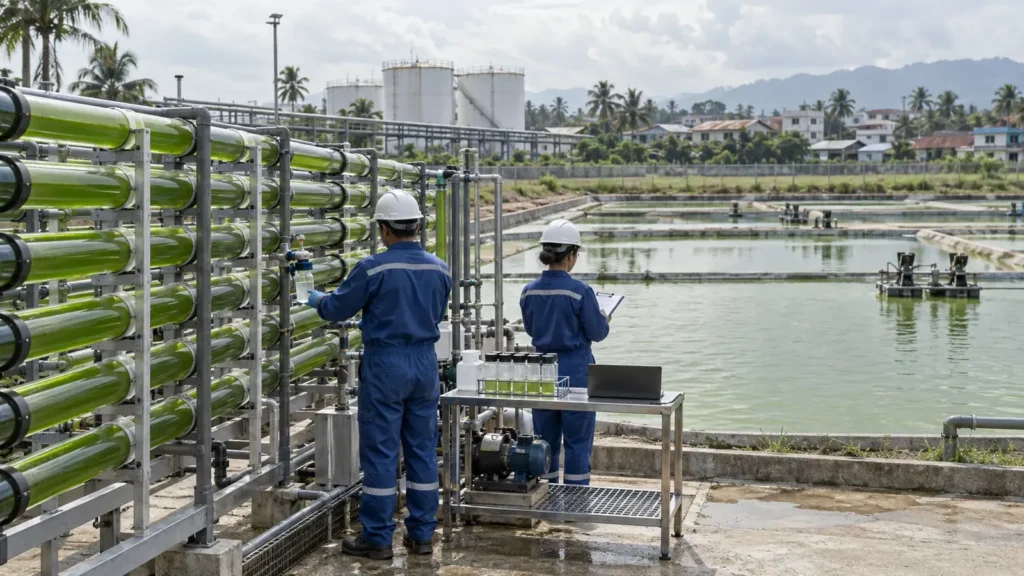
Can microalgae serve as a feedstock for a sustainable aviation fuel project at concept stage? In fact, my answer is a qualified yes as a fuel and no as a volume. The production routes are approved in ASTM D7566. For example, its yield table reaches 58,700 litres per hectare. No large-scale commercial algae-to-biofuels facility had been implemented by the end of 2015. That split is why I treat algae SAF feedstock as a volume question rather than an eligibility question. I set it against the regional feedstock pool before I price anything.
Algae is the standard third-generation candidate: no arable land, no food crop, a theoretical oil yield that dwarfs oil palm. I separate two questions when I read a feedstock file, what the standard certifies and what the market can deliver.
In short
- Approval: the hydrotreated esters and fatty acids route (HEFA-SPK) under Annex A2 of ASTM D7566, approved July 2011, listing algae among oil-based feedstocks. In addition, HC-HEFA-SPK under Annex A7, approved May 2020, covering algal oil at a 10% blend limit.
- Yield: the Joint Research Centre table gives microalgae 58,700 litres per hectare assuming 30% oil by weight, and 136,900 litres assuming 70%.
- Cost: IRENA prices microalgae SAF at USD 11.50 per litre in Malaysia against a Jet A-1 price of USD 0.6 per litre.
- Plant: no large-scale commercial algae-to-biofuels facility had been implemented by the end of 2015.
- Pool: in 2050, of an estimated 189 Mt of oil-based feedstock available for bioenergy and biofuels, 82 Mt could go to SAF. In addition, the theoretical maximum for oil-based HEFA is 63 Mt.
In this article
The short answer: approved as a fuel, unproven as a volume
Specifically, ASTM D7566 sets the fuel quality standards for non-petroleum-based jet fuel. In addition, it lists the approved fuel types and states the percent allowable in a blend with Jet A. Annex A2 approved HEFA-SPK in July 2011 for oil-based feedstocks that include jatropha, algae, camelina and yellow grease. The blend limit is 50%. Annex A7 approved HC-HEFA-SPK in May 2020 for algal oil at a 10% blend. Therefore, those percentages are the blend limit. Specifically, that is the maximum share of the finished tank the standard allows. Every drop-in fuel also runs in existing aircraft without modification. Therefore, terminal operators blend it with Jet A before it reaches the wing.
By contrast, approval is not a plant. The Joint Research Centre records no large-scale commercial algae-to-biofuels facility by the end of 2015. That holds despite a decade of research and investment. It adds that biomass from existing algal cultivation sites is currently exploited for production of food and feed. That biomass also supplies high added-value products such as nutritional supplements.
What this means for you: the standard certifies the molecule in the wing. It says nothing about whether a litre of algae-derived fuel will exist on your delivery date.
Why the yield table looks so good
The Joint Research Centre lists the advantages it expects algae to offer against land-based agricultural crops: better photosynthetic efficiency, higher oil yield, growth on non-fertile land, tolerance to a variety of water sources and CO2 re-using potential. Cultivation can be integrated in wastewater treatment plants to combine contaminant removal with biofuels production. Also, a biorefinery concept, meaning one facility that also extracts co-products such as chemicals and nutrients, is meant to carry the economics.
Then the table. Corn 172 litres per hectare, soybean 446, canola 1190, jatropha 1892, coconut 2689, oil palm 5950. Microalgae: 58,700 litres per hectare assuming 30% oil by weight in the biomass, and 136,900 litres assuming 70%. A lipid is simply the oil fraction the process extracts. As a result, that single assumption moves the headline number by more than double. Selected hybrid systems combine photobioreactors, closed vessels that grow the culture under controlled light, with open ponds, shallow unlined basins. Under favourable tropical climates they could give annual lipid production rates of 20 to 30 tonnes of oil equivalent per hectare. Photobioreactor productivity runs between 60 and 650 grams per square metre per day. Every advanced biofuel deck I see opens with a cousin of this table.
What this means for you: the table is a ceiling on biology. In addition, your model needs the distance between that ceiling and a volume someone can actually harvest.
What the certifier grants
ASTM D7566 does not admit a novel feedstock because a study likes it; it qualifies specific production routes. The table starts with Fischer-Tropsch synthetic paraffinic kerosene (FT-SPK) in June 2009. HEFA-SPK follows in July 2011, then hydroprocessed fermented sugars (HFS-SIP) in June 2014. Alcohol-to-jet (ATJ-SPK) arrives in April 2016 for isobutanol and June 2018 for ethanol. Catalytic hydrothermolysis (CH-SK) follows in February 2020, with hydrocarbon hydroprocessed esters and fatty acids (HC-HEFA-SPK) in May 2020 for algal oil. Also, each route carries its own percent allowable in a blend with Jet A. I do not quote a figure for the ethanol qualification of alcohol-to-jet.
Meanwhile, policy runs on a second track. The Joint Research Centre records a European Union cap of 7% on final consumption of crop-based biofuels. That cap favours advanced biofuels from non-food materials including algae. The European Commission’s ReFuelEU Aviation counts advanced biofuels from part A of annex IX. In addition, it adds the biofuels from the oils and fats listed in part B. Eligibility is a gate, not a purchase order, and I keep it in front of the ReFuelEU Aviation rules.
What this means for you: write down which annex and which annex entry your algae volume sits under. Do it before anyone models revenue. The compliance answer decides which market you are selling into.
What the cost says
EUCASS puts the theoretical yield of algae and other last-generation feedstocks at 30,000 litres per hectare a year. Then it prices the gap. In fact, cultivation and harvesting costs sit 5 to 10 times above conventional terrestrial biomass pathways. Meanwhile, SAF itself remains 2 to 5 times the cost of conventional jet fuel.
For example, IRENA makes the same gap concrete for Southeast Asia. Its own estimate puts microalgae SAF via HEFA at USD 11.50 per litre in Malaysia. That is nearly 20 times the current Jet A-1 price of USD 0.6 per litre. The HEFA minimum selling production cost sits at USD 1.6 to 2.1 per litre in the baseline scenario. Also, the Joint Research Centre gives the parallel figure for macroalgae. Ethanol lands at about USD 0.50 per kilogram dry weight, against about USD 0.16 per kilogram for corn ethanol. Macroalgal cultivation and processing costs therefore need to fall by at least 75% to become attractive. The centre also notes that microalgal biodiesel is not commercially produced, because of production and extraction costs.
Cost never travels alone. EUCASS notes that vegetable oils and animal oils face strict EU RED III sustainability criteria to limit indirect land use change and deforestation risks, so the sustainability criteria decide which cheap litre you are allowed to buy.
What this means for you: at USD 11.50 per litre against USD 0.6 per litre, algae needs a credible reason your volume lands far below that curve. That reason has to be a plant rather than a slide.
What the volume looks like in the wider pool
IATA puts global SAF production at about 2 Mt in 2025. Capacity should reach around 20 Mt by 2030 once the project success factor is applied. HEFA refineries will likely still dominate at about 95% of total volume. For 2050, an estimated 189 Mt of oil-based feedstock is available for bioenergy and biofuels. Of that, 82 Mt could be used for SAF. The theoretical maximum of oil-based HEFA SAF is 63 Mt. That is just over 15% of SAF in 2050.
By contrast, algae sits inside those lines rather than outside them. EUCASS reports that first-generation lipid-based feedstocks such as waste cooking oil and tallow dominate current production at more than 90%. It adds that the industrial sector expects those streams to supply 40% of all SAF feedstock by 2030. Stillwater Publications reaches the same place from the market side. The primary lipid feedstocks are all by-products. Growth in demand for low-carbon fuels points to significant market tightness, especially for waste oils like UCO and tallow.
The RSB lists algae oils among the alternative oilseed crops under consideration. It also records that only 17 of 85 articles were usable for its quantitative analysis. That pool sits behind CORSIA and behind every other compliance claim in the market.
What this means for you: algae competes for a share of a pool that is already spoken for. Therefore, each tonne another buyer books is a tonne your model has to replace.
Three ways the algae assumption fails
First, the commercial gap. The Joint Research Centre records no commercial algae-to-biofuels plant at the end of 2015. Biomass from existing cultivation sites goes to food and feed, together with high added-value products such as nutritional supplements. The output that exists is already spoken for.
Second, the cost. Nobody produces microalgal biodiesel commercially, mainly because of the high costs of production and extraction of lipids. IRENA prices microalgae SAF at USD 11.50 per litre in Malaysia. EUCASS puts cultivation and harvesting costs at 5 to 10 times conventional terrestrial biomass pathways.
Third, the spread in the underlying numbers. Chlorella vulgaris lipid values range from 5% to 58% of dry weight. The Joint Research Centre offers that spread as one illustration of how widely productivity and lipid yield assumptions vary across studies. Its own yield table swings from 58,700 to 136,900 litres per hectare on the oil content assumption alone.
What this means for you: I do not reject algae. However, I read every algae figure in a deck as a range with a named cause. In addition, I ask which of these three failures the sponsor has actually solved.
The order I would run the work in
I run the checks in a fixed order. One: confirm the pathway and its blend limit in writing from ASTM D7566. The percent allowable differs by route. Two: set the cost basis. Jet A-1 sits at USD 0.6 per litre, HEFA at USD 1.6 to 2.1 per litre. Three: find who else absorbs the same biomass. The RSB puts higher risk on food and feed crops such as palm oil, sugarcane and corn. That risk comes from intensive cultivation, plus direct and indirect land use change. It also records data gaps where only 17 of 85 studies were usable. Four: test the co-product case. The biorefinery argument for chemicals and nutrients is the offset the Joint Research Centre holds out. Only then do I price a litre, and this is the feedstock supply work I ask a sponsor to finish before I look at returns.
What this means for you: order matters because steps three and four usually kill a project that step one has already cleared.
How I would run this if it were my file
One page before committee, and nothing more. Line one: two ASTM D7566 listings. Annex A2 covers algae from July 2011, and Annex A7 covers algal oil from May 2020. Line two: 58,700 litres per hectare on the yield table. Against that, no large-scale commercial algae-to-biofuels facility existed at the end of 2015. Line three: 30,000 litres per hectare a year from EUCASS. Cultivation and harvesting costs sit 5 to 10 times above terrestrial pathways. Line four: USD 11.50 per litre for microalgae SAF in Malaysia. The fifth line is the pool: 189 Mt of oil-based feedstock. Of that, 82 Mt could go to SAF. The theoretical maximum for oil-based HEFA is 63 Mt.
Under those lines I would write one sentence: the fuel is approved and the volume is not proven.
What this means for you: the page must state both halves on the same side of the paper. Otherwise the file is not ready for committee.
Sources
- Joint Research Centre, 2015.
- RSB, September 2024.
- EUCASS, 2025.
- IATA, 16 November 2026.
- IRENA, December 2024.
- IATA, September 2025.
- Stillwater Publications, 28 October 2025.
Frequently asked questions
Is algae an approved SAF feedstock today?
Yes on paper. HEFA-SPK under Annex A2 of ASTM D7566 was approved in July 2011 with oil-based feedstocks that include algae, and HC-HEFA-SPK under Annex A7 was approved in May 2020 on algal oil at a 10% blend limit, and SAF must be blended with Jet A prior to use in an aircraft. What the approval covers is the production route and the fuel quality. It does not commit anyone to buy, finance or deliver the output.
How much algae oil can a project really count on per hectare?
The published yields are wide. The Joint Research Centre table gives 58,700 litres per hectare assuming 30% oil by weight and 136,900 litres assuming 70%, and selected hybrid systems combining photobioreactors and open ponds are quoted at 20 to 30 tonnes of oil equivalent per hectare a year under favourable tropical climates. EUCASS cites 30,000 litres per hectare a year for last-generation feedstocks such as algae. That last figure is a theoretical yield, not a contracted volume, and the same applies to the rest.
Why does algae SAF cost so much more than jet fuel?
Because cultivation, harvesting and extraction carry the cost. EUCASS puts cultivation and harvesting at 5 to 10 times conventional terrestrial biomass pathways, IRENA prices microalgae SAF at USD 11.50 per litre in Malaysia against Jet A-1 at USD 0.6 per litre, and the Joint Research Centre records that microalgal biodiesel is not commercially produced because of the high costs of production and extraction of lipids.
Does growing algae for fuel compete with food?
The land argument is the one algae makes in its favour: growth on non-fertile land, tolerance to a variety of water sources, CO2 re-using potential and integration in wastewater treatment plants. The caveat the Joint Research Centre attaches is that existing algal cultivation output still goes to food and feed, together with high added-value products such as nutritional supplements.
Not sure your project would survive a credit conversation?
A short call is usually enough to see where your project stands.
If you are at concept stage and want the pathway listing, the yield range, the cost curve. In addition, the competing claims on the same biomass read together before this reaches committee, that review sits inside investor introductions. Where the first question I put to a sponsor is which litre they can actually deliver.
I do not provide investment advice or arrange investments. I act as a strategic advisor and facilitator.

Alex, Founder of WeConnect Asia
I help low-carbon fuel and carbon removal project developers in Southeast Asia secure the commercial and financial partners needed to reach FID.
Related articles

Pitching a Climate Tech Company to Strategic Investors: What the Corporate Has to Believe Before It Writes a Cheque
How to pitch a climate tech company to strategic investors: the metric cluster, the readiness evidence and the ask that corporates fund.

Biomethane: What It Is, How It Is Made and Who Buys It
Biomethane is biogas cleaned to pipeline quality. I explain how it is made, how it differs from biogas and who buys it in Southeast Asia.

CO2 Sourcing for e-SAF Projects: What the Rules Allow and What the Contract Must Say
Biogenic CO2, direct air capture or industrial flue gas: which sources an e-SAF plant may use, what they cost and which contract terms make the fuel certifiable.

Operating Performance Guarantees for SAF Plants: What Lenders Ask For
Minimum guarantees, performance damages, retesting and who stands behind them: the operating guarantees a SAF plant needs to keep debt and offtake intact.

EPC and Construction Risk in SAF Plants: What a Lender Actually Tests
FEED scope, convertible EPC, performance guarantees and damages caps: the construction risk questions a SAF project must answer before financial close.

Matching Feedstock and Offtake Risk Back-to-Back in a SAF Project: How Lenders Read the Chain
Lenders do not buy a feedstock plan and an offtake plan separately. They buy the link between the two, and the link is where most SAF files break.