
Home » Governments and Military as SAF Buyers: What a State Buyer Actually Does
Governments and Military as SAF Buyers: What a State Buyer Actually Does
10 min read · Nov 2, 2026 · By Alex
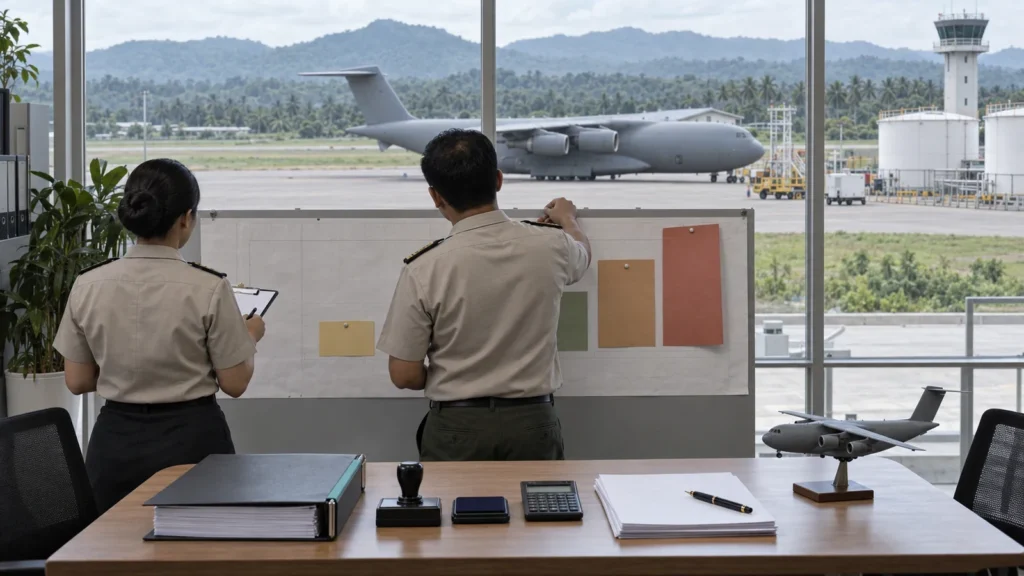
Governments and air forces rarely sign for the barrels themselves. Instead, The sustainable aviation fuel trade runs on contracts they shape rather than contracts they sign. Furthermore, The state acts as a rule writer, not as a customer of my molecule. However, Direct answer before a final investment decision (FID): no, not as a direct buyer of the molecule, because governments and air forces set targets, mandates, procurement rules and fuel specifications rather than signing for the barrels, and the demand they create is real but indirect. Specifically, That is the government military saf demand I test: rules that create volume, not a signature.
Government military saf demand: the pre-FID question
The evidence is concrete: the United States runs a government-wide Sustainable Aviation Fuel Grand Challenge aiming at 3 billion gallons a year by 2030 and 35 billion gallons a year by 2050; Indonesia proposes a 1 percent SAF blend in 2027 rising to 20 percent by 2045 and 50 percent by 2060 and mandates a 10 percent SAF blend for corporate and government business passengers, which on a domestic market projected at about 100 million departing passengers by 2035 would cover 10 million passengers; and defence buyers clear fuels rather than buy them, with Boeing’s global no technical objection of 20 July 2024 covering its military aircraft at up to a 50 percent blend.
For a developer at pre-FID structuration the useful question is not whether a ministry likes SAF. Meanwhile, It is which rule binds which counterparty, on what date, at what blend, and who signs the resulting offtake. Specifically, I settle that before I count a single litre as demand.
In short
- Short answer: The state does not buy the molecule; targets, mandates, procurement rules and specifications create the volume.
- Target lever: The United States runs to 35 billion gallons a year by 2050; Indonesia runs from 1 percent in 2027 to 50 percent by 2060.
- Procurement lever: A 10 percent travel blend covers 10 million of about 100 million departing passengers projected for 2035.
- Defence lever: Boeing’s no technical objection covers its aircraft at up to a 50 percent blend; JP-8 and JP-5 already carry SAF.
- Main risk: Policy moves: a credit that reached 1.75 US dollars per gallon now tops out at 1 US dollar per gallon.
In this article
The short answer: the state writes the demand, it rarely lifts the fuel
Governments and air forces are not the counterparty of a fuel contract. Therefore, They set the conditions under which fuel is bought: which blend is allowed, which budget line pays, which specification applies and who may supply it. Specifically, The US Department of Energy states the motive: the aviation sector is highly motivated to use cost-effective SAF for commercial, business and military aircraft because of the economic growth, job creation and environmental benefits they offer, and the availability of SAF is critical for the industry to meet significant international carbon reduction commitments that have already been made.
Two definitions keep my file honest. By contrast, An anchor buyer is a counterparty whose committed volume is large enough to carry the financing case on its own. Also, an offtake is the contract in which a buyer commits to take a defined volume over a defined period. In fact, A state target is neither; it pushes someone else toward a contract.
What this means for you: if your file counts a ministry as the buyer, rewrite that section. Instead, Name the rule, then name the airline, fuel supplier or air force that signs under it, and size the volume from that signature.
The target lever: a number with a date
A blending mandate is a legal obligation to put a minimum share of sustainable aviation fuel into fuel sold or uplifted for a defined set of flights. The United States leads with a target instead. The Sustainable Aviation Fuels Grand Challenge is an ambitious government-wide commitment to scale up production to 35 billion gallons a year by 2050, with a near-term goal of 3 billion gallons a year by 2030. The Department of Energy works with the Department of Agriculture and the Department of Transportation across research and development, scale-up, policy and financing, state and local involvement and workforce development, and a Memorandum of Understanding between the three places aviation on a pathway to lower emissions and 100 percent SAF by 2050.
Indonesia writes a rising target: 1 percent in 2027, 20 percent by 2045 and 50 percent by 2060, against comparators the roadmap quotes: Singapore at 1 percent by 2026 with an aim of 3 to 5 percent by 2030, Malaysia at 47 percent by 2050, and the European Union at 2 percent by 2025, 5 percent by 2030 and at least 63 percent by 2050, of which 28 percent synthetic. The country list sits on my blending mandates page.
What this means for you: a target gives me direction and a deadline, not a counterparty. I read it as an offtake sizing input, then look for the rule that converts it into an obligation.
The procurement lever: the travel rule that books tickets
The roadmap’s first demand policy is a mandate to use a 10 percent SAF blend for corporate and government passengers travelling for business. Instead, Against a domestic market projected to reach about 100 million departing passengers by 2035, a 10 percent ratio for corporate and government passengers reaches 10 million travellers, which the roadmap calls a substantial opportunity to secure SAF off-take. Meanwhile, Its reason is price behaviour. In fact, Corporate and government passengers are relatively less price responsive than regular passengers, which suits a mandate.
Execution runs through Garuda Indonesia, the state-owned airline, via an SAF Buyers’ Club whose members are government institutions and corporations. Also, Around it the National Action Plan lists a decree or regulation of the Ministry of Transportation on mandated use, a regulation or circular letter of the public procurement policy agency on the procurement of SAF for government passengers, changes to the rules on government official travel, and a travel mandate for corporate business travel on a 2025 to 2030 timeline. In addition, Regional context sits on my Southeast Asia SAF page.
What this means for you: this is the nearest thing to anchored volume in the region. Also, the signature is still corporate. Instead, Ask for the decree text, then for the airline that will sign.
The defence lever: specifications, not tenders
A fuel specification is the written standard a fuel must meet before an aircraft or installation may accept it. Also, a no technical objection is a manufacturer’s formal statement that its aircraft can operate on a fuel without technical issues. Consequently, Boeing issued a global no technical objection on 20 July 2024, covering all its defence aircraft and their derivatives on synthetic aviation turbine fuels, at approved limits of up to a 50 percent blend with conventional fuel. In addition, Unblended SAF can cut lifecycle carbon emissions up to 84 percent against conventional jet fuel, and 50-50 remains the maximum allowable blend.
The signal is clearance, not purchase. Meanwhile, After work in 2020 the Royal Air Force cleared all of its military aircraft for 50 percent SAF. Also, the data gathered informs the Ministry of Defence’s Defence Aviation Net Zero Strategy. Moreover, NATO states that all Allies are committed to secure, resilient and sustainable energy supplies for Allied forces, with SAF playing a key role while maintaining capability, effectiveness and interoperability. For example, Multiple SAFs are already incorporated into military fuel specifications such as JP-8/NATO F-34 and JP-5/NATO F-44, and Naval Air Systems Command describes the global no technical objection as helping expedite Department of Defense approval for worldwide interoperability. However, The Department of Defense pilot runs to the end of fiscal year 2028, with waiver authority for a lack of domestically available SAF or a national security contingency.
What this means for you: the defence route buys you acceptance and an interoperable specification, not an order. In fact, Confirm which specification your fuel certifies against before you size anything.
What the public buyer does to the price
IATA reports that SAF output in 2025 should reach 1.9 million tonnes, or 2.4 billion liters, double the 1 million tonnes produced in 2024, with 2026 growth projected to slow and reach 2.4 million tonnes. Therefore, That is 0.6 percent of total jet fuel consumption in 2025 and 0.8 percent the following year, and at current price levels the SAF premium adds 3.6 billion US dollars to the industry’s fuel bill in 2025.
Indonesia prices its own mandate in the same units: an SAF premium of 2.2 times conventional fuel on IATA data, and fuel at 35 percent of the total airfare on Garuda Indonesia data. Therefore, It puts the estimated price increase on international flights at 3.2 percent in Phase 1 and 6.4 percent in Phase 2, with 166 million liters of demand in 2030 and 397 million liters in 2035. Also, The premium arithmetic sits on my sustainable aviation fuel price page.
What this means for you: the public buyer passes the premium into fares and budgets instead of absorbing it. Therefore, a mandate widens demand while raising the price you must quote.
Three ways the state-anchor assumption fails
First, the counterparty. Meanwhile, The rule is set by a ministry. Meanwhile, the offtake is signed by an airline or a fuel supplier, and Indonesia’s own design puts the mandate through a state-owned airline’s buyers’ club rather than through a direct state purchase. The state originates the obligation; it does not take delivery.
Second, the policy can move. The United States let a SAF tax credit expire on 31 December 2024, replaced it with a clean fuel production credit, then removed the SAF special rate, cut the credit’s maximum value to 1 US dollar per gallon and extended it to 31 December 2029, and terminated the SAF excise credit after 30 September 2025. That earlier credit had run between 1.25 and 1.75 US dollars per gallon.
Third, the timing. The Indonesian blending phases start in 2030. Also, the United States pilot runs to the end of fiscal year 2028. Meanwhile, a project needs committed volume before either date. I keep that discipline in my SAF policy risk notes.
What this means for you: treat the state as a rule generator with a calendar and a signer. If you cannot name both, the anchor assumption is decoration.
The order I would run the work in
I ask which of the four levers the country applies to my pathway: national target, blending mandate, public travel procurement or fuel specification. Then I confirm who signs: a ministry, a national oil company, a state-owned airline, or the airline buying the volume. Therefore, Then I confirm when the obligation binds, using the 2027 start of the Indonesian target and the 2030 start of its first phase as the calendar. Then I confirm the specification route, since JP-8/NATO F-34 and JP-5/NATO F-44 already carry SAF and Boeing’s global no technical objection covers its aircraft at up to a 50 percent blend. Only then do I hand the file to a structured offtake rather than to a public promise, using the sequence on my how to secure SAF offtake agreements page.
What this means for you: levers, signer, calendar, specification, in that order. The public promise comes last, and it is never the thing I model.
How I would run this if it were my file
One page before committee: the four levers and who signs each of them. The government-wide target of 3 billion gallons a year by 2030 and 35 billion gallons a year by 2050 (US Department of Energy). The 10 percent corporate and government travel blend worth 10 million passengers against a 100 million passenger market projected for 2035 (Government of Indonesia); the no technical objection at up to a 50 percent blend with the JP-8 and JP-5 specifications (Boeing); the Department of Defense pilot running to the end of fiscal year 2028 together with the credit that moved from 1.75 US dollars per gallon to 1 US dollar per gallon (Congressional Research Service); and the 0.6 percent share of jet fuel with the 3.6 billion US dollar premium of 2025 (IATA). Everything else goes to the annex. This is the page I carry into FID structuring.
What this means for you: the committee is not buying a state guarantee. It is buying a rule that someone signed and dated. Bring the levers, the signer and the date, and the file reads like a contract rather than a policy brochure.
Sources
- US Department of Energy, 16 November 2026
- Congressional Research Service, 4 February 2026
- Government of Indonesia, 16 November 2026
- Boeing, 20 July 2024
- IATA, 9 December 2025
Frequently asked questions
Do governments buy SAF directly?
Rarely as a direct buyer: the state sets targets, mandates, procurement rules and specifications, while the contract sits with an airline or a fuel supplier. Indonesia’s design routes the travel mandate through the state-owned airline and an SAF Buyers’ Club of government institutions and corporations, and the defence route works through fuel specifications such as JP-8/NATO F-34 and JP-5/NATO F-44 (Government of Indonesia; Boeing).
What is a defence fuel specification worth to my project file?
It is an acceptance signal rather than a purchase: Boeing’s global no technical objection of 20 July 2024 covers its defence aircraft at up to a 50 percent blend with no technical issues, the Royal Air Force cleared all of its military aircraft for 50 percent SAF in 2020, and the data feeds the Ministry of Defence net zero strategy (Boeing).
Can a government travel mandate become my anchor offtake?
It can become anchored volume but not a state signature: Indonesia’s measure is a 10 percent blend for corporate and government business passengers, worth 10 million passengers against a domestic market projected at about 100 million departing passengers by 2035, executed by decree and by a public procurement regulation (Government of Indonesia).
How much of a public commitment can I put in a lender deck?
Put the rule, the date and the signer in the deck, not the promise: quote the target such as 3 billion gallons a year by 2030 and 35 billion gallons a year by 2050, the obligation date such as 1 percent in 2027 or the 7.5 percent first phase from 2030, and name the counterparty that signs, because credit support follows the signature and not the target (US Department of Energy; Government of Indonesia).
Not sure your project would survive a credit conversation?
A short call is usually enough to see where your project stands.
If you want the structure rather than the summary, my offtake agreements work turns a public rule into a signed contract, with the signer, the volume and the date written out before the file reaches committee.
I do not provide investment advice or arrange investments. I act as a strategic advisor and facilitator.

Alex, Founder of WeConnect Asia
I help low-carbon fuel and carbon removal project developers in Southeast Asia secure the commercial and financial partners needed to reach FID.
Related articles

Pitching a Climate Tech Company to Strategic Investors: What the Corporate Has to Believe Before It Writes a Cheque
How to pitch a climate tech company to strategic investors: the metric cluster, the readiness evidence and the ask that corporates fund.

Biomethane: What It Is, How It Is Made and Who Buys It
Biomethane is biogas cleaned to pipeline quality. I explain how it is made, how it differs from biogas and who buys it in Southeast Asia.

CO2 Sourcing for e-SAF Projects: What the Rules Allow and What the Contract Must Say
Biogenic CO2, direct air capture or industrial flue gas: which sources an e-SAF plant may use, what they cost and which contract terms make the fuel certifiable.

Operating Performance Guarantees for SAF Plants: What Lenders Ask For
Minimum guarantees, performance damages, retesting and who stands behind them: the operating guarantees a SAF plant needs to keep debt and offtake intact.

EPC and Construction Risk in SAF Plants: What a Lender Actually Tests
FEED scope, convertible EPC, performance guarantees and damages caps: the construction risk questions a SAF project must answer before financial close.

Matching Feedstock and Offtake Risk Back-to-Back in a SAF Project: How Lenders Read the Chain
Lenders do not buy a feedstock plan and an offtake plan separately. They buy the link between the two, and the link is where most SAF files break.