
Home » Airport SAF Readiness in Southeast Asia: What Actually Makes an Airport Ready
Airport SAF Readiness in Southeast Asia: What Actually Makes an Airport Ready
10 min read · Aug 2, 2026 · By Alex
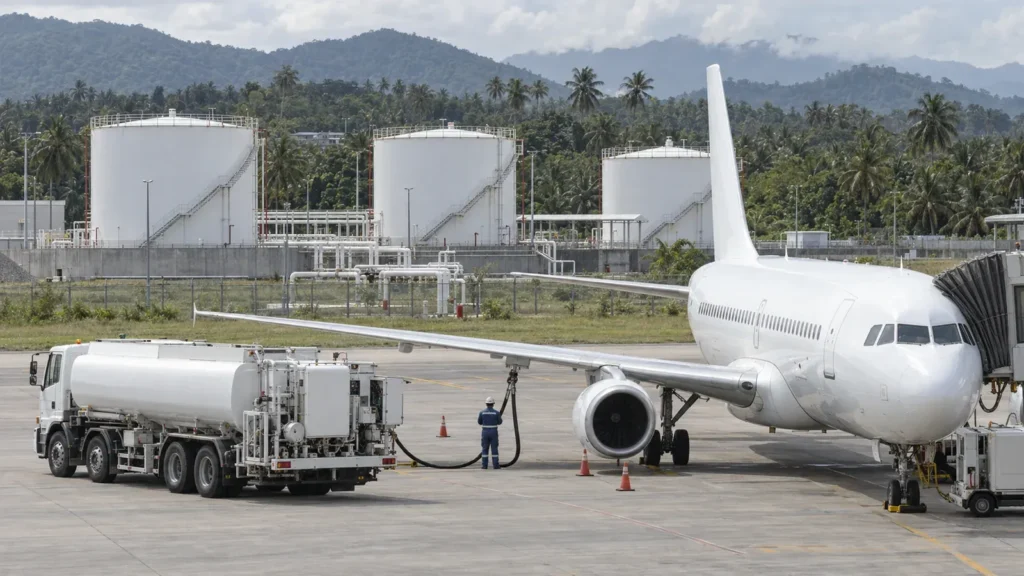
An airport is ready for SAF when the mandated volume can be physically delivered into its fuel farm, the airport’s fuel storage and distribution installation, and withdrawn by the carriers operating there, not when the country around it announces new production. I use sustainable aviation fuel readiness as a delivery test before anything else. For an offtaker or trader at feasibility stage, that is the test that changes a decision. Airport saf readiness southeast asia is a question about access, scheduling and supply lines rather than refinery headlines, and the two are routinely conflated, because blended SAF is fully fungible with conventional aviation fuel once it enters the supply chain.
Readiness is not a national scorecard. It is a set of conditions at a specific fuel farm, the airport’s fuel storage and distribution installation, on a specific date, with a specific obligation behind it. I set out those conditions below, then test the region against them.
In short
- Access: open fuel farm access on equal terms decides who can supply at all.
- Schedule: a dated uplift obligation, the volume to be loaded, with a levy behind it.
- Procurement: central procurement with a price mechanism, not spot purchases at short notice.
- Supply: physical volumes reaching the airport, not barrels exported to other markets.
- Fallback: book and claim through a registry where the physical route is missing.
In this article
The short answer: four tests, not a ranking
I would test an airport on four things: open access to its fuel infrastructure, a binding uplift schedule behind the mandate, a procurement route with a price behind it, and physical supply that reaches the airport. Uplift is the dated volume a carrier loads at the airport, and a mandate is the legal requirement to lift a set share of SAF. The last step is into-plane delivery, the loading of fuel into the aircraft.
IATA records that fuel facilities at an airport can be owned by fuel providers, airlines or consortia, while the operator usually holds part of the distribution infrastructure it can lease or run itself. Because the lifecycle reduction takes place upstream, none of the climate benefits of introducing SAF at an airport are experienced locally.
None of the four is a ranking, and an airport can pass one while failing another.
What this means for you: I score an airport on those four tests, and neither a country ranking nor a refinery announcement moves the score.
The regional picture
Readiness is uneven across the region. IRENA records progress in SAF development across Southeast Asia varying, with notable advancements in Singapore, followed by Malaysia, Indonesia, Thailand and the Philippines, and most countries responding reactively to market signals and relying on mandates rather than subsidies to drive adoption.
Singapore is the region’s largest aviation fuel consumer at more than 5 million tonnes of fuel per year, and its central geographical location together with Changi Airport’s growth plans make it a favourable location for investors. Malaysia has at least eight active players involved in refinery construction and feedstock development, more than any other country in the region. Indonesia plans pilot SAF offtake agreements at major airports, starting with Ngurah Rai International Airport and Soekarno-Hatta Airport.
I put the country by country picture in my Southeast Asia SAF page.
What this means for you: I would open a feasibility file on Singapore and Malaysia first, but I would not call either ready until the four tests pass at the fuel farm level.
Supply that has to physically arrive
An airport is only as ready as its supply line. Singapore’s Sustainable Air Hub Blueprint acknowledges shortages of fuel feedstocks and competing demand from shipping, road transport and energy as constraints on SAF availability, and calls for greater production across the region. It states that most of the SAF produced at the Tuas refinery is exported to other higher-demand markets, because regional demand is lower and there are no blending mandates across Asia-Pacific.
IRENA says the same from the other direction: relying solely on residues and waste for SAF in Southeast Asia is risky because of competition with other uses and cost challenges, and cross-border trade and foreign investment are crucial to meeting regional SAF targets. Feedstock availability is uneven, with Malaysia, Thailand and the Philippines projected to face significant shortages by 2050 while Indonesia’s biomass is spread across a vast territory.
I track that split in my feedstock availability page.
What this means for you: I check whether the volume I need is already spoken for by exports before I count a local refinery as supply.
The fuel farm question
Infrastructure ownership decides who can supply. IATA notes that airport fuel facilities can be owned by fuel providers, airlines or consortia, and the airport operator often owns at least some distribution infrastructure, which it can lease to other stakeholders or operate directly.
Supplying jet fuel has never been a core function for airport operators and should remain the case with SAF supply. Because airports face no additional infrastructure costs from introducing SAF, and incentive programs in airport charges are generally ineffective and carry a high risk of discrimination, airport charges should not be modified based on SAF. If an operator does provide fuel or SAF, that activity must be clearly separated from its role in owning fuel infrastructure.
Airlines increasingly under obligation to use SAF must rely on open access to the fuel infrastructure that brings fuel to the airplane through the airports’ fuel farms, because restrictions or preferences on who can supply interfere with a competitive market.
What this means for you: I ask who owns the fuel farm, who can access it and on what terms before I count a supplier relationship as real.
When uplift is not there
Readiness does not have to mean physical delivery. Book and claim is a chain of custody option that lets a customer decouple the sustainability attribute from the physical product and move it through a dedicated registry, without buyer and seller needing a physical supply chain.
IRENA notes that book and claim grants access to emission savings without requiring physical fuel transport or local SAF infrastructure, and that countries rich in feedstocks but not ready for mandates could still produce SAF and sell sustainability credits to airlines elsewhere. The system is still under development and the near-term benefit remains uncertain.
IATA adds that book and claim gives access to SAF to all aircraft operators and lets production happen where it is most efficient, minimising logistics costs. CORSIA already recognises book and claim through SAF use reporting based on purchase records.
I explain this in my book and claim page.
What this means for you: I treat book and claim as a fallback route to readiness where the pipe is missing, and I still want a registry behind it.
The mandate calendar
Singapore’s current position, set by the Ministry of Transport, is a 1 percent SAF uplift target for 2027, with the goal of 3 to 5 percent by 2030, subject to global developments and wider availability. A mandatory SAF levy applies to passengers, cargo shipments and general and business aviation flights departing Singapore from 1 January 2027, for tickets sold from 1 October 2026.
The 2024 blueprint behind that plan required flights departing Singapore to use SAF from 2026 at 1 percent, rising to 3 to 5 percent by 2030. It proposed an economy levy of 3 Singapore dollars short-haul, 6 Singapore dollars medium-haul and 16 Singapore dollars long-haul, with central procurement, a single buyer acting for all users, to aggregate demand and gain economies of scale.
Elsewhere the calendar is looser: IRENA records mandates planned for Malaysia and Indonesia, in progress for Thailand and the Philippines, and none elsewhere. The calendar sits in my SAF mandates page.
What this means for you: I read the dated obligation and its funding mechanism together, because one alone does not produce volume at the fuel farm.
What an offtaker or investor should test
I separate a country announcement from an airport commitment. A pledge of production capacity tells me fuel may exist in the country; it does not tell me the volume can be uplifted at the airport I need, on the date I need it.
Global SAF supplies are less than 1 percent of global jet fuel demand and capacity has to increase exponentially to meet 2050 demand, which is why the Sustainable Air Hub Blueprint insists on giving producers a demand signal.
The commercial layer matters too. IATA’s handbook is blunt: an offtake agreement here often spans two to ten years or longer, against one to three years for a traditional jet fuel contract, precisely so the neat SAF supplier can obtain finance and may offer preferential pricing.
The World Economic Forum and Kearney make the same link between binding long-term offtake and the ability to reach final investment decision.
What this means for you: I write the airport commitment and the offtake term together, because a short contract in this market is not a plan.
How I would run this if it were my file
I would ask four questions of any airport in the region before I counted it as ready.
First, who owns the fuel infrastructure, and can a new supplier get access on equal terms. Second, is there a dated uplift obligation behind it, with the levy or support mechanism that funds it. Third, can the physical supply actually reach that fuel farm, given that exported volumes and feedstock competition are the norm in the region. And fourth, if the physical route is not there yet, is there a credible book and claim route with a registry behind it.
The answers come from different documents and different counterparties, and they rarely arrive together. Once I have them, I would write the offtake around them, because that is where the obligation becomes bankable: how to secure saf offtake agreements.
What this means for you: I do not call an airport ready on a press release, I call it ready when those four answers sit in the same file.
Sources
- IATA, SAF Handbook, May 2024.
- Singapore Ministry of Transport, updated 25 August 2026.
- GreenAir News, 22 February 2024.
- IRENA, December 2024.
- IATA Press Release No 57, 9 December 2025.
- World Economic Forum and Kearney, February 2025.
Frequently asked questions
What makes an airport ready for SAF?
Open access to the fuel infrastructure that brings fuel to the aircraft through the airport’s fuel farms, a dated obligation with a funding mechanism behind it, and supply that physically reaches the airport (IATA; Singapore Ministry of Transport). Ownership matters as much as the obligation.
Does a country producing SAF mean its airports are ready?
No. Production capacity and uplift capacity are different things. In this region most SAF produced at the Tuas refinery is exported to higher-demand markets because regional demand is low and there are no blending mandates across Asia-Pacific (GreenAir News). A refinery announcement tells me fuel exists somewhere, not that it can be loaded at the airport I need.
How does Singapore's SAF uplift work?
Singapore has set a 1 percent SAF uplift target for 2027, with the goal of 3 to 5 percent by 2030, backed by a mandatory levy on passengers, cargo and general and business aviation flights departing from 1 January 2027 for tickets sold from 1 October 2026 (Singapore Ministry of Transport).
What is the role of book and claim for airports?
It lets the sustainability attribute move through a registry without physical transport, so a buyer can claim the reduction even where local infrastructure cannot yet deliver the volume. IRENA notes the system is still under development and the near-term benefit remains uncertain (IRENA). It is a bridge, not a replacement for a working fuel farm.
Not sure your project would survive a credit conversation?
A short call is usually enough to see where your project stands.
If you are at feasibility stage and need the airport, the volume and the term written into one instrument, that is the work I do on offtake agreements, where the obligation, the price mechanism and the delivery route sit in the same document rather than in three separate hopes.
I do not provide investment advice or arrange investments. I act as a strategic advisor and facilitator.

Alex, Founder of WeConnect Asia
I help low-carbon fuel and carbon removal project developers in Southeast Asia secure the commercial and financial partners needed to reach FID.
Related articles

Pitching a Climate Tech Company to Strategic Investors: What the Corporate Has to Believe Before It Writes a Cheque
How to pitch a climate tech company to strategic investors: the metric cluster, the readiness evidence and the ask that corporates fund.

Biomethane: What It Is, How It Is Made and Who Buys It
Biomethane is biogas cleaned to pipeline quality. I explain how it is made, how it differs from biogas and who buys it in Southeast Asia.

CO2 Sourcing for e-SAF Projects: What the Rules Allow and What the Contract Must Say
Biogenic CO2, direct air capture or industrial flue gas: which sources an e-SAF plant may use, what they cost and which contract terms make the fuel certifiable.

Operating Performance Guarantees for SAF Plants: What Lenders Ask For
Minimum guarantees, performance damages, retesting and who stands behind them: the operating guarantees a SAF plant needs to keep debt and offtake intact.

EPC and Construction Risk in SAF Plants: What a Lender Actually Tests
FEED scope, convertible EPC, performance guarantees and damages caps: the construction risk questions a SAF project must answer before financial close.

Matching Feedstock and Offtake Risk Back-to-Back in a SAF Project: How Lenders Read the Chain
Lenders do not buy a feedstock plan and an offtake plan separately. They buy the link between the two, and the link is where most SAF files break.