
Home » Airports as SAF Buyers: What an Airport Can Actually Buy
Airports as SAF Buyers: What an Airport Can Actually Buy
10 min read · Nov 2, 2026 · By Alex
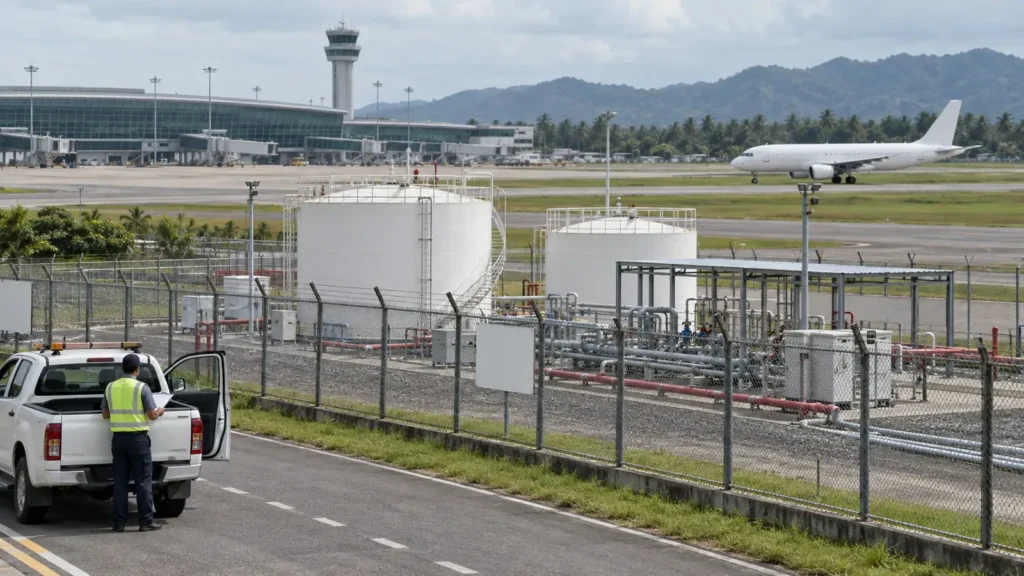
I meet the same question from developers at structuration stage: will the airport buy the sustainable aviation fuel my project makes? The direct answer is no, not as a buyer of the molecule. Airport operators are not selling or purchasing fuel, only very few airports are involved in fuel distribution, they rarely own the on-site fuel infrastructure and mostly provide the land for the fuel farm operator, and none of the climate benefit appears locally because the reduction happens upstream. So the airports saf demand question is really about enablement plus a share of the cost premium (the extra price SAF carries over kerosene): Swedavia has run a programme since 2019 under which airlines can apply for up to 50% coverage of the cost premium, AVINOR’s Oslo Airport put SAF into the main fuel farm in January 2016, and the demand that does exist sits with airlines and corporates, where 17 million tonnes a year is expected by 2030 and more than 80 percent of that demand is driven by 15 airlines.
A pre-FID file usually names an airport as an anchor source of demand, and the airports saf demand question rarely survives contact with the role description in the guidance. I use the material below to separate what an airport controls, what it spends, and what it only signals. Every claim carries the institution that published it.
In short
- Buyer: Airport operators do not sell or purchase fuel and rarely own the fuel farm, so the airport is an enabler, not an offtaker.
- Spend: Swedavia covers up to 50% of the cost premium, and Oslo Airport has moved SAF through the main fuel farm since January 2016.
- Demand: 17 million tonnes a year is expected by 2030, with more than 80 percent driven by 15 airlines.
- Supply: 4.4 Mt of installed capacity, a 5.8 Mt gap needing final investment decisions by 2026, and 19 to 45 billion US dollars of capital.
- Trap: Local benefit, price and certificate are the three assumptions that break an airport-led demand case.
In this article
The short answer: an airport enables the molecule, it does not buy it
Airport operators are not selling or purchasing fuel, and only very few airports are involved in fuel distribution. They rarely own fuel infrastructure on site (fuel farms, hydrant systems, trucks), and mostly just provide the land for the fuel farm operator to own and manage that infrastructure. A fuel farm is the storage site that feeds the hydrant system, the fixed pipework carrying jet fuel out to the aircraft stands, and an uplift is the moment that fuel is loaded into an aircraft. Supplying jet fuel has never been a core function for airport operators, and IATA says it should remain the case with SAF supply. The lifecycle reduction in carbon takes place upstream, so none of the climate benefits of introducing SAF at an airport are experienced locally. What an airport can offer instead is land, pipe access and coordination between the fuel supplier and the airlines.
What this means for you: I ask the airport to name, in writing, what it will enable, what it will fund and what it will merely welcome. A letter of welcome is not demand, and I do not count it as offtake.
What an airport actually controls
Under the Enable heading, ACI EUROPE asks airports to engage with SAF producers and aircraft operators beyond the blending mandate, to help each actor in the jet fuel supply understand its role, and to help establish the accounting and reporting mechanism through which airlines can claim emissions reductions from SAF. Under Deliver, it asks them to invest in SAF storage tanks, blending facilities and, where possible and relevant, local production plants, and where feasible to contribute to cover additional costs of SAF compared to kerosene. ACI EUROPE also notes that airports can attract leading airlines and corporate customers aiming to decrease their Scope 3 emissions (the emissions a company causes across its value chain, including the flights it buys) by facilitating access to the required infrastructure. The reporting side runs through book and claim: the claim is recorded on paper while the physical fuel is mixed into the common supply, so a buyer supports production without taking delivery.
What this means for you: I map each Enable and Deliver item to a named budget and a named counterparty. Items with no budget behind them describe process, not a commitment to buy.
What airports already spend
AVINOR’s Oslo Airport, January 2016: the first airport in the world where SAF was dropped into the main fuel farm and distributed in the hydrant and dispenser system. Swedavia, 2019: airlines can apply for up to 50% coverage of the cost premium for SAF uplifted at one of its airports. Royal Schiphol Group invests with SkyNRG in a bio kerosene plant on regional waste streams such as used cooking oil, with feedstocks expected to reduce CO2 emissions by 85% and operations due to commence in 2022, while a separate installation at Rotterdam The Hague Airport was expected to produce approximately 1,000 litres of SAF a day from CO2 captured from air, water and renewable electricity. A project by Orsted and Copenhagen Airport has the potential to displace 5% of fossil fuels by 2027 and 30% by 2030. Clermont-Ferrand Airport announced a 33% SAF blend in April 2021, SAF has been used at up to 30% at Paris-Le Bourget since mid-2021, and Brussels Airport launched its Stargate Project in November 2021 with 21 partners including Athens, Budapest and Toulouse Blagnac.
What this means for you: I hold this record against how to secure SAF offtake agreements, then ask which line my project sits on: infrastructure access, premium support or neither.
Where the demand really sits
Expected demand for SAF in 2030 is around 17 million tonnes per annum, about 4 to 5 percent of total jet fuel consumption, combining mandated volumes and voluntary commitments; the same report puts the commitment-based figure at around 16 Mt/a against a 2030 jet fuel demand of about 370 Mt. Adoption is concentrated: only three airlines, Air France-KLM, DHL and IAG, consumed over 1 percent of SAF in their fuel mix as of 2023, and more than 80 percent of this demand is driven by 15 airlines, with cargo carriers holding the highest 2030 targets. On the supply side, SAF output in 2025 is expected to reach 1.9 million tonnes, 2.4 billion liters, double the 1 Mt of 2024, which is 0.6 percent of total jet fuel consumption, and the premium cost the industry an additional 3.6 billion US dollars in fuel costs. The regional picture sits in the SAF market overview.
What this means for you: I do not model an airport as an offtake. I model a handful of airlines and corporates, and I check that the airport infrastructure lets their claims land.
What the supply and capital position looks like
Installed SAF capacity globally is likely to have reached 4.4 Mt by the end of 2024, with an additional 6.9 Mt of expansion planned through greenfield projects and retrofitting. Reaching anticipated 2030 demand would require an additional 5.8 Mt of production capacity, which would need to secure final investment decisions (FID) by 2026, against a capital expenditure requirement of between 19 billion and 45 billion US dollars by 2030. IATA expects global SAF production capacity around 20 Mt by 2030 with HEFA refineries at about 95% of total volume, and puts production at about 2 Mt in 2025. In Southeast Asia, IRENA finds Indonesia leads SAF potential from residues and wastes only at 9.3 Mt a year of agricultural residues against Malaysia’s 1.6 Mt, and warns that relying solely on residues is risky given competition from shipping fuels and biochar. The rules that convert this capacity into counted volume sit in SAF mandates.
What this means for you: I ask which capacity number my project is counted against and whether that number already carries a final investment decision. Announced capacity is not supply I can sell.
Three ways an airport-led demand assumption fails
First, the local benefit: airports neither buy the fuel nor own the infrastructure, and none of the climate benefit shows up locally because the reduction happens upstream. Hosting your molecule gives an airport no local emissions reduction to report, which removes the obvious local reason to pay. Second, the price: SAF costs 2 to 5 times conventional aviation fuel, the 2025 premium added 3.6 billion US dollars to the industry’s fuel bill, and prices exceed fossil jet fuel by a factor of two and by up to a factor of five in mandated markets. Third, the certificate illusion: a SAF certificate represents the environmental attributes of one metric ton of unblended certified sustainable aviation fuel and is claimed through book and claim while the physical fuel is blended with conventional jet fuel, so it signals demand without delivering a litre to anyone’s tank.
What this means for you: I keep three separate lines in my model: infrastructure access, cash contribution and attribute sale. An airport letter covering only the first line will not carry a bankable offtake.
The order I would run the work in
The order I run the work in. First, I ask the airport which Enable and Deliver actions it funds and whether it contributes to the cost premium, as Swedavia does up to 50%. Second, I confirm open access to the fuel farm and who owns the injection point, since restrictions or preferences on where SAF is injected should be avoided. Third, I confirm the shape of the offtake: long-term SAF contracts often run two to ten years, while traditional jet fuel contracts cover one year. Fourth, I confirm the certificate route and who holds the claim, including the registry infrastructure launched in December 2023 by RMI and the Environmental Defense Fund with SABA and Energy Web. Only then do I price the litre against the market reference in SAF price benchmarks.
What this means for you: if any of the four answers is missing, I leave the airport out of the demand section of the model and record it as an enabling stakeholder instead.
How I would run this if it were my file
One page before committee. Position: the airport does not own the fuel infrastructure and does not buy the fuel, it enables access and coordination. Precedent: Swedavia covers up to 50% of the cost premium, and Oslo Airport distributed SAF through the main fuel farm from January 2016. Demand: 17 Mt/a expected by 2030 with more than 80 percent driven by 15 airlines. Supply: 4.4 Mt of installed capacity, a 5.8 Mt gap that needs FID by 2026 and 19 to 45 billion US dollars of capital. Market today: 1.9 Mt in 2025 at 0.6 percent of jet fuel consumption. Attribute mechanics: a buyer can claim reductions through book and claim without taking delivery of the physical fuel. Nothing on that page describes an airport as a buyer, and nothing implies it will take delivery. Each line carries the source that supports it, so nobody in the room has to take my word for the role.
What this means for you: I write the airport line last and short. The committee should see what is signed, what is funded and what is only enabled, in that order.
Sources
- ACI EUROPE, 22 June 2022.
- IATA, 16 November 2026.
- World Economic Forum, February 2025.
- IATA, 9 December 2025.
- RMI, 8 May 2025.
- IRENA, December 2024.
- IATA, September 2025.
Frequently asked questions
Do airports buy SAF themselves?
Rarely as a buyer. Airport operators are not selling or purchasing fuel, only very few are involved in fuel distribution, they rarely own the on-site fuel infrastructure and mostly provide the land for the fuel farm, and supplying jet fuel has never been a core function for airport operators. Where an airport does engage in the provision of fuel or SAF, IATA says those activities need to be clearly separated from the airport’s role in the ownership of fuel infrastructure.
What does an airport actually invest in for SAF?
Under Deliver, ACI EUROPE asks airports to invest in SAF storage tanks, blending facilities and, where possible and relevant, local production plants, and where feasible to contribute to cover additional costs of SAF compared to kerosene. Oslo Airport has distributed SAF through the main fuel farm and the hydrant system since January 2016, which is what physical investment looks like in practice.
Can an airport help pay the SAF premium?
Yes in some places. Swedavia’s Sustainable Aviation Fuel Programme, launched in 2019, lets airlines apply for up to 50% coverage of the cost premium for SAF uplifted at one of its airports. I read that as a contribution to the premium rather than a fuel purchase, and the applicant is the airline, not the fuel producer.
How should I read an airport's support letter in my project file?
As enablement evidence, not as demand. I look for the named commitment on storage, blending or premium support, the accounting mechanism the airport helps establish so airlines can claim their emissions reductions, and whether the airport’s fuel infrastructure gives open access. Those three items tell me what the airport will do, and none of them tells me it will buy, because none of the climate benefit appears locally.
Not sure your project would survive a credit conversation?
A short call is usually enough to see where your project stands.
If you want a second set of eyes on the airport and offtake sections of your pre-FID file before it reaches committee, I can review your offtake agreements structure. I work from the same sources listed above, and I mark clearly which lines are signed, which are funded and which are only enabled.
I do not provide investment advice or arrange investments. I act as a strategic advisor and facilitator.

Alex, Founder of WeConnect Asia
I help low-carbon fuel and carbon removal project developers in Southeast Asia secure the commercial and financial partners needed to reach FID.
Related articles

Pitching a Climate Tech Company to Strategic Investors: What the Corporate Has to Believe Before It Writes a Cheque
How to pitch a climate tech company to strategic investors: the metric cluster, the readiness evidence and the ask that corporates fund.

Biomethane: What It Is, How It Is Made and Who Buys It
Biomethane is biogas cleaned to pipeline quality. I explain how it is made, how it differs from biogas and who buys it in Southeast Asia.

CO2 Sourcing for e-SAF Projects: What the Rules Allow and What the Contract Must Say
Biogenic CO2, direct air capture or industrial flue gas: which sources an e-SAF plant may use, what they cost and which contract terms make the fuel certifiable.

Operating Performance Guarantees for SAF Plants: What Lenders Ask For
Minimum guarantees, performance damages, retesting and who stands behind them: the operating guarantees a SAF plant needs to keep debt and offtake intact.

EPC and Construction Risk in SAF Plants: What a Lender Actually Tests
FEED scope, convertible EPC, performance guarantees and damages caps: the construction risk questions a SAF project must answer before financial close.

Matching Feedstock and Offtake Risk Back-to-Back in a SAF Project: How Lenders Read the Chain
Lenders do not buy a feedstock plan and an offtake plan separately. They buy the link between the two, and the link is where most SAF files break.