
Home » Australia SAF Policy: Supply-Side Money Without a Demand Order
Australia SAF Policy: Supply-Side Money Without a Demand Order
10 min read · Nov 2, 2026 · By Alex
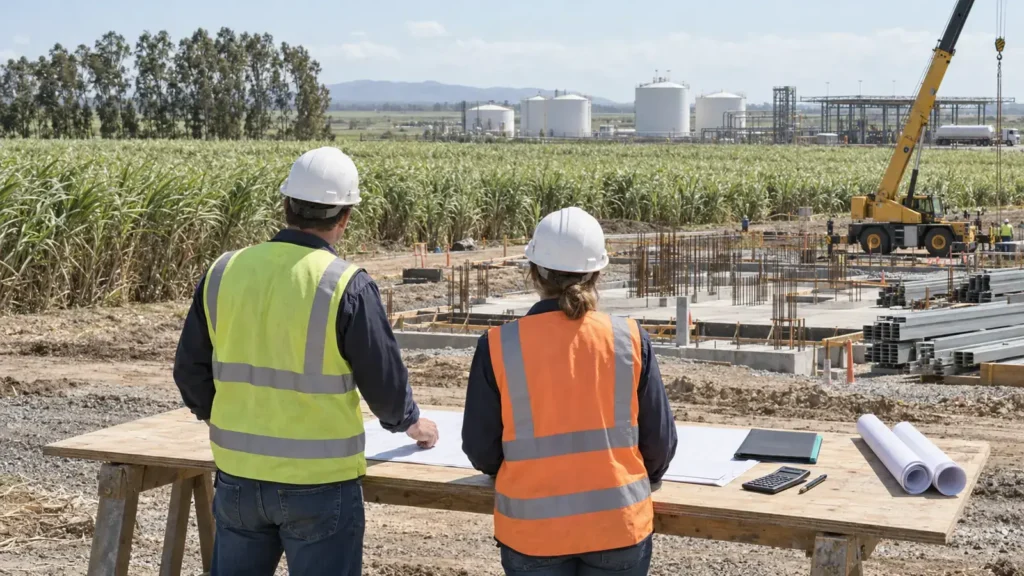
Australia has no blending mandate, meaning no required share of sustainable aviation fuel in jet fuel, so no volume is fixed. On 17 September 2025 the federal government announced a ten-year Cleaner Fuels Program of A$1.1 billion, or US$735 million, in production-linked incentives, meaning payments tied to fuel actually produced, with first production of drop-in cleaner fuels, usable in today’s engines, estimated by 2029. Eligibility runs through public consultation to 30 June 2026, grants are competitive, and A$250 million, or US$167 million, already sits in the Future Made in Australia Innovation Fund for research and development. That is the state of the Australia SAF policy today, and it sits on the supply side of the blending mandates adopted elsewhere.
I read this as a developer or a lender would: a package that pays for production and leaves demand to be negotiated. The eligibility rules are unfinished, the consultation is still open, and no purchase duty stands behind the fuel. Everything below separates what is announced from what is contracted.
In short
- Support: A$1.1 billion over ten years plus A$250 million for research and development, both competitive and production-linked.
- Eligibility: open until public consultation and design work close on 30 June 2026, with competitive grants.
- Timing: first production of drop-in fuels estimated by 2029, with 2 billion litres in the pipeline.
- Demand: no blending mandate, while stakeholders press for one to build demand and lower costs.
- Value read: the Clean Energy Finance Corporation sees $36 billion by 2050 and 230 million tonnes CO2-e of reductions, both estimates.
In this article
What the government actually announced
On 17 September 2025 four federal ministers issued a joint media release announcing $1.1 billion for low carbon liquid fuels, through a new ten-year Cleaner Fuels Program stimulating private investment in Australian onshore production of renewable diesel and SAF, with first production of drop-in fuels estimated by 2029. GreenAir News dates the package as a A$1.1 billion (US$735 million) incentive programme for renewable fuels from locally sourced agricultural and waste feedstocks, the plant oils and waste residues a fuel is made from, for commercial deployment by 2029.
The release states that liquid fuels make up around half of Australia’s national energy use, that Australia already exports nearly $4 billion of suitable feedstocks like canola and tallow, and that the Clean Energy Finance Corporation estimates such an industry could be worth $36 billion by 2050. The programme builds on the Sustainable Aviation Fuel Funding Initiative and the Future Made in Australia Innovation Fund, while the Guarantee of Origin Scheme, a record of how a fuel was produced, is extended to low carbon liquid fuels, and a fuel quality standard for renewable diesel is in place.
What this means for you: I date the media release as evidence of intent and wait for a signed grant agreement before I count any of the $1.1 billion as support.
What the money is tied to
The money is production-linked, meaning it pays against fuel produced rather than capacity built, and it is awarded competitively. Eligibility is to be determined after public consultation and design work running to 30 June 2026, and recipients must also deliver benefits under the community benefit principles of the Future Made in Australia Act. On top of the $1.1 billion, A$250 million (US$167 million) has already been allocated to research and development through the Future Made in Australia Innovation Fund. Until those eligibility rules are published, the recipient set stays open.
GreenAir News records that the announcement was welcomed by airlines, manufacturers and emerging producers, and that those same stakeholders are pressing for the next step, a usage mandate for SAF, to build demand and lower costs. Under the instruments adopted elsewhere the Australian tool is still an incentive rather than an obligation, so nothing in it fixes a volume of SAF that a buyer must purchase.
What this means for you: I carry the consultation window as an open eligibility risk and I book no grant line until a competitive award is signed.
What Australia would make, and from what
Australia’s stated feedstocks are canola, sorghum, sugar and waste, backed by cheap and reliable renewable energy and advanced farming practices. GreenAir News adds that the government sees abundant supplies of canola, sorghum, sugar cane and waste, which the aviation industry has long complained is being exported for other countries to produce renewable fuels, and that a new income stream for agriculture is part of the case.
The same source reports one producer’s Queensland portfolio: an alcohol-to-jet project using ethanol from sugar cane waste, a HEFA-pathway project, and a trial of two novel fuel feedstocks. The most advanced of the three targets 113 million litres of SAF and renewable diesel per year from 2028, with construction near Townsville targeted to begin next year, backed by an airline group, an aircraft manufacturer and a technology provider. The release also puts 2 billion litres worth of projects in the pipeline, many ready to scale. This is the supply side, and it is where an exported volume will eventually face the international fuel eligibility test.
What this means for you: I label pipeline volumes as pipeline and keep contracted volume in a separate row, because a project plan is not an offtake.
What the demand side still lacks
There is no Australian blending mandate for SAF, so no rule fixes the volume a supplier must sell or an airline must buy. Sustainable Aviation Futures counts Australia among the Asia-Pacific governments that have moved since 2024 from tentative goals to concrete blending targets and mandates, and names the announced ten-year Cleaner Fuels programme of A$1.1 billion (US$735 million) as the first major Asia-Pacific government subsidy programme for SAF, aiming to have projects producing fuel by 2029, while its list of concrete mandates and targets runs through Japan, India, Indonesia, Malaysia, Thailand and Singapore.
Transport & Environment counts eight SAF mandates adopted worldwide, including in the EU, the UK, India and Brazil, and observes that the main approach has been target-based while Canada and the US adopted an incentive-based approach; Australia sits with the incentive-based tools. That gap is what drives the price conversation, because a supply-side grant without a purchase duty leaves the offtake to be negotiated volume by volume.
What this means for you: I read demand as uncontracted until a buyer signs, and I do not assume a future mandate will appear to absorb the output.
What a finance plan has to survive here
IATA sets out the measures governments can use: production incentives, grants, loan guarantees, supportive regulatory frameworks, research and innovation support, and policies that facilitate access to feedstocks and infrastructure. It argues that effective sequencing of policies and investments is essential to avoid supply bottlenecks, infrastructure mismatches and unintended market distortions, and it states that any SAF mandates should be introduced only where the necessary market conditions, production capacity, infrastructure readiness and supportive policy measures are sufficiently in place.
Norton Rose Fulbright states that there is not yet an established wholesale market for SAF with a predictable and discoverable market price, so long-term, stable offtake terms from airlines and jet fuel providers will be critical to raising capital. In the way I approach financing a SAF project, I treat a competitive grant as a cost line that is not contracted until the grant agreement is signed, and I write no revenue line from a consultation that ends 30 June 2026.
What this means for you: sequencing is the test I apply here, and today the support sits ahead of the rules that would make it usable.
Where the risk sits today
SAF currently represents less than 1% of global aviation fuel use and is several times more expensive than conventional aviation fuel, because feedstocks cost more, production technologies are still developing, physical and market infrastructure is missing and upfront investment needs are high (IATA, June 2026). In a separate IATA release, global SAF production is expected to reach around 2.4 million tonnes in 2026, representing just 0.8% of aviation fuel use, at a cost to airlines of $4.3 billion (IATA, 6 June 2026).
Sustainable Aviation Futures notes that SAF produced in Asia has tended to flow to Europe where mandates create a price premium, and records the warning that Europe’s approach has driven SAF prices to five times that of conventional jet fuel. Norton Rose Fulbright adds that exporting SAF across borders from feedstock-rich countries to those with strong airline sectors is expensive and logistically complex and can reduce the net carbon benefit. The risks I track are timing risk on the grant design, demand risk from the missing mandate, and price risk on an unpriced market, which is how I read policy risk.
What this means for you: I date those three risks separately and I do not net them into a single adjustment.
What I would ask before signing
I ask four questions in writing. First, which document carries the support: the joint media release of 17 September 2025 or a signed grant agreement, and I date both. Second, what the eligibility rules say after the consultation and design work that runs to 30 June 2026, because until then the recipient set is open. Third, what demand exists without a mandate, and I look for a signed offtake rather than a stakeholder call for a usage mandate. Fourth, what the delivered price is against conventional jet fuel, and I take it from a contract, not from a policy announcement.
I do not average an announced envelope with contracted cash, and I do not treat a welcome statement from stakeholders as a purchase commitment. Every answer has to arrive with a document name, a date and a named counterparty attached to it.
What this means for you: if one answer is missing, I carry the file as concept stage rather than as financeable.
How I would model it if it were my file
I keep four dated rows. The support row carries A$1.1 billion over ten years plus the A$250 million already allocated to research and development, both labelled competitive and production-linked. The timing row carries first drop-in production estimated by 2029 and the consultation deadline of 30 June 2026. The capacity row carries 2 billion litres of projects in the pipeline, labelled pipeline rather than contracted. The market row carries the Clean Energy Finance Corporation reading of a potential $36 billion industry by 2050 and cumulative reductions of 230 million tonnes CO2-e by 2050, both labelled estimate.
My last row is contracted volume, because that is the only row a lender will count. Everything above it stays visible as context and stays out of the base case. If no grant is signed, the support row drops to zero and the model still has to stand on its own.
What this means for you: I build the model so that the first line a lender can rely on is a signed offtake, with the announced programme sitting below it as upside.
Sources
- GreenAir News, 24 September 2025.
- Australian Government, 17 September 2025.
- IATA, June 2026.
- IATA, 6 June 2026.
- Transport & Environment, consulted 16 November 2026.
- Sustainable Aviation Futures, 2025.
- Norton Rose Fulbright, October 2025.
Frequently asked questions
What is Australia's SAF policy?
I read it as a supply-side package: a ten-year Cleaner Fuels Program of A$1.1 billion announced on 17 September 2025, delivering production-linked incentives and competitive grants, supported by an expanded Guarantee of Origin Scheme and a fuel quality standard for renewable diesel (Australian Government; GreenAir News). I treat it as support for supply rather than as an order to buy.
Does Australia have a SAF blending mandate?
No, and I would not describe it as one. Transport & Environment counts eight SAF mandates adopted worldwide and Australia is not among them, while the Australian instrument is an incentive-based, production-linked programme and stakeholders are still calling for a usage mandate (Transport & Environment; GreenAir News). The pressure for one comes from the same stakeholders that welcomed the announcement.
How much funding has Australia committed to low carbon liquid fuels?
I count A$1.1 billion over ten years for production, plus A$250 million already allocated to research and development through the Future Made in Australia Innovation Fund, with the Clean Energy Finance Corporation estimating a potential industry worth $36 billion by 2050 (Australian Government; GreenAir News). I label that last figure as an estimate rather than as revenue.
When will Australian SAF be produced?
I work to three dates. First production of drop-in cleaner fuels is estimated by 2029, eligibility rules are settled through public consultation and design work by 30 June 2026, and one producer is targeting 113 million litres of SAF and renewable diesel per year from 2028 (Australian Government; GreenAir News). Until the eligibility rules close, I do not treat the recipient set as fixed.
Not sure your project would survive a credit conversation?
A short call is usually enough to see where your project stands.
If you are looking at an Australian file at concept stage, I separate announced support from contracted support, and I do that through my work on offtake agreements, starting with buyer, volume, price and term, so the model has a row a lender can count.
I do not provide investment advice or arrange investments. I act as a strategic advisor and facilitator.

Alex, Founder of WeConnect Asia
I help low-carbon fuel and carbon removal project developers in Southeast Asia secure the commercial and financial partners needed to reach FID.
Related articles

Pitching a Climate Tech Company to Strategic Investors: What the Corporate Has to Believe Before It Writes a Cheque
How to pitch a climate tech company to strategic investors: the metric cluster, the readiness evidence and the ask that corporates fund.

Biomethane: What It Is, How It Is Made and Who Buys It
Biomethane is biogas cleaned to pipeline quality. I explain how it is made, how it differs from biogas and who buys it in Southeast Asia.

CO2 Sourcing for e-SAF Projects: What the Rules Allow and What the Contract Must Say
Biogenic CO2, direct air capture or industrial flue gas: which sources an e-SAF plant may use, what they cost and which contract terms make the fuel certifiable.

Operating Performance Guarantees for SAF Plants: What Lenders Ask For
Minimum guarantees, performance damages, retesting and who stands behind them: the operating guarantees a SAF plant needs to keep debt and offtake intact.

EPC and Construction Risk in SAF Plants: What a Lender Actually Tests
FEED scope, convertible EPC, performance guarantees and damages caps: the construction risk questions a SAF project must answer before financial close.

Matching Feedstock and Offtake Risk Back-to-Back in a SAF Project: How Lenders Read the Chain
Lenders do not buy a feedstock plan and an offtake plan separately. They buy the link between the two, and the link is where most SAF files break.