
Home » Sugarcane Bagasse SAF Feedstock: What Is Left After Cogeneration
Sugarcane Bagasse SAF Feedstock: What Is Left After Cogeneration
10 min read · Nov 2, 2026 · By Alex
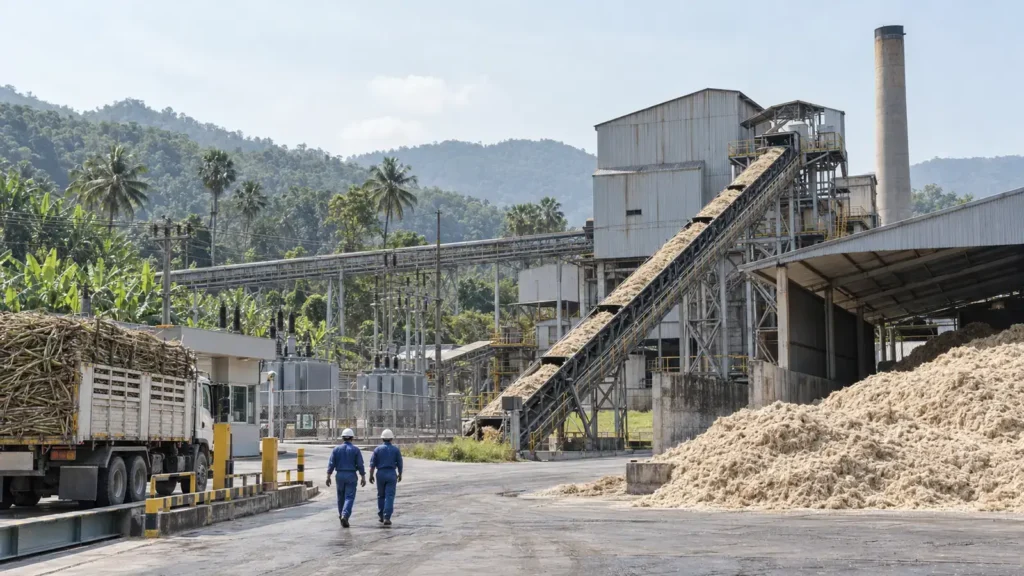
Sugarcane bagasse reaches a sustainable aviation fuel project only at the bottom of the branch. India makes about 100 million tonnes a year. Competing uses take most of it, mostly cogeneration (burning it in the mill’s own boilers). Cogeneration holds about 9200 MW of installed capacity, and about 30 million tonnes remain for advanced ethanol and SAF. Southeast Asia counts 23.9 million tonnes a year of bagasse, tops and leaves. That supports 3.3 million tonnes of potential SAF through the alcohol-to-jet route. European accounting puts bagasse in part A of annex IX. European rules may count its contribution towards the minimum shares twice. I set the wider regional picture in the Southeast Asia feedstock availability review. In fact, the bagasse saf feedstock case therefore turns on one question. That question is what the mill frees after it sells its own power.
I read this in the order a supplier at feasibility stage would. First comes what is physically there, then what the current energy business takes. Next come what the rules allow and what the finished fuel costs. For example, every figure below stays attached to the study that carries it.
In short
- Availability: India about 100 million tonnes a year, about 30 million tonnes free of competing uses. Southeast Asia adds 23.9 million tonnes a year for 3.3 million tonnes of SAF.
- Competing use: About 9200 MW of cogeneration in India, paid at INR6-7 against INR1-3 from other sources.
- Accounting: rules may count the contribution at point (j) of part A of annex IX twice.
- Route: ATJ, rated in development by RSB, with bagasse feedstock readiness rated high by ICAO.
- Price: Around USD 1.6 per litre in Thailand against fossil Jet A-1 at USD 0.6 per litre.
In this article
The short answer: available only at the bottom of the branch
The ICAO study for India counts about 100 million tonnes of sugarcane bagasse produced each year. It records installed cogeneration capacity of about 9200 MW. About 30 million tonnes stay available for advanced ethanol and SAF after competing uses. Meanwhile, the same study gives a low and high availability range of 30 and 120 million tonnes a year. Bagasse and ethanol to jet both fall in that range. Its low figure is the surplus left after bioenergy uses. That conversion runs at 0.18 tonnes of ethanol per tonne of bagasse. In addition, the RSB counts 23.9 million tonnes a year of bagasse, tops and leaves in Southeast Asia. This is 6.4% of the regional base, for 3.3 million tonnes of potential SAF through ATJ. The renewable energy directive puts bagasse at point (j) of part A of annex IX.
What this means for you: the volume exists on paper. As a result, the bagasse saf feedstock number I would underwrite is what the mill has left after its own energy use. So I ask for the mill balance before I model the plant.
What the residue base says about this one
That cogeneration business is the mill’s own power operation: bagasse goes into the mill boilers. Also, the mill sells the surplus power. Therefore, about 9200 MW of installed capacity in India is the competing use any SAF number has to clear. Specifically, the RSB clusters sugarcane bagasse, tops and leaves with medium availability and low risk. That places them one step below rice husks and straw. Thailand is the leading country, with a moisture content of 50.0% and an ATJ route rated in development.
The same study records low sustainability risks for bagasse. However, knowledge and technology readiness for its production, collection and utilisation remain less advanced than for traditional crops. Under CORSIA, feedstocks with low risk for land use change get an emission factor of zero. Technology readiness means how far a route has moved from demonstration towards commercial operation. IATA reads second generation feedstock as high emission reduction potential but relatively limited availability. Second generation ethanol means ethanol from lignocellulosic residue rather than sugar or starch. See the sustainability criteria page.
What this means for you: the tonne is low risk on land use but thin on collection knowledge. I read a published availability number as a starting point rather than a supply.
Why bagasse is the easier lignocellulosic case
Moreover, the ICAO study explains why a residue made inside a processing plant behaves differently from one left in a field. Bagasse incurs no transport cost from the fields. Sugar production already reduces and aggregates it. On-field residues, by contrast, need collecting, baling, transport, storage, drying and size reduction. That is a complex supply chain carrying quantity and quality risk. Therefore, on that basis the study calls bagasse a low-hanging fruit feedstock for advanced ethanol. It notes that Raizen has successfully demonstrated the route in Brazil. By contrast, the study gives the composition as 42 to 48% cellulose, 19 to 25% hemicellulose and 20 to 42% lignin. The lignin fraction cannot become ethanol and mostly goes to energy. I would pair that with the multi-product plant page.
What this means for you: I ask for the mill gate rather than the field. The sugar process has already solved the aggregation problem I would pay for in other residues.
What the European rules do with it
Part A of annex IX of the renewable energy directive lists feedstocks for biogas for transport and advanced biofuels. Instead, in that list, rules count the contribution towards the minimum shares twice their energy content. This is the double counting mechanism. Bagasse sits at point (j), alongside straw at (e) and palm oil mill effluent and empty palm fruit bunches at (g). Part B of annex IX holds only used cooking oil and animal fats of categories 1 and 2. Therefore, bagasse is not in that limited group.
ReFuelEU Aviation builds its SAF definition on that list. It sets a 2% share of SAF at EU airports from 2025, rising to 70% from 2050. It also sets a 1.2% share of synthetic aviation fuels from 2030, rising to 35% from 2050. Furthermore, the rule certifies blended fuels up to a 50% SAF blend. The mandate side is set out in the low carbon fuel mandates page.
What this means for you: the European rule gives bagasse a counting advantage rather than a price advantage, so I model the compliance value separately from the production cost.
What the market is doing with it
The IEA Bioenergy Task 39 report describes the DG Fuels project. Consequently, its gasification feedstock will be bagasse, sugar cane trash and pulp. The expected investment is in excess of USD 4 billion, including renewable power, desalination and water electrolysis. The plant expects to start operations in 2028. However, the same report records Raizen producing cellulosic ethanol from bagasse in Brazil with plans for several new facilities, and continuing efforts by Praj in India. On the price side, IRENA prices the ATJ pathway using sugarcane in Thailand. Also, it uses sugarcane as a first generation feedstock and reaches around USD 1.6 per litre. That is similar to HEFA at USD 1.6 to 2.1 per litre. It sits above the fossil Jet A-1 price of USD 0.6 per litre. The wider route comparison sits in the sustainable aviation fuel guide.
What this means for you: the USD 4 billion bagasse project due in 2028 is my market test. I read the price line as the gap my offtake has to close.
Three ways the bagasse assumption fails
First, the mill earns from the competing use. The ICAO records that electricity from bagasse costs INR6-7 against INR1-3 from other sources. Therefore, sugar mills have an income stream to give up. Also, cogeneration already uses that material widely. In fact, the same study notes that mills are actively investigating other lucrative applications for bagasse. They consider SAF a very attractive proposition. Second, the conversion record: many commercial scale cellulosic ethanol facilities closed because they could not achieve capacity. For example, they include facilities in Europe and the United States, such as the Italian plant opened in 2013. They also include the Clariant plant in Romania, which closed in December 2023. Raizen continues. Third, the cost of the finished fuel: advanced ethanol carries a high production cost compared with conventional ethanol, and IRENA puts SAF at two to three times the fossil Jet A-1 price.
What this means for you: each of the three assumptions needs its own line in my model, the forgone power revenue, the capacity the conversion plant actually reaches, and the price gap to fossil Jet A-1.
The order I would run the work in
I would start from the mill, not from the national statistic. Confirm what the mills in the catchment actually free after their own cogeneration. Next, confirm the moisture and storage plan for a wet residue. Then confirm the annex IX entry and the certification route. Also confirm the conversion route and its technology readiness. Finally, price the tonne against the electricity it displaces. The moisture question is not minor: the RSB records 50.0% moisture for bagasse tops and leaves. Therefore, storage and drying belong in the first pass. Two facts anchor the sequence. First, part A of annex IX writes bagasse in with a contribution rules may count twice. Second, the ICAO rates bagasse feedstock readiness as high while advanced ethanol still costs more than conventional ethanol. The sequence itself sits in the road to FID.
What this means for you: I run the work mill first, certification second, conversion third, price last, because each answer changes the value of the next.
How I would run this if it were my file
I would put my own mill level balance against the published numbers before I take it to a committee. India shows about 100 million tonnes a year, with about 30 million tonnes free of competing uses. Meanwhile, that sits against 9200 MW of cogeneration. Southeast Asia shows 23.9 million tonnes a year for 3.3 million tonnes of potential SAF. Then comes the annex IX entry at (j), with the contribution counted twice. The USD 4 billion bagasse gasification project is due in 2028. Price evidence from IRENA sits at around USD 1.6 per litre for ATJ. Fossil Jet A-1 costs USD 0.6 per litre. I would also carry the RSB moisture figure of 50.0%. Also, the conversion rate of 0.18 tonnes of ethanol per tonne of bagasse matters. In addition, it is one of the two assumptions most likely to move the answer.
My balance beats the published figure whenever they diverge. It is the catchment I would actually be contracting in.
What this means for you: my mill balance comes first, then my annex IX entry, then my conversion route. I let the published numbers sit behind them.
Sources
- ICAO, 2025.
- RSB, September 2024.
- IEA Bioenergy Task 39, January 2024.
- IRENA, December 2024.
- EUR-Lex, 16 November 2026.
- European Commission, 16 November 2026.
- IATA, September 2025.
Frequently asked questions
How much bagasse is actually available for SAF?
In India about 100 million tonnes a year is produced and about 30 million tonnes remains for advanced ethanol and SAF after competing uses, giving a low and high availability range of 30 and 120 million tonnes a year at a conversion of 0.18 tonnes of ethanol per tonne of bagasse. Southeast Asia counts 23.9 million tonnes a year of bagasse, tops and leaves, for 3.3 million tonnes of potential SAF through ATJ. The number I would underwrite is the surplus after cogeneration, not the gross production figure.
Is bagasse a better SAF feedstock than rice straw?
It is easier on logistics and harder on competing uses. Bagasse is generated at the mill, already size reduced and aggregated, and ICAO rates its feedstock readiness as high, while rice straw has to be collected from fields and is rated low on readiness because of supply chain challenges. Bagasse also already serves a cogeneration business that pays for electricity, so the surplus is smaller than the gross figure suggests.
What does bagasse based SAF cost today?
The published figures point to the ATJ pathway using sugarcane as a first generation feedstock in Thailand at around USD 1.6 per litre, against a fossil Jet A-1 price of USD 0.6 per litre, which is in line with HEFA at USD 1.6 to 2.1 per litre. On top of that, advanced ethanol carries a high production cost compared with conventional ethanol, and IRENA puts SAF at two to three times the fossil price.
What should my feasibility study check first?
Three checks in order: what the mills in the catchment free after their own cogeneration, the moisture and storage plan for the tonne, since the RSB records 50.0% moisture for bagasse tops and leaves, and the certification route plus the conversion readiness of the technology the offtaker intends to use. Only after those do I price the tonne against the electricity it displaces.
Not sure your project would survive a credit conversation?
A short call is usually enough to see where your project stands.
If you are at feasibility stage and want a second read on a mill balance or a certification route, I work through it with you at investor introductions.
I do not provide investment advice or arrange investments. I act as a strategic advisor and facilitator.

Alex, Founder of WeConnect Asia
I help low-carbon fuel and carbon removal project developers in Southeast Asia secure the commercial and financial partners needed to reach FID.
Related articles

Pitching a Climate Tech Company to Strategic Investors: What the Corporate Has to Believe Before It Writes a Cheque
How to pitch a climate tech company to strategic investors: the metric cluster, the readiness evidence and the ask that corporates fund.

Biomethane: What It Is, How It Is Made and Who Buys It
Biomethane is biogas cleaned to pipeline quality. I explain how it is made, how it differs from biogas and who buys it in Southeast Asia.

CO2 Sourcing for e-SAF Projects: What the Rules Allow and What the Contract Must Say
Biogenic CO2, direct air capture or industrial flue gas: which sources an e-SAF plant may use, what they cost and which contract terms make the fuel certifiable.

Operating Performance Guarantees for SAF Plants: What Lenders Ask For
Minimum guarantees, performance damages, retesting and who stands behind them: the operating guarantees a SAF plant needs to keep debt and offtake intact.

EPC and Construction Risk in SAF Plants: What a Lender Actually Tests
FEED scope, convertible EPC, performance guarantees and damages caps: the construction risk questions a SAF project must answer before financial close.

Matching Feedstock and Offtake Risk Back-to-Back in a SAF Project: How Lenders Read the Chain
Lenders do not buy a feedstock plan and an offtake plan separately. They buy the link between the two, and the link is where most SAF files break.