
Home » Biogas Upgrading Technologies: What Each Route Costs You
Biogas Upgrading Technologies: What Each Route Costs You
10 min read · Oct 13, 2025 · By Alex
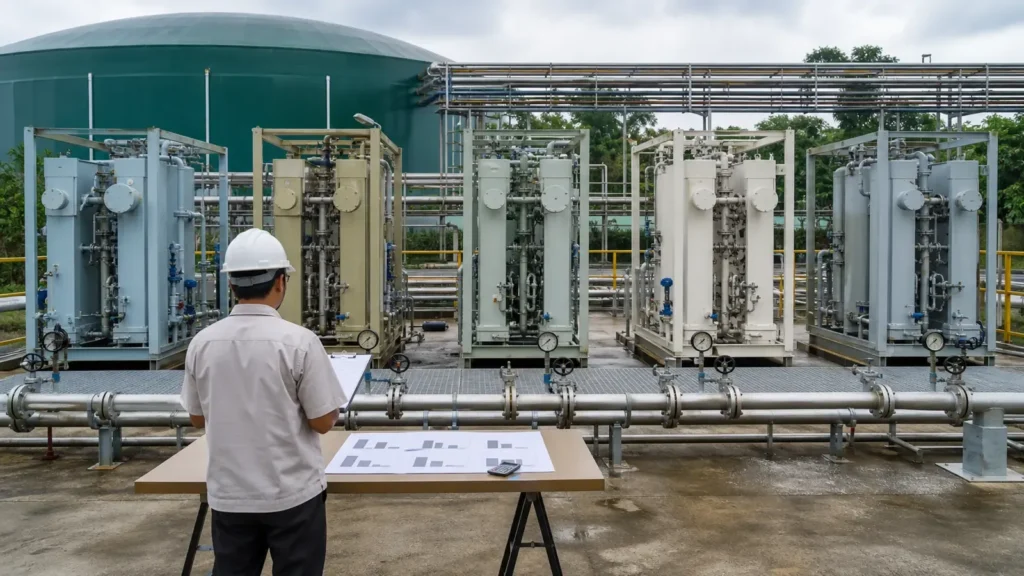
No single route wins everywhere. Water scrubbing, pressure swing adsorption, physical scrubbing, amine scrubbing and membranes all reach a sellable gas, and they separate on three numbers only: electricity per cubic metre, heat per cubic metre, and methane lost in the tail gas. Biogas upgrading technologies, meaning the step that strips CO2 and trace contaminants out of raw gas, separate on those three numbers plus one external constraint, the quality the offtaker (the buyer who takes the gas) will accept, and the choice usually writes itself. That is the frame I use with every developer who arrives with a vendor quote and no gas specification. The upstream picture, and the markets that pay for the output, sit in biomethane explained from feedstock to end use.
Biogas is the raw gas that anaerobic digestion, the bacterial breakdown of organic matter without oxygen, releases; upgrading turns it into biomethane, a gas that is mostly methane and can be sold into a network or a fuel contract. I will follow the order the decision arrives: what upgrading removes, the five routes, the energy bill, the methane lost, what the buyer accepts, what the step adds to the cost of the molecule, what is installed, and how I would choose here. Capex (capital expenditure) and opex (operating expenditure) rank second, behind those three numbers.
In short
- Five routes: water scrubbing, pressure swing adsorption, physical scrubbing, amine scrubbing, membranes.
- Electricity: 0.05 to 0.15 kWh/Nm3 for amines, 0.18 to 0.20 for membranes, 0.25 to 0.3 for water scrubbing.
- Heat: amines need 0.5 to 0.75 kWh/Nm3 of heat, the others need none.
- Methane slip: under 0.1 percent for amines, under 0.6 percent for membranes, under 4 percent for PSA.
- Cost of the step: about USD 2/MBtu to USD 4/MBtu on a plant cleaning 3.5 million m3 a year.
In this article
What upgrading actually removes
In 2018, raw biogas was reported to hold 50 percent to 70 percent methane and 30 percent to 50 percent CO2, plus nitrogen at 0 to 3 percent, water vapour at 5 to 10 percent, oxygen at 0 to 1 percent, H2S at 0 to 10 000 ppmv and siloxanes at 0 to 41 mg/m3. The lower calorific value of methane is 36 MJ/m3, so a biogas at 60 to 65 percent methane sits at about 20 to 25 MJ/m3.
Two jobs hide inside the word. Upgrading removes CO2 to raise the calorific value; cleaning removes the poisons, the H2S, the siloxanes, the water and the traces that attack a compressor or a burner. Vendors sell the two together and plants fail them separately.
Siloxanes are the quiet one. They burn into sticky silicon oxide residues that coat the inside of an engine or a burner tip, and the damage appears months after commissioning, when the maintenance log starts filling.
What this means for you: a route that ignores H2S and siloxanes will pass the first month and fail the second, so the cleaning duty, not the CO2 duty, is what I write into the specification first.
The five routes that exist at commercial scale
Costs first, because they set the frame. Global biogas production costs ran between USD 2/MBtu and USD 20/MBtu in 2020, with Southeast Asia at USD 9/MBtu and Europe at USD 16/MBtu, and 70 percent to 95 percent of that sat in the digesters rather than in the upgrading unit, according to the IEA biogas and biomethane outlook published in 2020. A developer who spends three weeks on the route and three days on the digester has the priorities inverted; the plant behind the fence is in how a biogas plant works from feedstock to gas.
Five routes are commercial. Water scrubbing is physical absorption in water, the most widespread of the five, at 6 to 10 bar and up to 40 degrees C. Physical scrubbing uses organic solvents that absorb three times more CO2 than water and are regenerated at 80 degrees C, reaching 98 percent methane. Amine scrubbing is chemical absorption in a liquid amine, with the absorber at atmospheric pressure, reaching up to 99 percent methane. Pressure swing adsorption cycles gas through a bed at varying pressure so CO2 sticks and methane passes. Membrane separation pushes gas through a membrane that lets CO2 through faster than methane.
What this means for you: all five sell gas, so the route is not a technical risk question. It is an energy price question, and the energy price lives on your site.
Electricity, heat, and the energy bill nobody models
In 2018, electricity consumption per Nm3 of raw biogas was 0.23 to 0.30 kWh/Nm3 for pressure swing adsorption, 0.25 to 0.3 for water scrubbing, 0.2 to 0.3 for physical scrubbing, 0.18 to 0.20 for membranes and 0.05 to 0.15 for amines, according to the 2018 review of upgrading technologies published in Biotechnology Advances. Heat was a separate column: amines consumed 0.5 to 0.75 kWh/Nm3, physical scrubbing under 0.2, the other three none at all.
That table is the whole argument. An amine unit halves the electricity and buys heat instead. If the digester already runs a heat loop, the heat is close to free and the amine route wins on energy. If there is no heat loop, the plant builds one, and the saving evaporates. The comparison most developers start from, gas plant against power plant, is in the difference between a biomethane plant and a biogas plant.
What this means for you: do not model the upgrading unit alone. Model it with the site heat balance, because the ranking of the five routes flips on a number that belongs to the digester.
Methane slip, the number that decides the carbon case
In 2018, methane losses were under 0.1 percent for amines, under 0.6 percent for membranes, under 2 percent for water scrubbing, under 4 percent for pressure swing adsorption and 2 to 4 percent for physical scrubbing. Recovery from the physicochemical processes can exceed 96 percent, and amines reach 96 to 99 percent.
Methane slip is two problems at once. It is fuel produced and not sold, and it is a greenhouse gas far more potent than the CO2 the plant was built to avoid, so it lands in the carbon intensity of the molecule and in the price the buyer will eventually pay. Feedstock choice and the economics behind it are in how feedstock choice drives biogas production economics, because slip is not the only place where a percent goes missing.
What this means for you: methane slip has to be contractual and measured on the tail gas during a witnessed performance test. A brochure number is not a guarantee, and a guarantee with no test protocol is not a guarantee either.
Quality and pressure: what the buyer can accept
In 2018, some countries already required more than 95 percent methane in the injected gas, and the European Commission had issued a mandate to harmonise gas quality specifications. The European Biogas Association note of March 2024 on biomethane standards shows why that is slow work. Grid entry follows EN 16723-1, the natural gas quality standard is EN 16726, and the standard is voluntary, so countries often keep their own limits. Oxygen causes the most difficulty, alongside the Wobbe index, the number that tells a burner how much energy arrives at a given pressure.
The oxygen limits alone explain the delay: 0.001 percent mol in France on an hourly basis, 0.5 percent mol in Denmark at entry and transit points and 0.1 percent at storage points, up to 0.6 percent mol in Italy. A plant built to the French figure meets the Danish one; a plant designed to the loose end of the range does not travel.
A plant selling electricity has no gas specification at all, which is why biogas power projects were built first in this region; that fleet is in biogas power plants in Southeast Asia.
What this means for you: read the offtaker’s specification, and the national one behind it, before ordering the unit. Oxygen removal is cheap to design in and expensive to retrofit.
What the step adds to the cost of the molecule
In 2020, the upgrading step alone was estimated at about USD 2/MBtu to USD 4/MBtu for a plant cleaning about 3.5 million m3 of biogas a year, grid connection at about USD 3/MBtu, and the average cost of biomethane once upgraded at around USD 19/MBtu. The same outlook put the 2040 average at about USD 14/MBtu, roughly 25 percent less, and said the scope for further reduction is limited because the technologies are mature.
The IEA renewables report published in 2026 adds the market context: world biogases production was 1 785 petajoules in 2025, of which 78 percent was biogas, growth of 18 percent is expected over 2026 to 2031, and biomethane output should nearly double.
Maturity is bad news if you hoped a cost curve would rescue the project, and good news if you are financing it. There is no technology risk in a membrane skid or an amine unit, and no surprise coming either.
What this means for you: budget the step at today’s number, not a hoped-for future one, and treat cheaper equipment projections as a sensitivity rather than a base case.
What is actually installed, and where
France declared 364 upgrading units in the IEA Bioenergy Task 37 country report of September 2024, the largest count of any country, and membrane separation was the most common technology there. The United Kingdom had 723 plants at the end of 2022 and 103 174 m3/h of biomethane capacity. Germany produced about 87 TWh of biogas a year and China about 81 TWh, and in most or all of those countries production depended on an investment support or a subsidy to be financially viable.
The lesson is uncomfortable. The route that gets installed is the one the local support scheme pays for, not the one with the best thermodynamics. A country that subsidises injection buys membranes and amine units; a country that subsidises electricity buys engines.
Southeast Asia sits at the other end. In 2026 the feedstock potential was estimated at almost 65 bcme, about 2 300 PJ, against barely 80 PJ of combined production in 2025. The market that would absorb the output is tracked in the biomethane market in Southeast Asia.
What this means for you: check what the scheme pays for before picking a route, because a technically superior choice the tariff does not reward is a cost, not an advantage.
How I would choose a route in Southeast Asia
Five questions, in this order. What heat is available on site, and at what temperature and quantity? What does the offtaker’s specification say, oxygen and Wobbe index included? What will the tail gas be measured against, and who witnesses the test? Who maintains the unit, and how far away is the nearest plant running the same technology on the same feedstock? And will this plant ever need to sell gas rather than electricity, because that answer changes the specification and the capex?
I would shortlist two routes, not five. Then I would ask both suppliers for a guaranteed electricity figure per Nm3 of raw gas, a guaranteed slip figure, and a performance test protocol stating how both will be measured and what happens if they are missed. I would compare the two on those three numbers only, because every other line of the two proposals is either a fixed cost both carry or a claim nobody will guarantee.
What this means for you: the route is chosen at FID (final investment decision) on three guaranteed numbers, not in a table of ten criteria.
Sources
- IEA, Outlook for biogas and biomethane, 2020.
- Angelidaki et al., Biogas upgrading and utilization, Biotechnology Advances, 2018.
- IEA Bioenergy Task 37, A perspective on the state of the biogas industry in 12 member countries, 2024.
- IEA, Renewables 2026, chapter Biogases, 2026.
- European Biogas Association, Biomethane standards: facilitating renewable gas uptake, 2024.
Frequently asked questions
Which biogas upgrading technology is the most common?
Water scrubbing, because it is simple and reliable and reaches up to 99 percent methane after drying. Membrane separation is now the most common route in France, with 364 upgrading units declared in 2024.
Do all upgrading routes cost the same?
At commercial scale they land close. In the 2018 comparison, electricity was 0.2 to 0.3 kWh/Nm3 of raw biogas for most routes, and the amine route halved that but added 0.5 to 0.75 kWh/Nm3 of heat, so the cost of heat decides the ranking.
How much methane is lost in upgrading?
Under 0.1 percent with amines, under 0.6 percent with membranes, under 2 percent with water scrubbing and under 4 percent with pressure swing adsorption, on the 2018 figures. The number belongs in the performance guarantee, measured on the tail gas.
What gas quality must the plant reach?
It depends on the buyer and the country. In 2018 some countries already required more than 95 percent methane for grid entry, and in 2024 oxygen limits ranged from 0.001 percent mol in France to 0.5 percent mol in Denmark, so the specification has to be read before the unit is ordered.
Not sure your project would survive a credit conversation?
A short call is usually enough to see where your project stands.
If you are at feasibility and want that shortlist tested against your own heat balance and your offtaker’s terms, that is the work I do; the scale-up side of it sits in technology maturity and scale up support.
I do not provide investment advice or arrange investments. I act as a strategic advisor and facilitator.

Alex, Founder of WeConnect Asia
I help low-carbon fuel and carbon removal project developers in Southeast Asia secure the commercial and financial partners needed to reach FID.
Related articles

Pitching a Climate Tech Company to Strategic Investors: What the Corporate Has to Believe Before It Writes a Cheque
How to pitch a climate tech company to strategic investors: the metric cluster, the readiness evidence and the ask that corporates fund.

Biomethane: What It Is, How It Is Made and Who Buys It
Biomethane is biogas cleaned to pipeline quality. I explain how it is made, how it differs from biogas and who buys it in Southeast Asia.

CO2 Sourcing for e-SAF Projects: What the Rules Allow and What the Contract Must Say
Biogenic CO2, direct air capture or industrial flue gas: which sources an e-SAF plant may use, what they cost and which contract terms make the fuel certifiable.

Operating Performance Guarantees for SAF Plants: What Lenders Ask For
Minimum guarantees, performance damages, retesting and who stands behind them: the operating guarantees a SAF plant needs to keep debt and offtake intact.

EPC and Construction Risk in SAF Plants: What a Lender Actually Tests
FEED scope, convertible EPC, performance guarantees and damages caps: the construction risk questions a SAF project must answer before financial close.

Matching Feedstock and Offtake Risk Back-to-Back in a SAF Project: How Lenders Read the Chain
Lenders do not buy a feedstock plan and an offtake plan separately. They buy the link between the two, and the link is where most SAF files break.