
Home » Strategic Corporate Pilots in Southeast Asia: How to Structure an Industrial Pilot That Ends in a Decision
Strategic Corporate Pilots in Southeast Asia: How to Structure an Industrial Pilot That Ends in a Decision
9 min read · Oct 2, 2026 · By Alex
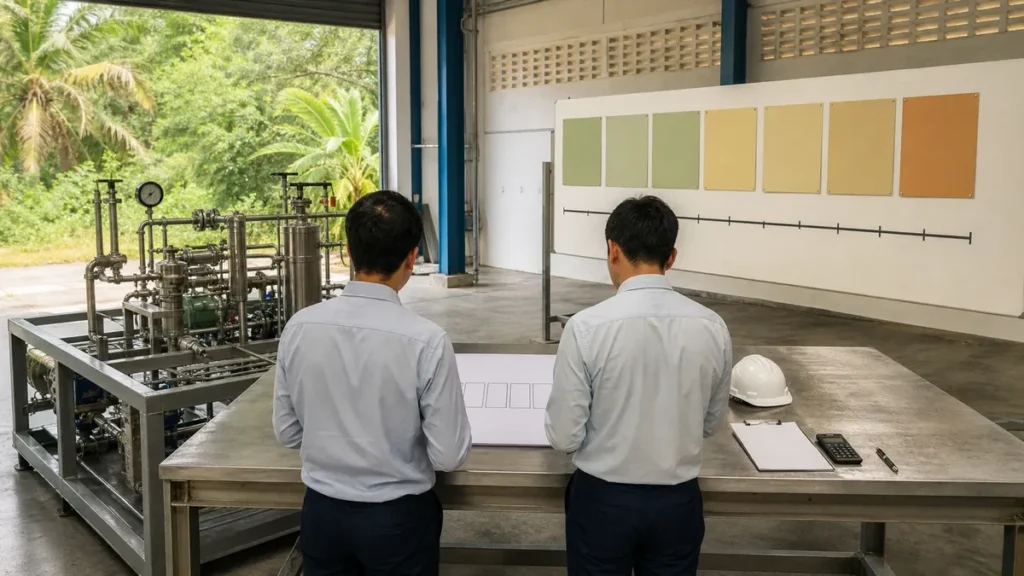
Most industrial trials die in the same place: nobody wrote down what would count as a pass. Structure decides whether a test inside a manufacturer ends with a signed next step or with free engineering. Structure a corporate pilot before it starts. Give it one problem, named owners on both sides, and a bounded scope. Agree measurable success criteria in advance and fix a decision meeting date. Without a decision meeting, a pilot turns into unpaid custom work. The wider industry view sits in climate tech and green tech in Southeast Asia.
I move in a fixed order: what the test is and why trials stall. In addition, I cover the parts a brief must hold and the regional test sites. Then what an investor needs to see, the route from test to contract, the mistakes I keep meeting. Also, the four steps I use.
In short
- One problem: the pilot tests a use case, not a feature list.
- Owners: both sides name the person who can approve the contract.
- Criteria: baseline, target, data source, owner, review date.
- Region: industrial hubs in Southeast Asia are opening as test sites.
- Decision: the exit is written before the first day of work.
In this article
What a corporate pilot is
A pilot is a limited, real-world test of one defined use case. It produces evidence for a single next decision inside an industrial company. The corporate partner is the industrial company that hosts it and can buy what it proves. A use case is the specific job the technology must do. Instead, state it in the buyer’s terms rather than as a feature list. A proof of concept shows that an idea could work under controlled conditions. A pilot asks whether it works in the buyer’s operating reality, with real operators and real data.
A technology readiness level is a scale showing how far a technology has moved. Specifically, it runs from basic principles to a system proven in real conditions. An economic buyer owns the budget for the outcome. Procurement is the internal process that turns an approved decision into a signed contract. Success criteria are the measures you set before the work starts, not impressions you collect after it. A first-of-a-kind plant installs a process at commercial scale for the first time. Therefore, its evidence carries more weight and more risk than a repeat build.
Design the test backwards from the decision. For example, ask what the decision maker must see to say yes. Then decide what the buyer must commit to produce it.
What this means for you: write the one-line decision your pilot must support before you write any scope. As a result, every later choice, from data access to timeline, should serve that decision.
Why industrial pilots stall
I start from technology maturity and scale-up. The mHUB guide to hardtech pilot readiness appeared in July 2025. It reports that more than 500 startups and manufacturers had received support in commercializing hardtech solutions.
It lists the pain points that derail trials: unclear objectives or misaligned incentives. Other risks include lack of organizational buy-in, poor planning or resource gaps. Also common are failure to define success, weak scale planning, and over-customization that works against scaling. In 2025 it also places hardtech startups at readiness stage 6 to 8. The scale runs from 1, basic principles observed, to 9, actual systems proven. That is the move from a controlled lab setting to a real uncontrolled environment.
In 2025 it describes a corporate turning to a pilot for one of four purposes. The company may solve a pain point that has no market-ready solution. It may also test a first-of-a-kind initiative, explore corporate venture investment, or win support for larger deployments. That list points at the same diagnosis: the stall is a design failure, not a technology failure.
What this means for you: when a trial stalls, check the design first: the objective, the internal sponsor, the resources, the success measure and the scale plan, before you blame the hardware.
The seven parts that must exist
I map the local partner ecosystem before I write the brief. In 2026, the Alloy guide to structuring a startup pilot, published in October 2026, defines a pilot. It is a limited real-world test of one defined use case. Specifically, its purpose is to produce credible evidence for one next decision. The decision may be a contract, an expansion to more users or locations, an approved second test, or a stop.
In 2026 it sets out seven parts: one specific problem and use case. Named owners and decision-makers on both sides; a bounded scope with stated exclusions. Customer commitments with owners and due dates; a timeline with decision-producing milestones. Measurable success criteria; and a commercial decision path discussed before work begins. In 2026 it requires each success criterion to carry a baseline, a target, a data source, a measurement owner and a review date, and it rejects formulations such as the customer likes it.
In 2026 it defines the exit in advance. The exit is success, partial success, criteria missed, a dependency block, or an approved extension. The brief aligns the plan, but it does not replace a written agreement covering scope, deliverables, dates, fees, data access and early exit.
What this means for you: count the seven parts in your brief today, and treat any missing one, usually the decision path or the stated exclusions, as a blocker to starting work.
The regional opportunity
I check the investment programmes behind a region before I pick a test site. In 2026, the Third Derivative analysis of Southeast Asia’s low-emission chemicals sector published in March 2026 describes industrial hubs that are opening pilot slots deliberately.
In 2026 Jurong Island hosts over 100 global energy and chemicals companies and employs over 27,000 people. Also, it alone accounts for more than half of Singapore’s emissions while direct emissions from refining and petrochemicals make up about a third of the country’s total. In 2026 Southeast Asia accounts for 4.5 percent of global chemicals output today. Moreover, analysts expect it to capture about 13 percent of global chemicals market growth this decade. That is nearly three times as fast as the world as a whole.
Singapore targets net-zero emissions by 2050 with an interim 45 to 50 percent cut by 2035. The island’s industrial developer and the analysis’s authors announced a collaboration. They aim to expand the pipeline of climate tech startups able to pilot solutions on the island. The goal is to turn it into a testbed. In 2026 an Indonesian producer group ranks as the world’s fifth-largest ammonia producer. The group is launching 17 clean ammonia projects. Meanwhile, a Thai petrochemical producer runs a 2.8 billion US dollar programme. The programme covers bioplastics, recycling and green chemistry pilots.
What this means for you: treat industrial hubs in Southeast Asia as candidate test sites, and ask what slot, sponsor and timeline a hub offers before you design the trial around your own calendar.
What a strategic investor wants from the test
The commercial side sits in how to secure offtake agreements, where an offtake agreement is a contract in which a buyer commits to purchase a defined volume of future output. The Net Zero Insights State of Climate Tech 2025 report shows capital shifting from climate ambition to commercial performance. Specifically, winning technologies meet real demand and demonstrate manufacturing readiness. They also secure offtake and align with market signals.
In 2025 it describes strategic investors as pivotal at technology readiness levels 7 to 8. They validate and commercialize technologies through investment, acquisition and offtake. In 2025 strategics deepened their commitments as technologies faced buy-ready pressure, with corporates pushing for competitive costs, proven supply chains and deployment certainty.
In 2025 it counts commercial agreements involving strategics by type. This covers covere offtake, service, strategic partnership and supply agreements, rising through the year. In 2025 venture investors took 34.1 percent of deals by investor type and strategics 13.8 percent. That is why the pilot is the corporate’s evidence too: the same test that convinces your team gives the investor a readable record of demand, cost and deployment risk.
What this means for you: build the pilot so it answers the investor’s questions on demand, cost and deployment, because the corporate partner is buying evidence for its own decision as much as for yours.
From test to contract
I keep the paperwork in contracting and risk management, where a memorandum of understanding is a written statement of shared intent that may create no obligation at all. In 2026, the University of Chicago Sustainability Dialogue analysis of climate tech commercialization, published in January 2026, describes a standoff. Corporate buyers hesitate to commit to an offtake agreement until a technology proves itself at scale. However, the startup cannot prove scale without that funding.
In 2026 it calls first-of-a-kind demonstrations notoriously difficult and expensive to finance. A demonstration runs the full process at commercial conditions outside the lab. In 2026 it lists milestone-based procurement. For example, corporate partners pay startups and buy more product when pilots hit technical or performance milestones. It also lists commercial partnerships in which corporations provide production space. That space lowers the cost of first-of-a-kind facilities.
In 2026 it describes letters of intent and memoranda of understanding as often non-binding with limited financial security. In H1 2025, climate tech funding fell 19 percent against 2024 to 13.2 billion US dollars, with 11 percent fewer deals, 653 in total. A paid milestone structure converts the test into revenue. Meanwhile, the evidence accumulates, replacing a vague promise of future purchase with a schedule of paid steps.
What this means for you: propose paid milestones in the first conversation, and keep the non-binding documents as signposts rather than as security for your runway.
The four mistakes I see founders make
In 2026 the four failures I see most often in pilot briefs are avoidable on paper, before day one.
- Running a pilot without identifying the person who can approve the purchase.
- Measuring activity such as logins and meetings instead of an operational or economic outcome.
- Accepting unlimited custom work, which tests service capacity rather than a repeatable product.
- Ignoring the client’s internal process, where security, legal, procurement and budget reviews stall a product that already works.
Each one starts as a shortcut in the brief and ends as a stalled site visit.
What this means for you: name the approver, measure an outcome, cap the custom work and map the client’s review path, and four of the most common failures disappear before day one.
How I structure it
I write the brief in four steps, in this order.
- Write the single problem the test must solve, in the buyer’s own words.
- Name the decision-makers on both sides, including the person who can approve the contract.
- Agree the success criteria and the decision date, with a baseline for each measure.
- Put the exit options in writing before the work starts, including an explicit stop.
Nothing starts while any of the four is still an assumption.
What this means for you: hold the four steps in order, and do not let a pilot start while the decision date is still open.
Sources
- mHUB, July 2025.
- Alloy, October 2026.
- Third Derivative, March 2026.
- Net Zero Insights, December 2025.
- University of Chicago Sustainability Dialogue, January 2026.
Frequently asked questions
What is the difference between a proof of concept and a pilot?
A proof of concept shows that a product could work, while a pilot is the real-world test of one defined use case that produces evidence for one decision. In 2026 that decision is described as a commercial contract, an expansion to more users or locations, a separately approved second test, or a stop.
Should a corporate pilot be paid?
There are three defensible settings: market price as a purchasable service, cost recovery, or free as a strategic priority, and the choice should be agreed before the work starts. In 2025 the readiness guidance I use frames a pilot as a packaged service with added value rather than a free trial.
How long does a pilot usually run?
In 2025 the guide describes a feedback cycle planned across 30, 60 and 90 days on the project’s own timescale, with the decision meeting fixed at the end. It adds that no major rework happens during the pilot, only confirmation or adjustment of the next steps.
What readiness level do I need before I ask an industrial partner?
In 2025 the readiness scale runs from 1, basic principles observed, to 9, actual systems proven, and you should ask at stage 6 to 8, which is the move from a controlled lab environment to a real one.
Want the pilot brief turned into a decision meeting?
A short call is usually enough to see where your project stands.
If you want a second set of eyes, I read a founder’s pilot brief before the first meeting and come back with the missing owner, the missing baseline and the missing decision date.
I do not provide investment advice or arrange investments. My role is strategic advisor and facilitator.
Alex, Founder of WeConnect Asia
I help low-carbon fuel and carbon removal project developers in Southeast Asia secure the commercial and financial partners needed to reach FID.
Related articles

Pitching a Climate Tech Company to Strategic Investors: What the Corporate Has to Believe Before It Writes a Cheque
How to pitch a climate tech company to strategic investors: the metric cluster, the readiness evidence and the ask that corporates fund.
Biomethane: What It Is, How It Is Made and Who Buys It
Biomethane is biogas cleaned to pipeline quality. I explain how it is made, how it differs from biogas and who buys it in Southeast Asia.
CO2 Sourcing for e-SAF Projects: What the Rules Allow and What the Contract Must Say
Biogenic CO2, direct air capture or industrial flue gas: which sources an e-SAF plant may use, what they cost and which contract terms make the fuel certifiable.
Operating Performance Guarantees for SAF Plants: What Lenders Ask For
Minimum guarantees, performance damages, retesting and who stands behind them: the operating guarantees a SAF plant needs to keep debt and offtake intact.
EPC and Construction Risk in SAF Plants: What a Lender Actually Tests
FEED scope, convertible EPC, performance guarantees and damages caps: the construction risk questions a SAF project must answer before financial close.

Matching Feedstock and Offtake Risk Back-to-Back in a SAF Project: How Lenders Read the Chain
Lenders do not buy a feedstock plan and an offtake plan separately. They buy the link between the two, and the link is where most SAF files break.