
Home » Empty Fruit Bunches as SAF Feedstock: The Route, the Cost and the Competition at the Mill
Empty Fruit Bunches as SAF Feedstock: The Route, the Cost and the Competition at the Mill
10 min read · Nov 2, 2026 · By Alex
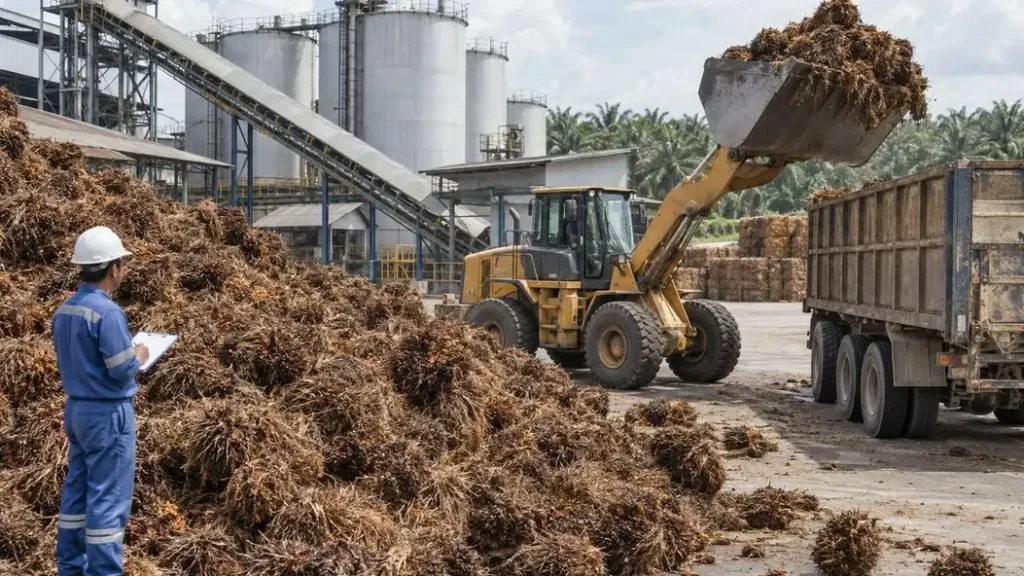
Feedstock availability across Southeast Asia is the first thing I am asked about at feasibility stage, and for this residue the answer has two halves. Empty fruit bunches can become sustainable aviation fuel, but never through HEFA, because they are lignocellulosic, meaning built from lignin and cellulose rather than from oil or fat. The route therefore runs through thermal conversion instead of hydrotreatment, while at the mill gate the same tonne is already wanted for something else. An EFB SAF feedstock file stands or falls on conversion cost and on the outlets the mill already runs.
Everything below comes from published research, regulation and industry reports, and I have kept the arithmetic to the figures those sources actually print. I read the material the way a supplier reads it: first whether it qualifies, then what conversion costs, then who else is bidding for the same tonne.
In short
- Route: Thermal conversion of the fibre, never HEFA, because it carries no oil.
- Scale: 1.07 ton of EFB comes out for every ton of palm oil produced.
- Rule: EU law lists EFB alongside the mill effluent and counts its energy twice.
- Cost: Fibre preparation and hydrogen sit on top of a capital bill above HEFA.
- Competition: Ethanol, methane, briquettes, power and compost already buy the same tonne.
In this article
The short answer: yes to the fuel, no to the quick route
Empty fruit bunches are a solid lignocellulosic residue, not an oil, so they cannot enter HEFA, the hydroprocessing route that handles oils and fats. The World Bank identifies the two most suitable technological pathways for oil palm and related residues as HEFA and Fischer-Tropsch Synthetic Paraffinic Kerosene. Known as FT-SPK, where gasification means heating solid feedstock in restricted oxygen until it yields a synthesis gas that a catalyst then converts into kerosene-range molecules. The trade sits inside the same source: gasification-FT routes rely on lower-cost residues such as EFB, mesocarp fibres, palm kernel shells, fronds and trunks. However, incur much higher capital and operating costs than HEFA. Availability is not the constraint. The conversion is: the palm oil industry generates 1.07 ton of empty fruit bunch for every ton of palm oil produced.
What this means for you: treat the residue as abundant and the process as the scarce thing. Your feasibility question is not whether the material exists, it is which conversion route you can finance. In addition, what it costs per litre.
What an empty fruit bunch actually is
An empty fruit bunch is what the mill keeps once the fruit has been stripped: sterilising fresh fruit bunches, stripping, digestion, screening. In addition, settling generate EFB, pressed palm fibres and wastewater together. The object itself is not uniform, with a typical weight of 3.5 kg and dimensions varying from 170 to 300 mm in length by 250 to 350 mm in width.
The sustainability criteria any feedstock must clear begin with composition, and here chemistry decides the route: compared with rice husk, corn cob and soybean, EFB has a relatively high content of lignin, and pine has the most similar overall composition (MDPI). The volumes are large: global production of EFB in 2018 was approximately 80 million tons, against wheat straw 354.34 million tons and corn straw 128.02 million tons, and Malaysia alone generates approximately 21.3 million tons per year (MDPI).
What this means for you: you are buying an irregular, lignin-heavy fibre in bulk. That is why the receiving plant must plan around handling and storage rather than around pumping a liquid oil.
The rule that decides whether it counts
ReFuelEU Aviation is where the requirement lands, and it traces back to one legal list. Annex IX means the annex of the renewable energy directive that lists waste and residue feedstocks for advanced biofuels. Its part A holds feedstocks whose contribution towards minimum shares may be considered to be twice their energy content, and point (g) reads ‘Palm oil mill effluent and empty palm fruit bunches’ (Directive (EU) 2018/2001).
Double counting follows by design: when biofuels derived from Annex IX feedstocks are used in the transport sector. Their energy content may count twice toward national renewable energy targets, which matters for the EU target of sourcing 29% of transport energy from renewables by 2030. ReFuelEU Aviation sets a 2% share of SAF in EU airports from 2025. In addition, its definition of SAF covers advanced biofuels from feedstock listed in part A of annex IX of the renewable energy directive (European Commission, 15 November 2026). RED III introduced a combined minimum target of advanced biofuels and RFNBOs, meaning renewable fuels of non-biological origin, of 5.5% fuel share in the transport sector in 2030, of which at least 1% must be RFNBOs.
What this means for you: the EU treats EFB as an advanced feedstock worth counting twice. Therefore, the regulatory upside is real, but it attaches to documented waste status. In addition, to audited volumes, not to the field the bunches came from.
What the conversion route costs
The price of sustainable aviation fuel is anchored to the cheapest pathway, so start with the route EFB cannot use. The HEFA process has an energy conversion efficiency of 97%, but only 55% of that output meets aviation fuel specifications, giving an overall efficiency of 54% for SAF production from crude palm oil. Against that, work on converting EFB itself is thin: it is not commonly used as feedstock compared with other kinds of biomass.
Pretreatment, meaning preparation of the fibre before any conversion step, is the first EFB-specific cost. Bundles are submerged in NaOH to expose the fibrous material, and in bioethanol production the same step disrupts the recalcitrant lignocellulose structure. Therefore, enzymes can reach the cellulose (MDPI). The pyrolysis route then adds hydrodeoxygenation, meaning the catalytic removal of oxygen using hydrogen. Bio-oil has low pH, high oxygen, high water content, low hydrogen, high viscosity and thermal instability, and hydrodeoxygenation tackles six of those critical properties but carries the high cost of hydrogen, cited at USD 500,000 per petroleum refinery unit (MDPI).
What this means for you: on top of a capital bill higher than HEFA you carry a fibre preparation line. In addition, a hydrogen cost, none of which shows up when you compare gate prices for raw material.
The other things the mill can do with the same tonne
A tonne of EFB already has published alternative outlets: 94.7 kg ethanol with 1.3 GJ of energy consumption, 79 m3 of methane with a GHG reduction of 154.6 kg CO2 eq, 0.33 t briquette, 0.43 MWh of electricity as fuel for a CHP plant with a GHG reduction of 218.6 kg CO2, and 0.4 t compost with a GHG reduction of 176.5 kg CO2 eq (MDPI Sustainability, 13 September 2021).
Those outlets set the opportunity cost a SAF project has to beat. In addition, they sit at the mill gate without a gasifier. Against that, residue availability has a structural argument in its favour. Residues from all harvested fresh fruit bunches can serve as SAF. That makes availability less dependent on planted area expansion, and residue-based SAF is not constrained by methane capture requirements, unlike crude palm oil.
What this means for you. I compare your offered price with what the mill already earns from the same bunch, and I ask for that alternative in writing before I model the SAF case.
Where this leaves Southeast Asia
The Southeast Asian SAF position is structural rather than speculative. ASEAN, led by Indonesia and Malaysia, is a top palm oil producer, contributing over 80% of the world’s palm oil production as of 2023, and further expansion is limited by land.
Together with the People’s Republic of China, ASEAN should emerge as a critical feedstock hotspot with about 240 Mt of biomass feedstock for SAF production by 2050, about 15% of the global total. Against a global biomass feedstock potential estimated at over 12,000 Mt by 2050. The clearest published residue trajectory I have comes from Colombia rather than from Asia: residue-based SAF production there is estimated at 92 million litres in 2025, rising to 124 million litres by 2030, 210 million litres by 2040 and 400 million litres by 2050, while total EFB available for SAF reaches 0.56 Mt in 2030, 1.00 Mt in 2040 and 1.80 Mt in 2050.
What this means for you. I would rather underwrite a region that already grows the feedstock than one that has to import it, and I want your mill’s own tonnage written into that regional curve.
The evidence I ask for before I fund an EFB project
The export file starts at the mill, not at a plantation statistic. Since April 2023 ISCC EU makes it mandatory for the Points of Origin, meaning the palm oil mills, to be individually certified and annually audited, with the auditor checking annual fresh fruit bunches processed, sterilisation technology, the recovery method of POME oil and annual waste streams.
I ask who else has a claim on the same bunches. That is because the alternative outlets already carry published yields and compete at the gate. Then I ask how the capital is covered before any term sheet. Gasification-Fischer Tropsch is capital-intensive and needs solid feedstock handling. Investors often require at least 70 to 80 percent of annual capacity to hold offtake agreements. Some lenders require 100 percent of the SAF produced to have reliable offtake covering the full loan tenor of, for example, 8 to 14 years. In addition, binding agreements rather than memoranda of understanding must exist before a project reaches FID (World Economic Forum with Kearney, February 2025).
What this means for you: I will not look at a site letter without audited tonnage at the mill. A named competing use for each tonne, and offtake running as long as the debt.
How I would run this if it were my file
I test the project against the pool it wants to sell into. By 2030 global SAF production capacity should reach around 20 Mt with the project success factor applied, of which HEFA refineries account for about 95% of total volume (IATA, September 2025), so a gasification project enters a market where the mature route already holds nearly all of it.
Demand for global SAF should reach 17 million tonnes per annum by 2030, approximately 4 to 5 percent of total jet fuel consumption, installed SAF capacity globally reached 4.4 Mt by end 2024 with 6.9 Mt of expansion planned. An additional 5.8 Mt would need final investment decisions by 2026 to meet 2030 demand. In addition, the industry may require between 19 billion and 45 billion US dollars of capital expenditure by 2030 depending on the technology mix (World Economic Forum with Kearney, February 2025).
What this means for you. Those are the three numbers on my committee page, the volume my route competes for, the capital it has to raise. In addition, the tonnes I can evidence at the mill. Anything weaker and the file waits.
Sources
- MDPI Sustainability, 13 September 2021.
- World Bank, 2025.
- ISCC, 22 August 2025.
- Directive (EU) 2018/2001, 15 November 2026.
- IATA, September 2025.
- European Commission, 15 November 2026.
- World Economic Forum with Kearney, February 2025.
Frequently asked questions
Can empty fruit bunches be used in a HEFA plant?
No. HEFA is the hydroprocessing route for oils and fats, while EFB is lignocellulosic, so the suitable route for palm residues is Fischer-Tropsch Synthetic Paraffinic Kerosene produced by gasification, a route that is capital-intensive and needs solid feedstock handling. The World Bank lists HEFA and FT-SPK as the two most suitable technological pathways for oil palm and related residues, and only the second one can take the solid fibre (World Bank, 2025; World Economic Forum with Kearney, February 2025).
How much empty fruit bunch is actually available?
The palm oil industry generates 1.07 ton of EFB for every ton of palm oil produced. The amount generated in Malaysia is approximately 21.3 million tons per year, against Malaysian palm oil output of 19.9 million tons in 2020, and global production of EFB in 2018 was approximately 80 million tons (MDPI Sustainability, 13 September 2021).
What is pretreatment and why does it matter?
Pretreatment prepares the fibre before conversion, for example by submerging EFB bundles in NaOH to expose the fibrous material. In bioethanol production the same step disrupts the recalcitrant lignocellulose structure so enzymes can reach the cellulose, and without it the conversion route sees the wrong material rather than accessible fibre (MDPI Sustainability, 13 September 2021).
Do empty fruit bunches get the same EU incentives as POME?
Yes, they sit in the same entry. Annex IX part A point (g) of the renewable energy directive reads ‘Palm oil mill effluent and empty palm fruit bunches’, and that annex treats the contribution of those feedstocks as twice their energy content toward minimum shares (Directive (EU) 2018/2001; ISCC, 22 August 2025). That double counting serves the EU target of sourcing 29% of transport energy from renewables by 2030.
Not sure your project would survive a credit conversation?
A short call is usually enough to see where your project stands.
When your mill tonnage is audited. In addition, your alternative outlets are priced. The next step is a conversation with people who fund this shape of project. I set up those conversations through investor introductions. In addition, I will say plainly whether the file is ready for that room.
I do not provide investment advice or arrange investments. I act as a strategic advisor and facilitator.

Alex, Founder of WeConnect Asia
I help low-carbon fuel and carbon removal project developers in Southeast Asia secure the commercial. In addition, financial partners needed to reach FID.
Related articles

Pitching a Climate Tech Company to Strategic Investors: What the Corporate Has to Believe Before It Writes a Cheque
How to pitch a climate tech company to strategic investors: the metric cluster, the readiness evidence and the ask that corporates fund.

Biomethane: What It Is, How It Is Made and Who Buys It
Biomethane is biogas cleaned to pipeline quality. I explain how it is made, how it differs from biogas and who buys it in Southeast Asia.

CO2 Sourcing for e-SAF Projects: What the Rules Allow and What the Contract Must Say
Biogenic CO2, direct air capture or industrial flue gas: which sources an e-SAF plant may use, what they cost and which contract terms make the fuel certifiable.

Operating Performance Guarantees for SAF Plants: What Lenders Ask For
Minimum guarantees, performance damages, retesting and who stands behind them: the operating guarantees a SAF plant needs to keep debt and offtake intact.

EPC and Construction Risk in SAF Plants: What a Lender Actually Tests
FEED scope, convertible EPC, performance guarantees and damages caps: the construction risk questions a SAF project must answer before financial close.

Matching Feedstock and Offtake Risk Back-to-Back in a SAF Project: How Lenders Read the Chain
Lenders do not buy a feedstock plan and an offtake plan separately. They buy the link between the two, and the link is where most SAF files break.