
Home » EU ETS Aviation: How SAF Gets a Zero-Emission Rating
EU ETS Aviation: How SAF Gets a Zero-Emission Rating
10 min read · Sep 17, 2026 · By Alex
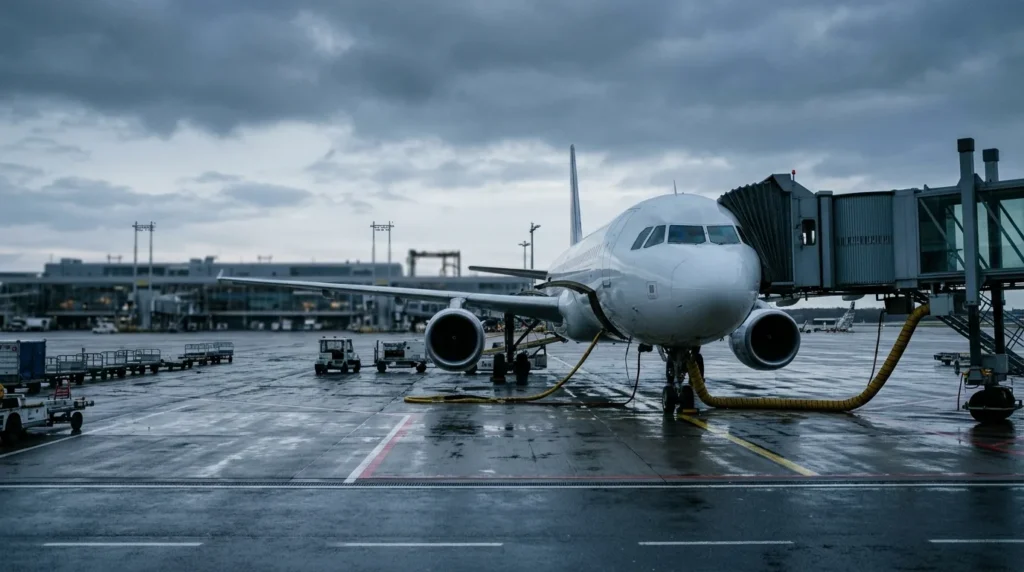
EU ETS aviation is the part of the EU emissions trading system that covers CO2 from flights. For SAF developers it matters for one reason: certified SAF is treated as emitting zero CO2 under the scheme, which gives airlines a financial reason to use it. Overall this guide explains how that works, how it stacks with the ReFuelEU mandate, and why it is a helpful signal rather than a revenue guarantee.
In short
- Aviation CO2 emissions have been covered by the EU ETS since 2012, for flights within the EU and the European Economic Area.
- As a result airlines that use eligible SAF do not have to surrender emissions allowances for it, because the SAF is attributed zero emissions.
- Moreover the scheme reserves 20 million allowances to cover part of the price gap between fossil fuel and eligible alternative fuels.
- Of course the saving depends on the allowance price, which moves.
- The EU ETS aviation rules stack with ReFuelEU Aviation. In fact they do not replace it.
In this article
EU ETS aviation in one page
In essence the EU emissions trading system sets a cap on emissions and lets companies trade allowances. In addition aircraft operators must surrender one allowance per tonne of CO2 emitted on covered flights. Since 2012 that duty covers flights between airports in the European Economic Area.
Also the cap on aviation is shrinking. For 2026 the aviation cap stands at 26.2 million tonnes of CO2 equivalent, according to the International Carbon Action Partnership. Moreover free allocation is disappearing. It fell by 25 % in 2024 and by 50 % in 2025, and the sector moves to full auctioning from 2026. Since 1 January 2026 every aviation allowance is auctioned, so no free allocation is left to soften the bill.
Consequently an airline now pays for almost every tonne it emits. In practice that changes the arithmetic of a gallon of SAF, because the alternative to buying fuel is buying allowances.
What the cap and the auction price mean for a gallon of SAF
Moreover the auction price is the number that decides how much an airline saves. In 2025 the average auction price was 73.43 euros per tonne, and the average secondary market price was 74.35 euros, again according to the International Carbon Action Partnership.
Also the price moves with the market. It has traded well above and well below those levels over the life of the scheme, so a lender will not treat the current print as a constant. Instead the allowance price belongs in a sensitivity table, next to the SAF premium.
For the current print I went to the primary market rather than to a secondary quote. When I checked the EEX auction results on 3 November 2026, the clearing price was 90.16 euros per tonne of CO2, on 2.7915 million tonnes sold that day, after 89.43 euros on 2 November 2026. So a model that still assumes the 2025 average understates the saving on every tonne of SAF today.
Therefore the saving from one tonne of SAF is simple to state. Multiply the avoided fossil CO2 by the allowance price and you have the number. For a flight of a thousand kilometres the number is small. For a long haul departure it is larger, and for an airline with a thin margin it is material.
Why EU ETS aviation gives certified SAF a zero-emission rating
EU ETS aviation attributes zero emissions to biomass based SAF that is certified as compliant with the sustainability criteria of the Renewable Energy Directive. As a result an airline using that SAF instead of fossil jet fuel does not surrender allowances for those tonnes. The airline saves the allowance price on every tonne of fossil CO2 it avoids.
Moreover the treatment rests on Article 14(1) of the ETS Directive, which makes that biomass zero rated once the sustainability and greenhouse gas saving criteria are met.
In practice the zero rating exists as an incentive, not as an accounting nicety. The Commission confirms that operators need not surrender allowances for the use of these fuels. Consequently the benefit lands on the airline’s compliance account, which is why the buyer, not the producer, captures it.
Also Article 9 of ReFuelEU Aviation closes a loophole. An operator cannot claim the same batch of SAF under more than one greenhouse gas scheme. Therefore a cargo claimed under CORSIA cannot also earn the zero rating in Europe, and the contract has to pick one route.
The 20 million allowances reserved for SAF
Furthermore the EU added a second channel of support. The 2023 revision of the ETS Directive reserved 20 million allowances to cover part, or all, of the price difference between conventional fuel and eligible alternative fuels uplifted from January 2024. Article 3c(6) of that directive caps the reserve at 20 million allowances for the seven years from 1 January 2024 to 31 December 2030, and it sets the share of the residual price gap that each category of fuel can recover. At an allowance price of 80 euros, the Commission values that reserve at about 1.6 billion euros.
In addition the support started to pay out. On 12 September 2025 the Commission adopted a decision allocating allowances for 2024. That first year came to about 1.3 million allowances, worth roughly 100 million euros, spread across 53 operators.
Also the Commission priced the zero rating in the same note. It estimated the advantage from not surrendering allowances at around 25 million euros in 2024. Taken together, the two channels delivered about 125 million euros of ETS support to SAF use that year. Consequently the mechanism is real money, but it is small next to the cost of building a plant.
Since then the numbers have grown. By 15 September 2026 DG CLIMA put the 2025 support at about 5.2 million allowances, or roughly 430 million euros, across 130 operators, plus 135 million euros of zero rating, against 530,000 tonnes of SAF and about 1.7 million tonnes of CO2. So the scheme has moved from a pilot to a recurring line in an airline’s fuel bill.
How much EU ETS aviation support your output can earn
Moreover the level of support depends on the fuel and on the airport. For uplift at most airports, renewable fuels of non-biological origin receive 95 % of the price difference. Advanced biofuels receive 70 %, and other fuels inside the ReFuelEU scope receive 50 %.
In practice the map matters more than the headline. Support can reach 100 % of the price difference for eligible fuel uplifted at small islands, small airports and outermost regions. Also only fuel used on flights covered by the ETS compliance obligation qualifies. Therefore a cargo bound for a route outside the scheme earns nothing from this reserve.
Consequently an e-SAF project in Asia should read the support rates as a signal about which molecule Brussels wants. The 95 % rate for synthetic fuel tells you where the policy preference sits, even if the money reaches you only through your buyer’s price.
How EU ETS aviation combines with ReFuelEU
By contrast the two rules do different jobs. ReFuelEU obliges fuel suppliers to supply SAF. The EU ETS reduces what an airline pays when it uses it. In practice the second softens the price gap, and the first creates the volume. However neither fixes a contract price. For the mandate side, read What Is ReFuelEU Aviation?.
Also the two rules now touch. ReFuelEU requires operators to report which schemes they claim SAF under, and it points to the ETS Directive for the allowances reserved for SAF. Therefore the same batch has to be documented for both regimes, and a producer that cannot supply the data cannot serve either market properly.
What it does to an airline's willingness to pay
The allowance saving is a number that moves with the carbon price. In practice a lender will treat it as upside in a sensitivity case, not as base case revenue. A buyer will use it as an argument in price talks, but it will not usually pay your cost gap in full.
Moreover the support mechanism changes the negotiation. If a buyer can recover 95 % of the price difference for a synthetic fuel, its willingness to sign a higher premium rises. Consequently the first question in a pricing meeting is not the spot price of jet. It is which support rate the fuel qualifies for, at which airport.
Also the timing matters. The 20 million allowance reserve covers fuel uplifted from January 2024, and the Commission allocates it year by year. Therefore a buyer will discount a support stream it has not yet received, and a producer should expect the premium to reflect that discount.
Limits of EU ETS aviation for a Southeast Asia developer
- The saving accrues to the airline, not to the producer. It only reaches you through the contract price.
- It applies to flights in scope, so it favours supply to those flights.
- Finally the carbon price is volatile, and delegated rules set the support rates, so those rates can change.
For how the regulated pieces join up, see ReFuelEU Bankability and Sustainable Aviation Fuel Price: What Sets It.
Where EU ETS aviation stops: the 2027 decision
Moreover the geographical scope is narrower than the name suggests. The EU limited the scheme to flights within the EEA to give ICAO room to build a global measure, and it extended that limitation one last time, until the start of 2027. In addition flights to the United Kingdom are covered, while arrivals from the UK sit in the UK scheme. Switzerland is linked in the same way.
Also a decision is due. During 2026 the Commission is assessing whether CORSIA is delivering, and it may propose extending the scope to departing flights while exempting incoming ones. In practice that choice decides whether an Asian producer can ever sell into a scheme that prices the long haul departure.
Therefore a developer should model two cases. In the first, the scope stays intra-European and the ETS premium reaches you only through a European buyer. In the second, departing flights enter the scheme from 2027 and the addressable market widens. I cover the global side in What Is CORSIA?.
What a lender does with the allowance price
In addition a lender will ask three questions about the ETS line in your model. What is the assumed allowance price, where does it come from, and what happens to debt service if it halves?
Furthermore the answer should not depend on the producer. Since the saving belongs to the airline, the lender will look for a contract clause that passes a defined share of it back to you. Without that clause the ETS is a benefit to your buyer that never appears in your cash flow.
Also the lender will test the support mechanism. It will ask whether your fuel is an RFNBO, an advanced biofuel or another eligible fuel, because the difference between 95 % and 50 % support is the difference between a workable premium and a thin one. Consequently the certification file and the ETS file are the same file.
Sources
Sources
- European Commission, DG CLIMA, “Reducing emissions from aviation”, including full auctioning from 2026, the 20 million allowance reserve and the scope limitation to the start of 2027. climate.ec.europa.eu
- European Commission, “EU allocates 100m euros worth of ETS allowances to help airlines buy Sustainable Aviation Fuels”, 17 September 2025. climate.ec.europa.eu
- International Carbon Action Partnership, “EU Emissions Trading System (EU ETS)”, factsheet with the 2025 average auction price and the 2026 aviation cap. icapcarbonaction.com
- European Energy Exchange, EU ETS primary market auction results, print of 3 November 2026 at 90.16 euros per tonne on 2.7915 million tonnes, after 89.43 euros on 2 November 2026. emis.eex.com
- European Parliamentary Research Service, “ReFuelEU Aviation initiative”, PE 698.900, November 2023. europarl.europa.eu
FAQ
Since when does EU ETS cover aviation?
Since 2012, for flights within the EU and the European Economic Area.
Does SAF really count as zero emissions?
Yes. Biomass based SAF that complies with the sustainability criteria is attributed zero emissions under the scheme.
Who benefits from the EU ETS aviation allowance saving?
The airline. Meanwhile producers benefit only through the contract price.
Does EU ETS replace ReFuelEU?
No. Instead the two rules apply together, one on price and one on volume.
Can a lender count on the EU ETS aviation price?
As upside only. The price moves, so it belongs in a sensitivity case.
Is the support for SAF capped?
Yes. In fact the reserve is fixed at 20 million allowances, and the Commission allocates it year by year against claims.
Next step
A short call is usually enough to see where your project stands before a lender or an offtaker looks at it.
To test how these signals turn into an offtake discussion for your project, book a 30-minute call or read about offtake agreements.
I do not provide investment advice or arrange investments. I act as a strategic advisor and facilitator.

Alex, Founder of WeConnect Asia
I help low-carbon fuel and carbon removal project developers in Southeast Asia secure the commercial and financial partners needed to reach FID.
Related articles

Biomethane: What It Is, How It Is Made and Who Buys It
Biomethane is biogas cleaned to pipeline quality. I explain how it is made, how it differs from biogas and who buys it in Southeast Asia.

Southeast Asia SAF: Policies, Demand and Project Status
Southeast Asia SAF policy is moving country by country. Here is where demand is forming, who the buyers are and what a developer can rely on today.

e-SAF Project Finance: Why the Sub-Mandate Is Not Enough
The synthetic fuel sub-mandate creates demand for e-SAF, but not a bankable project. Here is what e-SAF project finance still needs in Southeast Asia.

SAF Mandates by Country: A Developer’s Comparison
SAF mandates differ by country in scope, target and penalty. Here is a side-by-side comparison and what each one means for project revenue.

Sustainable Aviation Fuel: Pathways, Mandates and What Gets Financed
Sustainable aviation fuel has several pathways and sells into mandates. I explain the routes, the demand and what gets financed in Asia.

ReFuelEU Offtake: Who Actually Buys Your SAF?
The ReFuelEU mandate sits on fuel suppliers, not airlines. Here is what that means for ReFuelEU offtake contracts and what lenders expect to see.