
Home » Fats, Oils and Crops for SAF Feedstock: Sorting Lipids by Origin
Fats, Oils and Crops for SAF Feedstock: Sorting Lipids by Origin
10 min read · Nov 2, 2026 · By Alex
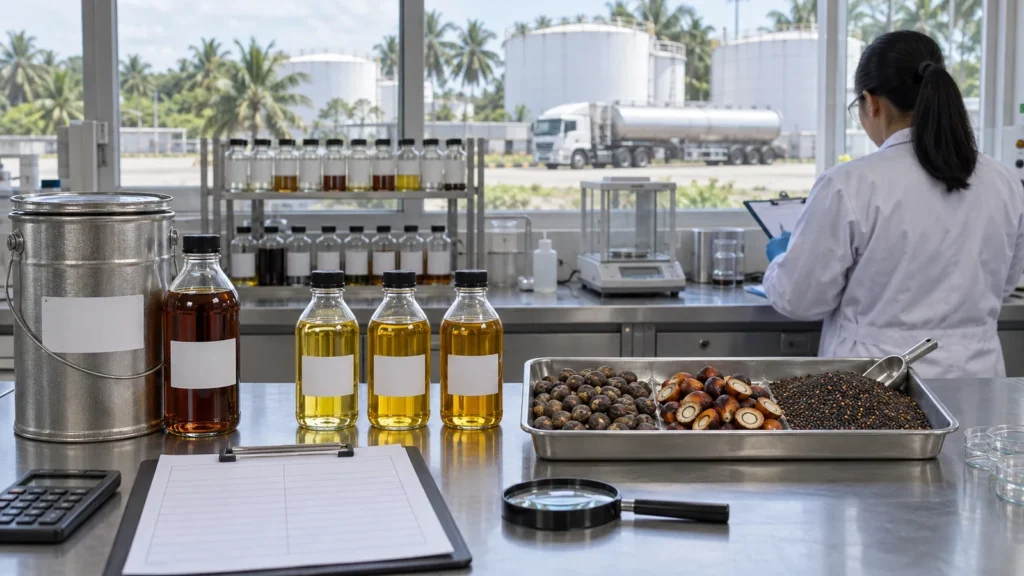
Fats, oils and crops for sustainable aviation fuel (SAF) separate into three families, and the family decides everything else: waste and by-product lipids (made alongside a primary product) such as used cooking oil and tallow are already collected, first generation vegetable oils compete with food and land, and dedicated oil crops or novel sources are still pre-commercial. The direction of travel is fixed: hydroprocessed esters and fatty acids (HEFA) already carries more than 90% of current or upcoming SAF capability, and the industrial expectation is that used cooking oil and tallow supply 40% of all SAF feedstock by 2030. The regional availability picture is where any supplier at feasibility stage starts. In one line, my fats oils crops saf feedstock screen runs origin, evidence, regulation, then price.
I write for a supplier who has to defend a feedstock choice in front of a committee, a buyer or an auditor. The page linked above carries the wider regional context, and this one stays on the lipid family itself.
In short
- Three families: waste and by-product lipids, first generation vegetable oils, and dedicated or novel oil crops, each carrying a different evidence burden.
- Dominance: HEFA holds over 90% of current or upcoming SAF capability at a technology readiness level of 9 (IATA).
- Cost: feedstock is the lion’s share of HEFA production cost, and HEFA sits at 2 to 2.5 times conventional aviation fuel (IATA).
- Rules: annex IX of the RED splits advanced feedstocks in part A from oils and fats in part B (EUR-Lex).
- Volume: waste cooking oil and tallow are expected to supply 40% of all SAF feedstock by 2030 (EUCASS).
In this article
The short answer: three families, not a shopping list
RSB places oils and fats inside a five-family map of feedstocks for sustainable aviation fuel production in Southeast Asia. Inside that family it lists animal fats, co-products of meat processing and rendering (rendering converts slaughterhouse material into tallow and grease), covering cattle tallow, hog white grease and poultry fat and split between edible and inedible grades. Used cooking oil, also called yellow grease, sits beside them. Then come the alternative oilseed crops under consideration, Camelina sativa and Brassica carinata, plus tall oil from wood pulp and algae oils (RSB).
That mix is why I do not read the family as a shopping list. IATA records HEFA as the dominant pathway with over 90% of current or upcoming SAF capabilities and a technology readiness level of 9 (IATA). EUCASS records that first-generation lipid-based feedstocks such as waste cooking oil and tallow dominate current production at more than 90% (EUCASS). Both sources point the same way: the contracted volume sits at the waste and by-product end.
What this means for you: I place your lipid in one of those three families before anything else, because the family sets which numbers are already proven and which still have to be generated.
Why origin decides the evidence I have to show
Stillwater Publications makes the structural point that the primary lipid feedstocks are all by-products: soybeans are grown for their meal rather than their oil, cattle are raised to supply beef rather than tallow, and ethanol plants produce ethanol rather than corn oil (Stillwater). No one produces these volumes because a fuel buyer asked for them, so a production statistic is not a supply commitment.
The traded categories matter too. Stillwater lists the tallow and UCO categories tracked by the USDA: choice white grease, yellow grease, brown grease, other greases, lard, inedible tallow and technical tallow. Europe separates tallow into category 1, from diseased livestock and usable for biofuels, category 2 for technical purposes, and category 3, fit for human consumption and excluded from biofuel production (Stillwater).
Classification is where a certification audit starts, and the sustainability criteria attach to the grade I claim, not to the tonnage I hope for.
What this means for you: I fix the exact traded category in the resource model first, because a grade I cannot evidence cannot be sold, however large the number on paper looks.
What the market pays for these lipids
Feedstock is the decisive cost line. IATA records that feedstock accounts for the lion’s share of total HEFA production costs and that its price varies significantly with market supply and demand dynamics, with HEFA costs currently 2 to 2.5 times that of conventional aviation fuel (IATA).
IRENA puts the minimum jet fuel selling price for HEFA between USD 1.6 and 2.1 per litre in the baseline scenario, about two to three times the fossil Jet A-1 price of USD 0.6 per litre (IRENA). Those are the published reference points behind how SAF pricing is usually framed, and they move with the lipid I choose rather than with the plant alone.
Stillwater’s bottom line is that growth in demand for low-carbon fuels points to significant market tightness, especially for waste oils like UCO and tallow (Stillwater).
What this means for you: I price the lipid before I size the plant, because the line that swings the business case sits in the feedstock, not in the conversion unit.
What the rules do with each family
The European definition of SAF covers advanced biofuels from feedstock listed in part A of annex IX of the RED and biofuels produced from oils and fats listed in part B, alongside synthetic fuels and recycled carbon aviation fuels (European Commission). That single definition sorts my three families into different legal boxes.
Part A carries the double counting mechanism, where a contribution towards the minimum shares may be counted twice, while the RED demands a phase-out of biofuels associated with high indirect land use change risk (indirect land use change, ILUC, is farm expansion that displaces other land uses and releases stored carbon), such as palm oil from high ILUC-risk areas (EUR-Lex).
EUCASS adds the practical consequence: vegetable oils such as soy and palm and animal oils such as tallow face strict EU RED III criteria limiting indirect land use change and deforestation risks, which is why used cooking oil has become an important feedstock (EUCASS). Low-carbon fuel mandates carry those rules onto the demand side.
What this means for you: I check which annex IX part my lipid falls into before I model revenue, because the counting treatment and the phase-out risk turn the same tonnage into two different businesses.
How volume and demand line up
EUCASS records the industrial expectation that waste cooking oil and tallow supply 40% of all SAF feedstock by 2030, while the IEA expects lignocellulose to supply less than 1% of the 13 million tonnes a year of biojet feedstock demand in 2030, with over 90% coming from waste oils (EUCASS).
IATA puts global SAF production in 2025 at just 2 Mt and expects capacity to reach around 20 million tonnes by 2030 with the project success factor applied, with HEFA refineries still at about 95% of total volume (IATA).
By 2050, of an estimated 189 million tonnes of oil-based feedstock available for bioenergy and biofuels, 82 million tonnes could be used for SAF and the theoretical maximum of oil-based HEFA SAF is 63 million tonnes, just over 15% of SAF in 2050 (IATA). Contracting has to be written against that shape, and the offtake structure follows it.
What this means for you: I write my volume case twice, once for the decade where lipids dominate and once for the long run where they are a minority, because a contract sized on the first will not fit the second.
Three ways the lipid bet fails
First, the family runs out before the demand does: IATA records second generation feedstocks as having high emission reduction potential but relatively limited availability, and Stillwater judges significant market tightness ahead for waste oils (IATA; Stillwater).
Second, the regional data is thin. The RSB found no quantitative data for animal fats in the ASEAN literature and UCO data only for Indonesia and Malaysia, while regional UCO availability is recorded at 0.3 million tonnes a year against 375.3 million tonnes of total feedstock (RSB). A gap in the literature is a gap in my due diligence.
Third, the substitution has limits of its own: virgin palm oil is not used as a biofuel feedstock in the United States and is used minimally in Europe and the United Kingdom, so a plant that plans to switch freely between lipids still has a short legal list in some markets (Stillwater).
What this means for you: I stress the case with three runs, scarce family, thin regional data and restricted substitution, and I keep the plant design able to move between the grades that remain legal.
The order I would run the work in
I classify before I price. The order I use is fixed: the family first, then the evidence that family can produce, then the regulation of the market I sell into, then the price and the contract term (RSB; EUR-Lex). Each step narrows the next, and reversing them gives me a costed plant with an unsellable grade.
Two anchors hold that order in place. The first is the RSB five-family map, which keeps oils and fats as one family against sugars and cereals, municipal solid waste, wood and agricultural residues, and renewable energy and carbon (RSB). The second is Stillwater’s substitution point: a plant with proper pre-treatment can switch between lipids as available supply and economics move (Stillwater). For the supply side of that work, my feedstock supply work is the natural next step.
What this means for you: I run those four steps in sequence and record what each one changed, so the committee sees a decision trail rather than a conclusion that arrived fully formed.
How I would run this if it were my file
If it were my file, I would set my own classification against the published numbers before it reached committee. The figures I would carry in are over 90% of capability on HEFA and costs at 2 to 2.5 times conventional aviation fuel (IATA); the 40% expectation for waste cooking oil and tallow by 2030 (EUCASS); the HEFA selling price range of USD 1.6 to 2.1 per litre against USD 0.6 for fossil Jet A-1 (IRENA); the annex IX split between part A and part B (European Commission; EUR-Lex); and the regional animal fat data gap recorded by the RSB (RSB).
Those lines do not choose a lipid for me. They show which family can be evidenced, priced and sold into a given market, which is the question a feasibility study exists to answer.
What this means for you: I hand over the classification, the evidence list, the regulatory box and the price basis as four separate attachments, so each can be challenged on its own without taking the whole file with it.
Sources
- RSB, September 2024.
- Stillwater Publications, 28 October 2025.
- EUCASS, 2025.
- IATA, September 2025.
- EUR-Lex, 16 November 2026.
- European Commission, 16 November 2026.
- IRENA, December 2024.
Frequently asked questions
Which lipid feedstock carries the least risk for a SAF project?
There is no single answer, only a fit. By-product and waste lipids carry lower carbon intensity (the lifecycle greenhouse gas emitted per unit of fuel energy) and the favourable regulatory treatment, first generation vegetable oils face strict sustainability criteria on indirect land use change and deforestation, and dedicated oil crops remain pre-commercial. So I choose by matching the family to the evidence I can produce (Stillwater; EUCASS; RSB). A feedstock that looks low risk on paper and cannot be documented is, for my purposes, high risk.
What is the difference between tallow categories 1 and 3?
Category 1 comes from diseased livestock and can be used for biofuels, while category 3 is fit for human consumption, animal and aqua feed and cosmetics and is excluded from biofuel production, with category 2 reserved for technical purposes (Stillwater). The practical consequence is that only some tallow grades can enter a SAF supply chain, and the grade has to be identified and documented before any volume is quoted.
Will there be enough used cooking oil and tallow by 2030?
The expectation is that waste cooking oil and tallow supply 40% of all SAF feedstock by 2030, but Stillwater judges that demand growth points to significant tightness in waste oils, and the RSB found no quantitative animal fat data for ASEAN and UCO data only for Indonesia and Malaysia (EUCASS; Stillwater; RSB). An expectation is not a contracted volume, and I treat the difference between the two as the risk my study has to size.
What should my feasibility study check first?
Three checks in order: the exact traded category and its regulatory status, the pre-treatment that lets my plant substitute between lipids, and the price basis against which the offtake is indexed (Stillwater; IATA). If those three are settled, the rest of the resource model can be built on them. If they are not, every tonnage figure after them stays provisional.
Not sure your project would survive a credit conversation?
A short call is usually enough to see where your project stands.
If you want a second read on your classification before it reaches committee, I can put your file in front of the right counterparties. The work starts with the family, the grade and the evidence, and the introduction only happens once those hold.
I do not provide investment advice or arrange investments. I act as a strategic advisor and facilitator.

Alex, Founder of WeConnect Asia
I help low-carbon fuel and carbon removal project developers in Southeast Asia secure the commercial and financial partners needed to reach FID.
Related articles

Pitching a Climate Tech Company to Strategic Investors: What the Corporate Has to Believe Before It Writes a Cheque
How to pitch a climate tech company to strategic investors: the metric cluster, the readiness evidence and the ask that corporates fund.

Biomethane: What It Is, How It Is Made and Who Buys It
Biomethane is biogas cleaned to pipeline quality. I explain how it is made, how it differs from biogas and who buys it in Southeast Asia.

CO2 Sourcing for e-SAF Projects: What the Rules Allow and What the Contract Must Say
Biogenic CO2, direct air capture or industrial flue gas: which sources an e-SAF plant may use, what they cost and which contract terms make the fuel certifiable.

Operating Performance Guarantees for SAF Plants: What Lenders Ask For
Minimum guarantees, performance damages, retesting and who stands behind them: the operating guarantees a SAF plant needs to keep debt and offtake intact.

EPC and Construction Risk in SAF Plants: What a Lender Actually Tests
FEED scope, convertible EPC, performance guarantees and damages caps: the construction risk questions a SAF project must answer before financial close.

Matching Feedstock and Offtake Risk Back-to-Back in a SAF Project: How Lenders Read the Chain
Lenders do not buy a feedstock plan and an offtake plan separately. They buy the link between the two, and the link is where most SAF files break.