
Home » Green Ammonia: What It Is, What It Is Used For and What Gets Financed
Green Ammonia:
What It Is, What It Is Used For and What Gets Financed
12 min read · Sep 24, 2025 · By Alex
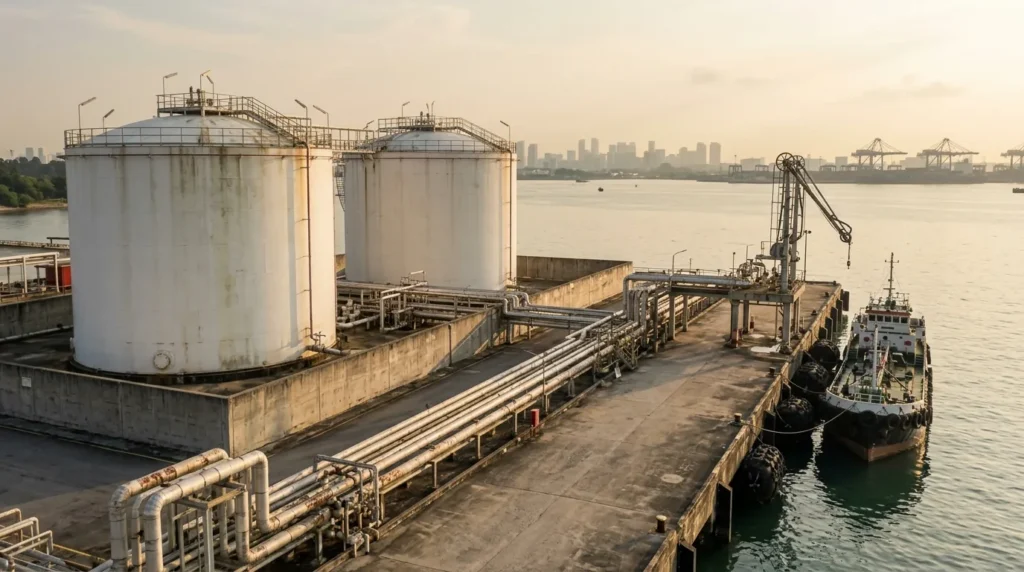
Green ammonia is ammonia that a plant makes from renewable hydrogen and nitrogen from the air, with no fossil fuel in the process. Ammonia is already one of the most traded chemicals in the world, mainly for fertiliser. However, the new interest in green ammonia comes from three other uses: shipping fuel, power generation and hydrogen transport. So the key question for a developer is not whether the chemistry works, but who will buy the product and at what price.
In short
- Green ammonia comes from combining hydrogen from electrolysis with nitrogen from air in a Haber-Bosch loop.
- Today, ammonia is mostly a fertiliser and chemical feedstock. New demand comes from shipping, power and hydrogen transport.
- In Southeast Asia, the bottleneck is usually offtake, not production.
- Lenders want a binding buyer, a secure power supply and a proven plant design.
In this article
Green ammonia in plain terms
First of all, ammonia is a compound of nitrogen and hydrogen. For example, farmers use it, directly or in other forms, to feed crops. Chemical producers use it too. Today, plants make most ammonia from natural gas or coal, and the process releases large amounts of CO2. The world produces around 183 million tonnes of ammonia each year, nearly all from fossil fuels: natural gas (72%) and coal (22%), with life-cycle emissions of 0.5 gigatonnes of CO2 a year (IRENA).
Green ammonia replaces that fossil route. First, renewable electricity splits water into hydrogen. Then the hydrogen reacts with nitrogen from the air to make ammonia. In other words, the product is chemically identical to conventional ammonia, but it has a different carbon footprint.
Because the molecule is the same, existing storage, ships and fertiliser plants can handle it. As a result, the challenge sits in the making and the paying, not in the handling. For the plant view, I wrote about what sits inside a green ammonia plant.
How green ammonia is made
The route has five steps. First, operators treat water and feed it into an electrolyser. Then the electrolyser makes hydrogen, while an air separation unit makes nitrogen. Next, a synthesis loop combines the two at high pressure and temperature over a catalyst. Finally, operators cool and store the ammonia.
In fact, everything in this chain is mature except the electrolyser at large scale. However, the real design challenge is that renewable power varies, and the synthesis loop prefers steady operation. Therefore, plants add a hydrogen buffer or a flexible loop. At the best locations, that flexibility raises the levelised cost of ammonia by 56% (Nayak-Luke et al.).
For the step-by-step view, read the green ammonia production process. For a route that starts from an existing plant, see the retrofit shortcut.
Green ammonia uses: fertiliser, shipping and power
Green ammonia has four main outlets.
- Fertiliser and chemicals. This is the largest existing market. Buyers here want lower-carbon supply, and some regions are building rules that reward it.
- Shipping fuel. Ship engines can burn ammonia, and makers are still developing the designs. The fuel carries no carbon, yet it is toxic, so handling and safety rules matter.
- Power generation. Some utilities, such as in Japan, are testing ammonia co-firing in coal plants to cut emissions. The Japanese power producer JERA completed a demonstration of 20% ammonia co-firing in a 1 GW coal-fired unit at Hekinan in fiscal 2024, and it is now preparing for commercial operation (IHI).
- Hydrogen carrier. Ammonia can move hydrogen over long distances, then a plant converts it back to hydrogen at the destination.
In practice, fertiliser is the only large market today. The others depend on engines, rules and infrastructure that suppliers and regulators have yet to deliver. Therefore, a developer should ask which outlet the project really serves, and what evidence of demand exists.
Green ammonia and fertiliser: the carbon accounting question
Fertiliser is the biggest market, so its carbon accounting matters. Ammonia fertiliser demand has risen steadily for decades, driven by growing food demand (IRENA). A large part of the CO2 from fossil ammonia production does not leave the plant as a gas. Instead, on-site urea production stores it, at 1.3 tonnes per tonne of ammonia feedstock, and farmers release it when they apply the fertiliser in the field (IRENA).
This changes how a buyer reads the claim. Carbon accounting rules and pricing for that CO2 can have a significant impact on the decarbonisation strategies of nitrogen fertiliser makers (IRENA). Therefore, a fertiliser buyer asks which rules apply to its product before it signs for a green supply. For a developer, that question belongs in the first offtake conversation, not in the last one.
Developing countries use urea fertiliser in particular (IRENA). In Southeast Asia, that makes the fertiliser buyer a natural first conversation, even if the premium it can pay stays limited.
Handling green ammonia safely
Ammonia is easy to store, which is one reason it travels well. Operators hold it as a liquid at 8 bar or above at ambient temperature, or at atmospheric pressure at minus 33 degrees Celsius (IRENA). Around 18 to 20 million tonnes of ammonia ship internationally each year, so the trade already exists. However, growing that trade for fuel use needs substantial investment in shipping infrastructure and in refuelling (IRENA).
Safety is the other half. Ammonia is toxic, so every port, plant and vessel needs clear procedures. Burning it as a fuel can also raise emissions of nitrogen oxides and nitrous oxide, which projects have to avoid (IRENA). As a result, a buyer in shipping or power asks about handling before it asks about price.
In practice, I check whether the project has a named safety approach for loading, storage and transfer. A project that leaves this for later risks delay at the permit stage.
What sets the price of green ammonia
The cost of green ammonia depends to a large extent on the cost of renewable hydrogen, which represents 90% of the production cost. The cost is an estimated USD 720 per tonne at locations with the best solar and wind resources today, falling to USD 480 per tonne by 2030 and USD 310 per tonne by 2050 (IRENA). An islanded plant can reach about USD 473 per tonne at the best locations today, and about USD 310 per tonne by 2030 (Nayak-Luke et al.). So the estimates differ, and the assumptions behind each number matter more than the number itself.
Fossil ammonia sets the benchmark. Producing it typically costs USD 110 to 340 per tonne, depending on the fossil fuel price. With carbon capture, the range moves to USD 170 to 465 per tonne (IRENA). Therefore, green ammonia needs help to compete: a carbon price of around USD 150 per tonne of CO2, or an electricity price below USD 20 per megawatt-hour (IRENA).
Operating hours matter too. Locations where wind and solar complement each other can yield electrolyser capacity factors of up to 70%, and the cash cost of running a large plant that includes its own renewable assets is well below USD 100 per tonne (IRENA). In other words, the cost sits in the capital and the power, not in the daily running of the plant.
The green ammonia pipeline: contracts, not announcements
Today, green ammonia is a small number next to the fossil market. In its 2022 outlook, IRENA counted about 183 million tonnes of ammonia produced each year against less than 0.02 million tonnes of renewable ammonia in 2021. Announced renewable ammonia plants add up to 15 million tonnes of annual capacity by 2030, across 54 projects, notably in Australia, Mauritania and Oman. A wider pipeline of 71 million tonnes runs out to 2040, but investment decisions are still pending for most projects (IRENA).
That gap between announced and decided is the point. A pipeline is a list of intentions, and lenders fund contracts. So when I read a project list, I count the projects that have a buyer, a power supply and a decision date, not the projects that have a press release.
Scenario demand does not close the gap either. In a 1.5°C scenario, shipping creates new demand of 197 million tonnes by 2050, and trade of ammonia as a hydrogen carrier adds 127 million tonnes (IRENA). However, a scenario is not a contract.
What has to scale for green ammonia
The chemistry is old. Commercial-scale renewable ammonia dates back to 1921, and IRENA expected it to dominate all new ammonia capacity after 2025 (IRENA). The equipment is the constraint. IRENA put global electrolyser production capacity at 2.1 GW per year in 2020 and judged that it had to scale up more than 20-fold to meet the renewable ammonia objectives for 2050 (IRENA). More recently, the IEA put global installed water electrolysis capacity at 2 GW in 2024 (IEA).
So a developer competes for equipment as well as for buyers. Early projects that lock in an electrolyser supplier, with guarantees, are easier to finance than projects that still name a supplier as a future step. In practice, I ask early for the supplier’s slot, its delivery date and its performance guarantee.
Policy sets the pace. Among its recommendations, IRENA lists a sufficiently high price on CO2 emissions, support for entire supply chains, investment in electrolyser manufacturing and the de-risking of early investment projects (IRENA). For a developer in Southeast Asia, the practical reading is simple. Where those supports exist, the project is financeable earlier. Where they do not, the offtake has to carry more of the weight.
Green ammonia demand in Southeast Asia
In practice, Southeast Asia has fertiliser producers, ports with growing fuel ambitions and renewable resources. For example, the port of Singapore serves as a living lab and regulatory sandbox to develop safe ammonia bunkering procedures (IRENA), and I explain why that matters in the Singapore bunkering article.
However, demand is still forming. First, fertiliser buyers need a price they can accept. Second, shipping companies need engines and vessels that run on ammonia. Meanwhile, utilities need clear rules on co-firing. As a result, many projects hold interest but few hold binding contracts.
For the broader picture of where demand might come from, see the Southeast Asia market article, and, for how it connects to hydrogen supply, the green hydrogen guide.
Why the buyer comes before the plant
In practice, most developers start with production, because that is where the engineering sits, and the buyer arrives last. Southeast Asia often runs the other way: a signed offtake brings power, equipment and finance faster than an engineering study does. Price, volume, term, the buyer’s credit and the timing all decide whether a lender can lend against the contract. I set out that sequence in why offtake, not production, is the bottleneck, and the commercial work sits in the offtake service.
Retrofit or new-build
There are two ways to add green ammonia capacity. A developer can build a new plant, or revamp an existing one. Around 80 million tonnes of existing ammonia production capacity is an early opportunity for decarbonisation, and partial revamping of fossil plants to introduce renewable hydrogen reduces the cost compared with stand-alone new-builds (IRENA). A retrofit also keeps the synthesis loop, the storage and the loading route that already exist.
However, a retrofit depends on the owner of the existing plant. So the question for a developer is whether that owner is a partner or a competitor. I cover this route in the retrofit article.
What lenders check on a green ammonia project
Lenders ask a short list of questions.
- Offtake. Is there a binding contract with volume, term, price and a creditworthy buyer?
- Power. Have they contracted the renewable supply, and does it meet the certification rules?
- Technology. Has the plant design proved itself, with supplier guarantees for the electrolyser and the loop?
- Site and permits. Are land, water, safety approvals and loading routes secured?
- Structure. Are equity, debt and any grants lined up in the right order?
Above all, lenders want to see that each risk has a contract or a guarantee. I explain the general logic in infrastructure project finance and the hydrogen version in how to finance a hydrogen project. For the services around it, see project finance and the hydrogen, PtX and e-fuels industry page.
How I read a green ammonia project
When a developer sends me a green ammonia project, I read it in a fixed order, and I stop at the first gap.
First, the buyer. Who signs, for how long and at what price? Second, the hydrogen. Hydrogen drives most of the production cost, so I look at the power contract and the expected operating hours before the plant design. Third, the flexibility. A plant on solar and wind needs a buffer or a flexible loop, and that flexibility adds cost, so I check that the model includes it. Fourth, the route. Is it a new-build or a revamp, and who owns the site? Finally, the sequence. Who comes in first, the equity or the offtake?
In practice, a project that answers the first two questions clearly is ready for investors and lenders. One that does not has work to do before any introduction, and I say so early.
Checklist
- You know which outlet the project serves: fertiliser, shipping, power or transport.
- The offtake is a binding contract, or at term-sheet stage.
- The developer has contracted renewable power that meets certification rules.
- Suppliers guarantee a plant design that has proved itself.
- The team has secured land, water, safety approvals and the loading route.
- The financing plan shows equity, debt and grants in order.
Next step
If you are developing a green ammonia project and the offtake or the capital is the open point, book a 30-minute call or send me your project brief. I tell you early if the project is not ready.
Sources
FAQ
What is green ammonia?
You make it from renewable hydrogen and nitrogen from air, without fossil fuels.
How is green ammonia different from conventional ammonia?
The molecule is the same. The difference is the carbon footprint, because the hydrogen comes from water and renewable power.
What do buyers use green ammonia for?
Fertiliser and chemicals today, with new uses in shipping fuel, power generation and hydrogen transport.
Why is green ammonia expensive?
Renewable hydrogen and the electrolyser cost more than gas-based hydrogen, and the plant has to run enough hours.
Is there demand for green ammonia in Southeast Asia?
Demand is forming, especially around bunkering and fertiliser, but few projects hold binding offtake contracts yet.
How much does green ammonia cost?
An estimated USD 720 per tonne at the best solar and wind locations today, against USD 110 to 340 per tonne for fossil ammonia (IRENA).
How big is the green ammonia market today?
Small. IRENA counted less than 0.02 million tonnes of renewable ammonia in 2021, against about 183 million tonnes of ammonia overall (IRENA).
What do lenders ask first?
Who buys the ammonia, at what price and for how long.
Not sure your project would survive a credit conversation?
A short call is usually enough to see where your project stands against what a lender or an equity investor will ask for. Tell me where your project is today, and I will tell you what the next conversation needs to look like.

Alex, Founder of WeConnect Asia
I help low-carbon fuel and carbon removal project developers in Southeast Asia secure the commercial and financial partners needed to reach FID.
Related articles

Biomethane: What It Is, How It Is Made and Who Buys It
Biomethane is biogas cleaned to pipeline quality. I explain how it is made, how it differs from biogas and who buys it in Southeast Asia.

Southeast Asia SAF: Policies, Demand and Project Status
Southeast Asia SAF policy is moving country by country. Here is where demand is forming, who the buyers are and what a developer can rely on today.

e-SAF Project Finance: Why the Sub-Mandate Is Not Enough
The synthetic fuel sub-mandate creates demand for e-SAF, but not a bankable project. Here is what e-SAF project finance still needs in Southeast Asia.

SAF Mandates by Country: A Developer’s Comparison
SAF mandates differ by country in scope, target and penalty. Here is a side-by-side comparison and what each one means for project revenue.