
Home » Japan SAF Policy: A 10% Target, a 1% Obligation, and the Gap Between Them
Japan SAF Policy: A 10% Target, a 1% Obligation, and the Gap Between Them
10 min read · Nov 2, 2026 · By Alex
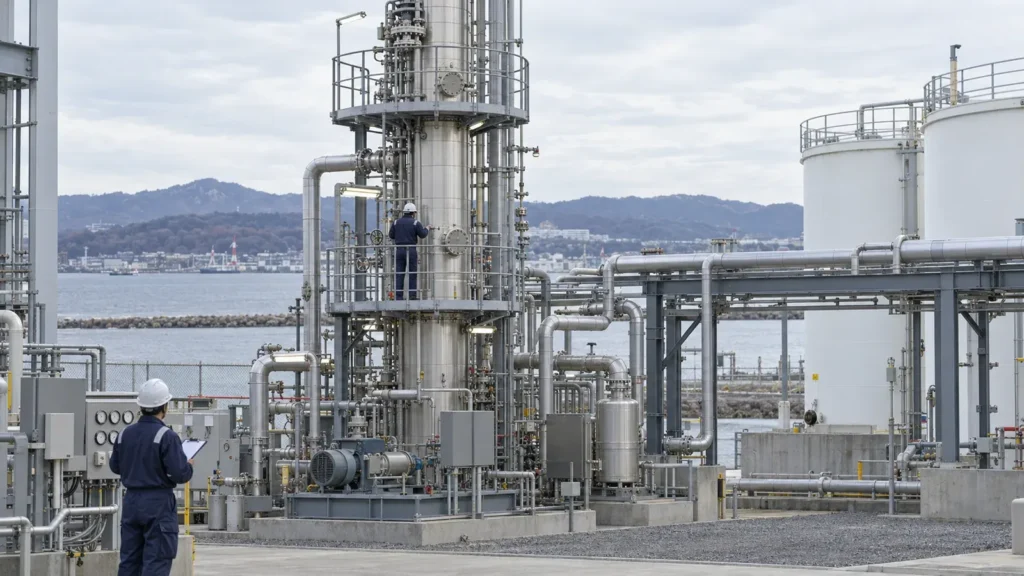
Japan arrives in my inbox with two numbers, and only one of them is a requirement. The stated target is that 10% of the fuel used by Japanese airlines be sustainable aviation fuel by 2030. The supply obligation, a rule telling fuel suppliers how much SAF to sell, was proposed on 23 July 2026 by the 9th Public-Private Council of METI and MLIT: 1% or more of supply volume in FY2030, 3% in FY2031, 5% from FY2032 through FY2034, on international routes at seven airports including Narita and Haneda, while as of April 2026 only one SAF plant in Japan is in commercial supply. That gap is the whole question behind japan saf policy: my parent page on SAF mandates holds the wider view.
Below I separate the target from the obligation, then look at supply, budget support and the model I would put in front of a lender. FY means fiscal year, the government accounting year, and I date every figure as I go, because in this file the dates matter more than the headline.
In short
- Target: 10% of the fuel used by Japanese airlines to be SAF by 2030, first set in December 2021.
- Obligation: a 23 July 2026 proposal: 1% or more in FY2030, 3% in FY2031, 5% from FY2032 through FY2034, seven airports.
- Supply: one commercial plant at roughly 30,000 kilolitres a year as of April 2026, plus five projects at front-end engineering design, which settles specifications and costs.
- Support: 30 yen per litre tax credit, 4.1 yen per litre subsidy, around 340 billion yen over five years.
- Gap: all five pipeline projects need a final investment decision, the decision to build, by the end of 2026.
In this article
The target Japan has been repeating since 2021
MLIT published the Roadmap for Decarbonization of Aviation in December 2021 with a target of replacing 10% of the fuel used by Japanese airlines with SAF by 2030. The Basic Policy for Promoting Decarbonization in Aviation in December 2022 repeated it, and the GX Basic Policy approved by Cabinet decision in February 2023 confirmed it, as the InfluenceMap tracker records. The ICAO APAC presentation sets the wider frame: carbon neutrality by 2050 and a 46% cut in greenhouse gas emissions in FY2030 compared with 2013.
JCAB created a Carbon Neutrality Promotion Office in April 2022 and a Public-Private Council with METI, the Ministry of the Environment, the Ministry of Agriculture, Forestry and Fisheries, airlines, airport companies and oil companies, with two purposes: facilitating domestic SAF production and establishing a supply chain that includes imported SAF.
What this means for you: I read a target as a direction of travel, not a revenue line. It has been restated across three policy documents, so it is durable, but it does not oblige any fuel supplier to contract with my project.
The number that changed in July 2026
On 23 July 2026 the 9th Public-Private Council, held by METI and MLIT, put out a proposal requiring jet fuel suppliers to supply SAF starting FY2030, covering international routes at seven airports including Narita and Haneda, at 1% or more of supply volume in FY2030, 3% in FY2031 and 5% from FY2032 through FY2034. The pattern is the same one I track in low carbon fuel mandates.
The earlier target, approved in September 2024 under the Act on Sophistication of Energy Supply Structures, applied to oil wholesalers producing and supplying 100,000 kilolitres or more of jet fuel a year. It asked for an amount equal to at least 5% of the greenhouse gas emissions from jet fuel produced and supplied domestically in FY2019, which is a 10% blend multiplied by a 50% greenhouse gas reduction effect. The reformulated target keeps FY2030 to FY2034.
What this means for you: I keep both readings with their source, the 10% by 2030 target and the 1% to 5% supply obligation, and I never average them. Debt service runs off the obligation schedule, not the target.
What Japan can actually supply
As of April 2026 Japan has one commercial SAF plant, Cosmo Oil’s facility in Osaka Prefecture, roughly 30,000 kilolitres a year, online since April 2025; five further major projects are at FEED stage. All five need a final investment decision (FID) by the end of 2026: construction takes two and a half to three years, tax credit certification is due by the end of FY2026, and GX Economy Transition Bonds and Green Innovation Fund support end in FY2028 and FY2029.
The two conversion routes are HEFA, limited by feedstock supply, and Alcohol-to-Jet, which in Japan assumes imported ethanol because there is no large domestic ethanol supply. Beyond Japan I watch feedstock availability in Southeast Asia.
MLIT’s 2024 material repeats the 10% supply target for 2030 under current legislation, a decarbonisation promotion plan for airlines, capital investment support and a 30 yen per litre tax credit for SAF produced and sold in Japan; Japan also committed to an ASEAN-Japan CORSIA Eligible Fuels Certification Guidebook by FY2026.
What this means for you: I compare the obligation schedule to the pipeline and the certification dates, not to the 2030 target. The plant in commercial supply and the 10% target are two different kinds of number, so I keep them on separate lines.
The support already budgeted
The Strategic Domestic Production Promotion Tax Incentive gives a tax credit of 30 yen per litre on the volume of domestically produced and sold SAF, and a subsidy for aviation fuel of 4.1 yen per litre runs under the fixed-price reduction measures. The Green Innovation Fund funds demonstration equipment and processes, with a stated goal of commercial fuel prices of approximately 100 yen per litre by approximately 2030. GX Prior Investment Support draws on approximately 20 trillion yen of GX transition bonds, of which around 340 billion yen goes in over five years to large-scale SAF production facilities and supply chains. I keep that next to low carbon fuels investment, because the size of the gap decides whether it helps.
The gap is still large: SAF costs three to five times conventional jet fuel, so the difference runs two to four times the conventional price, and a credit of 30 yen per litre closes 8% to 15% of it.
What this means for you: I treat the credit as a reduction in the gap, never as a price, so the contract has to carry the rest of a gap that runs two to four times the conventional price.
What a finance plan has to survive
The bottleneck in Japan is not the subsidy schedule, it is signed purchase agreements. Government materials state that refiners will not commit without visibility on airline purchase agreements, while airlines squeezed by fuel costs cannot take on domestic SAF unless it is priced competitively by international standards. SAF plants are capital intensive with payback horizons past a decade, and an offtake agreement, a long term contract signed before construction with a set volume, period and price, is what makes future cash flows predictable enough for a final investment decision.
IATA’s sequencing warning applies directly here: mandates should be introduced only where market conditions, production capacity, infrastructure readiness and supportive policy measures are in place, and sequencing should reduce risk before mandates are imposed. That is why how I finance a SAF project opens with three checks before the debt tenor begins: the instrument, the authority that issues it, and the date by which it must be certified.
What this means for you: a subsidy that is announced but uncertified is not collateral. I check the instrument, the issuing authority and the certification date, because those three decide whether a lender can count the revenue.
Where the risk sits today
As of mid-August 2026 no Japanese company had announced a final investment decision on a SAF plant. Taiyo Oil has said it is pushing front-end engineering design toward a decision in 2026 with production targeted for 2029, and Idemitsu Kosan and Cosmo Oil are also aiming for decisions within the year. The ramp has a measurable cost: at 1% in FY2030 the estimate is a 2% to 4% increase in total fuel cost, at 3% it is 6% to 12%, and at 5% from FY2032 it is 10% to 20%, assuming SAF at three to five times conventional fuel.
On the demand side, one major Japanese carrier publishes an FY2030 target of 10% SAF as a share of total fuel and a 5% emission reduction through SAF, assuming stable supply at stable volumes and prices. SAF is still less than 1% of global aviation fuel use and several times more expensive, which is the demand side of saf policy risk.
What this means for you: I do not model the 10% target as demand. I model the 1% obligation in FY2030, then the 3% and 5% steps, and I check the build date against them.
What I would ask before signing
I ask four questions in writing. First, which instrument carries the obligation, and does it sit in the Act on Sophistication of Energy Supply Structures with an implementing ordinance, or only in a council proposal. Second, what volume the plant can sell in each fiscal year, taken from the obligation schedule rather than from the 2030 target. Third, by when the certification deadline falls for the tax credit, because certification requires a final investment decision first. Fourth, what volume remains sellable if the obligation slips, and I take that answer from signed contracts rather than from the roadmap.
I keep both readings, the target and the obligation, each with its source, and I never average them. Both come from published documents, so I can show a lender exactly where each number came from and on what date.
What this means for you: until the fourth question has an answer from signed contracts, I treat the obligation as a schedule to be verified, not as revenue I can underwrite.
How I would model it if it were my file
I put the target row and the obligation row on separate lines and I date every entry. The target row carries 10% by 2030 as stated in the roadmap and the GX materials. The obligation row carries 1% or more in FY2030, 3% in FY2031 and 5% from FY2032 through FY2034 across seven airports. The supply row carries the 30,000 kilolitres a year of the only plant in commercial supply as of April 2026 and the five projects at front-end engineering design. I run the model twice, once with a decision by the end of 2026 and once without it, and I show the lender the difference in one line.
My last row is the contracted volume, because that is the only row a lender will count.
What this means for you: I hand over two columns, one built on the target and one built on the obligation, and I let the lender decide which one the debt can sit on, and I date both.
Sources
- ICAO APAC Regional Seminar presentation, 7 August 2024.
- Codo Advisory, consulted 16 November 2026.
- InfluenceMap, January 2026.
- METI, 23 July 2026.
- Japan Airlines, consulted 16 November 2026.
- IATA, June 2026.
- ICAO, November 2026.
Frequently asked questions
What is Japan's SAF target for 2030?
The target is that 10% of the fuel consumed by Japanese airlines be replaced with SAF by 2030. It was set in the December 2021 roadmap, repeated in the December 2022 basic policy and confirmed in the February 2023 GX Basic Policy, as the InfluenceMap tracker records. MLIT’s 2024 material carries the same figure as the supply target for 2030 under current legislation.
What obligation do fuel suppliers face from FY2030?
A proposal adopted at the 9th Public-Private Council on 23 July 2026 would require jet fuel suppliers to supply SAF at 1% or more of supply volume in FY2030, 3% in FY2031 and 5% from FY2032 through FY2034, covering international routes at seven airports including Narita and Haneda. It keeps FY2030 to FY2034 as the target period.
How much SAF can Japan produce domestically?
As of April 2026 the only commercial plant is Cosmo Oil’s facility in Osaka Prefecture at roughly 30,000 kilolitres a year, with five further projects at front-end engineering design. All five need a final investment decision by the end of 2026.
Does Japan's SAF policy make a project bankable?
The support is real, with a 30 yen per litre tax credit and around 340 billion yen committed over five years for facilities and supply chains, but as of mid-August 2026 no final investment decision had been announced, so a finance plan still needs a signed offtake before it can treat the obligation as contracted revenue.
Not sure your project would survive a credit conversation?
A short call is usually enough to see where your project stands.
When the file is ready for a lender, the row that decides it is the contracted volume. I work through offtake agreements with developers and lenders who need a signed volume, a period and a price before the final investment decision.
I do not provide investment advice or arrange investments. I act as a strategic advisor and facilitator.

Alex, Founder of WeConnect Asia
I help low-carbon fuel and carbon removal project developers in Southeast Asia secure the commercial and financial partners needed to reach FID.
Related articles

Pitching a Climate Tech Company to Strategic Investors: What the Corporate Has to Believe Before It Writes a Cheque
How to pitch a climate tech company to strategic investors: the metric cluster, the readiness evidence and the ask that corporates fund.

Biomethane: What It Is, How It Is Made and Who Buys It
Biomethane is biogas cleaned to pipeline quality. I explain how it is made, how it differs from biogas and who buys it in Southeast Asia.

CO2 Sourcing for e-SAF Projects: What the Rules Allow and What the Contract Must Say
Biogenic CO2, direct air capture or industrial flue gas: which sources an e-SAF plant may use, what they cost and which contract terms make the fuel certifiable.

Operating Performance Guarantees for SAF Plants: What Lenders Ask For
Minimum guarantees, performance damages, retesting and who stands behind them: the operating guarantees a SAF plant needs to keep debt and offtake intact.

EPC and Construction Risk in SAF Plants: What a Lender Actually Tests
FEED scope, convertible EPC, performance guarantees and damages caps: the construction risk questions a SAF project must answer before financial close.

Matching Feedstock and Offtake Risk Back-to-Back in a SAF Project: How Lenders Read the Chain
Lenders do not buy a feedstock plan and an offtake plan separately. They buy the link between the two, and the link is where most SAF files break.