
Home » Livestock Manure Biogas: Is Manure a Bankable Feedstock?
Livestock Manure Biogas: Is Manure a Bankable Feedstock?
9 min read · Dec 13, 2025 · By Alex
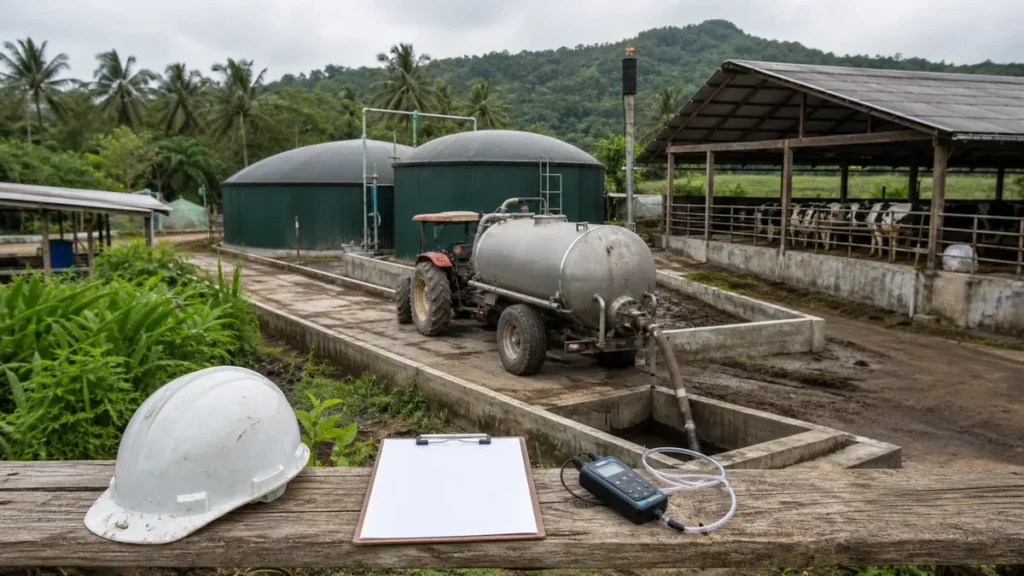
A livestock cluster carries a project finance model only when the gas is worth more than the methane it avoids. That question sits inside the biogas, biomass and biofuels hub. Manure biogas is bankable because of the emissions it avoids, not because it is cheap. In fact, livestock manure and enteric fermentation represent roughly 32 percent of global anthropogenic methane emissions. Specifically, a manure-based plant reaches exceptionally low greenhouse gas intensity, because avoiding those emissions earns a credit. The same plant loses that credit if it leaks 2 to 5.5 percent of output, on 2026 operating figures. The collection radius, the digester design and the leak detection plan therefore belong in the credit paper. Instead, they do not belong in the annex.
I take the questions in order: the methane problem first, then what the credit is worth. Next come the cost of the material, the collection radius and the small-digester record. Then comes the cluster model, then the leakage that can cancel the credit. In addition, I run a final set of checks before a lender sees the file.
The manure biogas case at a glance
In short
- Methane first: Livestock manure and enteric fermentation drive global anthropogenic methane. Specifically, they are roughly 32 percent of the total, on 2021 figures.
- Credit, not price: The value sits in the avoided emission; Southeast Asia biogas production cost was around USD 9/MBtu in 2020.
- Radius sets size: Animals per square kilometre and haul distance set plant size; a bigger digester cannot fix a spread-out cluster.
- Small digesters: More than 40 million household biodigesters exist worldwide, on 2025 counts, and abandonment is a documented problem.
- Leakage: Plant operations can leak 2 to 5.5 percent of output, on 2026 figures. As a result, that leakage erodes the credit the case rests on.
In this article
A methane problem before it is a fuel
In fact, a manure project is a methane project first. A 45 percent cut in human-caused methane this decade would avoid nearly 0.3 degrees C of global warming by 2045. The figure comes from the 2021 UNEP and Climate and Clean Air Coalition methane assessment. Anthropogenic emissions are roughly 60 percent of the total. Agriculture accounts for about 40 percent, fossil fuels about 35 percent and waste about 20 percent. Inside agriculture, livestock emissions from manure and enteric fermentation are roughly 32 percent of global anthropogenic emissions. By contrast, rice cultivation adds about 8 percent. Moreover, a 45 percent reduction would prevent 260 000 premature deaths and 775 000 asthma-related hospital visits. It would also prevent 73 billion hours of lost labour from extreme heat. Crop losses would fall by 25 million tonnes a year.
By contrast, for one farm the number is narrower: the counterfactual. What would have happened to the manure without the digester is the source of the emission credit. The model assigns that value to methane captured instead of released. Against an open lagoon that vents methane, capture is the avoided emission, a measured difference rather than a payment.
What this means for you: write the baseline before the gas yield. As a result, every credit in the model is a delta against that baseline.
What the credit is worth, and what the feedstock costs
Specifically, feedstock is the organic material fed to the plant, here livestock manure. The gas comes from anaerobic digestion, in which bacteria break down that material without oxygen. IEA’s 2020 outlook for biogas and biomethane sets out the economics. For example, global biogas production costs range from USD 2/MBtu to USD 20/MBtu. Meanwhile, Europe sits around USD 16/MBtu and Southeast Asia around USD 9/MBtu in 2020. Moreover, the same outlook puts 70 percent to 95 percent of the total cost in installing the biodigesters. A co-generation unit, the grid connection and the distribution of recovered heat can add 70 percent to an integrated project. Biomethane production could reach 30 Mtoe for less than the domestic price of natural gas. The volume is about 1 percent of global gas demand.
Those numbers show production cost ranges, not a plant price. In fact, manure is not a cheap feedstock. It is a feedstock whose revenue case includes an avoided emission, not a cash payment from the buyer. My cost work sits in my notes on production economics and feedstock choice.
What this means for you: keep delivered manure cost and avoided emission on two separate lines in the model.
Collecting manure decides the plant size
You calculate levelised cost by dividing lifetime cost by the energy delivered. Moreover, the IEA’s 2025 outlook for biogas and biomethane covers operating and feedstock costs. In fact, they are around two-thirds of the total levelised cost of production. A 2023 assessment puts manure and crop residues at around USD 10/GJ to USD 12/GJ. By contrast, rice paddy residues in India cost as little as USD 3/GJ. Moreover, the same outlook puts the levelised cost of biogas for electricity at around USD 100/MWh. In fact, that is far above most solar or wind projects at USD 30/MWh to USD 50/MWh.
Collection, not tank volume, sets the plant: haul radius, moisture in the manure and animals per square kilometre decide it. Volatile solids are the fraction microbes can convert. Methane potential is the gas that fraction yields. Together they tell you what the collected mass is worth in energy. A spread-out cluster cannot be fixed by a bigger digester, only by fewer pickup points or by not building; the process description I work from shows why.
What this means for you: size the plant from the pickup map you can service. You then test the levelised cost against that map.
Small digesters, large numbers, thin maintenance
In fact, the household record is large; the maintenance record is thin. More than 40 million household-scale biodigesters exist worldwide, on 2025 counts. They sit primarily in China but also in Brazil, India, Southeast Asia and parts of Africa. China had 42 million small-scale biogas units installed by 2015, and India’s national programme supported over 4 million household-scale biodigesters.
For example, the Indonesia Domestic Biogas Program found abandonment a key issue in a 2022 user survey. Of 554 respondents, 256 reported discontinuing use or facing issues with their biodigesters. The programme repaired 225 units in 2023. Those numbers describe two different businesses. Public health budgets fund household sanitation, and the family maintains or abandons the unit alone. Delivered gas funds a commercial plant: a service contract, spare parts and a technician who arrives. However, the scale that makes the household unit cheap is the scale at which maintenance is hardest to coordinate. The regional context sits in the Southeast Asian project landscape.
What this means for you: do not underwrite a commercial plant on a household programme’s unit count. Instead, underwrite the service model that keeps units running.
Clustering farms around one upgrading unit
Specifically, clustering means several farms feeding one upgrading unit that cleans raw biogas into biomethane. Global demand for biogases climbs an estimated 30 percent from 2024 to 2030. The IEA’s Renewables 2024 puts 2030 volume at almost 2 270 PJ, around 59 bcme a year. Moreover, the Net Zero by 2050 Scenario requires 3.7-fold growth by 2030. As a result, 2030 demand sits 64 percent below the level the scenario requires. From 2024 to 2030 the transport sector leads demand growth for biogases. Two drivers are central: the carbon intensity of biomethane from wastes and residues, and methane emissions from livestock manure. Specifically, carbon intensity means CO2 equivalent emitted per megajoule delivered.
Total installed biogas capacity reaches 20 GW by 2035. Moreover, emerging market and developing economies account for 80 percent of that potential, on 2025 estimates. One upgrading unit must take gas from several farms, and carbon intensity must stay low enough for the buyer. The cluster model I use around one upgrading unit sets out that structure.
What this means for you: build the cluster around one upgrading unit and several contracted farms. Demand growth sits in transport, and buyers ask about carbon intensity.
The leakage that can cancel the credit
Leak detection and repair means a scheduled search for holes: measurement, repair and re-measurement on a fixed cycle. The World Biogas Association presented to the IMO in 2026. It puts plant leaks at 2 to 5.5 percent of output. Moreover, internal energy use takes 15 to 20 percent of the biogas for upgrading and compression. In addition, end-use engines slip 0.15 percent to 2.6 percent, depending on engine type. The same presentation puts manure and waste pathways below negative 150 g CO2-eq/MJ. By contrast, fossil LNG sits at plus 75 to plus 95.
Meanwhile, wider ranges exist. A 2025 assessment puts leakage in the production process at 0 percent to 12 percent. In addition, upgrading adds a further 0.2 percent to 10 percent, depending on the technology. Consequently, every point of that range comes off the emission credit the project is underwritten on. Therefore, the plan is revenue protection, not an environmental gesture. My feedstock supply work starts from that measurement.
What this means for you: put a measured leak rate in the model. Add a repair response time and an independent verification date. Consequently, the credit moves with those numbers.
My diligence checklist
I run five checks before a lender sees the file. In fact, each one has a document behind it, and each is cheap to run at feasibility stage.
- Animals under contract: how many animals sit inside the collection radius, and for how long the farms are bound to deliver.
- The counterfactual: what happens to the manure today, lagoon, covered digester or open storage. You measure the avoided emission against that baseline. As a result, you must document it rather than assume it.
- The measured leak rate: who measures it, how often, and who verifies the result. In fact, a modelled rate is not a measurement.
- Digestate is what remains in the tank after digestion. It needs an offtaker and a spreading plan, with a season and a field area attached.
- Gas specification: whether the buyer accepts what the plant can actually deliver, including impurities and consistency.
What this means for you: five answers, five documents. As a result, a missing document turns the feedstock section into an assumption rather than a fact.
What I would put in the feedstock section of a credit paper
Four dated rows, each with its year attached, because a lender will ask where the number came from.
- Feedstock cost from 2023: manure and crop residues at around USD 10/GJ to USD 12/GJ, with rice paddy residues in India at as little as USD 3/GJ.
- Plant economics from 2020: 70 percent to 95 percent of the total cost sits in installing the biodigesters, and Southeast Asia biogas production cost was around USD 9/MBtu.
- Emissions case from 2021: livestock manure and enteric fermentation at roughly 32 percent of global anthropogenic methane emissions.
- Leakage range from 2025 and 2026: 0 percent to 12 percent in production, and 2 to 5.5 percent of output in plant operation.
I would add the collection radius, the animals under contract and the verification date for the leak rate. The avoided emission would sit on its own line. I label that line as a measured difference rather than a payment.
What this means for you: a feedstock section that carries its years, its baseline and its leak rate. A lender can test that section instead of having to trust it.
Sources
- UNEP and Climate and Clean Air Coalition, Global Methane Assessment https://www.unep.org/en/news-and-stories/press-release/global-assessment-urgent-steps-must-be-taken-reduce-methane, 2021.
- IEA, Outlook for biogas and biomethane: Prospects for organic growth https://www.iea.org/reports/outlook-for-biogas-and-biomethane-prospects-for-organic-growth/sustainable-supply-potential-and-costs, 2020.
- IEA, Outlook for Biogas and Biomethane: A global geospatial assessment, World Energy Outlook Special Report https://iea.blob.core.windows.net/assets/5b757571-c8d0-464f-baad-bc30ec5ff46e/OutlookforBiogasandBiomethane.pdf, 2025.
- IEA, Renewables 2024, chapter Renewable fuels https://www.iea.org/reports/renewables-2024/renewable-fuels, 2024.
- World Biogas Association, From Waste to Wake: Scaling Bio-LNG for a Net-Zero Maritime Sector, IMO Future Fuels seminar https://futurefuels.imo.org/wp-content/uploads/2026/05/Low-res-05.-WBA-IMO-Technical-Seminar-on-methane-based-fuels-Presentation-Script-FINAL.pdf, 2026.
Frequently asked questions
Is manure a good feedstock for a biogas plant?
It depends on what you compare it with. Manure and crop residues cost around USD 10/GJ to USD 12/GJ in a 2023 assessment, biogas production in Southeast Asia was around USD 9/MBtu in 2020, and 70 percent to 95 percent of the total cost of biogas goes into installing the biodigesters. On price alone manure is not the cheap option. It earns its place because the methane it would otherwise release can be captured, and that avoided emission is what makes the revenue case work.
How much methane does a manure digester avoid?
There is no single figure, because the answer is set by the counterfactual. Livestock manure and enteric fermentation account for roughly 32 percent of global anthropogenic methane emissions on 2021 figures, and manure pathways can score below negative 150 g CO2-eq/MJ against plus 75 to plus 95 for fossil LNG on 2026 figures. The avoided amount is the difference between your documented baseline and what the plant actually emits, after leakage of 2 to 5.5 percent of output in operation.
Why do small farm digesters get abandoned?
Maintenance. A 2022 user survey for an Indonesian household programme found 256 of 554 respondents had stopped using their biodigester or were facing issues, and 225 units were repaired in 2023. Household units are run by families with no service contract, no spare parts supply and no technician on call. A commercial plant is a different business: the unit is maintained under contract because the gas is sold.
Can a manure project earn carbon credits?
It can be eligible, but nothing here is guaranteed revenue. Carbon dioxide removed during biogas upgrading can earn a removal credit worth around USD 500/t CO2 to USD 600/t CO2 on voluntary carbon markets, and biomethane certificates have produced total revenues estimated between USD 80/MWh and USD 210/MWh in some countries, on 2025 figures. Both depend on measurement, verification and a buyer, and both fall if the plant leaks.
Want a second read on the manure case?
A short call is usually enough to see where your project stands.
At feasibility stage, I can give the manure case a second read. I can review the collection map, the baseline and the buyer’s specification before modelling. The commercial side sits in my work on offtake agreements, where specification and delivery obligations are settled.
In addition, I do not provide investment advice or arrange investments. I act as a strategic advisor and facilitator.

Alex, Founder of WeConnect Asia
I help low-carbon fuel and carbon removal project developers in Southeast Asia secure the commercial and financial partners needed to reach FID.
Related articles

Pitching a Climate Tech Company to Strategic Investors: What the Corporate Has to Believe Before It Writes a Cheque
How to pitch a climate tech company to strategic investors: the metric cluster, the readiness evidence and the ask that corporates fund.

Biomethane: What It Is, How It Is Made and Who Buys It
Biomethane is biogas cleaned to pipeline quality. I explain how it is made, how it differs from biogas and who buys it in Southeast Asia.

CO2 Sourcing for e-SAF Projects: What the Rules Allow and What the Contract Must Say
Biogenic CO2, direct air capture or industrial flue gas: which sources an e-SAF plant may use, what they cost and which contract terms make the fuel certifiable.

Operating Performance Guarantees for SAF Plants: What Lenders Ask For
Minimum guarantees, performance damages, retesting and who stands behind them: the operating guarantees a SAF plant needs to keep debt and offtake intact.

EPC and Construction Risk in SAF Plants: What a Lender Actually Tests
FEED scope, convertible EPC, performance guarantees and damages caps: the construction risk questions a SAF project must answer before financial close.

Matching Feedstock and Offtake Risk Back-to-Back in a SAF Project: How Lenders Read the Chain
Lenders do not buy a feedstock plan and an offtake plan separately. They buy the link between the two, and the link is where most SAF files break.