
Home » Membrane or Amine Biogas Upgrading: The Trade You Are Actually Making
Membrane or Amine Biogas Upgrading: The Trade You Are Actually Making
10 min read · Oct 23, 2025 · By Alex
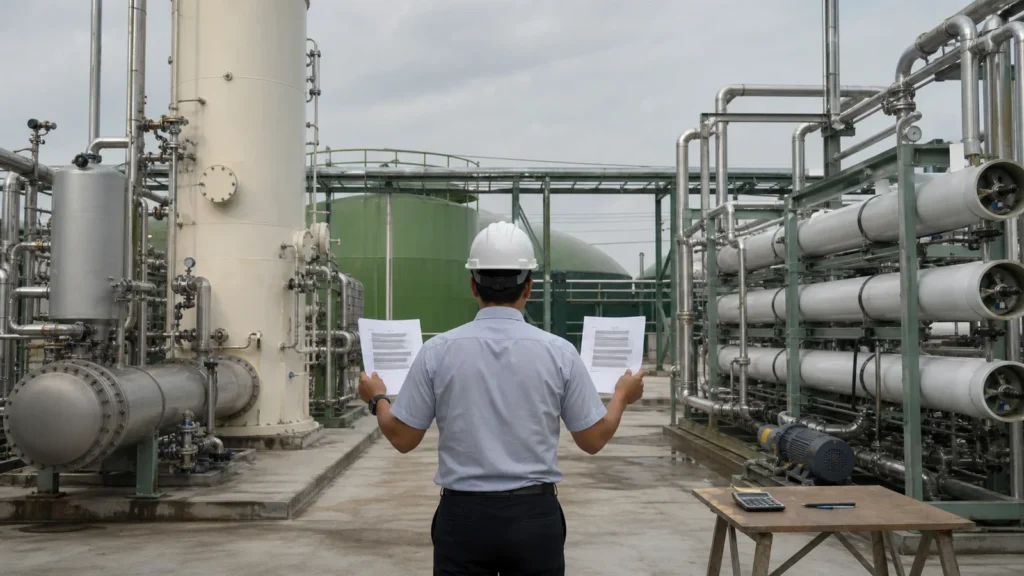
Two offers sit on my desk for the same raw gas: a membrane skid and an amine unit. The amine route buys purity with heat; the membrane route buys simplicity with electricity. On the 2018 comparison figures I work from, the amine unit needs 0.05 to 0.15 kWh/Nm3 of electricity plus 0.5 to 0.75 kWh/Nm3 of heat and loses under 0.1 percent of the methane, while the membrane skid needs 0.18 to 0.20 kWh/Nm3, no heat, and loses under 0.6 percent. If heat is already on site, amine usually wins; if it is not, membrane usually does. That is the membrane vs amine biogas upgrading question at the level of energy, and the rest of this page is what changes once the grid and the rest of the plant enter the room. For the vocabulary, start with the basics of biomethane explained from raw gas to grid entry.
I take the offers one at a time: what arrives at the unit, how each route separates CO2, the electricity and heat balance, methane slip, the grid specification, the rest of the plant, what is installed, and the five questions I would ask before the final investment decision, FID, is taken.
In short
- Amine: 0.05 to 0.15 kWh/Nm3 of electricity plus 0.5 to 0.75 kWh/Nm3 of heat, under 0.1 percent methane slip, up to 99 percent methane.
- Membrane: 0.18 to 0.20 kWh/Nm3 of electricity, no heat, under 0.6 percent methane slip, 96 to 98 percent recovery.
- Pressure: the amine absorber works at 1 to 2 bar, a membrane skid at 5 to 8 bar.
- Quality: the oxygen limit of the local grid, from 0.001 percent mol in France to 0.5 percent mol in Denmark, can decide the route on its own.
- Cost: the upgrading step adds about USD 2/MBtu to USD 4/MBtu on a plant cleaning 3.5 million m3 a year.
In this article
The two offers in front of you
Biogas is the raw mixture leaving the digester; biomethane is that gas after upgrading, meaning the CO2 and the contaminants are removed until it meets the quality the buyer or the grid accepts. In 2018 figures, raw biogas carries 50 to 70 percent methane and 30 to 50 percent CO2, with water vapour at 5 to 10 percent, H2S at 0 to 10 000 ppmv, siloxanes at 0 to 41 mg/m3 and hydrocarbons at 0 to 200 mg/m3. H2S is hydrogen sulphide, which corrodes steel and poisons catalysts; siloxanes are silicon-bearing molecules that leave deposits when burned.
Cleaning comes before upgrading. Both routes want the H2S taken out upstream, because the compressor and the membranes or the solvent circuit do not accept it at those levels. The difference is what is left: in the 2018 data, an amine unit absorbs H2S completely, while a membrane skid does not, so the sulphur has to be gone before the gas reaches the membrane. That changes the pretreatment bill, which is capex, the money spent before the plant runs, and it changes the operating risk, which sits in opex, the money spent keeping it running.
What this means for you: the two quotes are probably not on the same gas. Put the same raw gas analysis, H2S figure and siloxane figure in front of both suppliers before you compare a price.
How each route separates the CO2
The amine route is chemical absorption. Per the 2018 review of upgrading technologies published in Biotechnology Advances, gas enters the absorber at 1 to 2 bar, the solvent is regenerated between 120 and 160 degrees C in a stripper at 1.5 to 3 bar, and final methane content can reach 99 percent. The membrane route is a physical barrier operated at 5 to 8 bar. In the same 2018 comparison, water scrubbing runs at 4 to 10 bar and pressure swing adsorption at 3 to 10 bar, and five technologies are commercial: water absorption, physical absorption in organic solvents, chemical absorption in amines, pressure swing adsorption and membrane separation.
The consequence is mechanical before it is chemical. The amine route treats gas close to atmospheric pressure and spends energy reheating a solvent. The membrane route compresses the gas, and that compression is the only reason the skid can feed a high pressure grid without a second compressor. On a transmission connection part of that problem is already solved; on a distribution line you may pay for pressure you do not need. The sequence inside a biogas plant shows where each unit sits.
What this means for you: ask for the pressure at the outlet flange and the electricity figure at that pressure. A membrane quote at 5 to 8 bar and an amine quote at 1 to 2 bar are not the same product, and the compressor sits inside one price and outside the other.
Electricity against heat
In 2018 figures, electricity per Nm3 of raw biogas is 0.05 to 0.15 kWh/Nm3 for chemical absorption in amines and 0.18 to 0.20 kWh/Nm3 for membranes. Heat is 0.5 to 0.75 kWh/Nm3 for amines, under 0.2 kWh/Nm3 for physical scrubbing, and none for the other routes. Those two lines decide most projects, in three cases.
First, a plant that already has a heat loop from a boiler or an engine: the amine heat demand is close to free at the margin and its lower electricity figure is a straight saving. Second, a plant with a CHP unit and no spare heat: the engine heat is already used or sold, so the amine unit forces a choice between heat for the solvent and heat for the customer. Third, a plant that buys both electricity and heat: amine adds two bills, membrane adds one. The difference between a biomethane plant and a biogas plant sits largely in that balance.
What this means for you: price both routes on your own tariff and your own heat availability. If nobody on your team can state the heat balance in kWh/Nm3, the comparison is not ready.
Methane slip: the number you must write into the contract
Methane slip is the share of methane that leaves in the tail gas instead of the product. In 2018 figures it is under 0.1 percent for amines, under 0.6 percent for membranes, under 2 percent for water scrubbing, under 4 percent for pressure swing adsorption and 2 to 4 percent for physical scrubbing. Methane recovery is 96 to 99 percent for amines and 96 to 98 percent for membranes, and the 2018 review notes that physicochemical recovery can exceed 96 percent.
A slip of 0.6 percent is two problems at once: a fuel loss, because methane you paid to produce leaves the plant, and a carbon intensity problem, because escaped methane warms far more than the CO2 it would have become. On a plant with a tight carbon contract that is a line in the calculation, not a rounding error.
What this means for you: write the guarantee on the tail gas, at guaranteed capacity, on the agreed raw gas. A design sheet is not a guarantee, and a guarantee measured at part load will not protect you at full load. Make the measurement method an annex to the contract.
The specification that can override the economics
In 2018 figures, some countries require more than 95 percent methane in the injected gas. The grid specification goes further. Per the European Biogas Association note of March 2024 on biomethane standards, EN 16723-1 covers grid entry, EN 16726 covers natural gas quality, both are voluntary, and countries often keep their own limits. Oxygen causes the most difficulty, with the Wobbe index, the calorific value and the relative density; the Wobbe index tells a network whether a gas delivers the same heat through a burner at a given pressure.
The oxygen limits in that 2024 note run from 0.001 percent mol in France on an hourly basis to 0.5 percent mol in Denmark at entry and transit, with 0.1 percent mol at storage points, and Italy allows up to 0.6 percent mol. Controlling oxygen avoids corrosion and the black powder that forms in high pressure networks.
A membrane skid removes part of the oxygen along with the CO2, while an amine unit removes almost none of it: the solvent is selective for CO2 and H2S. A very tight oxygen limit therefore pushes a project towards pretreatment or towards a membrane with a tighter stage arrangement, not towards amine, whatever the energy balance says. The feedstock choice behind those limits sets how much sulphur and oxygen you start with.
What this means for you: get the connection agreement before you choose the technology. At 0.001 percent mol, the energy argument is over before it starts.
What the choice does to the rest of the plant
Per the IEA biogas and biomethane outlook published in 2020, 70 percent to 95 percent of the cost of biogas sits in the digesters, adding cogeneration, grid connection and heat distribution can add 70 percent to an integrated project, and upgrading itself costs about USD 2/MBtu to USD 4/MBtu for a plant cleaning about 3.5 million m3 a year. Grid connection is about USD 3/MBtu in the same 2020 estimate, and average biomethane cost is around USD 19/MBtu, falling to about USD 14/MBtu in 2040, about 25 percent less, because the technologies are mature.
Put those numbers side by side. The gap between a membrane skid and an amine unit is a fraction of the upgrading step, which is a fraction of the plant, which is a fraction of delivered gas cost. A decision on the unit price alone is a decision on the wrong number. The 2020 outlook adds that revenue from digestate and pure CO2 is modest and usually not enough to close the gap with natural gas, so the case rests on policy and avoided emissions. The compliance and carbon intensity file is where that case is built.
What this means for you: compare the two routes on total cost per MBtu of delivered biomethane over the financing life, not on the equipment line of the quote.
What is installed, and what that tells you
Installed capacity is a better guide than a brochure, with one caveat: countries count differently. Per the IEA Bioenergy Task 37 country report of September 2024, France declares 364 upgrading units, the largest count among the countries compared, and membrane separation is the most common technology there. The same 2024 report puts the United Kingdom at 723 plants at the end of 2022 with 103 174 m3/h of biomethane capacity, Germany at about 87 TWh of biogas a year and China at about 81 TWh a year.
Read that carefully. The reason is not that amine failed. The units are modular and skid mounted, the plants are small, and a skid can be shipped and commissioned quickly. A region building its first units buys what can be delivered, installed and serviced, which is usually the simpler package. The Southeast Asia market is at that stage now.
In the IEA renewables report published in 2026, the gap is between resource and output: Southeast Asia has feedstock potential of almost 65 bcme, about 2 300 PJ, against barely 80 PJ of combined production in 2025. The same 2026 report puts world biogases production at 1 785 petajoules in 2025, of which 78 percent was biogas, with 18 percent growth over 2026 to 2031 and biomethane output nearly doubling between 2025 and 2031.
What this means for you: if you are buying the first unit in your market, buy for serviceability and speed and accept that the energy optimum may not be the practical one. If you are buying the tenth, the calculus changes.
How I would decide
I would answer five questions before FID is signed. Is there heat on site, and at what temperature? What is the tightest oxygen and sulphur limit in the connection agreement? What tail gas measurement will be used at the performance test, and who signs it? Who can service the unit within a day of a fault, with parts? And what happens to the product if the offtaker asks for liquefaction later, since a membrane skid and an amine unit leave the gas at different pressures for that conversation?
Then I would ask both suppliers for the same three guarantees: electricity per Nm3, slip percentage and methane purity, on the same raw gas analysis, at the same capacity. I would refuse to compare two offers built on two different gas compositions, because that is how a cheap unit becomes an expensive plant.
What this means for you: the decision is not membrane or amine in the abstract. It is which of the two, on your gas, at your pressure, under your connection agreement, can be guaranteed and serviced for the life of the finance.
Sources
- Angelidaki et al., Biogas upgrading and utilization, Biotechnology Advances, 2018.
- European Biogas Association, Biomethane standards: facilitating renewable gas uptake, 2024.
- IEA, Outlook for biogas and biomethane, 2020.
- IEA Bioenergy Task 37, A perspective on the state of the biogas industry in 12 member countries, 2024.
- IEA, Renewables 2026, chapter Biogases, 2026.
Frequently asked questions
Is membrane cheaper than amine for biogas upgrading?
Not on electricity. A membrane skid uses 0.18 to 0.20 kWh/Nm3 of raw biogas against 0.05 to 0.15 for amines, but the amine unit also needs 0.5 to 0.75 kWh/Nm3 of heat. The cheaper route is the one whose energy is already on site.
Which route loses less methane?
Amine, with losses under 0.1 percent against under 0.6 percent for membranes. Both are far below water scrubbing at under 2 percent and pressure swing adsorption at under 4 percent.
Can a membrane unit reach grid quality?
Yes in most cases, with 96 to 98 percent methane recovery, but the binding constraint is often oxygen rather than methane. Limits range from 0.001 percent mol in France to 0.5 percent mol in Denmark, so the connection agreement decides.
Why does France install mostly membrane units?
Because the technology is modular and quick to commission, and because the units are small. France declares 364 upgrading units, the largest count in the countries compared, and membrane separation is the most common route there.
Not sure your project would survive a credit conversation?
A short call is usually enough to see where your project stands.
If you want a second pair of eyes on the two offers before signature, the technology maturity and scale-up review is where I would start.
I do not provide investment advice or arrange investments. I act as a strategic advisor and facilitator.

Alex, Founder of WeConnect Asia
I help low-carbon fuel and carbon removal project developers in Southeast Asia secure the commercial and financial partners needed to reach FID.
Related articles

Pitching a Climate Tech Company to Strategic Investors: What the Corporate Has to Believe Before It Writes a Cheque
How to pitch a climate tech company to strategic investors: the metric cluster, the readiness evidence and the ask that corporates fund.
Biomethane: What It Is, How It Is Made and Who Buys It
Biomethane is biogas cleaned to pipeline quality. I explain how it is made, how it differs from biogas and who buys it in Southeast Asia.
CO2 Sourcing for e-SAF Projects: What the Rules Allow and What the Contract Must Say
Biogenic CO2, direct air capture or industrial flue gas: which sources an e-SAF plant may use, what they cost and which contract terms make the fuel certifiable.
Operating Performance Guarantees for SAF Plants: What Lenders Ask For
Minimum guarantees, performance damages, retesting and who stands behind them: the operating guarantees a SAF plant needs to keep debt and offtake intact.
EPC and Construction Risk in SAF Plants: What a Lender Actually Tests
FEED scope, convertible EPC, performance guarantees and damages caps: the construction risk questions a SAF project must answer before financial close.
Matching Feedstock and Offtake Risk Back-to-Back in a SAF Project: How Lenders Read the Chain
Lenders do not buy a feedstock plan and an offtake plan separately. They buy the link between the two, and the link is where most SAF files break.