
Home » PFAD and SAF: Why Palm Fatty Acid Distillate Sits Outside Annex IX
PFAD and SAF: Why Palm Fatty Acid Distillate Sits Outside Annex IX
10 min read · Nov 2, 2026 · By Alex
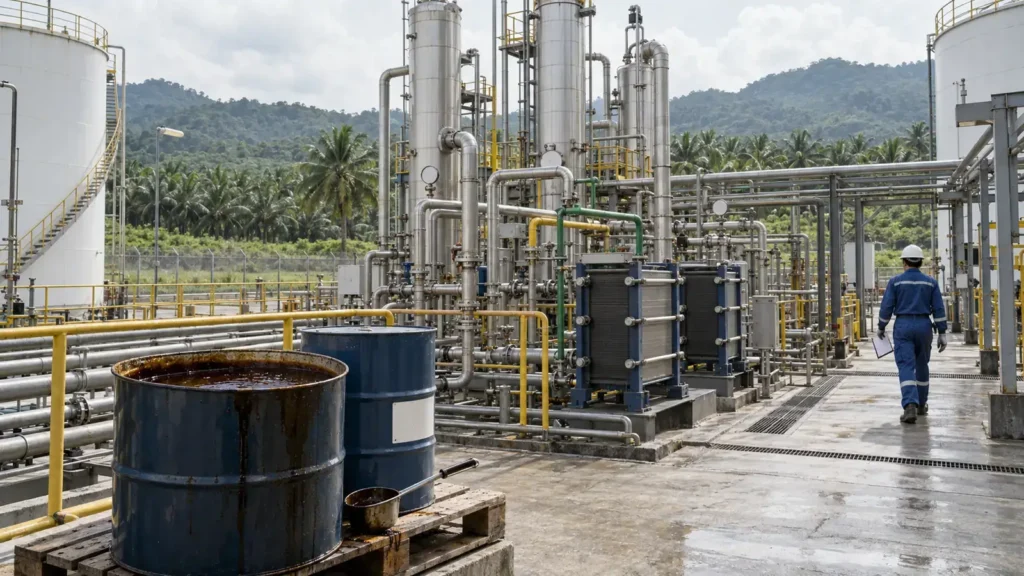
I get one feasibility question more often than any other: whether a palm refining stream can carry a European aviation fuel project plan. My answer is no, not for a project that counts on the European sustainable aviation fuel mandate, because palm fatty acid distillate (PFAD) appears in neither part A nor part B of annex IX of the renewable energy directive, and the ISCC list of eligible materials marks it for FuelEU Maritime only. It remains a valuable refining co-product for other markets, with a market of its own beside the main product, and that is a different project. I keep that separation explicit in every PFAD SAF feasibility note. The wider regional picture sits in sustainable aviation fuel feedstock availability in Southeast Asia.
I write this for a supplier sitting at feasibility stage with PFAD volumes and a draft project plan. The classification question comes before the price question, because the accounting decides whether the tonne exists in the mandate at all. Below I work through the text, the certification columns and the market.
In short
- Eligibility: PFAD appears in neither part A nor part B of annex IX, so no tonne can be counted under the European SAF mandate.
- Classification: The ISCC list marks it M for FuelEU Maritime only, and several member states classify it as a co-product.
- Material: It is a byproduct of the physical refining of crude palm oil, not a residue from the mill.
- Risk: Selling it as POME oil or EFB oil is a serious and fraudulent breach under ISCC EU.
- Sequence: I confirm the entry and the columns before I discuss the price.
In this article
The short answer: the text it does not appear in decides
Palm fatty acid distillate appears in neither part A nor part B of annex IX, the list of feedstocks attached to the renewable energy directive. Part A, the first part of that list, holds feedstocks whose contribution towards the minimum shares may be considered twice their energy content, and its point (g) covers palm oil mill effluent and empty palm fruit bunches. Part B, the second part, is capped rather than open: its contribution towards the minimum share shall be limited, and it holds exactly two entries, used cooking oil at point (a) and animal fats classified as categories 1 and 2 in accordance with Regulation (EC) No 1069/2009 at point (b). My material is named in neither part, so there is no double counting to claim and no limited contribution either. The ISCC list of materials eligible for ISCC EU certification marks PFAD with an M, for FuelEU Maritime, and leaves the ReFuelEU Aviation column empty.
What this means for you: I read the absence itself as the answer, because a project plan built on a feedstock the annex does not name has no accounting path into the European SAF mandate.
What the material actually is
PFAD is a byproduct obtained during the physical refining process of crude palm oil. It is made mainly of free fatty acids, triglycerides, moisture and minor components including phytosterols and tocopherols, and IMARC describes it as a dark brown oily material with strong fatty characteristics. Free fatty acids are the acidic fraction that is not bound into triglycerides. ISCC records that PFAD has a significant economic value in relation to the main product, palm oil, and a variety of applications other than bioenergy, and that several EU Member States explicitly classify PFAD as a co-product, for example the United Kingdom and the Netherlands. A co-product carries its own market beside the main product. ISCC describes selling PFAD as POME oil as a serious and fraudulent breach, with withdrawal of the certificate and exclusion from recertification. Mass balance is the chain-of-custody rule under which certified and non-certified volumes are mixed and certificates follow the certified share. I read it against sustainable aviation fuel sustainability criteria.
What this means for you: I settle identity before price, because a co-product described as waste changes the compliance record of the chain.
What the directive says, line by line
Part A of annex IX is a list of feedstocks whose contribution towards the minimum shares may be considered twice their energy content. It runs from algae through straw, animal manure and sewage sludge to palm oil mill effluent and empty palm fruit bunches at point (g), then tall oil pitch at (h), crude glycerine at (i) and bagasse at (j). Part B is shorter and capped: its contribution towards the minimum share shall be limited, and it holds only used cooking oil and animal fats of categories 1 and 2. Palm fatty acid distillate is written nowhere in either part, and I cannot read a gap as an entry. A material in neither list sits outside the accounting that ReFuelEU aviation uses to build its SAF share, so no volume of it can be reported against the mandate. I run that compliance reading first in EU compliance and carbon intensity services.
What this means for you: I check the entry rather than the sustainability claim, because the accounting only recognises feedstocks the annex actually names.
What the certification schemes do with it
The ISCC list separates two columns: classification as a waste or residue material in a given EU Member State or the United Kingdom, and eligibility for ReFuelEU Aviation (A) or FuelEU Maritime (M). PFAD carries an M and no A. Used cooking oil carries A and M, described as oil that was used to cook food for human consumption, with RED II indicating this material as waste or residue and member states including Germany, France, Ireland, the Netherlands and the United Kingdom classifying it as such. Palm oil mill effluent carries A and M, with the note that POME oil cannot be covered under the material entry of POME, and empty palm fruit bunches carry A and M as well. ReFuelEU aviation builds its SAF definition on those same lists: advanced biofuels from feedstock listed in part A of annex IX, and biofuels produced from oils and fats listed in part B. I map the mandate itself in ReFuelEU Aviation.
What this means for you: I read the columns before the certificate, because a scheme can hold a material the mandate still refuses.
What PFAD is worth if it is not SAF
PFAD still has a market, and its price logic does not follow waste oils. IMARC reports that in Asia Pacific PFAD pricing has been largely driven by feedstock availability from major palm oil producing countries, while domestic biodiesel blending mandates in producing countries supported consistent local consumption and reduced export availability in certain periods. The demand PFAD cannot serve is specific. HEFA holds over 90% of current or upcoming SAF capabilities, and yet IATA estimates that of 189 Mt of oil-based feedstock available for bioenergy and biofuels in 2050 only 82 Mt could be used for SAF, the theoretical maximum of oil-based HEFA SAF is 63 Mt, and oil-based HEFA is projected to account for just over 15% of the SAF in 2050. The slot PFAD is asked to fill belongs to the waste oils and residues the annex names, and the price view I keep beside it is used cooking oil price volatility.
What this means for you: I price PFAD in its own market and treat the aviation route as a separate case that still has to prove eligibility before it proves margin.
Three ways the eligibility assumption fails
I see three places where an eligibility assumption fails before the first cargo moves. First, the label: ISCC treats labelling PFAD as POME oil, or selling it under another milling oil name such as EFB oil, as a serious and fraudulent breach, with withdrawal of the certificate and exclusion from recertification. Second, the national classification: several member states classify PFAD as a co-product rather than a waste or residue, and that decision is taken nationally, so a status that holds in one market can fail in another. Third, the competition for eligible tonnes: UCO made up 80% of the increasing but still very limited SAF demand between 2021 and 2023, and European countries consumed close to seven million tonnes of UCO for biofuels in 2023, close to eight times higher than collected volumes that year. The eligible pool is spoken for by material the annex names.
What this means for you: I assume the label will be tested, the classification will be national, and the eligible tonnes will be contested before I commit a single shipment.
The order I would run the work in
I check the material before I check the price, and I run the checks in a fixed order. I read annex IX and confirm the entry is there. I read the scheme’s material list and confirm the A and M columns. I ask which member state will count the tonne and how it classifies the material there. Only then do I discuss offtake. Two facts anchor the sequence. The SAF definition in ReFuelEU aviation is built directly on parts A and B of annex IX, so the scheme list and the mandate describe the same population of materials. IATA describes second generation waste oils, including palm oil mill effluent, as carrying high emission reduction potential while remaining relatively limited in availability, which tells me the eligible volumes are scarce and worth checking early. When the order is clear I move to feedstock supply.
What this means for you: I spend a day on the text and the columns before I spend a week on commercial terms, because eligibility is the cheapest thing to verify and the most expensive thing to discover late.
How I would run this if it were my file
I would put my own sheet against the published texts and let the sheet carry the decision, because every line below is traceable to a document I have read rather than to a description I have been given:
- Annex IX: PFAD is absent from both parts of the annex (EUR-Lex).
- Scheme columns: PFAD is marked M only, with a co-product classification in member states such as the United Kingdom and the Netherlands (ISCC, February 2026).
- Material boundaries: PFAD is excluded from POME oil and EFB oil, under penalty of certificate withdrawal (ISCC, 22 August 2025).
- Named residues: Palm oil mill effluent and empty palm fruit bunches are listed at point (g) of part A (EUR-Lex).
- Pathway: HEFA holds over 90% of current or upcoming SAF capabilities (IATA).
Those five lines fit on one page, and I would send that page before any commercial discussion starts.
What this means for you: I treat the published classification as the first input to the project plan, and I only write volumes, prices and dates after the feedstock is named in the text I am relying on.
Sources
- EUR-Lex, 16 November 2026.
- ISCC, February 2026.
- ISCC, 22 August 2025.
- European Commission, 16 November 2026.
- IMARC, 16 November 2026.
- IATA, September 2025.
- Transport & Environment, June 2024.
Frequently asked questions
Is PFAD eligible for the EU SAF mandate?
No, not for the mandate itself. PFAD appears in neither part A nor part B of annex IX, and the ISCC eligible materials list marks it for FuelEU Maritime only. ReFuelEU aviation builds its SAF share from advanced biofuels in part A and from biofuels produced from oils and fats in part B, so a material outside both parts has no route into the reported volume (EUR-Lex; ISCC, February 2026; European Commission).
Can PFAD be certified under ISCC?
It can sit inside a certificate scope as a material, and ISCC keeps a line for it in the list. What it does not carry is the A column for ReFuelEU Aviation. ISCC also records that several EU Member States explicitly classify PFAD as a co-product, for example the United Kingdom and the Netherlands (ISCC, February 2026).
Why do some traders describe PFAD as a waste residue?
Because it is a residue of refining rather than of milling, and because national rules diverge. ISCC notes that PFAD has a significant economic value in relation to the main product, palm oil, and a variety of applications other than bioenergy, and several member states classify it explicitly as a co-product (ISCC, February 2026).
What should I do if my project plan assumes PFAD?
I would split the plan. I would keep PFAD volumes for the markets where the material is accepted, and source the SAF feedstocks that annex IX actually lists, starting with palm oil mill effluent and empty palm fruit bunches at point (g). I would also keep in mind that second generation waste oils, including POME, are described as having high emission reduction potential but being relatively limited in availability (IATA).
Not sure your project would survive a credit conversation?
A short call is usually enough to see where your project stands.
If your file needs a counterparty rather than another classification note, I introduce projects and counterparties where the material, the route and the mandate line up, with the annex reading attached so the conversation starts from the text quoted here: investor introductions.
I do not provide investment advice or arrange investments. I act as a strategic advisor and facilitator.

Alex, Founder of WeConnect Asia
I help low-carbon fuel and carbon removal project developers in Southeast Asia secure the commercial and financial partners needed to reach FID.
Related articles

Pitching a Climate Tech Company to Strategic Investors: What the Corporate Has to Believe Before It Writes a Cheque
How to pitch a climate tech company to strategic investors: the metric cluster, the readiness evidence and the ask that corporates fund.

Biomethane: What It Is, How It Is Made and Who Buys It
Biomethane is biogas cleaned to pipeline quality. I explain how it is made, how it differs from biogas and who buys it in Southeast Asia.

CO2 Sourcing for e-SAF Projects: What the Rules Allow and What the Contract Must Say
Biogenic CO2, direct air capture or industrial flue gas: which sources an e-SAF plant may use, what they cost and which contract terms make the fuel certifiable.

Operating Performance Guarantees for SAF Plants: What Lenders Ask For
Minimum guarantees, performance damages, retesting and who stands behind them: the operating guarantees a SAF plant needs to keep debt and offtake intact.

EPC and Construction Risk in SAF Plants: What a Lender Actually Tests
FEED scope, convertible EPC, performance guarantees and damages caps: the construction risk questions a SAF project must answer before financial close.

Matching Feedstock and Offtake Risk Back-to-Back in a SAF Project: How Lenders Read the Chain
Lenders do not buy a feedstock plan and an offtake plan separately. They buy the link between the two, and the link is where most SAF files break.