
Home » POME for SAF: What a Palm Oil Mill Effluent Is Actually Worth in a Fuel Project
POME for SAF: What a Palm Oil Mill Effluent Is Actually Worth in a Fuel Project
10 min read · Nov 2, 2026 · By Alex
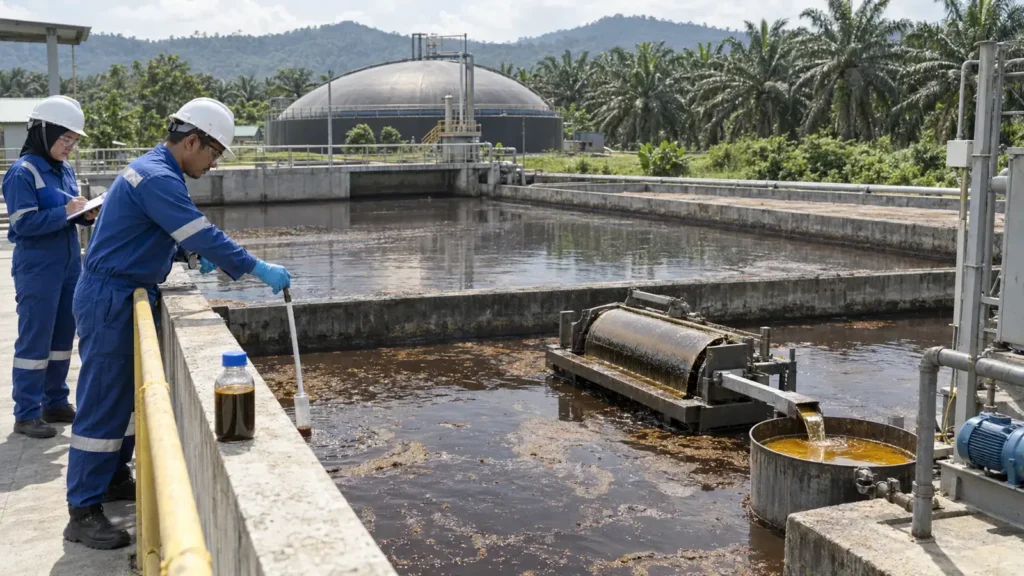
Palm oil mill effluent is wastewater rather than an oil, the quantity you can actually sell is the oil recovered from that wastewater measured in kilos per tonne of fresh fruit bunches according to the mill’s sterilisation technology, and there is currently no established default life cycle emissions value for sustainable aviation fuel made from it. Those are the three facts a feedstock availability study for Southeast Asia starts from, because a feasibility study on this stream must build its own number before a buyer or lender will underwrite it.
The question in front of you is therefore not how much effluent a country produces. It is what a specific mill can plausibly declare, what it costs to recover that oil, and which rules turn a brownish wastewater stream into a contracted feedstock.
In short
- The material: Palm oil mill effluent is voluminous wastewater from sterilisation and clarification, about 90 to 95% water, and what enters a contract is the oil recovered from it.
- The yield: ISCC EU plausibility ranges run 2.1 to 7.6 kg per tonne of FFB on horizontal sterilisation and 6.0 to 28.8 kg on vertical sterilisation.
- The rule: Annex IX part A lists “Palm oil mill effluent and empty palm fruit bunches” and counts its energy contribution twice toward minimum shares.
- The gap: There is no established default life cycle emissions value for POME-derived SAF, so every project carries its own evidentiary burden.
- The cost: Complete biological treatment systems span from about US$0.5 million to well over US$5 million, and methane capture drives eligibility.
In this article
The short answer: it is wastewater, and the volume is a mill calculation
Palm oil mill effluent is the voluminous wastewater from the sterilisation and clarification process in milling oil palm fruits, a brownish, viscous liquid with a strong odour that is about 90 to 95% water with residual oil, fatty acids, soil particles and suspended solids (ISCC, 22 August 2025). What enters a fuel contract is not that effluent but the oil recovered from it, and that recovery depends on how the mill works rather than on a published national figure (ISCC). There is currently no established default life cycle emissions value for POME-derived SAF, which is exactly why a feasibility study has to build its own number (Asia Pacific Sustainable Aviation Centre, 15 November 2026).
What this means for you: I start every POME file at the mill rather than at the district, and I treat the emissions figure as a deliverable of the study, not an assumption handed to you by a template.
Where the oil actually sits
The milling sequence is sterilising palm fresh fruit bunches, stripping, digestion, and a combination of screening and settling, which generates empty fruit bunches, pressed palm fibres and the wastewater itself (ISCC). The effluent cannot be freely discharged without treatment, typically anaerobic then aerobic, the anaerobic process releases methane that is increasingly captured to generate power, and the aerobic stage uses several open ponds where water and residual oil separate and the floating oil is skimmed off (ISCC). I have written up the broader sustainability criteria that govern this chain in the criteria note, because eligibility and recovery are decided there, not in the offtake negotiation.
POME oil, however, is broader than pond skimmings: it refers to the oil recovered from any wastewater from the palm oil mill, including oil recovered before discharge through fat traps or centrifuge technology (ISCC). Each tonne of POME produces approximately 28 m3 of biogas, which is the first revenue line attached to the same stream (ISCC).
What this means for you: I map every recovery point on the mill flowsheet, ponds included, because each one is a separately defensible volume and each one carries its own measurement method.
The rule that gives the material its value
Annex IX part A of the renewable energy directive covers feedstocks whose contribution towards the minimum shares may be considered to be twice their energy content, and point (g) of that annex reads “Palm oil mill effluent and empty palm fruit bunches” (Directive (EU) 2018/2001). Double counting follows from that: when biofuels derived from Annex IX feedstocks are used in the transport sector, their energy content may be counted twice toward national renewable energy targets, which is particularly relevant for the EU target of sourcing 29% of transport energy from renewables by 2030 (ISCC). The downstream demand picture that this rule feeds into is set out in the SAF mandates note.
Being listed also brings obligations: POME is considered advanced and subject to mandatory minimum targets, RED III introduced a combined minimum target of advanced biofuels and RFNBOs of 5.5% fuel share in the transport sector in 2030 of which at least 1% must be RFNBOs, and waste and residue materials are regarded as having zero GHG emissions at their origin (ISCC).
What this means for you: I check which of the two effects your project actually monetises, because double counting benefits the obligated party downstream while the zero-at-origin presumption benefits your life cycle claim upstream, and they rarely land in the same wallet.
How much a mill can plausibly declare
ISCC EU publishes plausibility ranges rather than a single yield: POME oil per tonne of FFB runs from 2.1 to 7.6 kg with horizontal sterilisation and from 6.0 to 28.8 kg with vertical sterilisation (ISCC). Only about 10% of palm oil mills use horizontal sterilisation, which results in an average POME oil yield of up to almost 10 kg per tonne of FFB, and the higher end of the vertical range belongs to a relatively inefficient mill where more oil is lost to the wastewater (ISCC).
At country scale, ISCC translates global CPO production of 76 million tonnes, a typical oil yield of 23.5% for FFB and a 90:10 split between horizontal and vertical sterilisers into a maximal global POME oil potential of up to approximately 3 million tonnes, with Indonesia alone reaching up to almost 2 million tonnes against an Indonesian estimation of only 0.3 million tonnes (ISCC). The regional energy balance looks different again: POME production in 2020 reached an estimated 1.4 million tonnes, and at typical HEFA conversion yields of 1,200 litres per tonne that translates into a potential 1.7 billion litres of SAF production capacity (Asia Pacific Sustainable Aviation Centre).
What this means for you: I derive supply from audited FFB throughput multiplied by a technology-specific yield range, and I show the low and high case side by side rather than presenting a single central estimate.
What it costs to turn effluent into feedstock
The first cost is the treatment itself: complete biological treatment systems for industrial effluents span from about US$0.5 million for small plants to well over US$5 million for high-capacity plants, and methane emissions from POME represent one of the most significant greenhouse gas sources in the palm oil supply chain (World Bank, 2025). Eligibility pushes the same direction, since under CORSIA and other leading sustainability frameworks only crude palm oil processed at mills equipped with methane-capture systems qualifies as an eligible SAF feedstock (World Bank). Methane capture means collecting that biogas instead of venting it.
Feedstock is where the money sits anyway: it accounts for the lion’s share of total HEFA production costs and its price can vary significantly with market supply and demand dynamics (IATA, September 2025). The missing default life cycle value is a commercial cost too: establishing a robust default LCA value would enhance POME’s commercial attractiveness and stimulate further investment in the POME SAF supply chain (Asia Pacific Sustainable Aviation Centre). I have written about where the price premium lands in the SAF price note.
What this means for you: I put treatment capital, methane capture and life cycle assessment in the same cost line as feedstock purchase, because on this stream those three are what set the delivered price.
The disputes I expect in due diligence
Definitions come first. Before POME was listed in Annex IX the same mill waste oils were traded under names such as palm oil slurry, palm oil sludge, decanter cake and mainly palm acid oil, partly to avoid restrictions on the import of waste materials, and labelling or selling other types of oil, such as palm fatty acid distillate or crude palm oil, as POME oil is a serious and fraudulent breach of ISCC EU requirements with consequences up to withdrawal of the certificate and exclusion from recertification (ISCC).
Volumes come second: in April 2025 Transport & Environment published an estimate that about 2 million tonnes of POME oil-based biofuels were used in the European market in 2023 and argued this exceeded global production capacity, while Studio Gear Up challenged that conclusion and estimated global capacity at around the current consumption of 2 million tonnes (ISCC, reporting both positions). Jurisdiction comes third: the Malaysian Palm Oil Board recently required all types of oil produced from palm fruit milling, including steriliser condensate and EFB oil, to be classified as crude palm oil, and ISCC EU sought clarification and is still awaiting a response (ISCC).
What this means for you: I brief the analyst on all three disputes before the file leaves your desk, so that a classification change or a contested capacity estimate is answered with your own mill records rather than with a position paper.
The evidence pack I ask for
I ask for the mill file first. Since April 2023 ISCC EU makes it mandatory for the Points of Origin, that is the palm oil mills, to be individually certified and annually audited, and the auditor checks the annual amount of processed FFB, the mill’s sterilisation technology, the recovery method of POME oil and the annual amounts of generated waste streams, assessing plausibility against the yield ranges (ISCC). Where compliance work has to be handed to a local partner, I run it through the policy risk note.
I then ask what the treatment and methane capture actually cost and how they are funded, because mandatory individual certification with its effort and costs has already made it harder for smaller mills to participate and has contributed to a decline in ISCC EU-certified POME oil volumes (ISCC). On the financing side I require offtake evidence before the term sheet: investors often require at least 70 to 80 percent of annual capacity to be covered by offtake agreements, some lenders require 100 percent of the SAF produced to have reliable offtake covering the full loan tenor of for example 8 to 14 years, and contractually binding agreements rather than memoranda of understanding are needed for a project to reach FID (World Economic Forum with Kearney).
What this means for you: I assemble mill certificate, flowsheet, treatment capex and a binding offtake as one pack, because a lender will ask for all four in the same meeting.
How I would run this if it were my file
I anchor the study on three published anchors. First the demand pool: by 2030 global SAF production capacity is expected to reach around 20 Mt with the project success factor applied, of which HEFA refineries account for about 95% of total volume (IATA, September 2025), while demand for global SAF is expected to reach 17 million tonnes per annum, approximately 4 to 5 percent of jet fuel consumption (World Economic Forum with Kearney). A dedicated volume plan for this stream belongs in the offtake note.
Second the feedstock class: second generation feedstocks such as used cooking oil, animal fat, industrial grease and residues like palm oil mill effluent have a high emission reduction potential but are relatively limited in availability (IATA, September 2025).
Third the long run: in 2050, of an estimated 189 Mt of oil-based feedstock available for bioenergy and biofuels, 82 Mt could be used for SAF production, and oil-based HEFA is projected to account for just over 15% of the SAF in 2050 (IATA).
What this means for you: I write the feasibility file so that the volume rests on your mill records, the emissions on your own life cycle assessment, and the revenue on a binding offtake, in that order of dependency.
Sources
- ISCC, 22 August 2025.
- Asia Pacific Sustainable Aviation Centre, 15 November 2026.
- Directive (EU) 2018/2001, 15 November 2026.
- World Bank, 2025.
- IATA, September 2025.
- World Economic Forum with Kearney, February 2025.
Frequently asked questions
Is POME oil the same thing as crude palm oil?
No. POME oil is the oil recovered from any wastewater from the palm oil mill, including oil skimmed off the treatment ponds and oil recovered before discharge through fat traps or centrifuge technology, while crude palm oil is the primary product of milling. Selling crude palm oil or palm fatty acid distillate as POME oil is a serious and fraudulent breach of ISCC EU requirements, carrying consequences up to withdrawal of the certificate and exclusion from recertification (ISCC).
How much POME oil can one mill plausibly declare?
It depends on the sterilisation technology: 2.1 to 7.6 kg per tonne of FFB with horizontal sterilisation and 6.0 to 28.8 kg with vertical sterilisation, with an average of up to almost 10 kg per tonne because only about 10% of mills use horizontal sterilisation (ISCC).
Does POME-derived SAF qualify under CORSIA?
POME is recognised as an approved feedstock under CORSIA, but there is currently no established default life cycle emissions value for POME-derived SAF, so a project has to evidence its own value rather than claim a default (Asia Pacific Sustainable Aviation Centre).
Why is there no default life cycle value for POME SAF?
Because a widely validated default reference does not exist yet, which creates challenges for policymakers assessing POME as a feedstock option in their jurisdictions. The Asia Pacific Sustainable Aviation Centre is partnering with the industry on a project to develop a comprehensive life cycle assessment model to establish definitive values for POME SAF.
Not sure your project would survive a credit conversation?
A short call is usually enough to see where your project stands.
If you are at feasibility stage and need the mill file turned into a volume, price and emissions case that a lender can read, I offer investor introductions for developers with an audited feedstock position.
I do not provide investment advice or arrange investments. I act as a strategic advisor and facilitator.

Alex, Founder of WeConnect Asia
I help low-carbon fuel and carbon removal project developers in Southeast Asia secure the commercial and financial partners needed to reach FID.
Related articles

Pitching a Climate Tech Company to Strategic Investors: What the Corporate Has to Believe Before It Writes a Cheque
How to pitch a climate tech company to strategic investors: the metric cluster, the readiness evidence and the ask that corporates fund.

Biomethane: What It Is, How It Is Made and Who Buys It
Biomethane is biogas cleaned to pipeline quality. I explain how it is made, how it differs from biogas and who buys it in Southeast Asia.

CO2 Sourcing for e-SAF Projects: What the Rules Allow and What the Contract Must Say
Biogenic CO2, direct air capture or industrial flue gas: which sources an e-SAF plant may use, what they cost and which contract terms make the fuel certifiable.

Operating Performance Guarantees for SAF Plants: What Lenders Ask For
Minimum guarantees, performance damages, retesting and who stands behind them: the operating guarantees a SAF plant needs to keep debt and offtake intact.

EPC and Construction Risk in SAF Plants: What a Lender Actually Tests
FEED scope, convertible EPC, performance guarantees and damages caps: the construction risk questions a SAF project must answer before financial close.

Matching Feedstock and Offtake Risk Back-to-Back in a SAF Project: How Lenders Read the Chain
Lenders do not buy a feedstock plan and an offtake plan separately. They buy the link between the two, and the link is where most SAF files break.