
Home » Renewable Diesel and HVO in Southeast Asia: Where the Demand Actually Sits
Renewable Diesel and HVO in Southeast Asia: Where the Demand Actually Sits
10 min read · Nov 22, 2025 · By Alex
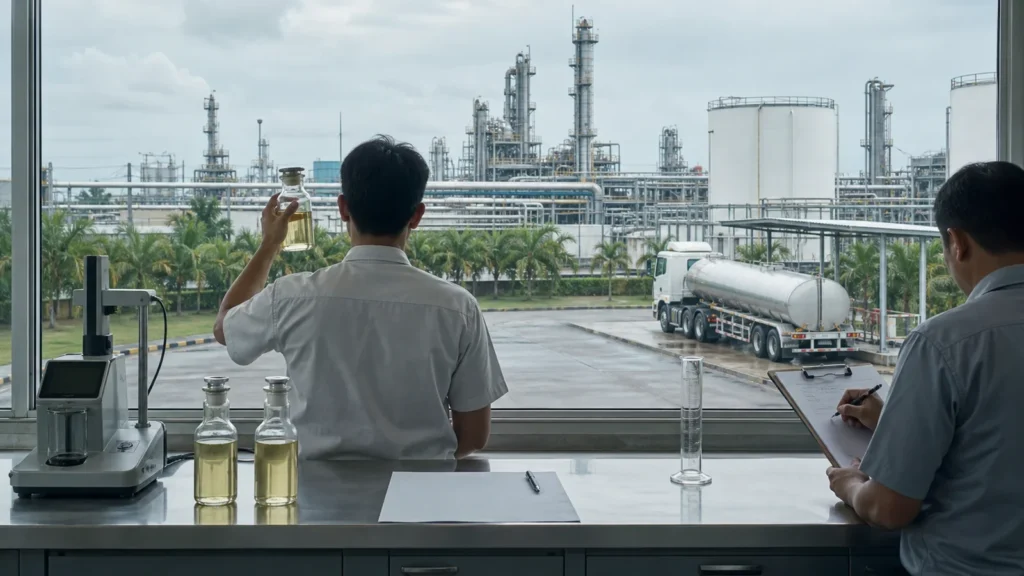
Renewable diesel, sold as HVO (hydrotreated vegetable oil), is a drop-in fuel, meaning no engine change: it fits the existing diesel pool, and the demand is not where the headlines sit. I start from the biogas, biomass and biofuels hub. In the renewable diesel Southeast Asia market, Indonesia’s mandate (a legal duty to blend) sits on palm-based FAME (fatty acid methyl ester) at 35 percent in 2024, Thailand does not permit biodiesel, the ester blendstock, to be imported and is unlikely to allow HVO, and the outlet is an export contract to Europe or the United States, priced against tight to negative margins in 2025.
I take this in the order a buyer asks for it: what the molecule is, why the plant is the hard part, where the mandate sits, what Indonesia and Thailand each do, how certificates and exports work, and the checks I run before I commit. Every figure below carries its date in the same sentence.
In short
- Molecule: HVO is a hydrotreated hydrocarbon, not an ester, so it drops into the diesel pool with no engine change.
- Plant: feedstock is the binding constraint, and announced Indonesian capacity is not operating output.
- Mandate: Indonesia held a 35 percent rate in 2024 on FAME; Thailand permits no biodiesel imports.
- Certificates: the revenue stack, not the molecule, is what an export contract actually sells.
- Route: the buyer sits behind a mandate in Europe or the United States, not in the region.
In this article
What HVO is, and what it is not
HVO stands for hydrotreated vegetable oil, and renewable diesel is the same product under another name. An oil or fat is reacted with hydrogen until it becomes a straight-chain hydrocarbon, which is why it behaves like diesel and can be sold as a drop-in fuel with no engine change. Biodiesel is a different molecule: it is fatty acid methyl ester, made by reacting an oil with an alcohol, and the fuel pool has to accept it.
The pool is growing, but slowly. In the IEA’s Renewables 2024, liquid biofuels carried 20 percent of renewable energy demand in transport in 2023, and the biofuel share of total liquid fuel transport demand moves from 5.6 percent in 2023 to 6.4 percent in 2030, reaching 215 billion litres a year, or 5.7 EJ, in 2030. Growth is concentrated in the United States, Europe, Brazil, Indonesia and India, which together account for 85 percent.
What this means for you: the reactor is the easy half, so I put my diligence budget into the feedstock contract and the outlet, because those two decide whether an HVO line earns anything once it runs.
Why the molecule is easy and the plant is not
The chemistry scales, the supply does not. Fats, oils and greases are also the preferred feedstock for biodiesel and biojet, so a renewable diesel line, a biogas project and a multi-product plant can all chase the same barrel of used cooking oil, meaning the spent fryer oil. Co-processing, meaning a bio feedstock fed into an existing refinery unit, competes for that same stream.
Indonesia’s announced hydrogenation derived renewable diesel capacity, abbreviated HDRD, as of 2024 sits at three Pertamina sites. In 2024 Cilacap in Central Java held 477 kilolitres per day of HDRD and SAF, meaning sustainable aviation fuel, reported operational with a phase 2 due onstream by 2026; Plaju in South Sumatra held 3 180 kilolitres per day under development for completion in 2027; Dumai in Riau ran a 159 kilolitres per day trial. These are installed and planned capacities, not production volumes, and a trial is not a contract.
What this means for you: I treat the feedstock as the constraint and the reactor as a commodity, so I do not pay for feasibility work until the feedstock is contracted and the offtaker is named.
Where the mandate is, the demand is
Transport is where the volume goes. Renewable energy consumption in transport is expected to rise 50 percent by 2030, in the IEA’s Renewables 2025, with road biofuels contributing 35 percent of that growth and significant expansion in Brazil, Indonesia, India and Malaysia. Indonesia reduces its diesel import dependence by near 30 percentage points through a biodiesel mandate that enforced a minimum blending rate of 40 percent in 2025, backed by a subsidy covering the price difference between biodiesel and conventional diesel.
The word that matters is mandate. A mandate names a biocomponent, and a blending rate, meaning the minimum share of the pool, names a percentage, so a rule written as a 40 percent minimum for biodiesel in 2025 gives an HVO producer nothing to sell into. I read every mandate text for the molecule it names, not for the percentage it announces.
What this means for you: the demand curve is real, but the specification is the gate, so I check the named molecule before I model a single litre of output.
Indonesia: a mandate built on FAME
Indonesia maintained a 35 percent biodiesel blending rate in 2024, and B35 became nationwide in August 2023, after B30 in January 2020 and B20 in 2018, in the USDA report on Indonesian biofuels published in October 2024. Biodiesel production in 2024 is estimated at 13 billion litres, 3 percent higher than 2023, with exports projected at 350 million litres.
The programme is financed by a levy on palm oil product exports, through the CPO fund agency BPDPKS, which subsidises the price spread between biodiesel and fossil diesel. That is a subsidy, not an HVO incentive: support for biodiesel has not translated into support for an advanced biofuels programme, and no incentives exist to lower the carbon intensity of the biodiesel supplied.
What this means for you: feedstock leaves anyway, since palm oil mill effluent, the liquid waste from palm oil milling, is expected to reach almost 2 million metric tons in 2024 and palm fatty acid distillate runs at 3 to 3.5 million metric tons a year, so my case on SAF and renewable diesel feedstock has to start with an export contract instead of a domestic blend.
Thailand: a market that closed its door
Thailand’s Alternative Energy Development Plan 2024 sets a biofuel consumption target of 2 760 million litres by 2037, made of 1 185 million litres of ethanol, 900 million litres of biodiesel and 675 million litres of SAF, in the USDA report on Thai biofuels published in July 2024. The plan sets an SAF blending rate of 1 percent in 2026, gradually reaching 8 percent by 2036, and the Ministry of Energy estimates SAF demand at 73 million litres by 2026.
The mandatory biodiesel blend rate rose from 5 percent in 2022 to 6.6 percent in 2023, and the government established B7 as the primary rate with B20 as the alternative. Renewable drop-in diesel is no longer commercialised in Thailand because of the removal of subsidies and high production costs, and Thailand is unlikely to allow imports of hydrotreated vegetable oil for the same reason that it does not permit biodiesel imports. I check where the feedstock would come from before I model anything.
What this means for you: a target of 2 760 million litres by 2037 is volume without a door for imports, so I treat Thailand as a closed market for HVO.
Certificates and the export route
The revenue stack, not the molecule, is the product. In the IEA’s 2025 outlook for biogas and biomethane, estimated total revenues from biomethane certificates in some countries range from USD 80/MWh to USD 210/MWh, and carbon dioxide removed during upgrading can earn a removal credit worth around USD 500/t CO2 to USD 600/t CO2 on voluntary carbon markets. Those numbers sit in the biogas book, but they show the shape of the layer that can carry a plant the fuel market alone would not.
On 11 April 2025 the IMO reached a provisional agreement on a global greenhouse gas fuel standard for international shipping, which could result in 0.4 EJ of new renewable fuel demand by 2030 in the accelerated case and 2.5 EJ to 3.5 EJ by 2035. In the short term, biodiesel, renewable diesel and bio-LNG are likely to meet most new maritime demand because of their commercial readiness, availability and ship compatibility.
What this means for you: I would price an HVO contract against the certificate layer and a book and claim structure, because the export buyer pays for the attribute as much as for the molecule.
My checks before I underwrite an HVO plant
Concept stage is where I do this work, and I run the same five checks on every HVO file before I spend anything on studies:
- Feedstock: is it contracted with a traceability chain that the export market accepts, covering origin, carbon intensity and custody at every handover?
- Offtaker: is the buyer a mandate holder in Europe or the United States, rather than a domestic distributor who can only pay the local price?
- Flexibility: can the same unit switch between HVO and SAF, so that a change in the mandate does not strand the asset?
- Carbon intensity: is it documented per batch, in a form the buyer’s regulator will accept without a second audit?
- Working capital: does it cover the gap between paying for feedstock and receiving the certificate payment, which are never on the same date?
What this means for you: if any one of the five fails, the plant is a technology project rather than a fuel business, and I stop the file there rather than model a return I cannot evidence.
What I would write in the offtake section
The offtake section is where I put dated facts, because a buyer’s counsel reads the date before the adjective. I write four dated rows and nothing else:
- Mandate coverage, 2024: Indonesia held a 35 percent blending rate on FAME, while Thailand permitted no biodiesel imports and no HVO entry.
- Capacity, 2024: 477 kilolitres per day at Cilacap, 3 180 kilolitres per day at Plaju and 159 kilolitres per day at Dumai, all announced, in development or in trial.
- Demand, 2025: road biofuels carry 35 percent of transport renewable growth and Indonesia enforced a minimum blending rate of 40 percent.
- Price risk, 2025: producers of biodiesel, renewable diesel and SAF faced negative economics, with a 20 percent drop in United States biodiesel and renewable diesel use and production down nearly 15 percent.
What this means for you: four dated rows tell a lender exactly what is contracted, what is announced and what is only policy, and that distinction decides whether the file survives credit review in advance.
Sources
- IEA, Renewables 2024, chapter Renewable fuels https://www.iea.org/reports/renewables-2024/renewable-fuels, 2024.
- IEA, Renewables 2025, chapter Renewable transport https://www.iea.org/reports/renewables-2025/renewable-transport, 2025.
- USDA Foreign Agricultural Service, Biofuels Annual, Indonesia, report ID2024-0018 https://apps.fas.usda.gov/newgainapi/api/Report/DownloadReportByFileName?fileName=Biofuels+Annual_Jakarta_Indonesia_ID2024-0018.pdf, 2024.
- USDA Foreign Agricultural Service, Biofuels Annual, Thailand, report TH2024-0032 https://apps.fas.usda.gov/newgainapi/api/Report/DownloadReportByFileName?fileName=Biofuels+Annual_Bangkok_Thailand_TH2024-0032.pdf, 2024.
- IEA, Outlook for Biogas and Biomethane: A global geospatial assessment, World Energy Outlook Special Report https://iea.blob.core.windows.net/assets/5b757571-c8d0-464f-baad-bc30ec5ff46e/OutlookforBiogasandBiomethane.pdf, 2025.
Frequently asked questions
Is HVO the same as biodiesel?
No. HVO, hydrotreated vegetable oil, is a hydrocarbon made by reacting an oil or fat with hydrogen, and it is the same product as renewable diesel. Biodiesel is fatty acid methyl ester, made by reacting an oil with an alcohol. Both can enter a diesel pool, but they are different molecules made by different routes, and HVO is the one that needs no engine change.
Can I sell HVO into Indonesia's biodiesel mandate?
Not on the terms that applied in 2024. The blending rate was maintained at 35 percent in 2024 and the pool is defined as FAME. The programme is financed by a levy on palm oil product exports managed by BPDPKS, which subsidises the price spread between biodiesel and fossil diesel, and no incentives exist to lower the carbon intensity of the biodiesel supplied.
Why does Thailand not import HVO?
Renewable drop-in diesel is no longer commercialised in Thailand because of the removal of subsidies and high production costs, and Thailand is unlikely to allow imports of hydrotreated vegetable oil for the same reason that it does not permit biodiesel imports. The Alternative Energy Development Plan 2024 targets 2 760 million litres of biofuel by 2037, so the volume exists but the door to imports stays shut.
What feedstock does an HVO plant in Southeast Asia use?
Fats, oils and greases: used cooking oil, palm fatty acid distillate and palm oil mill effluent. Those streams are also the preferred feedstock for biodiesel and biojet, so competition is the normal condition. In 2024 Indonesia was expected to export almost 2 million metric tons of palm oil mill effluent and 3 to 3.5 million metric tons a year of palm fatty acid distillate, which shows how much feedstock already leaves the region.
Not sure your project would survive a credit conversation?
A short call is usually enough to see where your project stands.
If you are at concept stage and need a contracted outlet before you pay for feasibility work, I structure the offtake conversation, the certificate route and the export terms with you, starting from how I structure offtake work.
I do not provide investment advice or arrange investments. I act as a strategic advisor and facilitator.

Alex, Founder of WeConnect Asia
I help low-carbon fuel and carbon removal project developers in Southeast Asia secure the commercial and financial partners needed to reach FID.
Related articles

Pitching a Climate Tech Company to Strategic Investors: What the Corporate Has to Believe Before It Writes a Cheque
How to pitch a climate tech company to strategic investors: the metric cluster, the readiness evidence and the ask that corporates fund.

Biomethane: What It Is, How It Is Made and Who Buys It
Biomethane is biogas cleaned to pipeline quality. I explain how it is made, how it differs from biogas and who buys it in Southeast Asia.

CO2 Sourcing for e-SAF Projects: What the Rules Allow and What the Contract Must Say
Biogenic CO2, direct air capture or industrial flue gas: which sources an e-SAF plant may use, what they cost and which contract terms make the fuel certifiable.

Operating Performance Guarantees for SAF Plants: What Lenders Ask For
Minimum guarantees, performance damages, retesting and who stands behind them: the operating guarantees a SAF plant needs to keep debt and offtake intact.

EPC and Construction Risk in SAF Plants: What a Lender Actually Tests
FEED scope, convertible EPC, performance guarantees and damages caps: the construction risk questions a SAF project must answer before financial close.

Matching Feedstock and Offtake Risk Back-to-Back in a SAF Project: How Lenders Read the Chain
Lenders do not buy a feedstock plan and an offtake plan separately. They buy the link between the two, and the link is where most SAF files break.