
Home » SAF Blending Limits and Drop-In Fuel: Where the Ceiling Comes From
SAF Blending Limits and Drop-In Fuel: Where the Ceiling Comes From
10 min read · Nov 2, 2026 · By Alex
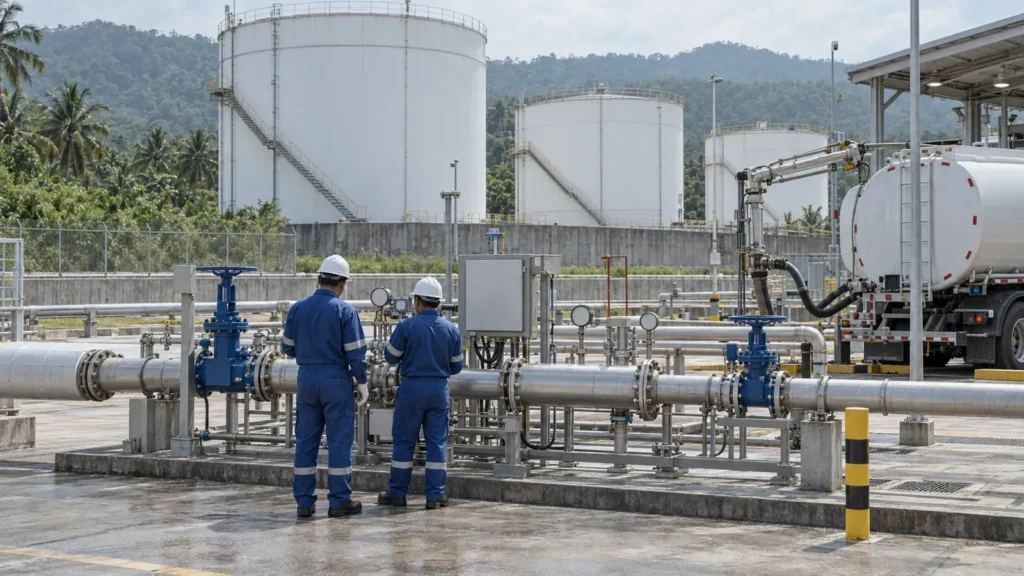
Every approved conversion pathway for sustainable aviation fuel carries its own published ceiling, which is why the fuel arrives mixed rather than on its own. SAF is blended because each approved conversion pathway has a published ceiling, with limits between 10 percent and 50 percent depending on the feedstock and how the fuel is produced, and 5 percent for co-processing (blending biomass feedstocks inside a petroleum refinery) under ASTM D1655 (the specification for aviation turbine fuels), so the fuel delivered to the aircraft stays a conventional Jet A or Jet A1. I start from sustainable aviation fuel and work down to the number a buyer should ask for.
The saf blending limit is a technical parameter written into the certification specification, not a policy preference and not a share of market supply. I keep two numbers apart throughout: the ceiling that certification grants a pathway, and a mandate, a legal minimum share of SAF that suppliers must place in the fuel they sell.
In short
- Ceiling: Limits run from 10 percent to 50 percent by pathway, and 5 percent for co-processing under ASTM D1655.
- Drop-in rule: The blended fuel must behave exactly like conventional jet fuel, so nothing at the airport changes.
- Mixing point: Blending happens at existing fuel terminals, upstream of the airport.
- Mandates: A mandate sets the share of supply; it does not raise a technical ceiling.
- Revenue: Above the annex limit there is no SAF to invoice.
In this article
The short answer: a ceiling, not a preference
The short answer is that the ceiling sits in the specification, not in anyone’s ambition. SAF can be blended at different levels with limits between 10 percent and 50 percent, depending on the feedstock and how the fuel is produced, according to the US Department of Energy. IATA states the industry criterion without decoration: the ability of the SAF to be dropped in to conventional jet fuel, with a maximum limit of 50 percent of the blend. The result is that the aircraft takes a certified conventional fuel, and the renewable content exists only inside that ceiling.
Each ceiling is a blend limit: the largest share of neat SAF, the unblended conversion product leaving the bio-refinery, permitted in the finished fuel. ASTM D7566 regulates the technical certification of SAF and evaluates which technologies, under specific circumstances and characteristics, can produce on specification neat SAF.
What this means for you: when a supplier quotes a percentage, ask which annex it comes from, because the number that matters is the certified share of the finished fuel.
Why the fuel is mixed in the first place
A drop-in fuel is one that substitutes for conventional jet fuel with no adaptation of engines, aircraft or delivery infrastructure. SAF must have the same qualities and characteristics as conventional jet fuel in order to substitute it, so manufacturers do not have to redesign engines or aircraft and fuel suppliers and airports do not have to build new fuel delivery systems. The result is drop-in fuels entirely fungible with conventional kerosene requiring no adaptation of engines or associated delivery infrastructure.
Because the same aircraft can be fueled in different countries, international specifications have been adopted, and the two most widely utilized standards are ASTM D1655 and DEF STAN 91-91. The blend lets a renewable molecule enter a fossil supply chain without a parallel infrastructure. Any SAF that does not meet the drop-in condition could present safety issues associated with risks of mishandling.
What this means for you: the mixing rate is the price of keeping the existing supply chain, and it is set by specification rather than by preference.
The ceilings, pathway by pathway
The annex carries the number. The US Department of Energy table gives 50 percent for Fischer-Tropsch SPK (Annex A1, approved June 2009), 50 percent for HEFA-SPK (Annex A2, approved July 2011), 10 percent for hydroprocessed fermented sugars to synthetic isoparaffins (Annex A3, approved June 2014), 50 percent for Fischer-Tropsch with aromatics (Annex A4, approved November 2015), 50 percent for alcohol-to-jet SPK (Annex A5, approved April 2016), 50 percent for catalytic hydrothermolysis kerosene (Annex A6, approved February 2020) and 10 percent for hydrocarbon hydroprocessed esters and fatty acids (Annex A7, approved May 2020).
The same shape appears in the industry table, with 50 percent for Fischer-Tropsch, HEFA, alcohol-to-jet and catalytic hydrothermolysis jet fuel, and 10 percent for the hydroprocessed hydrocarbons route and synthesized iso-paraffins. Each pathway ends as a synthetic blending component, the pure hydrocarbon stream the process produces, and the annex fixes how much of it enters the finished fuel. Outside the annexes, ASTM D1655 allows co-processing in blends up to 5 percent, covering fats, oils and greases and Fischer-Tropsch biocrude.
What this means for you: read the annex before you read the proposal, because the pathway name decides your ceiling, not the feedstock brochure.
Where the mixing actually happens
Not at the aircraft stand. SAF must be blended with Jet A prior to use in an aircraft, and SAF produced at biofuels facilities is expected to be blended with Jet A at existing fuel terminals and then delivered to airports by pipeline or truck. While it is technically possible to blend fuels at an airport, it is not the most practical or cost-effective method due to the need for additional equipment, staff and insurance.
Due to strict fuel quality standards, it is preferable to certify SAF as ASTM D1655 upstream of an airport. A SAF is produced in a bio-refinery, then blended up to the maximum certified blending limit; upon release from blending the fuel is certified to ASTM D1655 and is regarded as conventional Jet A or Jet A1 kerosene. The airport sees no change: it receives blended fuel in the same pipelines and trucks as today.
The practice already runs at scale on that model: ICAO counts over 360,000 commercial flights that have used SAF at 46 different airports, largely concentrated in the United States and Europe, and every one of those uplifts took a fuel already blended and released from blending as Jet A or Jet A1 (US Department of Energy). Nothing in that flow asks an airport to change its equipment, which is why the ceiling reads as a specification question rather than an infrastructure question.
What this means for you: put the blending obligation and the certification step in the terminal contract, because that is where both the equipment and the responsibility already sit.
Why a mandate does not move your ceiling
A mandate sets how much SAF enters the supply, not how much of it a pathway can carry. ReFuelEU aviation obliges suppliers to increase the SAF share to 2 percent from 2025 and 70 percent from 2050, with synthetic aviation fuels at 1.2 percent from 2030 and 35 percent from 2050, and those shares are measured on the fuel supplied at EU airports.
Those shares sit in the mandate schedules, while the ReFuelEU aviation regulation states that the blended aviation fuels are certified to reach a SAF blend of up to 50 percent, with research devoted to increasing the maximum blending rate to 100 percent. The regulation replaces any national mandates on SAF in Member States, so the share obligation moves while the annex ceiling stays where the specification put it.
One rule travels with the package: aircraft operators must refuel with the aviation fuel necessary to operate the flight, avoiding emissions from extra weight and carbon leakage caused by tankering, the practice of loading more fuel than the flight needs.
What this means for you: report the supply share and the blend ceiling on separate lines, because they answer different questions.
What the ceiling does to your compliance plan
A compliance obligation is a volume obligation, and the volume you can deliver into it is the certified share of the fuel you produce. I treat the ceiling as a planning constraint sitting next to the mandate: my low carbon fuel mandate tracker and the blend arithmetic have to agree before anyone quotes a delivered tonne.
The definition side matters too. Under ReFuelEU aviation, SAF covers synthetic aviation fuels, advanced and other aviation biofuels and recycled carbon aviation fuels, all drop-in and compliant with the sustainability criteria of the renewable energy directive. Suppliers may also comply by using renewable hydrogen for aviation, or synthetic low-carbon aviation fuels and low-carbon hydrogen from non-fossil sources meeting a lifecycle emissions savings threshold of 70 percent.
CORSIA adds a second condition: eligible fuels must come from producers certified by a Sustainability Certification Scheme approved by the ICAO Council, and batches may be produced for 365 calendar days after certification before re-certification is required.
What this means for you: the ceiling enters your compliance model as a conversion factor between production and obligation.
What the ceiling does to your revenue
The ceiling is a volume cap on the renewable claim you can sell, and the claim is priced separately from the molecule. IATA records that SAF prices exceed fossil-based jet fuel by a factor of two, and by up to a factor of five in mandated markets, and that in Europe airlines pay up to five times more than the price of conventional jet fuel under ReFuelEU Aviation, without guarantee of supply or consistent documentation.
Production context matters: in 2025 SAF output is expected to reach 1.9 million tonnes, which is only 0.6 percent of total jet fuel consumption, and at current price levels the premium translates into an additional USD 3.6 billion in fuel costs for the industry.
The point for a developer is arithmetic, not opinion: above the annex limit there is no SAF to invoice, so the revenue model stops at the ceiling while the cost base does not.
What this means for you: size the plant on the certified share, then model the premium against that volume rather than against the nameplate capacity.
How I would run this if it were my file
I would put the ceiling in the model as a constraint line before I size the plant, because the annex limit defines the sellable share of every batch. I would place the blending step in the contract, at a terminal, with the certification done upstream of the airport, so the responsibility and the equipment sit where they belong.
I would separate the two numbers in every board paper: the share of supply my offtaker must reach, and the share of blend my pathway can carry. I would keep a check on ASTM revisions, since both ASTM standards are continuously updated to allow for advancements in technology to produce SAF, with processes and tests in place for the approval of other feedstocks, fuel molecules and blending limits.
And I would tie the volume that survives the ceiling into the financing plan, where the claim chain and the recertification clock are already tracked.
What this means for you: fix the ceiling before you fix the price, and every downstream number, from obligation to revenue to financing, inherits the same constraint.
Sources
- IATA Fact Sheet 2, consulted 16 November 2026.
- US Department of Energy Alternative Fuels Data Center, consulted 16 November 2026.
- ICAO, consulted 16 November 2026.
- European Commission, consulted 16 November 2026.
- ICAO, Fourth Edition June 2025.
- IATA Press Release No 57, 9 December 2025.
Frequently asked questions
Why can SAF only be blended up to a certain percentage?
Because each conversion pathway is approved with a published maximum that applies to that pathway, so the finished fuel stays within the specification of conventional jet fuel after blending, with limits between 10 percent and 50 percent depending on the feedstock and how the fuel is produced (US Department of Energy; IATA).
Does a SAF mandate force suppliers to blend above the technical limit?
No: the mandate sets the minimum share of SAF in the fuel supplied, while the technical ceiling stays where the specification puts it, up to a SAF blend of 50 percent under current certification, with research working toward a maximum blending rate of 100 percent (European Commission).
Where is SAF blended in the supply chain?
At existing fuel terminals, upstream of the airport: SAF must be blended with Jet A prior to use in an aircraft, and blending at an airport would need additional equipment, staff and insurance (US Department of Energy).
Is the blend limit the same for every SAF pathway?
No: the US table lists 50 percent for Fischer-Tropsch SPK, HEFA-SPK, Fischer-Tropsch with aromatics, alcohol-to-jet SPK and catalytic hydrothermolysis kerosene, 10 percent for the sugars route and for the hydrocarbon hydroprocessed esters route, and 5 percent for co-processing under ASTM D1655 (US Department of Energy).
Not sure your project would survive a credit conversation?
A short call is usually enough to see where your project stands.
If you are working on a SAF file and want the ceiling, the mandate schedule and the financing path read as one document, start an investor introduction conversation with me.
I do not provide investment advice or arrange investments. I act as a strategic advisor and facilitator.

Alex, Founder of WeConnect Asia
I help low-carbon fuel and carbon removal project developers in Southeast Asia secure the commercial and financial partners needed to reach FID.
Related articles

Pitching a Climate Tech Company to Strategic Investors: What the Corporate Has to Believe Before It Writes a Cheque
How to pitch a climate tech company to strategic investors: the metric cluster, the readiness evidence and the ask that corporates fund.

Biomethane: What It Is, How It Is Made and Who Buys It
Biomethane is biogas cleaned to pipeline quality. I explain how it is made, how it differs from biogas and who buys it in Southeast Asia.

CO2 Sourcing for e-SAF Projects: What the Rules Allow and What the Contract Must Say
Biogenic CO2, direct air capture or industrial flue gas: which sources an e-SAF plant may use, what they cost and which contract terms make the fuel certifiable.

Operating Performance Guarantees for SAF Plants: What Lenders Ask For
Minimum guarantees, performance damages, retesting and who stands behind them: the operating guarantees a SAF plant needs to keep debt and offtake intact.

EPC and Construction Risk in SAF Plants: What a Lender Actually Tests
FEED scope, convertible EPC, performance guarantees and damages caps: the construction risk questions a SAF project must answer before financial close.

Matching Feedstock and Offtake Risk Back-to-Back in a SAF Project: How Lenders Read the Chain
Lenders do not buy a feedstock plan and an offtake plan separately. They buy the link between the two, and the link is where most SAF files break.