
Home » SAF Export Logistics and Port Infrastructure: The Crossing Leg
SAF Export Logistics and Port Infrastructure: The Crossing Leg
10 min read · Nov 2, 2026 · By Alex
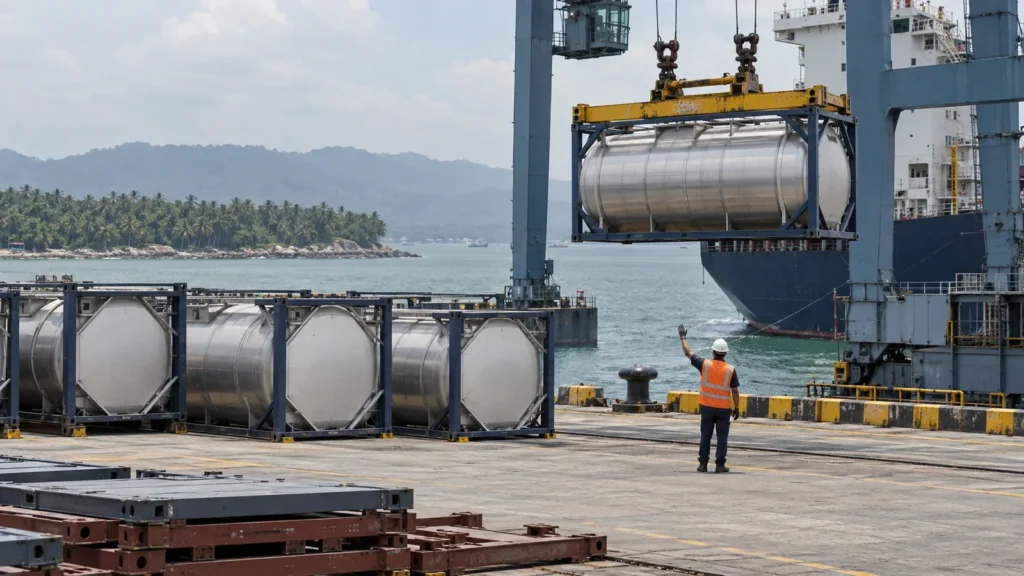
A cargo of sustainable aviation fuel leaving a port is usually neat SAF. Also, This means undiluted SAF before it is mixed with conventional jet fuel. Consequently, It leaves in a tank that respects the separation rule, travels by pipeline, barge or tanker to a terminal, meaning a storage site upstream of the airport where blending (mixing SAF with Jet A) and certification happen before the fuel reaches its destination, and the documents (batch certificate, proof of sustainability, product transfer document) are the part of the cargo that has to survive the crossing. Specifically, That is the shape of the crossing leg, and it is where many pre-FID files break. Meanwhile, I write SAF export logistics as two legs that must arrive together: the molecule and the claim.
Before I price a voyage I separate what moves from what is claimed. In addition, The molecule follows tanks, pipelines and barges; the claim follows certificates and purchase documents. Instead, Most of the work in a pre-FID file sits in making sure the two arrive at the same time.
In short
- Cargo: Neat SAF crosses the border, not the blend; blending and certification happen at a terminal near the destination airport.
- Route: Pipeline, barge, tanker or truck, using the fuel infrastructure that already exists.
- Documents: Batch number, refinery certificate of quality, certificate of analysis, proof of sustainability, proof of compliance, product transfer document.
- Contract: The offtake carries the crossing risk; airports do not buy jet fuel.
- Alternative: Book and claim, a paper transfer of the emissions benefit, can move the attribute without moving the molecule, and CORSIA already accepts purchase documents for reporting.
In this article
The short answer: neat fuel, certified documents
SAF from approved pathways is specified by ASTM D7566 before blending. Also, it must be blended with Jet A before use in an aircraft.
Therefore, the cargo that moves between countries is generally neat SAF that will be blended and certified at a terminal near the destination (National Renewable Energy Laboratory, September 2024). By contrast, SAF produced at a biofuels facility should be blended with Jet A at existing fuel terminals and then delivered to airports by pipeline or truck (US Department of Energy, Alternative Fuels Data Center, consulted 16 November 2026). Moreover, In the years to come most aerodromes will receive blended SAF via pipeline, rail, barge or fuel truck (ICAO, ACT-SAF Series 7, consulted 16 November 2026). In fact, So the export question is not whether the fuel can fly. Consequently, It is which terminal receives the cargo, which specification the blend is certified to, and which documents leave with it.
What this means for you: I book the receiving terminal and its certificate chain before I book the freight, because a cargo that lands with no blending site is a cargo that stops at the gate.
What leaves the country starts with the feedstock map
The distribution of feedstocks is uneven against the mandates, and Southeast Asia has historically been a key supplier of bio-based feedstocks to other regions (IRENA, December 2024). Furthermore, Actors from outside the region, including Australia, China and Japan, partner with Southeast Asian countries for production destined for export, which intensifies competition for feedstocks by bringing capital and technology (IRENA, December 2024). By contrast, Singapore, with its SAF policies and industrial infrastructure, may attract a disproportionate share of available feedstocks. Also, it moves more than 5 million tonnes of fuel per year (IRENA, December 2024). For example, Malaysia and Indonesia represent 58 percent and 25 percent of world palm oil production respectively. Also, the region’s resources vary significantly. Meanwhile, This makes cross-border trade and foreign investment crucial to regional SAF targets (IRENA, December 2024). Specifically, I read the feedstock map before the shipping schedule.
What this means for you: I fix the origin and its competing demand first, then I ask whether my volume can leave at all.
The tank rule decides what can be loaded
Neat SAF from two different annexes cannot be commingled into the same tank for blending with Jet A. Meanwhile, SAF that has been segregated, blended with Jet A and certified as ASTM D1655 can then be blended within the allowable ASTM percentage (National Renewable Energy Laboratory, September 2024). In addition, Each batch leaving a refinery carries a batch number and a refinery certificate of quality, and a certificate of analysis follows it with retesting of key properties (National Renewable Energy Laboratory, September 2024). Therefore, That sequence is the chain of custody: the paper trail that keeps environmental attributes attached after the molecules become fungible. Meanwhile, Entities must be certified wherever significant changes of properties and environmental attributes occur, from producers to blenders and suppliers.
Also, each delivery carries a proof of sustainability, a proof of compliance under the EU scheme from ISCC or RSB, and a product transfer document authenticating the transfer of ownership (IATA, SAF Handbook, May 2024).
What this means for you: I check the annex of every lot offered for loading and refuse any nomination that would put two annexes in one tank.
Water and pipe: the crossing modes, and the regulation that is a separate question
Blending can take place at a terminal directly connected to an airport by pipeline or hundreds of miles away.
Also, the fuel can then be transported by pipeline or barge to a terminal near the airport (US Department of Energy, Alternative Fuels Data Center, consulted 16 November 2026). Meanwhile, The 10 largest airports in the United States are all connected to major pipelines. However, many smaller airports do not have pipeline access (ICAO, ACT-SAF Series 7, consulted 16 November 2026). In Europe the blended volumes are largely delivered by pipeline to the aerodrome (National Renewable Energy Laboratory, September 2024). The port, is a terminal like any other: what matters is whether it can receive neat SAF and blend to specification. The regulatory question of what counts as an export for compliance purposes is handled on export SAF regulation; here I only look at the physical leg.
What this means for you: I confirm pipeline, barge or truck access at the receiving end before I confirm the sailing.
The cargo contract, not the flag
Purchasing options run from spot buying, which suits small volumes at short term and higher price, through long-term offtake agreements that are often 2 to 10 years or longer while conventional jet fuel contracts cover 1 to 3 years, to an equity stake or a joint purchase agreement grouping buyer volumes (IATA, SAF Handbook, May 2024). Pricing can be a SAF premium indexed on a jet fuel index. A cost-plus model, or price reporting agency evaluations such as Platts and Argus, generally more expensive. Meanwhile, the market is not yet mature and liquid (IATA, SAF Handbook, May 2024). Airports do not buy jet fuel and their role in the chain is preparation (National Renewable Energy Laboratory, September 2024). Therefore, the cargo is contracted between producer, trader and offtaker. The offtake structure is where the crossing risk sits, not the flag under which the vessel sails.
What this means for you: I read the delivery clause, the certificate clause and the claim clause together, because freight terms cannot cure a contract that never promised the blend.
What the crossing costs, and when not to ship at all
SAF can cost 2 to 5 times the cost of conventional jet fuel depending on the technology pathway. Also, the feedstock, and the cost is driven mainly by the feedstock (IATA, SAF Handbook, May 2024). Before I add freight I ask whether the molecule needs to move at all. Book and claim, meaning a mechanism that moves the emissions benefit on paper. Meanwhile, the physical fuel goes to another buyer, gives access to the emissions gain without physical transport or local infrastructure. Countries rich in feedstocks that are not ready for mandates could produce SAF and sell sustainable credits to airlines elsewhere. However, the system is still in development and its benefit remains uncertain in the short term (IRENA, December 2024).
CORSIA already recognizes book and claim by allowing SAF use to be reported on the basis of purchase documents (IATA, SAF Handbook, May 2024). This is the choice that book and claim addresses: ship the molecule, or sell the attribute.
What this means for you: I price the freight and the claim mechanism as two separate lines. Also, i drop the voyage when the attribute can be sold without it.
Where I draw the line
I do not treat a port as a line on a map, I treat it as a tank with a rule. Once SAF enters the jet fuel chain and becomes fungible. The molecules can no longer be traced independently. Therefore, the sustainable attributes are only assured if the fuel stays physically segregated from origin to wing or if an adequate accounting mechanism covers the trip (IATA, SAF Handbook, May 2024). Before I sign anything I ask which tank can hold the cargo without mixing annexes, which certificate is produced at loading and at discharge, and who carries the claim if a document is missing on arrival. I write assumed in the margin whenever the receiving terminal is unnamed, and I price the claim mechanism separately from the freight. My test for the crossing is simple: if the ship arrives.
Also, the documents do not, the cargo is fuel without a claim.
What this means for you: I ask for the loading instruction, the discharge certificate and the claim wording in the same email, and I sign only when all three name the same terminal.
How I would run this if it were my file
I draw the export leg as three points: the tank that loads, the terminal that receives, and the airport that takes the blend. On each point I write the owner, the certificate and the cost. Also, i mark whether the capacity exists today, is contracted, or is assumed, treating assumed as a gap. I check that the separation rule sits into the loading instruction and that the claim mechanism matches how I book the revenue. My last line is the receiving terminal: if it cannot take neat SAF and blend to specification. The export plan describes a fuel that cannot be landed.
What this means for you: I bring the three points into one table before the investment committee meets, because a crossing that exists only on paper is a crossing I cannot underwrite.
Sources
- IATA, SAF Handbook, May 2024.
- ICAO, ACT-SAF Series 7, consulted 16 November 2026.
- National Renewable Energy Laboratory, September 2024.
- US Department of Energy, Alternative Fuels Data Center, consulted 16 November 2026.
- IRENA, December 2024.
Frequently asked questions
Does SAF need a dedicated shipping route?
No dedicated route is required. In the years to come most aerodromes will receive blended SAF via pipeline, rail, barge or fuel truck (ICAO, ACT-SAF Series 7, consulted 16 November 2026), and blending can happen at a terminal hundreds of miles from the airport, with transport by pipeline or barge (US Department of Energy, Alternative Fuels Data Center, consulted 16 November 2026).
Can neat SAF from two producers share one tank?
Not for blending. Neat SAF from two different annexes cannot be commingled into the same tank for blending with Jet A, while fuel that has been segregated, blended and certified as ASTM D1655 can then be blended within the allowable ASTM percentage (National Renewable Energy Laboratory, September 2024). The rule follows the certificate, not the producer’s name.
Which documents must accompany an export cargo?
A batch number and a refinery certificate of quality, a certificate of analysis for each movement with retesting of key properties, a proof of sustainability for each delivery, a proof of compliance under the EU scheme from ISCC or RSB, and a product transfer document authenticating the transfer of ownership (National Renewable Energy Laboratory, September 2024; IATA, SAF Handbook, May 2024).
Is book and claim an alternative to shipping the fuel?
It can be, for part of the claim. Book and claim gives access to the emissions gain without physical transport or local infrastructure, and CORSIA already allows reporting on the basis of purchase documents (IATA, SAF Handbook, May 2024). It remains a claim mechanism rather than a replacement for the molecule your offtake has to deliver (IRENA, December 2024).
Not sure your project would survive a credit conversation?
A short call is usually enough to see where your project stands.
If you are structuring the crossing leg for a pre-FID file, the offtake contract is where I start: offtake agreements set the volume, the certificate chain and the party that carries the claim when a document goes missing. That is the document I read first.
I do not provide investment advice or arrange investments. I act as a strategic advisor and facilitator.

Alex, Founder of WeConnect Asia
I help low-carbon fuel and carbon removal project developers in Southeast Asia secure the commercial and financial partners needed to reach FID.
Related articles

Pitching a Climate Tech Company to Strategic Investors: What the Corporate Has to Believe Before It Writes a Cheque
How to pitch a climate tech company to strategic investors: the metric cluster, the readiness evidence and the ask that corporates fund.

Biomethane: What It Is, How It Is Made and Who Buys It
Biomethane is biogas cleaned to pipeline quality. I explain how it is made, how it differs from biogas and who buys it in Southeast Asia.

CO2 Sourcing for e-SAF Projects: What the Rules Allow and What the Contract Must Say
Biogenic CO2, direct air capture or industrial flue gas: which sources an e-SAF plant may use, what they cost and which contract terms make the fuel certifiable.

Operating Performance Guarantees for SAF Plants: What Lenders Ask For
Minimum guarantees, performance damages, retesting and who stands behind them: the operating guarantees a SAF plant needs to keep debt and offtake intact.

EPC and Construction Risk in SAF Plants: What a Lender Actually Tests
FEED scope, convertible EPC, performance guarantees and damages caps: the construction risk questions a SAF project must answer before financial close.

Matching Feedstock and Offtake Risk Back-to-Back in a SAF Project: How Lenders Read the Chain
Lenders do not buy a feedstock plan and an offtake plan separately. They buy the link between the two, and the link is where most SAF files break.