
Home » SAF Into-Plane Supply: Who Blends and Who Delivers
SAF Into-Plane Supply: Who Blends and Who Delivers
10 min read · Nov 2, 2026 · By Alex
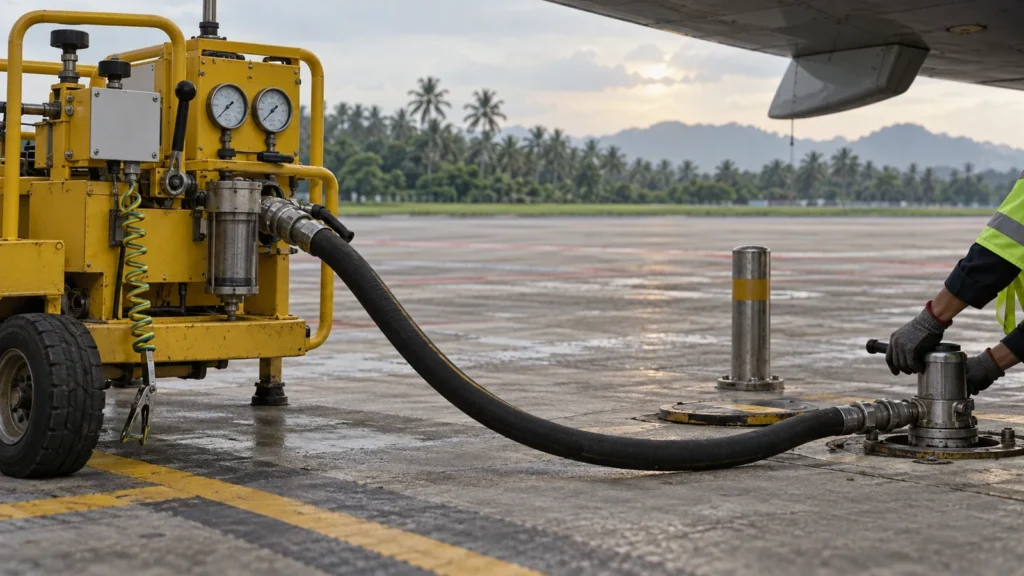
Nobody blends at the airport. Blending, meaning mixing sustainable aviation fuel with conventional jet fuel, happens upstream at a terminal, the storage and transfer site between the plant and the airport, and the result is certified as ASTM D1655 before it arrives. The fuel farm, the storage tanks at or near the airport that hold jet fuel before uplift, receives that blend through the same pipelines, trucks and hydrant system, the pipework that carries fuel to the aircraft stand. Into-plane is the last paid handover, from the airport fuel system to the aircraft. In addition, into-plane supply turns on the document rather than the molecule.
I am writing this for one reader at the feasibility stage asking who blends and delivers SAF at the airport. The answer sits in three places: the terminal where the blend is made. Also, the fuel farm where it is shared, and the paperwork that follows it to the wing.
In short
- Where blending happens: Upstream at a terminal, before the fuel reaches the airport.
- What arrives: A blend already certified to ASTM D1655, moved by the existing pipelines, trucks and hydrant.
- Who refuels: The airport fuel system, working with the airline’s suppliers, terminals and distributors.
- What travels with it: A proof of sustainability, a proof of compliance and a product transfer document.
- Also, What the contract must cover: The shared fuel farm, the claim mechanism and the last paid handover.
In this article
The short answer: the airport receives, it does not blend
SAF is generally blended with conventional aviation fuel before it is delivered to an aerodrome fuel farm, and the smaller volumes and 100 percent SAF flights bypass that system using dedicated fuel trucks to supply specific aircraft (ICAO, ACT-SAF Series 7, consulted 16 November 2026). Also, SAF must be blended with Jet A before use in an aircraft. In addition, once the blend meets the requirements it is redesignated as meeting ASTM D1655. That allows it to be transported in pipelines and used in aircraft (National Renewable Energy Laboratory, September 2024). The aerodrome receives a finished, certified product. Where a hydrant exists, pipework carries it to the stand; where none exists, a fuel truck does. Nothing at the airport has to be re-blended or re-certified, because that work was completed upstream.
What this means for you: treat the airport as a receiving point in your plan, and place the certification step before it, not at it.
What sets the volume that has to arrive
Most countries in the region respond to market signals by relying on mandates rather than subsidies on the demand side, while supply is promoted through fiscal and non-fiscal incentives (IRENA, December 2024). Low-carbon fuel mandates therefore set the volume that has to arrive. Singapore, the region’s largest aviation fuel consumer at more than 5 million tonnes of fuel per year, has issued a Sustainable Air Hub Blueprint through its Civil Aviation Authority, and the levy that funds the purchase stays constant while the volume bought can be adjusted (IRENA, December 2024). The blending limit depends on the feedstock. In addition, the production method, with limits ranging from 10 percent to 50 percent (US Department of Energy, Alternative Fuels Data Center, consulted 16 November 2026), and a blend of up to 50 percent suits the majority of aircraft whatever their age (ICAO, ACT-SAF Series 7, consulted 16 November 2026).
What this means for you. The volume in your contract is a certified blend, produced, blended and certified upstream of the airport. Therefore, the mandate is settled before the fuel ever reaches the fuel farm.
The paperwork that must travel with the fuel
Entities along the chain must hold certification wherever properties or environmental attributes change significantly, covering feedstock producers and processors, transporters, traders, SAF producers, blenders. In addition, SAF suppliers (IATA, SAF Handbook, May 2024). Three documents travel with it under the sustainability criteria: a proof of sustainability from the supplier for each delivery, a proof of compliance under the EU Renewable Energy Directive scheme issued by a body such as ISCC or RSB, and a product transfer document that authenticates the transfer of ownership (IATA, SAF Handbook, May 2024). Each batch of jet fuel leaving a refinery carries a batch number and a refinery certificate of quality, and a certificate of analysis follows it through the chain with retesting (National Renewable Energy Laboratory, September 2024).
Once certified upstream, segregation from conventional jet fuel is technically unnecessary at the airport. In addition, no additional blending or recertification is needed there (ICAO, ACT-SAF Series 7, consulted 16 November 2026).
What this means for you. Your evidence file is built before the fuel moves, so ask which body signs each document and where that signature is produced.
Who is actually responsible at the aircraft
Airlines are responsible for ensuring fuel supply for their aircraft by working with airline fuel groups at various airports and with fuel suppliers, terminals and distributors (National Renewable Energy Laboratory, September 2024). Securing a SAF offtake agreement does not change that operating reality: airlines share refuelling infrastructure, and while one or more airlines may purchase the blend. All airlines must accept its use. That is because fuel is generally not directed at a specific airline or flight (National Renewable Energy Laboratory, September 2024). Once neat SAF is blended upstream of the airport fuel storage and certified to the relevant specification. It can be released into that storage.
In addition, once fuel enters a fuel farm it is unlikely to reach specific flights or airlines, so extra fuel truck deliveries happen when a specific SAF delivery is requested (ICAO, ACT-SAF Series 7, consulted 16 November 2026).
What this means for you. The contract has to describe that shared reality. That is because the offtake structure, not the delivery instruction, is where the risk sits.
The claim at the wing is an accounting question
Once SAF enters the jet fuel chain and becomes fungible. The molecules can no longer be traced independently, and without an adequate accounting mechanism the durable attributes are only assured if the SAF stays physically segregated from origin to wing (IATA, SAF Handbook, May 2024). Two chain of custody options are usually on the table. Mass balance allows mixing in shared infrastructure but requires the user to take fuel from that same infrastructure, while book. In addition, claim, where the environmental attribute is bought without moving the fuel, gives access to SAF to all operators. In addition, complements mass balance (IATA, SAF Handbook, May 2024).
CORSIA already recognizes book and claim by permitting the reporting of SAF use on the basis of purchase documents (IATA, SAF Handbook, May 2024), and book. In addition, claim also delivers the emissions gain without physical transport or local infrastructure (IRENA, December 2024).
What this means for you: an offtaker asking for a specific batch on a specific flight is asking the physical system to do something it is not built to do, so write the claim mechanism into the contract instead.
What the last handover costs
SAF can cost 2 to 5 times the cost of conventional jet fuel depending on the pathway and the feedstock. In addition, the cost is driven mainly by the feedstock (IATA, SAF Handbook, May 2024). The price of SAF is therefore settled upstream, where the feedstock. In addition, the production route are chosen. No climate benefit is felt locally at the aerodrome, and since airports have no additional infrastructure cost with SAF. There should be no modification of airport charges based on SAF (IATA, SAF Handbook, May 2024). Supplying aviation fuel has never been a core function of airport operators and should not become one for SAF (IATA, SAF Handbook, May 2024). Terminals charge lease fees for tanks and associated equipment, with lease terms generally at least one year (National Renewable Energy Laboratory, September 2024).
What this means for you: put the cost in the fuel line. In addition, the terminal services line, and do not model an airport surcharge that the published position does not support.
Where I draw the line
I read the delivery instruction and the offtake contract side by side. That is because into-plane supply is settled in those two documents rather than at the stand. Before I sign I ask who blends, who owns the tank that holds the blend, which document is produced at the uplift. In addition, whether my claim survives a shared fuel farm. I treat any promise of a dedicated batch through a shared system as unsupported. In addition, I price the dedicated truck option separately when the volumes are small. My test is simple: on the day my cargo is not the cargo being uplifted, does my claim still stand.
What this means for you: if the answer to that test is no. The contract is describing a physical delivery it cannot evidence. In addition, the claim mechanism has to carry the weight instead.
How I would write it into my own file
I put the terminal, the fuel farm and the aircraft stand on the same line of the plan, and next to each one I write who operates it, who certifies it and who pays for it. Also, I mark which assumptions are contracted and which are assumed, and I treat assumed as a gap. I check that the certification location in my logistics plan is upstream of the airport and that the claim mechanism matches how I book the revenue. My last line is the uplift: if the certificate is not produced where the fuel changes hands, the contract describes a fuel that cannot be evidenced.
What this means for you: write the handover as a line item with an owner, a certificate and a payment, and if any of the three is missing, treat it as an open item before you sign.
Sources
- IATA, SAF Handbook, May 2024.
- ICAO, ACT-SAF Series 7, consulted 16 November 2026.
- National Renewable Energy Laboratory, September 2024.
- US Department of Energy, Alternative Fuels Data Center, consulted 16 November 2026.
- IRENA, December 2024.
Frequently asked questions
Who actually refuels a flight that is uplifted with SAF?
The airport fuel system delivers the certified blend through its pipelines, hydrant or fuel trucks, and the airlines secure supply by working with airline fuel groups and their suppliers, terminals and distributors (National Renewable Energy Laboratory, September 2024). Dedicated fuel trucks supply specific aircraft, which is how the smaller volumes and 100 percent SAF flights are handled (ICAO, ACT-SAF Series 7, consulted 16 November 2026).
Does the airport have to change anything to handle SAF?
No process change is needed at aerodromes with a hydrant or bowser system, and the fuel can be stored in general fuel storage tanks with minimal infrastructure modifications (ICAO, ACT-SAF Series 7, consulted 16 November 2026). Because blending and certification happen upstream, the airport continues with business as usual, using the same pipelines, trucks, tank farms and hydrant systems (National Renewable Energy Laboratory, September 2024).
Can a specific flight be given a specific batch of SAF?
Not through the shared system. Once fuel enters a fuel farm it is unlikely to be delivered to specific flights or airlines (ICAO, ACT-SAF Series 7, consulted 16 November 2026), and fuel is generally not directed at a specific airline or flight (National Renewable Energy Laboratory, September 2024). Dedicated fuel trucks are what supply a specific aircraft.
Who pays for the into-plane handover?
The cost sits in the fuel and in the terminal services rather than in an airport surcharge. SAF can cost 2 to 5 times conventional jet fuel (IATA, SAF Handbook, May 2024), airports should not modify their charges based on SAF (IATA, SAF Handbook, May 2024), and terminals charge tank lease fees generally of at least one year (National Renewable Energy Laboratory, September 2024).
Not sure your project would survive a credit conversation?
A short call is usually enough to see where your project stands.
If you want the last handover written into a contract rather than assumed. I work through the offtake structure, the chain of custody and the uplift documentation with you, and I write the result into a file you can take to your counterpart. See offtake agreements.
I do not provide investment advice or arrange investments. I act as a strategic advisor and facilitator.

Alex, Founder of WeConnect Asia
I help low-carbon fuel and carbon removal project developers in Southeast Asia secure the commercial. In addition, financial partners needed to reach FID.
Related articles

Pitching a Climate Tech Company to Strategic Investors: What the Corporate Has to Believe Before It Writes a Cheque
How to pitch a climate tech company to strategic investors: the metric cluster, the readiness evidence and the ask that corporates fund.

Biomethane: What It Is, How It Is Made and Who Buys It
Biomethane is biogas cleaned to pipeline quality. I explain how it is made, how it differs from biogas and who buys it in Southeast Asia.

CO2 Sourcing for e-SAF Projects: What the Rules Allow and What the Contract Must Say
Biogenic CO2, direct air capture or industrial flue gas: which sources an e-SAF plant may use, what they cost and which contract terms make the fuel certifiable.

Operating Performance Guarantees for SAF Plants: What Lenders Ask For
Minimum guarantees, performance damages, retesting and who stands behind them: the operating guarantees a SAF plant needs to keep debt and offtake intact.

EPC and Construction Risk in SAF Plants: What a Lender Actually Tests
FEED scope, convertible EPC, performance guarantees and damages caps: the construction risk questions a SAF project must answer before financial close.

Matching Feedstock and Offtake Risk Back-to-Back in a SAF Project: How Lenders Read the Chain
Lenders do not buy a feedstock plan and an offtake plan separately. They buy the link between the two, and the link is where most SAF files break.