
Home » SAF Market Players: Producers, Traders and Suppliers in Roles
SAF Market Players: Producers, Traders and Suppliers in Roles
10 min read · Nov 2, 2026 · By Alex
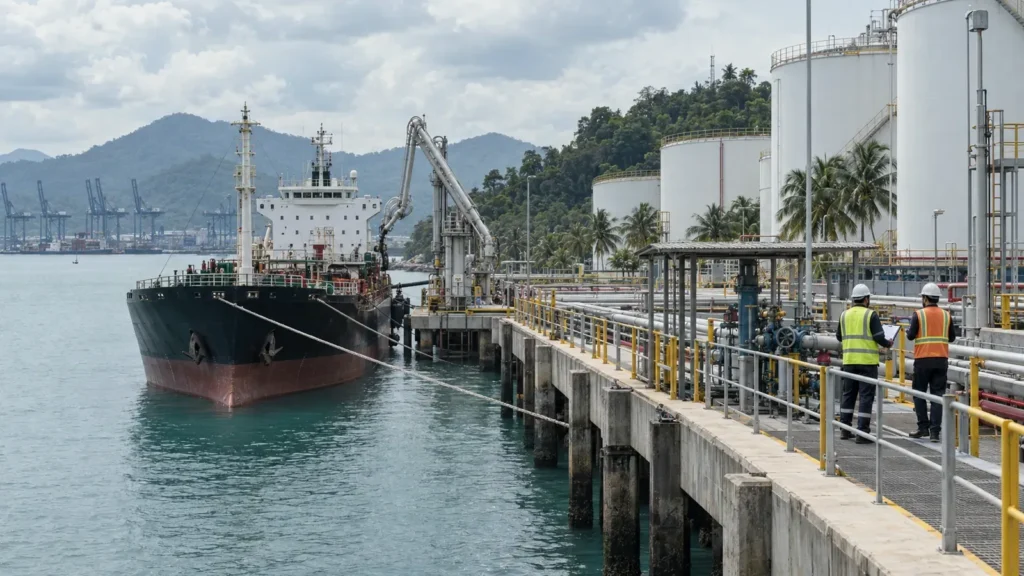
The actors of a sustainable aviation fuel supply chain sit at the points where the product and its attributes change hands: feedstock producers and providers, transporters, traders, producers, blenders and suppliers, each certified wherever significant changes to the properties and environmental attributes take place. That is the direct answer to the question of who stands where. The subject is a sequence of custody transfers, not a roster of brands. I read the SAF market players through the certificates that travel with each lot, because in a drop-in fuel market the paperwork, not the company name, is what a buyer, a lender or an investor can verify.
In practice the chain is easy to describe and hard to audit: a physical fuel that behaves exactly like conventional jet fuel, plus a paper trail that has to survive every handover. I work from that trail and from the roles that issue it.
In short
- Roles: Certification follows custody: feedstock producers and providers, transporters, traders, SAF producers, blenders and suppliers each hold the document for their own step.
- Price: Production cost plus a market premium, logistics, certification, transaction costs and chain markups, with benchmarks published by a price reporting agency, meaning an independent publisher that assesses market prices.
- Claims: After mixing, mass balance (co-mingle in common infrastructure, but uplift from that same infrastructure) or book and claim (buy the attributes without moving the fuel) keeps the claim separate from the molecule.
- Contracts: A spot-buy for small volume over a short period, an offtake agreement reserving volume across several years, an equity stake, or a joint purchasing agreement pooling airline volume.
- Assets: Terminals and airport fuel farms belong to fuel providers, airlines and airport operators, so access rules matter as much as capacity.
In this article
Reading the market as roles, not as names
I read a market as a list of custody transfers, because that is where value and liability move. Entities along the supply chain must be certified wherever significant changes to the properties and environmental attributes take place as the sustainable material passes through their custody: feedstock producers and providers, feedstock transporters, feedstock traders, SAF producers, SAF blenders and SAF suppliers (IATA, SAF Handbook, May 2024). Developing the whole ecosystem involves actors from the land sectors, feedstock collectors and traders, downstream processors, and retailers and off-takers such as airports and airlines (IRENA, December 2024). SAF is a drop-in fuel that stays fully fungible with conventional aviation fuel, which is exactly why the chain is held together by documents rather than by segregated pipes (IATA, SAF Handbook, May 2024). Chain of custody, as I use the term, is the ordered record of who held the fuel and its attributes at each step.
What this means for you: I ignore the brand and count the certified handovers, because every handover is a place where a claim can be lost, duplicated or defended.
Who prices the fuel, and who publishes the number
The price airlines pay for SAF, on top of production costs, incorporates a market premium, logistics, certification, transaction-related costs and markups throughout the supply chain (IATA, 12 May 2024). In 2024 that market premium reached as high as around 1 000 USD per tonne of HEFA SAF in Europe, while the market lacks transparency in terms of deals and prices paid (IATA, 12 May 2024). SAF can also cost 2 to 5 times conventional aviation fuel depending on the pathway and the feedstock (IATA, SAF Handbook, May 2024). Near-term pricing therefore mirrors conventional aviation fuel: an aviation fuel index plus a SAF premium, or a SAF index, for trading markets such as the US West Coast, Northwest Europe and Singapore, published by agencies including Argus Media and S&P Global Commodity Insights from data supplied by producers, consumers and intermediaries and from electronic trading platforms (IATA, 12 May 2024). The published structures sit on the sustainable aviation fuel price page.
What this means for you: I ask which index a contract references, who publishes it and whether the premium is fixed or floating, because that line decides who absorbs feedstock movement and who absorbs fuel price movement.
Who owns the claim once the molecules mix
Once SAF enters the jet fuel supply chain and becomes fungible with conventional aviation fuel, an accounting mechanism is needed for airlines to track and claim the environmental benefit of their purchases, and such a system separates the environmental claims from the physical journey of the fuel (IATA, SAF Handbook, May 2024). Two frequently cited chain of custody options are mass balance, which allows co-mingling of SAF and conventional fuel into common infrastructure but requires users to physically uplift fuel from that infrastructure, and book and claim, which gives access to SAF to all aircraft operators while allowing cost efficient deployment in all locations (IATA, SAF Handbook, May 2024). CORSIA already recognizes book and claim by allowing SAF use reporting based on purchase records (IATA, SAF Handbook, May 2024). Accounting must let aircraft operators and their customers address their shared emissions responsibility while avoiding double counting and double claiming, through transparent and credible registry systems (IATA, SAF Handbook, May 2024).
What this means for you: I check that the claiming method matches how the buyer intends to report, and I look for the registry that stops the same tonne from being claimed twice.
Who signs what: the purchasing types
Four purchasing types cover this market: a spot-buy, meaning small volumes bought over a short period at a higher market price; an offtake agreement, meaning a long-term contract often spanning 2 to 10 years or longer while traditional jet fuel contracts cover 1 to 3 years; an equity stake; and a joint purchasing agreement where airlines pool volume to give suppliers greater demand certainty (IATA, SAF Handbook, May 2024). The longer term of an offtake lets the SAF supplier obtain finance and can bring preferential pricing to the customer (IATA, SAF Handbook, May 2024). The documents that travel with the fuel are a Proof of Sustainability issued for each delivery, a Proof of Compliance under the EU RED scheme from a certifying organization such as ISCC or RSB, and a Product Transfer Document authenticating the transfer of ownership from seller to buyer (IATA, SAF Handbook, May 2024).
What this means for you: I read the contract and the certificates together, because a counterparty’s claims are worth only what those documents can prove at the moment of delivery.
Where the regional players actually sit
On the supply side, Southeast Asia promotes SAF production as part of industrial development, with fiscal and non-fiscal incentives to attract investment, while on the demand side most countries respond to market signals and rely on mandates rather than subsidies (IRENA, December 2024). Malaysia has at least eight active players in refinery construction and feedstock development, more than any other country in the region, and Petronas has pledged to produce SAF as early as 2028 (IRENA, December 2024). Planned HEFA facilities there, valued at around 3 billion US dollars and totalling 1.5 million tonnes per year, will depend on imports when fully operational, and EcoCeres Renewable Fuels has invested 230 million US dollars in Johor with production due in 2025 (IRENA, December 2024). Neste’s Singapore expansion in 2024 doubles that refinery from 1.3 to 2.6 million tonnes per year and lifts Neste’s global SAF capacity to 1 million tonnes annually, while Singapore’s policies may draw a disproportionate share of available feedstocks (IRENA, December 2024).
What this means for you: I read a regional announcement as a role being filled, then I look for the feedstock source, the import dependency and the certificate that will follow the volume.
Who owns the steel the fuel passes through
Airport fuel infrastructure is one layer of the wider ecosystem: it can be owned by fuel providers, airlines or joint holdings, and the airport operator often owns at least part of the distribution system, which it can lease or run itself (IATA, SAF Handbook, May 2024). Supplying jet fuel has never been a core function of airport operators and should remain so for SAF, and since SAF adds no infrastructure cost at the airport, airport charges should not be modified on that basis (IATA, SAF Handbook, May 2024). Airlines increasingly obliged to use SAF must rely on open access to the fuel farms that bring fuel to the airplane, because restrictions or preferences about who may supply interfere with a competitive market (IATA, SAF Handbook, May 2024). Terminals are a separate owner group: of the US terminals storing refined petroleum products, 33% belong to refinery owners, 36% to midstream companies with pipelines and 31% to midstream companies owning one or more terminals, a share of terminal counts rather than capacity, and airports themselves do not purchase jet fuel (National Renewable Energy Laboratory, September 2024).
What this means for you: I map who owns each tank and each hydrant before I model volume, because an access restriction can delay a delivery long before a feedstock problem appears.
Where I draw the line
I refuse to underwrite a name. I underwrite a role, the document that proves the role, and the counterparty that can carry the obligation when the document is questioned. The certification requirement makes this concrete: entities must be certified wherever significant changes to properties and environmental attributes occur, so a missing certificate is not a clerical gap, it is a broken chain (IATA, SAF Handbook, May 2024). I also weigh the stage of the market, since SAF currently represents less than 1% of global aviation fuel use and costs several times more than conventional aviation fuel, which means the parties able to absorb cost and delay are the ones who matter (IATA, June 2026). Before I sign, I ask who certifies each custody transfer, which certificate travels with each delivery, and which party remains liable if a claim is later challenged. My test is simple: if the counterparty disappears, does the paperwork still prove what was bought?
What this means for you: I treat the paperwork as the asset, and I price the transaction on the strength of the entity that has to answer for it.
How I would write it into the investment paper
I map every counterparty in the model to one row of a roles table, with the certificate each one must hold and the document each one must issue at transfer. I mark which rows are covered by a signed agreement and which are covered only by an intention, and I treat the second as unfilled. I check that the claiming mechanism chosen, mass balance or book and claim, matches the way the buyer intends to report, and I record whether the volume will be reported on purchase records accepted under CORSIA (IATA, SAF Handbook, May 2024). I date the certification of each party, because a certificate held last year is not evidence of a status today. My last line is the obligation that survives the transaction, because a chain of custody is only as good as the entity that has to answer for it.
What this means for you: I write the table before I write the narrative, and any row without a named certificate holder stays unfilled in my model.
Sources
- IATA SAF Handbook, May 2024.
- ICAO ACT-SAF Series 7, consulted 16 November 2026.
- National Renewable Energy Laboratory, September 2024.
- Alternative Fuels Data Center, consulted 16 November 2026.
- IRENA, December 2024.
- IATA, 12 May 2024.
- IATA fact sheet, June 2026.
Frequently asked questions
Who actually sells SAF to an airline?
Sales take the form of a spot-buy, a long-term offtake agreement, an equity stake or a joint purchasing agreement, and the fuel moves through certified feedstock traders, SAF producers, blenders and suppliers, each issuing the documents of the chain of custody (IATA, SAF Handbook, May 2024). In practice an airline rarely buys from a single name: it works through supplier relationships, terminals and distributors, and the certificate set tells it who actually held the product before the fuel reached the aircraft.
Do I need to know every company in the SAF market?
No. The durable reading is by role rather than by name, because entities must be certified where properties and environmental attributes change, and the certification and the transfer documents are what a buyer or lender can verify (IATA, SAF Handbook, May 2024). A long list of names goes stale quickly, while a roles table with the certificate attached to each row stays usable across a project’s life.
What is the difference between a trader and a supplier?
The published categories are custody roles rather than job titles, and the practical difference sits in the contract: a spot-buy covers small volumes over a short period at a higher price, while an offtake agreement is a long-term contract that lets the supplier obtain finance (IATA, SAF Handbook, May 2024). What distinguishes the counterparty in diligence is therefore the obligation it signs and the certificate it issues at transfer, not the label it uses.
Which document proves that my SAF claim is real?
The Proof of Sustainability issued for each delivery, supported by the Proof of Compliance under the EU RED scheme and the Product Transfer Document that authenticates the transfer of ownership (IATA, SAF Handbook, May 2024). Together they show what was delivered, that it met the scheme requirements, and that ownership moved from seller to buyer, which is the sequence a buyer, a lender or an investor can check.
Not sure your project would survive a credit conversation?
A short call is usually enough to see where your project stands.
If you are mapping counterparties for a specific project, I can help you turn the roles table into a diligence checklist, with the certificate and the issuing party set against every row: strategic partnerships.
I do not provide investment advice or arrange investments. I act as a strategic advisor and facilitator.

Alex, Founder of WeConnect Asia
I help low-carbon fuel and carbon removal project developers in Southeast Asia secure the commercial and financial partners needed to reach FID.
Related articles

Pitching a Climate Tech Company to Strategic Investors: What the Corporate Has to Believe Before It Writes a Cheque
How to pitch a climate tech company to strategic investors: the metric cluster, the readiness evidence and the ask that corporates fund.

Biomethane: What It Is, How It Is Made and Who Buys It
Biomethane is biogas cleaned to pipeline quality. I explain how it is made, how it differs from biogas and who buys it in Southeast Asia.

CO2 Sourcing for e-SAF Projects: What the Rules Allow and What the Contract Must Say
Biogenic CO2, direct air capture or industrial flue gas: which sources an e-SAF plant may use, what they cost and which contract terms make the fuel certifiable.

Operating Performance Guarantees for SAF Plants: What Lenders Ask For
Minimum guarantees, performance damages, retesting and who stands behind them: the operating guarantees a SAF plant needs to keep debt and offtake intact.

EPC and Construction Risk in SAF Plants: What a Lender Actually Tests
FEED scope, convertible EPC, performance guarantees and damages caps: the construction risk questions a SAF project must answer before financial close.

Matching Feedstock and Offtake Risk Back-to-Back in a SAF Project: How Lenders Read the Chain
Lenders do not buy a feedstock plan and an offtake plan separately. They buy the link between the two, and the link is where most SAF files break.