
Home » SAF Supply Chain and Infrastructure: From Plant to Wing
SAF Supply Chain and Infrastructure: From Plant to Wing
10 min read · Nov 2, 2026 · By Alex
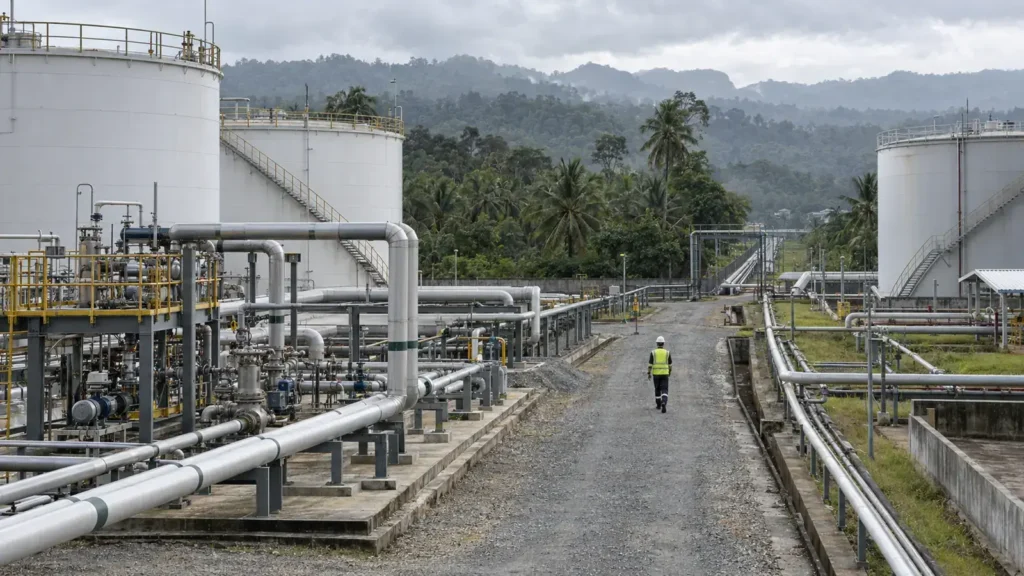
I am asked how sustainable aviation fuel physically reaches the wing. Also, the answer is short: it uses the existing jet fuel chain. Aircraft operators must blend SAF with Jet A before use. Once the blend meets the specification, ASTM D1655 classifies it as conventional jet fuel. It then travels the same pipelines, trucks and tank farms. The centre of gravity moves away from the airport. The question is not whether an airport can accept a new fuel. It is where the blending and storage capital has to sit. The published answer is almost always the terminal rather than the airport. A terminal is the fuel storage and transfer site between the plant. Also, the airport, and blending is the controlled mixing of neat SAF, meaning undiluted SAF, with Jet A before certification.
In this piece I walk the route from plant to aircraft. I name the physical objects, the documents and the contracts at each step. I write it for a developer at pre-feasibility stage. That developer needs to know what must already exist before any delivery assumption can hold.
In short
- Blended fuel: SAF is blended with Jet A before use. The blend is certified upstream of the airport.
- Capital location: Blending and storage investment sits at the terminal, not at the airport.
- Chain of custody: Once the molecules mix, accounting carries the claim, either through mass balance or book and claim.
- Contracts: Offtake structures, not delivery instructions, carry the physical risk.
- Terminal test: If the terminal cannot receive neat SAF and blend to specification, no fuel arrives.
In this article
What the chain actually looks like
Sustainable aviation fuel is a blended fuel. Producers generally mix it with conventional jet fuel before delivery to an airport fuel farm. That farm is the set of storage tanks that feeds the aircraft. Smaller volumes and 100% SAF flights bypass the farm on trucks (ICAO, ACT-SAF Series 7, consulted 16 November 2026). Aircraft operators must blend SAF with Jet A before use in an aircraft. Once the blend meets the requirements, ASTM D1655 redesignates it as conventional jet fuel. The certified blend can then move through pipelines and into aircraft (National Renewable Energy Laboratory, September 2024). Every batch of Jet A leaving a refinery carries a batch number. Also, a refinery certificate of quality.
Also, each batch receives a certificate of analysis as it moves through the chain. Retesting of key properties continues at the point where Jet A and SAF mix (National Renewable Energy Laboratory, September 2024). Most airports will receive blended SAF by pipeline, rail, barge or fuel truck. Also, ordinary fuel tanks can store SAF with minimal infrastructure modification (ICAO, ACT-SAF Series 7, consulted 16 November 2026). A hydrant system pipes fuel under the apron to the aircraft stand, and into-plane is the handoff into the aircraft.
What this means for you: I do not budget a new fuel network at the airport. I budget documents, certificates and a blending point, because the pipes already exist. The certification is the only part I have to create.
The first leg starts where the feedstock is
Producers make SAF at a biofuels facility and expect to blend it with Jet A at existing fuel terminals. They then deliver it to airports by pipeline or truck (Alternative Fuels Data Center, consulted 16 November 2026). The distribution of feedstocks is uneven against the mandates. Southeast Asia has historically been a key supplier of bio-based feedstocks to other regions. The first leg is therefore a feedstock geography problem before it is a fuel geography problem (IRENA, December 2024). Cross-border trade and foreign investment are crucial to meeting regional SAF targets. Singapore may attract a disproportionate share of available feedstocks. It is the region’s largest aviation fuel consumer, at over 5 million tonnes a year (IRENA, December 2024). I set out the regional feedstock picture in SAF feedstock availability in Southeast Asia.
Where the feedstock sits decides where the plant sits. The plant’s location then decides which terminal must be able to receive neat SAF.
What this means for you: before I model a delivery route, I locate the plant against the feedstock. I ask whether a terminal within reachable distance can take undiluted SAF. A plant with no receiving terminal has no exit.
Where the blend is decided, and where the claim survives
The quality requirements point to one place: a terminal. Blending SAF from a stand-alone facility with Jet A belongs upstream of an airport, at that terminal. Terminals already hold the blending equipment and staff used for on-highway fuels (National Renewable Energy Laboratory, September 2024). Blending belongs at a terminal, not at an airport. It would be the first certification of the blend under ASTM D1655 at that location. The blend would need significant capital investment and affect airport tank farm insurance. Such blending also adds truck traffic, staff and testing (National Renewable Energy Laboratory, September 2024). Blending at terminals upstream of airports keeps the airport at business as usual. The same pipelines, trucks and tank farms deliver the blend to aircraft. The infrastructure investment lands at terminals (National Renewable Energy Laboratory, September 2024). At that point the molecules mix.
Therefore, accounting rather than the pipe has to carry the environmental claim. Chain of custody is the system that proves which sustainable attributes belong to which buyer. Also, the two published options are mass balance and book and claim (IATA, SAF Handbook, May 2024). I describe the accounting route in book and claim. Segregating SAF from conventional jet fuel at the airport is technically unnecessary. The same applies to additional blending or recertification there (ICAO, ACT-SAF Series 7, consulted 16 November 2026).
What this means for you: I put the blending certificate and the claim mechanism in one paragraph of my model. One upstream moment creates both the physical blend and the sold attribute. I must evidence them together.
The contracts that hold the physical chain together
Many airlines have entered offtake agreements with existing and anticipated future SAF producers. Also, they ensure supply through airline fuel groups at different airports. They draw on fuel suppliers, terminals and distributors (National Renewable Energy Laboratory, September 2024). Airlines share refueling infrastructure. One or more may purchase the blend, but all must accept its use. Operators do not direct fuel toward a specific airline or flight (National Renewable Energy Laboratory, September 2024). Operators blend neat SAF upstream of the airport fuel farm and certify it to specification. They can then release it into airport fuel storage. Once fuel enters a fuel farm, it rarely reaches a specific flight. A requested SAF delivery can still arrive by extra truck (ICAO, ACT-SAF Series 7, consulted 16 November 2026).
The contract has to mirror that physical reality. This is why the offtake structure, not the delivery instruction, is where the risk sits. I set out how I approach that structure in how to secure SAF offtake agreements.
What this means for you: I draft the offtake as a claim on a blended, shared pool. I write delivery as a best effort against that pool, not as a promise of a dedicated batch.
The export and crossing leg
Blending can take place at a terminal directly connected to an airport by pipeline, or far from it. The blend then moves by pipeline or barge to a terminal near the airport. The crossing leg is therefore a terminal location decision (Alternative Fuels Data Center, consulted 16 November 2026). Two different annexes cannot commingle their neat SAF in the same tank for blending with Jet A. Meanwhile, terminals can blend SAF already segregated and certified as ASTM D1655. Further blending stays within the ASTM percentage limits (National Renewable Energy Laboratory, September 2024). The 10 largest airports in the United States are all connected to major pipelines. However, many smaller airports have no pipeline access (ICAO, ACT-SAF Series 7, consulted 16 November 2026).
In Europe, water rather than truck or pipeline largely carries neat SAF. Airport tank farms belong either to airports or to joint ventures among fuel suppliers (National Renewable Energy Laboratory, September 2024). The crossing question is therefore a terminal question: I look at export SAF for the route itself.
What this means for you: I choose the receiving terminal before I choose the shipping mode. The mode follows from where the blend can be certified. The airport will only ever receive whatever that terminal sends.
What the infrastructure costs, and who funds it
The capital sits upstream. The lowest-cost route to blending capacity is to use existing tanks at a terminal that already stores jet fuel. Adding tanks at an existing terminal costs more. Building a new terminal is a significant investment on a long timeline (National Renewable Energy Laboratory, September 2024). A terminal that does not store jet fuel yet needs dedicated equipment: pipes, pumps and off-loading gear. Leases generally run for at least one year. Terminals charge lease fees for tanks and equipment (National Renewable Energy Laboratory, September 2024).
At industry level, the World Economic Forum with Kearney estimate what meeting 2030 demand requires. That means an additional 5.8 million tonnes of SAF production capacity. Those capacities need final investment decisions by 2026. They also need between 19 billion and 45 billion US dollars of capital expenditure by 2030. That depends on the share of HEFA in the mix (World Economic Forum with Kearney, February 2025). IATA records that SAF currently represents less than 1% of global aviation fuel use. One reason is a lack of physical and market infrastructure. IATA also prioritises open access to fuel infrastructure, including pipelines, storage and airport fuel systems (IATA, 6 June 2026). I treat that capital question through bankability.
What this means for you: my cost base includes the terminal lease, the tank capacity and the certification equipment. I include them even when I do not own them. A model that treats upstream infrastructure as free describes a route that someone else has to fund.
Where I draw the line
I price the chain, not just the plant. Before I sign anything I ask four physical questions. I ask which terminal blends and who owns the tanks. Next, I check whether the pipeline reaches the airport I have contracted for. I also ask which certificate appears at each transfer. I treat any assumption that an airport will absorb extra cost as unsupported. The published position says that airports do not purchase jet fuel. It also says that airport charges should not change on the basis of SAF (IATA, SAF Handbook, May 2024). I also check who operates the hydrant and who performs into-plane. Those functions decide whether a delivery request turns into a truck movement or stays inside the fixed system.
What this means for you: my line is simple. I will not sign a route whose four answers I have not evidenced. Each of the four is a cost, an owner and a certificate that either exists or does not.
How I would write it into the investment paper
I draw the chain as a sequence of custody transfers and I put a certificate, a cost. Also, an owner on each arrow. I list the infrastructure that must exist but that my project does not own. Also, I mark whether it exists today, sits under contract, or remains an assumption, treating assumption as a gap. I check that operators certify the blending location upstream of the airport. The claim mechanism must match how the model books revenue. The offtake volume must match the terminal capacity I have leased.
What this means for you: my last line is the terminal. Without a terminal that can receive neat SAF and blend, the model only describes a fuel that cannot arrive.
Sources
- IATA SAF Handbook, May 2024.
- ICAO ACT-SAF Series 7, consulted 16 November 2026.
- National Renewable Energy Laboratory, September 2024.
- Alternative Fuels Data Center, consulted 16 November 2026.
- IRENA, December 2024.
- World Economic Forum with Kearney, February 2025.
- IATA, 6 June 2026.
Frequently asked questions
Does SAF need new pipelines and new airport tanks?
No new dedicated network is required for the blend itself, because the blend is certified as ASTM D1655 upstream of the airport and travels the pipelines, trucks and tank fleets that already carry jet fuel (National Renewable Energy Laboratory, September 2024; ICAO, ACT-SAF Series 7, consulted 16 November 2026). The capital that is genuinely needed sits at a terminal, in SAF storage and blending equipment (National Renewable Energy Laboratory, September 2024).
Where should SAF be blended?
Upstream of the airport, at a terminal. Blending at an airport would be the first certification of the blend at that location, it would need significant capital investment, it would affect airport tank farm insurance, and it would add truck traffic, staff and testing (National Renewable Energy Laboratory, September 2024).
Who owns the fuel farm at an airport?
Airport fuel infrastructure can belong to fuel providers, airlines or airline groups, and the airport operator often owns part of the distribution infrastructure, which it can lease or operate directly; in Europe, airport tank farms belong to airports or to joint ventures among fuel suppliers (IATA, SAF Handbook, May 2024; National Renewable Energy Laboratory, September 2024).
Can a specific flight be given a specific batch of SAF?
Not through the shared system, because once fuel enters a fuel farm it is unlikely to be delivered to specific flights or airlines; dedicated fuel truck delivery is what handles smaller volumes and 100% SAF flights to a specific aircraft (ICAO, ACT-SAF Series 7, consulted 16 November 2026).
Not sure your project would survive a credit conversation?
A short call is usually enough to see where your project stands.
If you want this chain written into your own pre-feasibility work, I take it on directly: offtake agreements is where I start, because the contract must describe the same route the model assumes.
I do not provide investment advice or arrange investments. I act as a strategic advisor and facilitator.

Alex, Founder of WeConnect Asia
I help low-carbon fuel and carbon removal project developers in Southeast Asia secure the commercial and financial partners needed to reach FID.
Related articles

Pitching a Climate Tech Company to Strategic Investors: What the Corporate Has to Believe Before It Writes a Cheque
How to pitch a climate tech company to strategic investors: the metric cluster, the readiness evidence and the ask that corporates fund.

Biomethane: What It Is, How It Is Made and Who Buys It
Biomethane is biogas cleaned to pipeline quality. I explain how it is made, how it differs from biogas and who buys it in Southeast Asia.

CO2 Sourcing for e-SAF Projects: What the Rules Allow and What the Contract Must Say
Biogenic CO2, direct air capture or industrial flue gas: which sources an e-SAF plant may use, what they cost and which contract terms make the fuel certifiable.

Operating Performance Guarantees for SAF Plants: What Lenders Ask For
Minimum guarantees, performance damages, retesting and who stands behind them: the operating guarantees a SAF plant needs to keep debt and offtake intact.

EPC and Construction Risk in SAF Plants: What a Lender Actually Tests
FEED scope, convertible EPC, performance guarantees and damages caps: the construction risk questions a SAF project must answer before financial close.

Matching Feedstock and Offtake Risk Back-to-Back in a SAF Project: How Lenders Read the Chain
Lenders do not buy a feedstock plan and an offtake plan separately. They buy the link between the two, and the link is where most SAF files break.